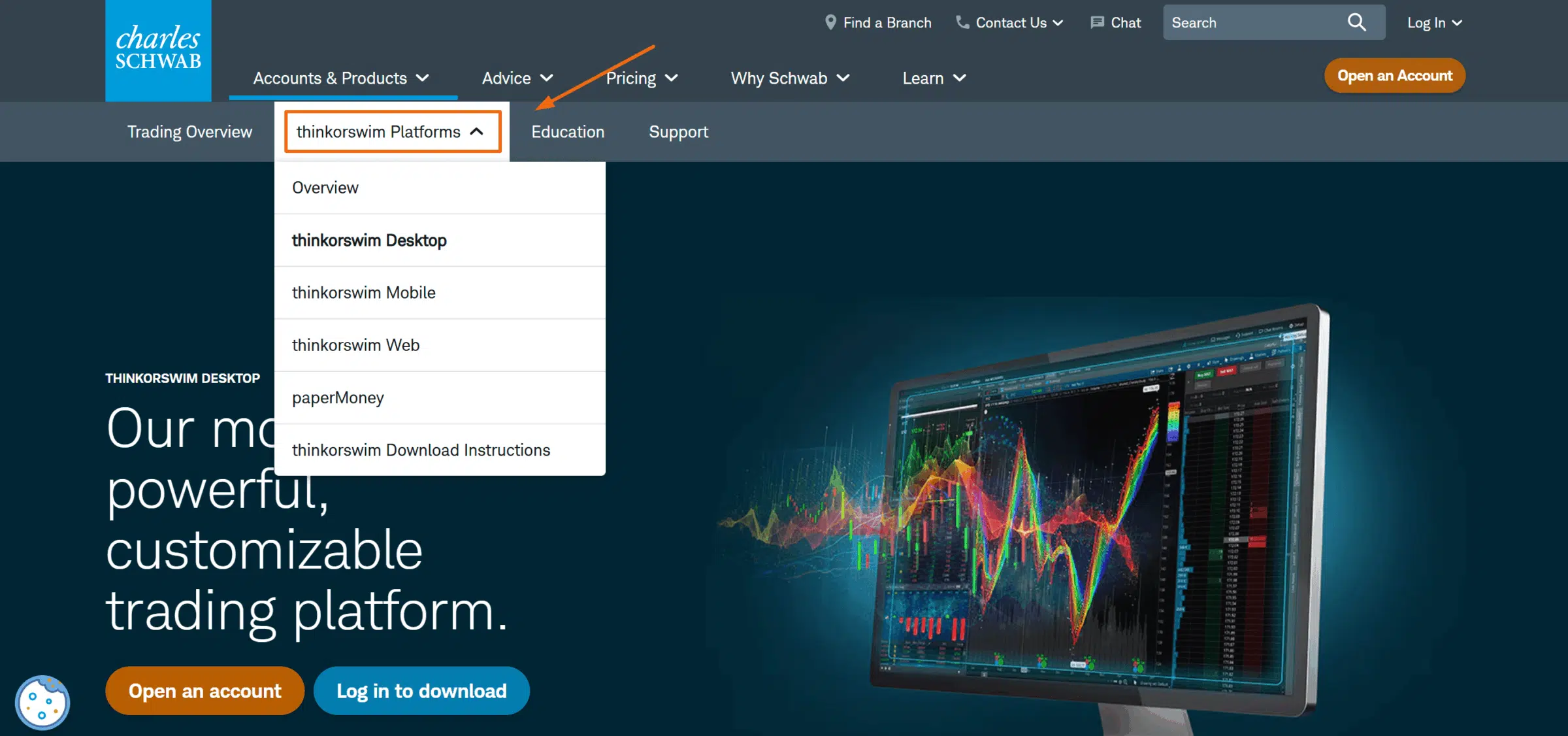
If you follow active trading, the name thinkorswim will likely be familiar. It is a trading platform originally built by TD Ameritrade, now part of Charles Schwab following the acquisition completed in 2023. Designed primarily for derivatives traders, it also serves a wider range of active investors.
The name borrows from the idiom “sink or swim”.
Is thinkorswim available in Europe and the UK?
Yes, though access differs considerably by region.
Following the TD Ameritrade acquisition, Schwab integrated the thinkorswim suite into its own offering. In June 2024, Schwab launched thinkorswim in the UK as part of “Schwab Trading Powered by Ameritrade”, making it directly available to UK retail traders.
For other European residents, access runs through Charles Schwab International’s Schwab One International account, with availability depending on your country. Schwab accepts clients from Portugal, Spain, Germany, Italy, the Netherlands, and Ireland among others, while rejecting applications from France, Greece, Croatia, and Estonia. Verify your own country directly, as the list changes.
One point to establish upfront: Schwab One International is a US brokerage account, not a locally regulated one. You would be contracting with a US entity supervised by the SEC and FINRA, with SIPC protection up to $500,000 (including a $250,000 cash sub-limit), rather than falling under FCA or EU investor compensation schemes. The account also carries a $25,000 minimum deposit for international applicants.
The drawbacks for European and UK investors are significant:
- USD-only base currency: euro and sterling investors face conversion costs on every deposit, withdrawal, and dividend payment, which recur indefinitely;
- No US-domiciled ETFs: European retail investors cannot buy them under PRIIPs regulation, which removes the low-cost index funds that draw many investors to US brokers in the first place;
- No EU or UK stocks: the platform covers US-listed securities only, so no European market access;
- No margin, short selling, or futures for most non-US residents. Schwab’s disclosures state explicitly that EU residents (excluding Switzerland) are not eligible for margin – a considerable limitation given thinkorswim was built for derivatives traders;
- No fractional shares, meaning higher-priced US stocks require full-share purchases;
- Lengthy onboarding: the application requires printing, signing, and scanning a PDF form alongside passport and proof of address, rather than a fully digital process;
- US estate tax exposure: US-situs assets above $60,000 held by non-resident aliens can fall within scope, though relief depends on whether your country has an estate tax treaty with the US.
The margin and futures restriction deserves particular attention. thinkorswim’s reputation rests on its options and derivatives tooling, and without margin access much of that capability is unavailable to European users – which means many arrive for the platform’s strengths and find they cannot use them.
What makes thinkorswim appealing?
thinkorswim is a desktop trading platform built around customisable tools, letting you test strategies, develop ideas, and execute complex multi-leg trades from a single interface.
Its feature set covers economic data, company profiles, options statistics, earnings tools, custom alerts, and a market monitor. Web and mobile versions are available, though with less customisation than the desktop application. A PaperMoney practice account with $100,000 in virtual funds lets you test the platform before committing capital.
The platform suits a wide range of users. Newer investors can progress gradually, supported by extensive educational material, while experienced traders value the ability to build custom indicators, write scripts in thinkScript, and share screens with the wider user community. Its options analysis tooling in particular is among the strongest available to retail traders anywhere.
That last point is worth holding alongside the restrictions covered above: the capabilities that make thinkorswim distinctive are largely derivatives-focused, and those are precisely what European users cannot fully access without margin permissions.
Want alternatives that avoid those limitations? Read on.
Top thinkorswim alternatives for European and UK investors
Although thinkorswim is now available in the UK and several EU countries, many European traders prefer alternatives that support EUR or GBP as a base currency, provide access to European-listed stocks and ETFs, and remove the restrictions on margin and derivatives that apply to non-US residents.
Most brokers build their platforms in-house, so no exact equivalent to thinkorswim exists. These come closest:
Trader Workstation (TWS)
The flagship desktop platform from Interactive Brokers, and the closest functional equivalent to thinkorswim available in Europe. It offers the widest product range of any broker here – stocks, options, futures, bonds, forex, and funds across 170+ markets in 36+ countries – with extensive customisation, advanced order types, algorithmic execution, and full options analysis tooling.
Critically for European users, TWS supports EUR and GBP as native base currencies, provides access to European exchanges, and permits margin and derivatives trading subject to standard eligibility – removing the main restrictions that limit thinkorswim outside the US. There is also no minimum deposit, against Schwab’s $25,000.
xStation 5
The proprietary platform from XTB, available on web, desktop, and mobile. It is considerably more approachable than TWS while still offering solid charting, technical indicators, and a trader calculator for margin and commission. Features are customisable by instrument and asset class, and switching between them is seamless.
XTB supports EUR and GBP accounts, offers real stocks and ETFs commission-free up to a monthly turnover threshold, and added vanilla options in early 2026. Best suited to traders who want capable tooling without TWS’s learning curve.
SaxoTrader
The advanced platform from Saxo, available on web, mobile, and desktop, covering fundamental analysis tools, news, research, and technical analysis within a well-designed interface. The desktop version adds multi-screen workspaces of up to six screens, Depth Trader with Level 2 order book data, and time and sales data – the features active traders will recognise from thinkorswim.
Saxo gives access to over 71,000 instruments including options and futures, supports multiple base currencies, and is backed by a bank holding an A-/A2 credit rating from S&P. Note a custody fee of up to 0.15% per year on stock, ETF, and bond positions, avoidable through securities lending. Long-term investors are better served by SaxoInvestor, the simpler platform accessible from the same account.
Thinkorswim European alternatives
# Trader Workstation

Trader Workstation at a glance
Trader Workstation (TWS), the proprietary platform from Interactive Brokers, is among the most capable trading platforms built by a brokerage. It comes in two configurations: TWS Mosaic, a fully customisable workspace, and Classic TWS, which exposes the more advanced tooling for experienced traders.
You get comprehensive order management, technical charting, watchlists, and portfolio tools within a single view. Activity can be organised by asset class while staying current with market news, alongside fundamental data covering thousands of companies.
Interactive Brokers also offers Client Portal, a lighter web-based alternative for tracking portfolio performance without the full complexity, and IBKR Mobile for monitoring positions on the go. Newer investors can start with IBKR GlobalTrader, which simplifies the experience further.
For anyone coming from thinkorswim specifically, TWS is the closest match on capability – it is the only platform here combining comparable derivatives tooling with margin access for European residents, EUR and GBP base currencies, and no minimum deposit.
Thinkorswim European alternatives
# xStation 5

xStation 5 at a glance
69-80% of retail CFD accounts lose money.
xStation 5 is the proprietary platform from XTB, a global broker listed on the Warsaw Stock Exchange serving over 1.7 million clients. It gives access to thousands of instruments across real stocks and ETFs, forex, indices, commodities, cryptocurrency CFDs, and – since early 2026 – vanilla options.
The design is less dense than thinkorswim, though not at the cost of capability. You get advanced charting with 50+ indicators, economic data, custom alerts, a market monitor, and company fundamentals, alongside sentiment tools. XTB also provides substantial educational content through the XTB Trading Academy, including free courses, webinars, and account manager support.
The xStation Mobile app keeps everything synchronised across devices. xStation suits both shorter-term trading and longer-term investing, and is the more approachable option for anyone who finds TWS overwhelming.
CFDs are complex instruments and come with a high risk of losing money rapidly due to leverage. Between 69-80% of retail investor accounts lose money when trading CFDs. You should consider whether you understand how CFDs work and whether you can afford to take the high risk of losing your money.
Thinkorswim European alternatives
# Saxo

Saxo at a glance
62% of retail CFD accounts lose money.
Saxo now runs two platforms rather than three: SaxoInvestor, the straightforward option for long-term investors, and SaxoTrader, the advanced platform available on web, mobile, and desktop. A single account gives access to both, and the former SaxoTraderGO and SaxoTraderPRO branding has been retired.
SaxoTrader covers fundamental and technical analysis tools, an extensive charting package, performance analysis, and a comprehensive account overview within a well-designed interface, synchronised across web and mobile. The desktop version adds multi-screen workspaces of up to six screens, Depth Trader with Level 2 order book data, and time and sales data.
The product range spans FX, FX options, CFDs, stocks, ETFs, futures, listed options, bonds, mutual funds, and commodities – over 71,000 instruments in total. Saxo was acquired by J. Safra Sarasin in March 2025 and holds an investment-grade A-/A2 credit rating from S&P.
Note that a custody fee of up to 0.15% per year applies to stock, ETF, and bond positions, avoidable by opting into securities lending.
Note on availability: Saxo has adjusted its market coverage in recent years as part of a strategic reorganisation. It continues to serve most EU countries and the UK, but check Saxo’s official list of supported countries before opening an account.
Bottom line: which platform should you use?
The most reliable way to decide is to trial each one. Feature overlap between these platforms is high – what you find in one usually exists in another, often just presented differently – and all three offer demo accounts, so testing costs you time rather than money.
That said, a few distinctions genuinely separate them:
- For derivatives and options traders: TWS is the clear choice, offering the depth thinkorswim users expect alongside margin access that Schwab restricts for European residents;
- For traders wanting capability without complexity: xStation 5 delivers solid tooling with a far shorter learning curve;
- For investors prioritising breadth and institutional backing: Saxo offers the widest instrument range and a bank-grade balance sheet, with a custody fee to factor in;
- On cost: currency conversion and recurring charges typically matter more over time than headline commissions, particularly for a euro or sterling-based investor buying US assets.
Worth remembering too that platform quality and broker quality are separate questions. A sophisticated interface is of little use if the underlying pricing, market access, or regulatory protection does not suit you – which is precisely the issue European users encounter with thinkorswim.
The above should not be construed as investment advice and is provided for informational purposes only. Investors should do their own research and due diligence regarding the services best suited to their risk, return, and impact strategy.