


What is the difference between VWRL and VWRP? These are two share classes of the same Vanguard fund that, despite having different tickers, replicate the same index, the FTSE All-World. The difference between them lies in the way dividends are treated: VWRL distributes dividends, while VWRP accumulates them.
VWRL is a distributing ETF that pays you dividends on a quarterly basis. On the other hand, VWRP is an accumulating ETF that reinvests dividends back into the fund instead of paying them out to you. Both ETFs are offered by the same provider, Vanguard, and both charge an ongoing charges figure of 0.14%.
Throughout this article, we will address all the relevant topics so that you can make an informed investment decision. All fund data comes from Vanguard’s factsheets as at 31 July 2026.
VWRL vs VWRP compared in a nutshell
Our team has compiled all the information discussed throughout the article into a table, so that it can be easier for you to observe the differences and make a decision.
| ETF | VWRL | VWRP |
| Full name | Vanguard FTSE All-World UCITS ETF (USD) Distributing | Vanguard FTSE All-World UCITS ETF (USD) Accumulating |
| ISIN | IE00B3RBWM25 | IE00BK5BQT80 |
| Index tracked | FTSE All-World | FTSE All-World |
| Fund manager | Vanguard | Vanguard |
| Inception date | 22 May 2012 | 23 July 2019 |
| Share class assets | $26.2 billion | $53.4 billion |
| Exchanges* | XLON (GBP and USD), XSWX, XAMS, XETR, XMIL | XLON (GBP and USD), XSWX, XAMS, XETR, XMIL |
| Fund currency** | USD | USD |
| Dividend policy | Distributing (quarterly) | Accumulating |
| Ongoing charges (TER) | 0.14% | 0.14% |
| Domicile | Ireland | Ireland |
*Official listings according to Vanguard. Tickers differ by exchange: VWRL trades as VGWL on Deutsche Börse, and VWRP trades as VWCE in euros and as VWRA in USD and CHF (see the exchanges table below). Both are also traded on German regional venues such as gettex and the Stuttgart Stock Exchange.
**Fund currency is the reporting currency. Still, you can trade both ETFs in other currencies, such as EUR, GBP and CHF. Share class assets as at 31 July 2026.
Index tracked
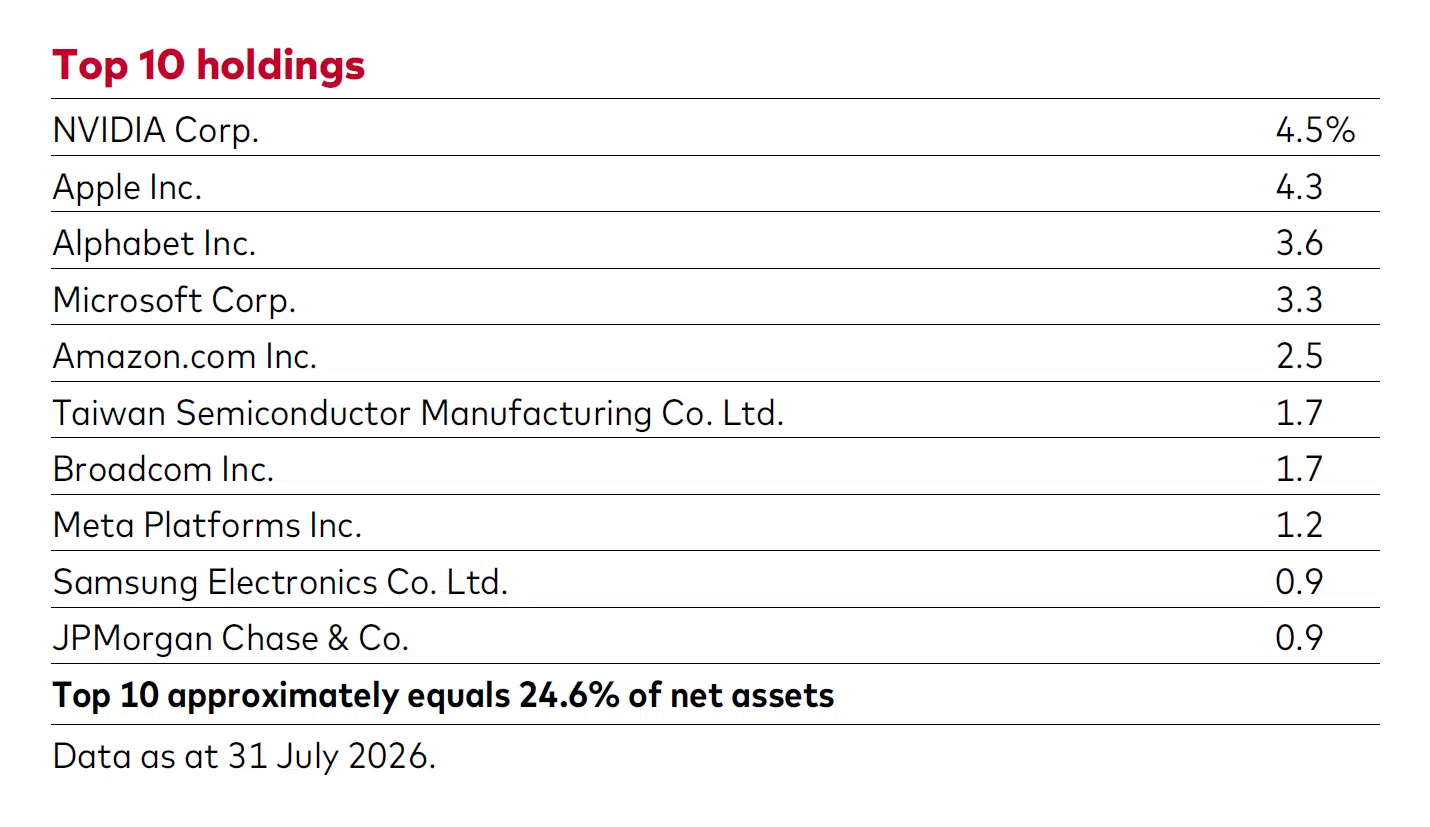
Both ETFs replicate the FTSE All-World index, which tracks large and mid-sized company stocks from developed and emerging markets globally. Since VWRL and VWRP are two share classes of the same fund (Vanguard FTSE All-World UCITS ETF), they hold exactly the same 3,782 stocks in the same proportions. The top 10 holdings represent about 24.6% of net assets, led by NVIDIA, Apple, Alphabet and Microsoft.
Both VWRP and VWRL use physical replication as their ETF construction strategy. This means that the fund manager acquires the assets that comprise the ETF’s benchmark index, the FTSE All-World Index, investing in a representative sample of its constituents (the fund holds 3,782 stocks versus 4,264 in the index).
The fund manager
Both ETFs are offered by the same fund manager, Vanguard. The legal entity is Vanguard Funds plc, managed by Vanguard Group (Ireland) Limited, with Global Equity Index Management as the investment manager. While VWRL was launched on 22 May 2012, VWRP is more recent, with an inception date of 23 July 2019. Despite being younger, VWRP has already gathered more assets ($53.4 billion versus $26.2 billion for VWRL), reflecting the preference of European investors for accumulating share classes.

Currency
Both ETFs, VWRL and VWRP, have the US dollar (USD) as their fund currency. However, the specific tickers listed can be traded in different currencies depending on the exchange, as is the case with the VWRL ticker traded in GBP on the London Stock Exchange or in CHF on the SIX Swiss Exchange.
Both ETFs are “unhedged”. This means that you, as an investor, are directly exposed to fluctuations in exchange rates between your own currency and the currencies of the underlying stocks (about 62% of the portfolio is invested in US companies, so the USD is the main exposure). The trading currency of the ticker you buy does not change this exposure: it only determines the currency in which you pay and receive money.
Exchanges
As previously mentioned, the ETFs in question can be traded on different exchanges and in different currencies, resulting in different tickers. Therefore, our team has prepared a summary of how these ETFs are listed on the various exchanges, along with the associated currency and ticker.
| Listing | Trade currency | VWRL | VWRP |
| Tickers* | |||
| London Stock Exchange | GBP | VWRL | VWRP |
| London Stock Exchange | USD | VWRD | VWRA |
| SIX Swiss Exchange | CHF | VWRL | VWRA |
| Euronext Amsterdam | EUR | VWRL | VWCE |
| Deutsche Börse (Xetra) | EUR | VGWL | VWCE |
| Borsa Italiana | EUR | VWRL | VWCE |
| gettex** | EUR | VGWL | VWCE |
| Stuttgart Stock Exchange** | EUR | VGWL | VWCE |
*Official listings according to Vanguard’s factsheets as at 31 July 2026. Each listing also has its own iNAV Bloomberg code (for example IVWRLEUR and IVWRAEUR for the euro listings).
**German regional trading venues where the ETFs are traded but which are not part of Vanguard’s official listings.
Distribution
There is a significant distinction between the two ETFs’ distribution strategies. VWRL is a distributing ETF that pays you dividends on a quarterly basis (the dividend yield of the underlying holdings was 1.5% as at 31 July 2026). This feature can be appealing if you seek regular income from your investments.
On the other hand, VWRP is an accumulating ETF that reinvests dividends back into the fund instead of distributing them to you. This structure may attract you if you are focused on long-term capital growth and want the dividends to compound automatically without paying broker commissions to reinvest them.
Tax strategy
When considering tax strategies, it’s important for you to note that VWRL and VWRP may have different tax implications.
As a distributing ETF, VWRL’s dividends are subject to taxation in the year you receive them as an investor, in most countries.
In contrast, with VWRP, the reinvested dividends are generally not taxed at the time they are reinvested, so taxation is usually deferred until you sell your shares. Be aware that this depends on your country’s tax rules (Germany, for example, taxes accumulating funds annually through the “Vorabpauschale”). Make sure to dig deeper into your tax situation before deciding between the two ETFs.
Fund domicile
Both ETFs, VWRL and VWRP, are domiciled in Ireland, so they benefit from the favourable tax environment and tax treaties that Ireland has in place. Ireland has a double taxation treaty with the US, meaning that Irish-domiciled ETFs only pay a 15% withholding tax on US dividends, versus 30% in domiciles such as Luxembourg, where no such treaty exists. Since about 62% of the portfolio is invested in US companies, this reduces the tax drag on the fund’s returns.
Total expense ratio
Besides the fees you pay to your broker when trading ETF shares, there’s another cost called the total expense ratio (TER), which Vanguard reports as the ongoing charges figure (OCF). It’s a fee charged by the fund manager to cover the expenses of running the ETF.
The TER is shown as a percentage of the total amount of money in the fund and is charged on a daily basis according to its Net Asset Value (NAV), in the TER daily proportion. For instance, if it is 0.50% and you have $10,000 invested in the ETF, you would pay $50 as expenses for that year, adding all trading days (for simplicity, we consider the ETF didn’t move during this period). With a TER of 0.14%, the same $10,000 in VWRL or VWRP costs you about $14 a year.
| TER | VWRL | VWRP |
| TER (%) | 0.14 | 0.14 |
Performance
Because VWRL and VWRP hold the same portfolio and charge the same fee, their total returns are identical: both returned 22.05% in the 12 months to 31 July 2026, 18.27% a year over 3 years and 10.84% a year over 5 years (in USD, net of fees, with dividends reinvested), against 22.03%, 18.29% and 10.85% for the FTSE All-World index. The only visible difference is in the share price: VWRP’s price grows faster because the dividends stay inside the fund, while VWRL’s price drops by the amount of each quarterly dividend paid out.
| Annualised return (USD) | 1 year | 3 years | 5 years | 10 years |
| VWRL / VWRP (net of fees) | 22.05% | 18.27% | 10.84% | 12.26%* |
| FTSE All-World index | 22.03% | 18.29% | 10.85% | 12.27% |
Source: Vanguard factsheets, data as at 31 July 2026. *10-year figure for VWRL only, since VWRP was launched in 2019. Past performance is not a reliable indicator of future results.
Diversification
When it comes to geographic distribution, both VWRL and VWRP offer broad global diversification. They include stocks from companies located in more than 40 countries around the world. This means that as an investor, you have exposure to companies in different regions such as North America, Europe, Asia, the Pacific and emerging markets. Keep in mind, though, that the United States alone represents about 62% of the portfolio, followed by Japan (6%) and the United Kingdom (3.3%). This diversified geographic distribution helps to reduce the specific risk associated with any single country or region, allowing you to benefit from global economic growth.

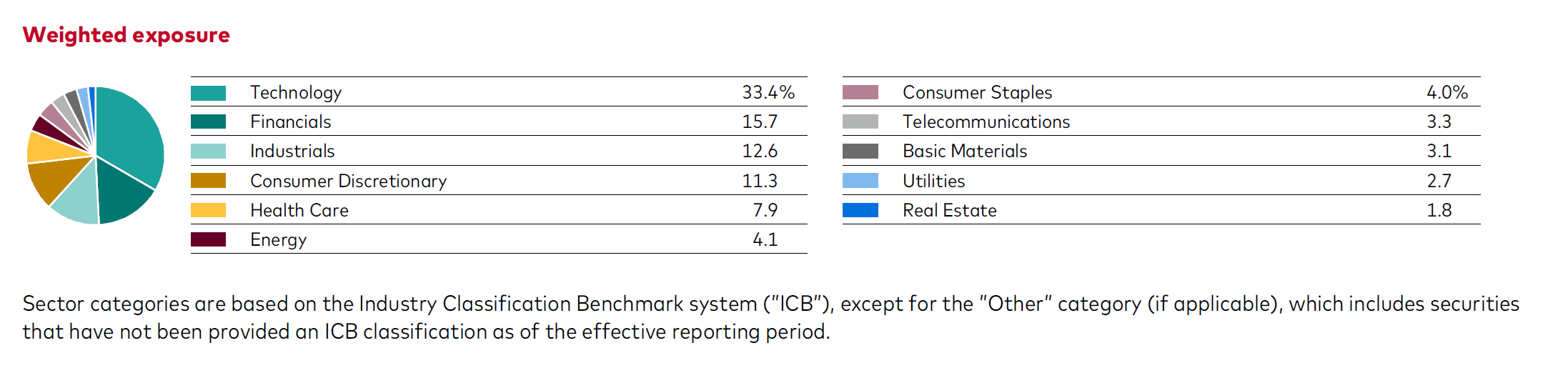
When it comes to sector distribution, the ETFs are also diversified across the various sectors of the economy: technology (33.4%), financials (15.7%), industrials (12.6%), consumer discretionary (11.3%), health care (7.9%) and more. By diversifying across sectors, you can benefit from different areas of the economy, reducing your exposure to the specific risks associated with individual sectors, although the weight of technology stocks has grown considerably in recent years.
Cheapest brokers to invest in ETFs
Now that you’re familiar with the differences between the two ETFs and have decided, it’s time to choose the best broker to move forward with your investment. That’s why Investing in the Web collected all this information, evaluated the most important features of different European ETF brokers and compiled a list of four ETF brokers in Europe.
Without further delay, here are four ETF brokers in Europe and why you should consider them:
- eToro: Best for social trading and commission-free ETF investing
- Interactive Brokers: Best for the largest ETF offering
- DEGIRO: Best for low-cost ETF trading
- Trading 212: Best for commission-free stock and ETF trading (Other fees may apply. See terms and fees.)
Disclaimer: Investing involves risk of loss; eToro is a multi-asset investment platform. The value of your investments may go up or down. Your capital is at risk. Other fees apply. For more information, visit etoro.com/trading/fees.
| Broker | ETF fees | Minimum deposit | Number of ETFs | Regulators |
| eToro | $0 (other fees apply) | $50 (varies between countries) | 700+ | FCA, CySEC, ASIC |
| Interactive Brokers | Varies by exchange. Tiered pricing on European exchanges: 0.05% of trade value (min. €1.25, max. €29) | €/$/£0 | 13,000+ | SEC, FINRA, CFTC, SIPC, CIRO, FCA, CBI, ASIC, SFC, MAS, CBH |
| DEGIRO | €0 commission + €1 handling fee on the ETF Core Selection (fair use policy applies), €2 + €1 on other ETFs, plus a €2.50 annual connectivity fee per exchange (except the home exchange) | €/£1 | Thousands (Core Selection with no commission) | BaFin (flatexDEGIRO Bank SE), DNB and AFM |
| Trading 212 | £/€0 commission (other fees may apply) | £/€1 | 2,800+ | FCA, CySEC, BaFin, ASIC |
Disclaimer: When investing, your capital is at risk and you may get back less than invested. Past performance doesn’t guarantee future results.
Conclusion
All in all, both VWRL and VWRP offer exposure to the same diversified portfolio of international equities, with the same 0.14% ongoing charge and the same returns before dividends are paid out. The only difference comes from the way the dividends are used. In VWRL, the policy is to distribute dividends to the shareholders on a quarterly basis. In VWRP, the dividends are kept inside the ETF and reinvested in its holdings. If you want regular income, VWRL is the natural choice. If you are building wealth for the long term and want to avoid reinvestment costs (and possibly defer taxes, depending on where you live), VWRP is the simpler option.



