SPY (SPDR S&P 500 ETF Trust) and VOO (Vanguard S&P 500 ETF) are the two best-known ETFs tracking the S&P 500. Their performance is almost identical day to day, so the differences come down to fees, size, liquidity and structure.
VOO is three times cheaper (0.03% against 0.0945%) and is now the largest ETF in the world, with around $1.05 trillion in assets. It became the first ETF ever to pass $1 trillion on 2 June 2026, having overtaken SPY as the largest roughly 18 months earlier.
SPY, with about $783 billion, remains the most heavily traded ETF in the world, with the deepest options market and the tightest spreads, which is what keeps active traders on it.
Below we compare both in detail, with data from the funds’ own pages, checked in September 2026.
SPY vs VOO compared in a nutshell
Everything discussed in this article, in one table.
| ETF | SPY | VOO |
| Expense ratio (TER) | 0.0945% | 0.03% |
| Assets under management | ~$783 billion | ~$1.05 trillion (largest ETF in the world) |
| Average daily volume | ~80 million shares (highest of any ETF) | ~9 million shares |
| Full name | SPDR S&P 500 ETF Trust | Vanguard S&P 500 ETF |
| Fund manager | State Street Global Advisors | Vanguard |
| Inception | January 1993 | September 2010 |
| Index tracked | S&P 500 | S&P 500 |
| Fund structure | Unit Investment Trust (UIT) | Open-end fund |
| Dividends | Distributing, quarterly | Distributing, quarterly |
| Dividend yield | ~1.1% | ~1.1% |
| Best for | Active traders and options strategies | Long-term buy-and-hold investors |
Performance
Both funds track the same index, so returns are nearly identical. Any gap comes almost entirely from the expense ratio, plus small operational differences: VOO’s open-end structure allows faster dividend reinvestment and securities lending, while SPY, as a Unit Investment Trust, has to hold dividend cash until the quarterly distribution, creating a small cash drag.
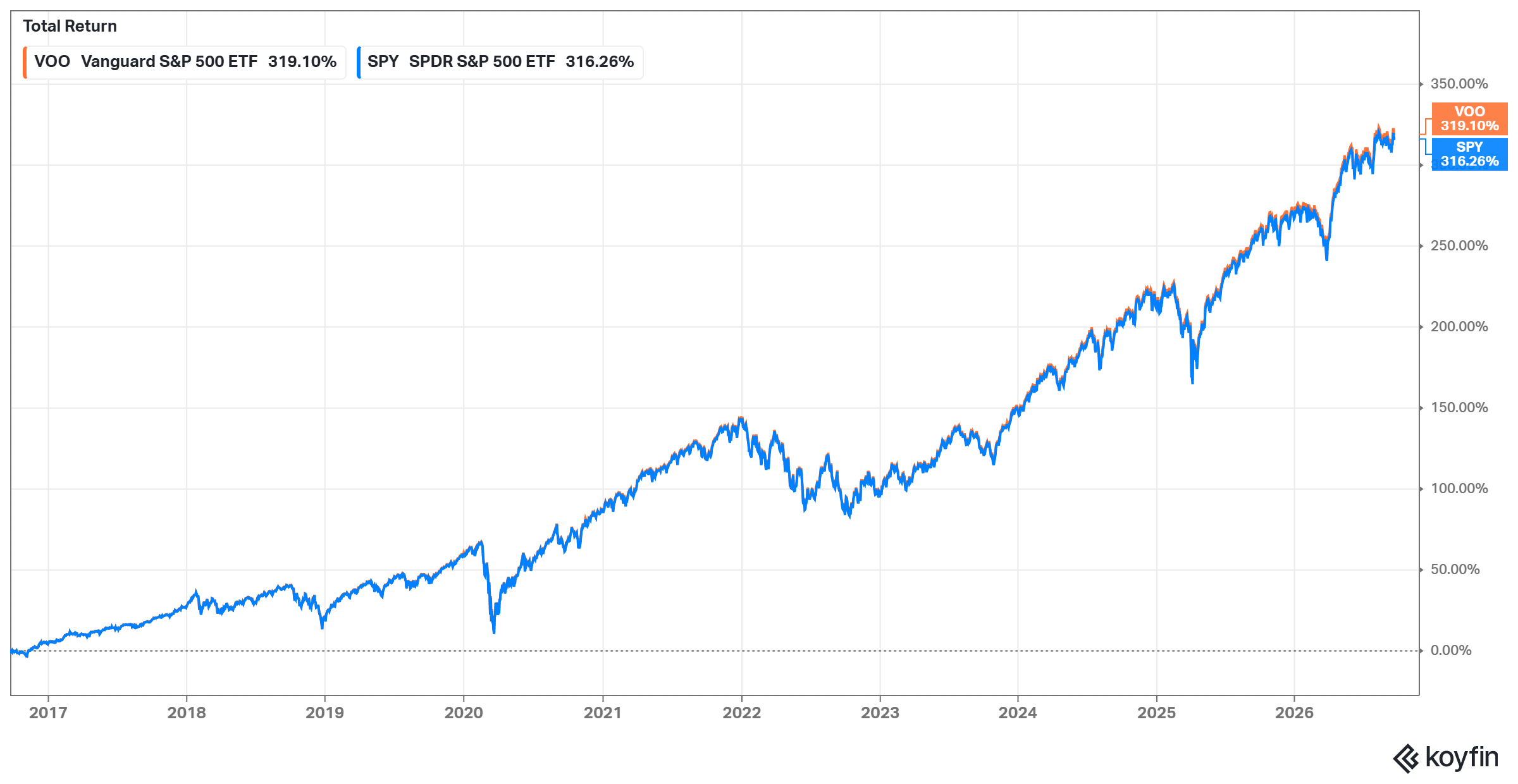
Here is how both funds compare with the index, with returns net of fees and dividends reinvested, to 31 August 2026:
| Period | SPY | VOO | S&P 500 Index |
| 1 year | 20.21% | 20.3% | 20.38% |
| 3 years a year | 20.89% | 21.0% | 21.04% |
| 5 years a year | 12.65% | 12.7% | 12.79% |
| 10 years a year | 15.22% | 15.3% | 15.37% |
Sources: SSGA (SPY, NAV returns to 31 August 2026) and Vanguard and Morningstar (VOO, same date). VOO figures are rounded to one decimal. Past performance is not a reliable indicator of future returns.
Both funds trail the index by roughly their fee, which is exactly what a well-run index tracker should do. SPY lags it by about 0.15 points a year over ten years, VOO by about 0.07, leaving a gap of roughly 0.06 to 0.1 points a year in VOO’s favour.
That sounds trivial, and over a year it is: 20.21% against 20.3% is noise. Over 30 years on a $100,000 position it compounds into several thousand dollars. For a long-term investor that is the whole argument.
Overview
SPY: SPDR S&P 500 ETF Trust
Launched in January 1993 by State Street Global Advisors, SPY is the oldest ETF in the world, the fund that started the industry. It is no longer the largest by assets, having been overtaken by VOO in early 2025, but it remains the most heavily traded, with around 80 million shares changing hands daily. That depth, plus the deepest options market of any ETF, is what keeps active traders and institutions on it.
VOO: Vanguard S&P 500 ETF
Vanguard launched VOO in September 2010. It grew quickly on the back of its 0.03% expense ratio and Vanguard’s reputation for low-cost products, and in June 2026 it became the first ETF in history to pass $1 trillion in assets. Its open-end structure also gives it small operational advantages over SPY’s Unit Investment Trust: faster dividend reinvestment and the ability to lend securities to offset costs.
Index tracked and holdings
Both track the S&P 500, giving exposure to the 500 largest US-listed companies, which is why they are among the most popular ETFs in the world. Small differences in composition and tracking come from fund structure, cash management and the timing of dividend reinvestment.
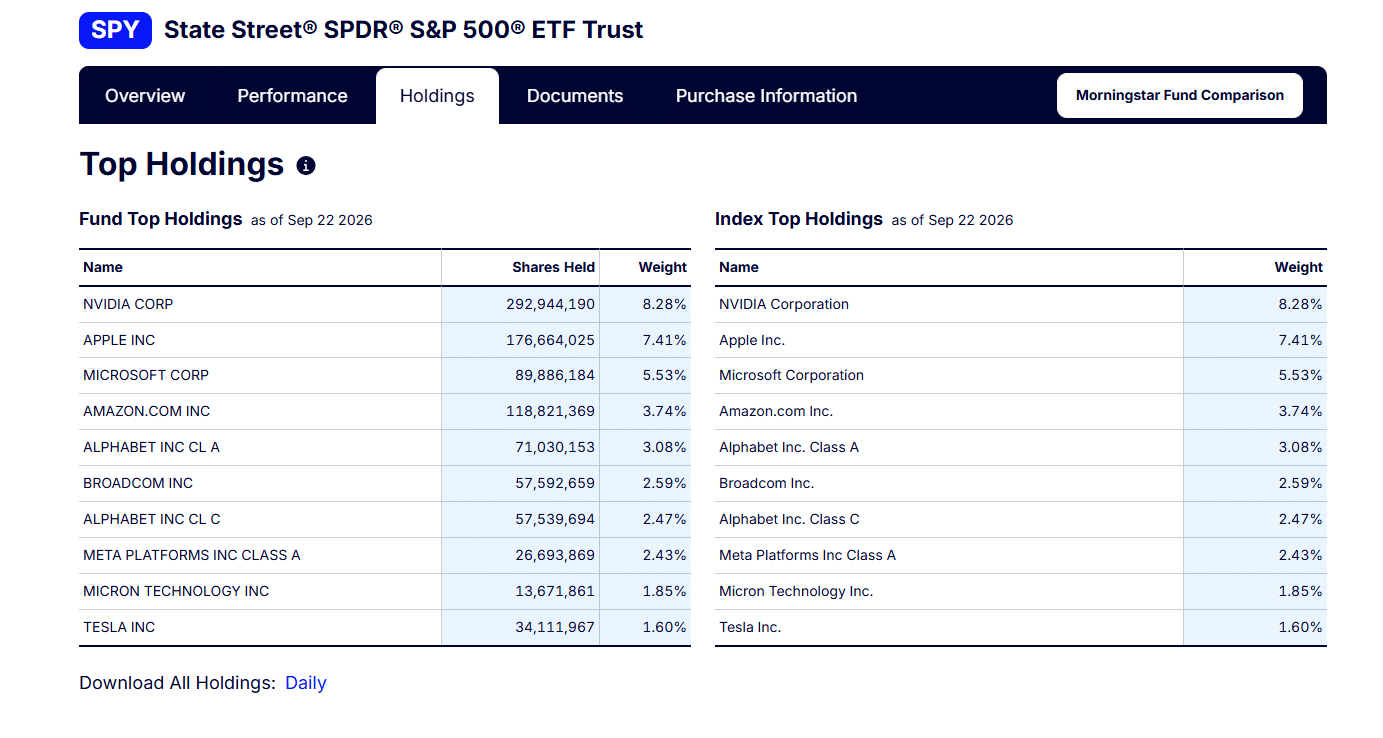
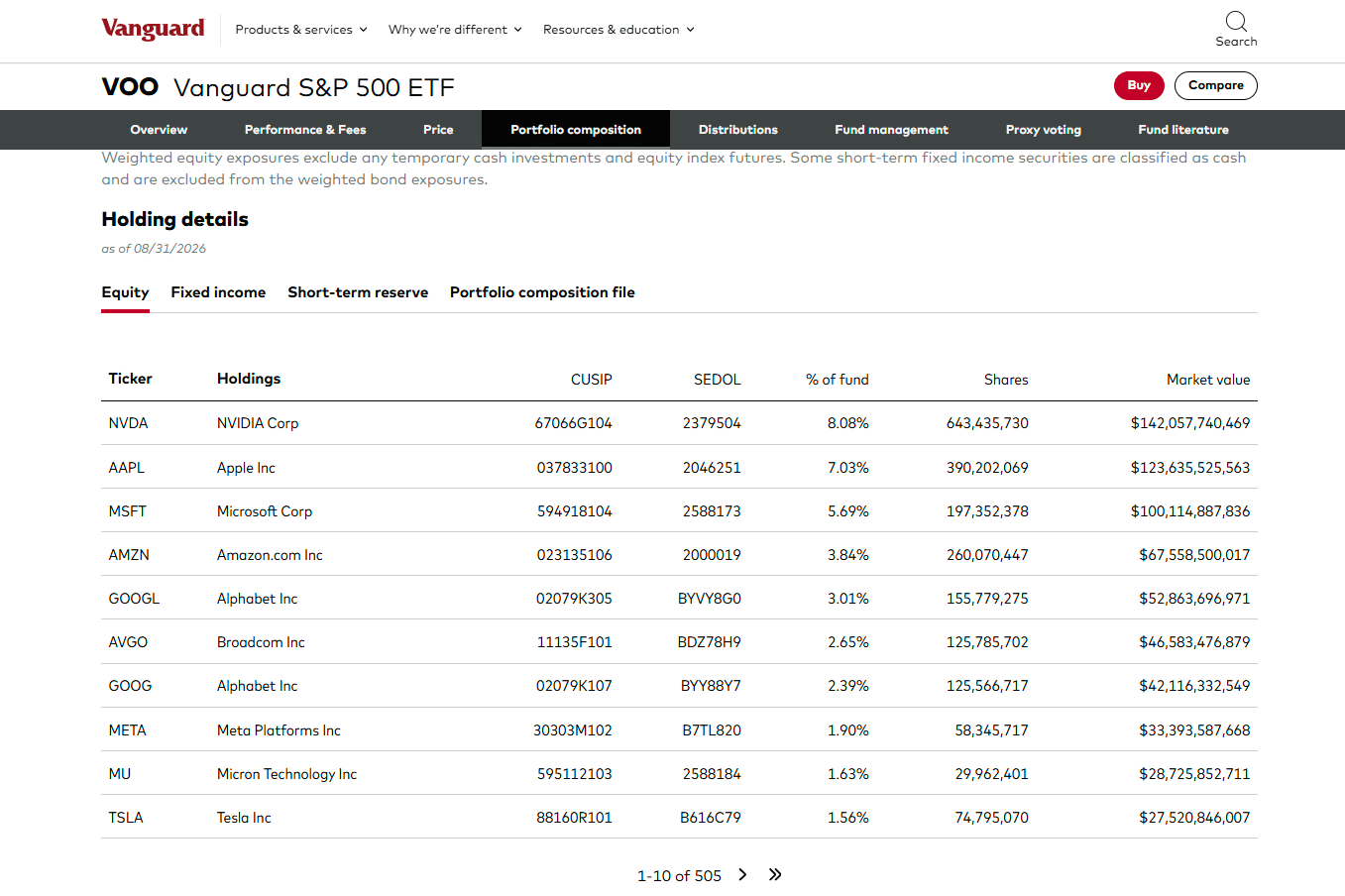
One point worth understanding before you buy either: the index is market-cap weighted and highly concentrated. The ten largest holdings were around 37% of the fund in mid-2026, led by NVIDIA (7.5%), Apple (6.6%), Alphabet (5.8%), Microsoft (4.3%) and Amazon (3.6%). Buying 500 companies does not mean buying 500 equal stakes: a handful of technology giants drive most of the movement, in both directions.
Both are physically replicated: they hold the actual shares at index weights, rather than using swaps to mirror the index synthetically. For long-term investors, physical replication removes counterparty risk and gives genuine ownership exposure.
Fund manager
SPY was launched in January 1993 by State Street Global Advisors, one of the world’s largest asset managers, with over $5 trillion under management. SPY belongs to its SPDR ETF brand and, as the first ETF ever created, effectively launched the industry.
VOO was launched in September 2010 by Vanguard, the world’s second-largest asset manager, with more than $10 trillion under management. Founded in 1975 by John C. Bogle, Vanguard pioneered the low-cost index fund. Its mutual structure, where the company is owned by its funds and therefore by their investors, is one structural reason products like VOO can keep fees this low.
Dividends and tax
Both are distributing ETFs, paying dividends quarterly. The yield on both is around 1.1%, and the difference between them is within rounding: the S&P 500 is dominated by growth companies that reinvest earnings rather than paying them out.
If you are not a US resident, dividends from US-listed ETFs face a 15% US withholding tax under most tax treaties, or 30% without one, which reduces the effective yield further.
For European readers there is a bigger obstacle: SPY and VOO are US-listed ETFs that retail investors in the EU and the UK cannot buy, because they don’t publish a KID under PRIIPs rules. The practical route is a UCITS equivalent tracking the same index, such as SPYL, CSPX, VUSA (distributing) or VUAA (accumulating). Accumulating versions also avoid the dividend being paid out and taxed each quarter, which matters in countries where dividends are taxed on receipt.
Total expense ratio (TER)
The TER is the annual cost of running the fund, deducted from returns. It is the one difference between these two ETFs that is certain in advance.
| ETF | SPY | VOO |
| TER | 0.0945% | 0.03% |
| Cost per $10,000 a year | $9.45 | $3.00 |
VOO’s 0.03% is among the lowest in the industry, and SPY’s 0.0945% is roughly three times higher. The difference is about $6 a year per $10,000 invested, which is nothing in a single year and meaningful over decades.
SPY’s fee is not an oversight: its Unit Investment Trust structure, fixed when it launched in 1993, cannot be amended as easily as an open-end fund’s, which is why State Street launched a cheaper twin (SPYM, formerly SPLG, at 0.02%) instead of cutting SPY’s fee. If cost is your only criterion, that cheaper twin beats both.
Liquidity
Liquidity determines how easily you can buy or sell at the price you want, and how quickly the order fills. The key numbers:
| Metric | SPY | VOO |
| Average daily volume | ~80 million shares | ~9 million shares |
| Average daily volume in dollars | ~$50 billion | ~$6 billion |
| Average bid-ask spread | ~$0.01, the tightest in the industry | ~$0.03 |
| Options market | Deepest of any ETF | Much smaller than SPY’s |
| Assets under management | ~$783 billion | ~$1.05 trillion |
Volume and spread figures are approximate and vary with market conditions.
What this means in practice:
- For options and short-term trading: SPY, clearly. The volume, the options depth and the tightest spreads make it the default for covered calls, spreads and weeklies. The higher fee is irrelevant on a position held for days.
- For long-term investing: VOO. You pay the spread twice, on the way in and on the way out, so a couple of cents is trivial against 0.06% a year compounding for decades.
- For large orders: SPY moves size with less market impact, which is why institutions use it.
Note that VOO’s lower share volume does not make it illiquid. At around $6 billion traded a day it is among the most liquid ETFs in the world, and its creation and redemption mechanism keeps the price tied to the underlying holdings regardless of volume.
Sector diversification
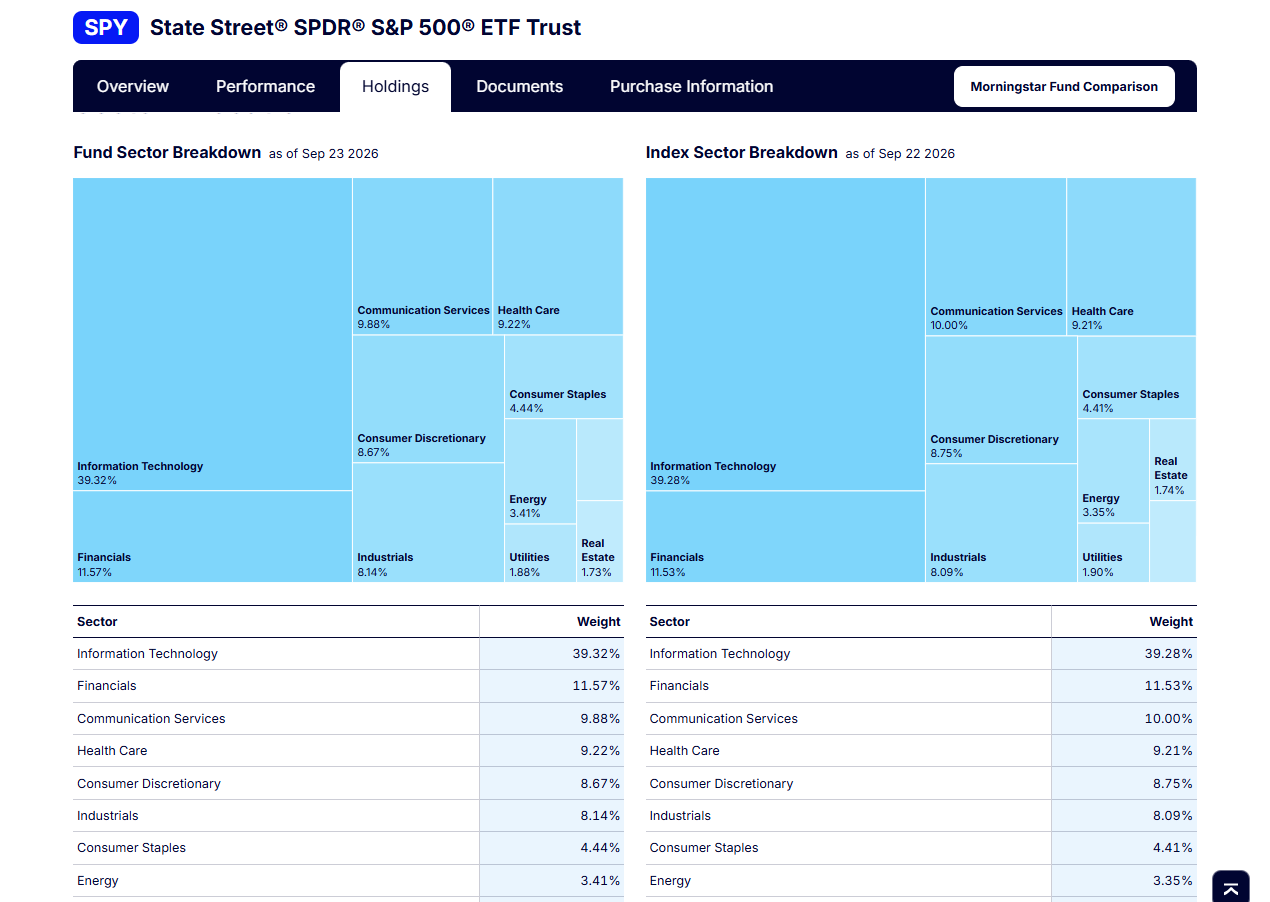
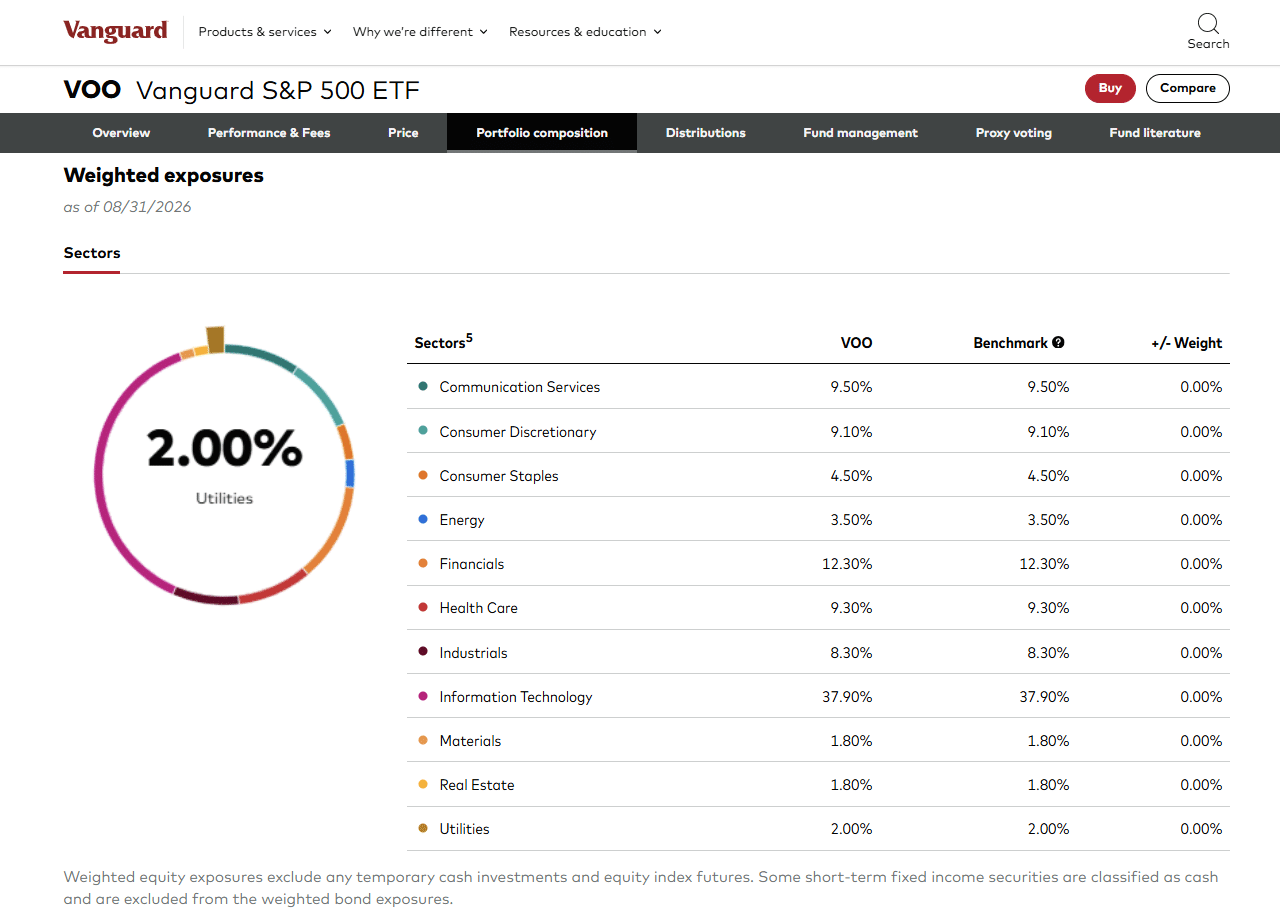
The S&P 500 holds companies across all eleven GICS sectors, and both ETFs replicate those weights, as you can see below. Technology dominates, at close to 40% of the index in 2026, which is the concentration risk to understand before buying either.
Where to invest in SPY and VOO
We have reviewed the main brokers offering access to both, focusing on cost, platform quality and product range:
- eToro: best for commission-free real ETF investing and social trading.
- Interactive Brokers: best for global market access and the lowest FX fees.
- Public.com: best for US residents wanting commission-free trading.
- Webull: best for low-cost trading with strong mobile and desktop platforms.
| Broker | ETF fees | Minimum deposit | Regulators |
| eToro | $0 (other fees apply) | $50, varies by country | SEC, FINRA, FCA, CySEC, ASIC |
| Interactive Brokers | $0 for US clients; up to $0.0035 per share (min. $0.35) elsewhere | $0 | SEC, FINRA, SIPC, CFTC, FCA, CBI, CIRO, ASIC, SFC, SEBI, MAS, MNB |
| Public.com | $0 on US stocks and ETFs in regular hours | $0 | SEC, FINRA |
| Webull | $0 | $0 | SEC, FINRA, SIPC |
Checked in September 2026. European investors should note that most brokers cannot offer SPY or VOO to EU retail clients, and will offer UCITS equivalents instead.
Disclaimer: eToro is a multi-asset investment platform. The value of your investments may go up or down. Your capital is at risk. Other fees apply. For more information, visit etoro.com/trading/fees.
The bottom line
Both are excellent S&P 500 vehicles and their correlation is near perfect, so the practical difference is smaller than a side-by-side comparison suggests. SPY wins on liquidity: the most traded ETF in the world, the deepest options market and the tightest spreads. VOO wins on cost, with a fee three times lower and marginally better tracking.
A simple way to decide:
- Choose SPY if you trade actively, run options strategies or need to move large positions with minimal market impact.
- Choose VOO if you are buying and holding for years and want the lowest cost.
- Either works if you are building a long-term core US equity allocation: the decision matters far less than actually making the investment and holding it.
- Choose neither if you live in the EU or the UK, where you cannot buy them. Use a UCITS equivalent tracking the same index instead.
The market has been voting with its money: VOO passed $1 trillion in June 2026, while SPY remains the trading vehicle of choice for active and institutional investors. Both are excellent in their own lane, and the right answer depends on which lane you’re in.
This article is for information only and is not investment advice. Past performance is not a reliable indicator of future returns, and markets can fall as well as rise. ETF availability, fees and tax treatment vary by country: EU and UK retail investors generally cannot buy SPY or VOO and should consider UCITS equivalents. Always do your own research and consider speaking to a qualified adviser about your situation.