Several times a year, publicly traded companies announce their financial results to the market. US-listed companies report every quarter, while many European companies publish full results semi-annually, often with lighter trading updates in between. This is what is widely known as the “earnings season”.
These performance figures are crucial information for all company stakeholders because they give a clear view of each company’s financial strength, helping investors form well-grounded opinions and, consequently, act on them.
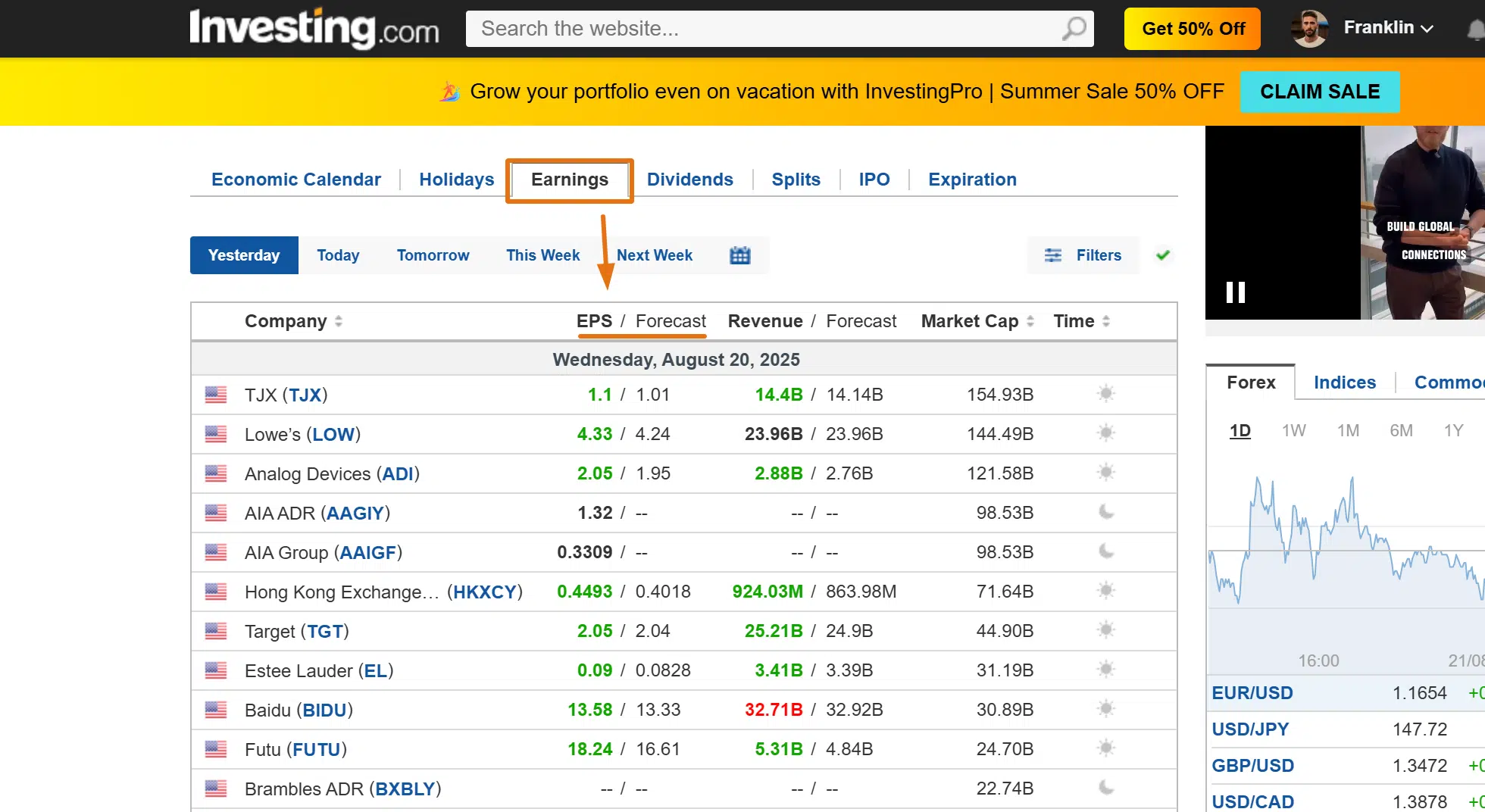
One of the fundamental data points investors are particularly interested in is the earnings per share (EPS). On any major financial website, such as Investing.com (image below), you will notice that the EPS is, by default, presented as one of the most important indicators: analysts take the time to forecast it and then compare their estimate with the actual value shown in the quarterly, semi-annual or annual financial statements.
So, what is the earnings per share ratio (EPS)?
The earnings of any company are simply its after-tax net income: in plain English, what remains after deducting all the company’s costs, interest and taxes. The earnings per share ratio (EPS) is that net income (minus any preferred dividends) divided by the weighted average number of shares outstanding over the period.
You will often see two versions: basic EPS, which uses the shares currently outstanding, and diluted EPS, which also counts shares that could be created from stock options, convertible bonds and similar instruments. Diluted EPS is the more conservative figure and the one most analysts quote.
EPS is used to measure how successful management has been in generating profit for the company’s owners, typically over the last twelve months (trailing EPS) or over a single reporting period. The higher the EPS, the greater the profit per share and the greater the company’s capacity to increase the dividends paid to shareholders.
What is considered a good EPS?
There is no rule of thumb for the “correct” number. An EPS of $5 is not automatically better than an EPS of $1, because it depends on how many shares the company has and what price you pay for each one. That is why EPS is rarely analysed in isolation. Instead, it is typically considered good when:
- It beats analyst expectations: during earnings season, the market reacts mostly to the gap between the reported EPS and the consensus estimate, not to the absolute number.
- It grows consistently over time: a company whose EPS rises year after year is creating more profit per share, either by growing earnings or by buying back shares.
- It compares well within the sector: profitability levels differ enormously between industries, so the relevant benchmark is companies with a similar business model.
- It is reasonably priced: dividing the share price by the EPS gives the price-to-earnings (P/E) ratio, which tells you how much investors pay for each unit of profit and makes companies with different share counts comparable.
How bad is a negative EPS?
The most intuitive interpretation is that the company is losing money (a fact) and may be facing some problems, but there is often more to it than that. Note also that a negative trailing-twelve-month EPS does not mean every quarter was negative, just that the total over the period was below zero. We need to understand the “why”:
Is the company in a phase of heavy investment? Since EPS refers to a single period, is it just a one-off event? Or, on the other hand, does it reveal a company that is living on borrowed time? These are the questions any retail or professional investor should ask to assess what each EPS number really means.
For example, it is quite common for technology, biotech and pharmaceutical companies to report negative earnings per share due to heavy spending on research and development, marketing and expansion. The short-term impact is unfavourable but, in the long run, it may produce extraordinary results. Think of a biotech company spending years and hundreds of millions on clinical trials: the losses are real, but so is the potential payoff if a drug is approved. The flip side is that companies which spend heavily and never find their “cure” may face serious financial constraints later on.
There is also a governance angle. Management teams may be tempted to prioritise short-term results, for instance because their stock options vest over a short timeframe and they do not want the share price to fall. That is why some investors, including Warren Buffett, have long argued for less frequent financial reporting. The debate is now live again: in May 2026, the SEC proposed giving US public companies the option to file semi-annual reports instead of quarterly ones, bringing the US closer to the European model.
Moreover, a company can present a negative EPS because of a change in accounting standards, a large one-off write-down or a few unexpected events. In such scenarios, you should investigate further to determine whether the impact is temporary or tells you something about the company’s future.
In summary, some reasons for a negative EPS include:
- Struggling business: the corporation may be facing structural problems that lead to consistent destruction of value. Companies in this situation have a higher chance of bankruptcy.
- Sector characteristics: it is very common for specific sectors, as mentioned above, to show high expenses at an early stage of the business or of a particular project. Most of the time, it is a work in progress that is expected to bear fruit at a future date.
- Growth companies: many companies with strong revenue growth are unprofitable because they are still in an investment phase. Investors back them anyway because they are growing fast and may become profitable later. Uber and Spotify, for instance, reported years of negative EPS before posting their first full-year profits.
- Changes in accounting: changes in accounting methods can sometimes push EPS negative for a short period, even if the company did not actually lose any money.
- One-off effects: a large impairment, a restructuring charge, a lawsuit settlement or an external shock (the 2020 pandemic being the classic example) can produce a negative EPS in a company that has reported positive earnings for years. Investors usually recognise these as exceptional rather than typical of regular activity.
Bottom line
All in all, a negative EPS does not automatically equate to a “badly managed company”. If you are a beginner, you will sleep better investing in companies with positive, sustainable profits, so staying away from unprofitable companies may be a sensible idea.
A good way to check whether negative earnings are caused by accounting, for instance, is to look at the cash flow statement. It tells you whether the company is spending more cash than it takes in or whether the negative earnings are simply the result of accounting rules. Looking at a company’s revenue growth rate and margin trends is also a reasonable way to judge whether it is on a “path to profitability”.
Finally, you should never decide whether or not to invest in a company based solely on a single fundamental ratio. Other data points (enterprise value, EBITDA, ROCE, debt levels and so on) are just as relevant to assessing how attractive a potential investment is. So, it is prudent to keep each number in context.