
While Americans can buy Treasury bonds directly through TreasuryDirect.gov, it is not that simple for Australian investors. The good news is that investing in US Treasury bonds from Australia is still possible, through several routes.
In this article, we explain step by step how Australian investors can buy US Treasury bonds, including T-bills and T-notes, on the secondary market, through ASX-listed ETFs or through US-listed ETFs.
What are US Treasury bonds?
US Treasury bonds are debt securities issued by the United States Department of the Treasury to finance government spending. They are backed by the full faith and credit of the US government, which is why they are treated as the benchmark for a risk-free asset in global markets.
Treasury securities pay a fixed interest rate and mature anywhere from a few weeks to thirty years. They are sold at auction and bought by individuals, companies and foreign governments.
On tax, one detail is often misstated: in the US, interest on Treasury securities is exempt from state and local taxes but is still subject to federal income tax. For Australian investors, what matters is Australian tax, which we cover further down.
Treasury bonds vs Treasury notes vs Treasury bills
All three are issued by the US Treasury. The difference is how long they run:
- Treasury bills (T-bills): mature in one year or less and are sold at a discount to face value, paying no coupon. You earn the difference between what you pay and the face value at maturity.
- Treasury notes (T-notes): mature in 2 to 10 years and pay interest every six months.
- Treasury bonds (T-bonds): mature in 20 to 30 years and pay interest every six months. Longer maturities usually pay more, but their prices move far more when interest rates change.
How to buy US Treasury bonds from Australia
As an Australian resident you cannot open a TreasuryDirect.gov account, since that service is limited to US persons. You have three practical options: buying bonds on the secondary market, buying an ASX-listed bond ETF, or buying a US-listed bond ETF.
Not every broker supports these products. Below we use Interactive Brokers, founded in 1978, listed on Nasdaq and part of the S&P 500 since August 2025. It is regulated in Australia by the Australian Securities and Investments Commission (ASIC) through Interactive Brokers Australia Pty Ltd, which is also a participant of ASX, ASX 24 and Cboe Australia.
Option 1: buy US Treasury bonds on the secondary market
Interactive Brokers lets you buy T-bills, T-notes and T-bonds on the secondary market. Treasuries are highly liquid and trade on tight spreads. The commission is 0.002% of face value, with a minimum of $5 per order.
Interactive Brokers gives access to over 1 million bonds, including US government securities and corporate bonds. Its Bond Scanner lets you filter by maturity, yield and coupon, and compare prices.
Because bonds are treated as complex instruments, you must request bond trading permission in your account settings before you can place an order.
Buying individual Treasuries has one advantage over an ETF: if you hold to maturity, you know exactly what you will receive, whatever happens to rates in between. The trade-off is that you choose the maturities yourself and reinvest each one as it matures.
Here is an example of a US Treasury on Interactive Brokers’ web platform:
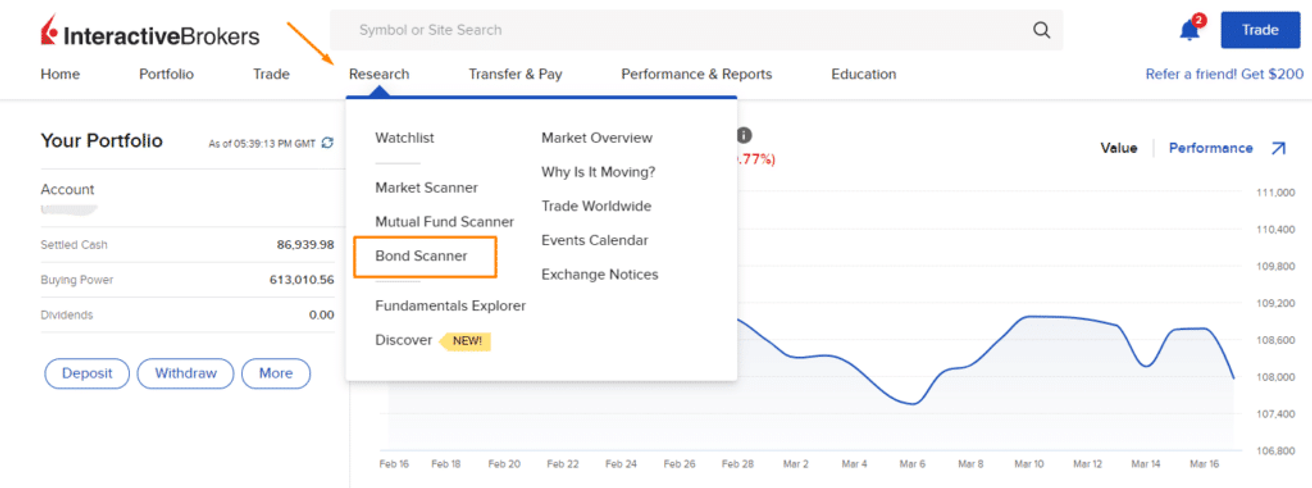
IBKR bond scanner
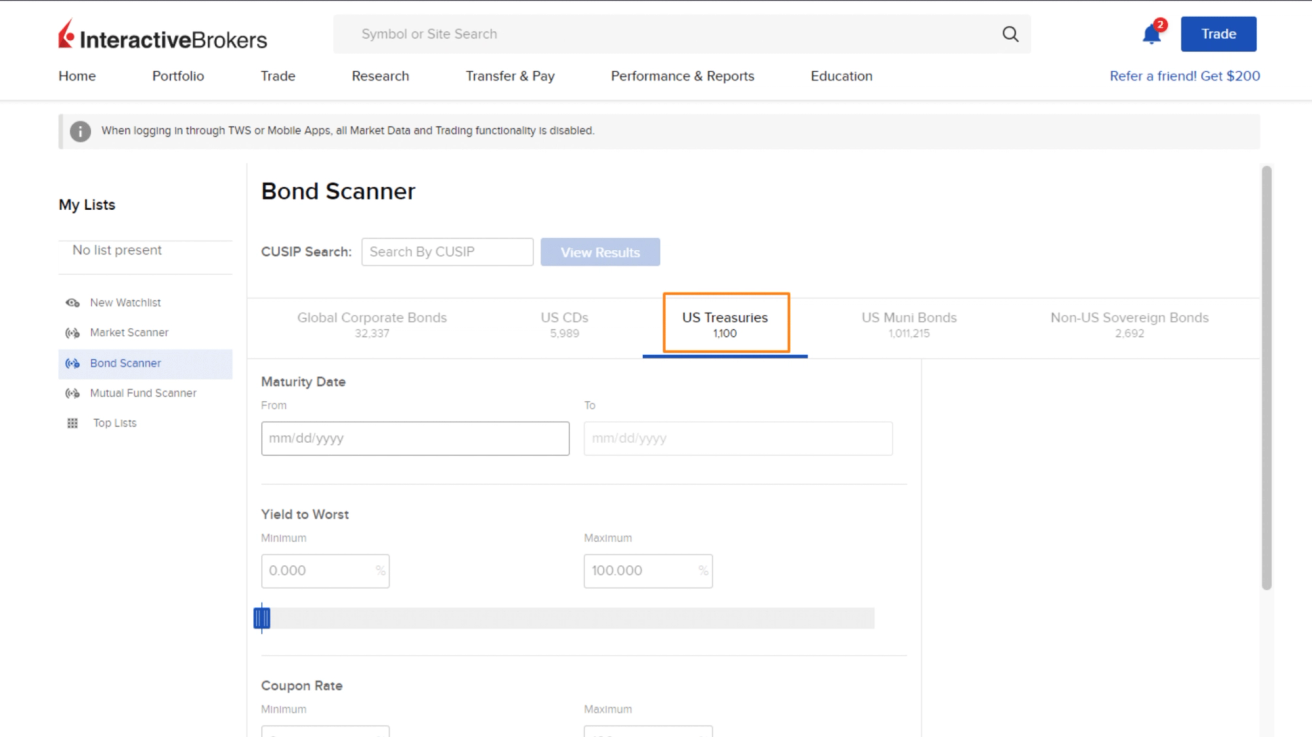
IBKR web app options
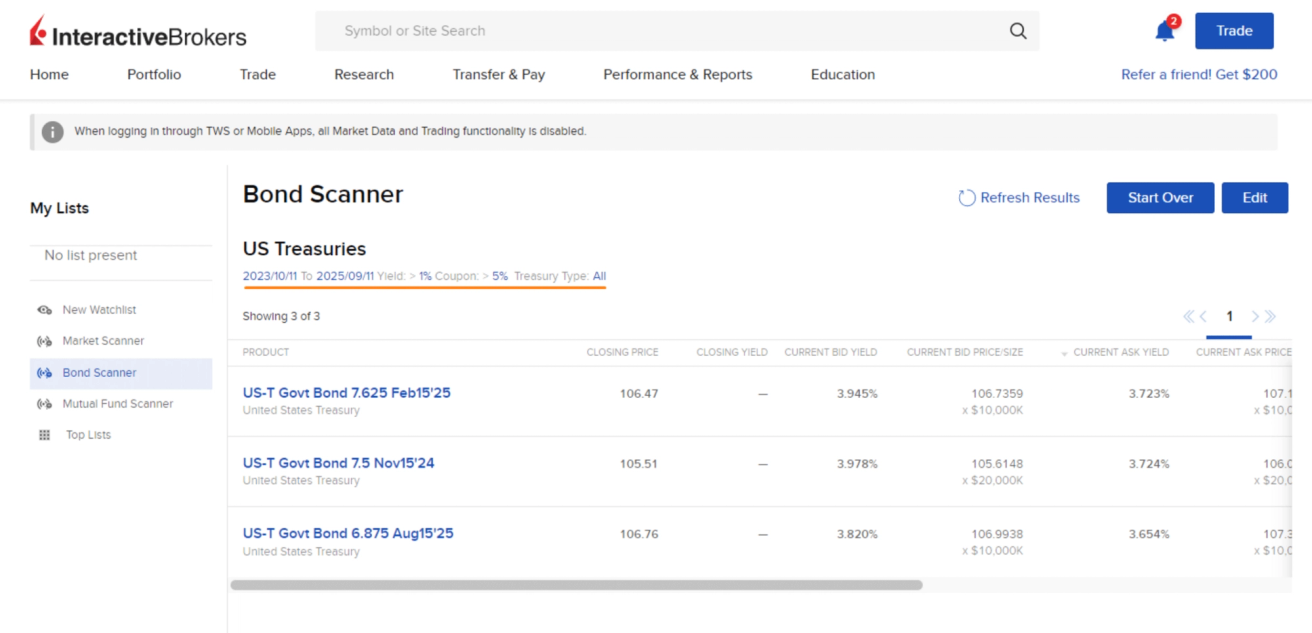
US Treasuries on IBKR
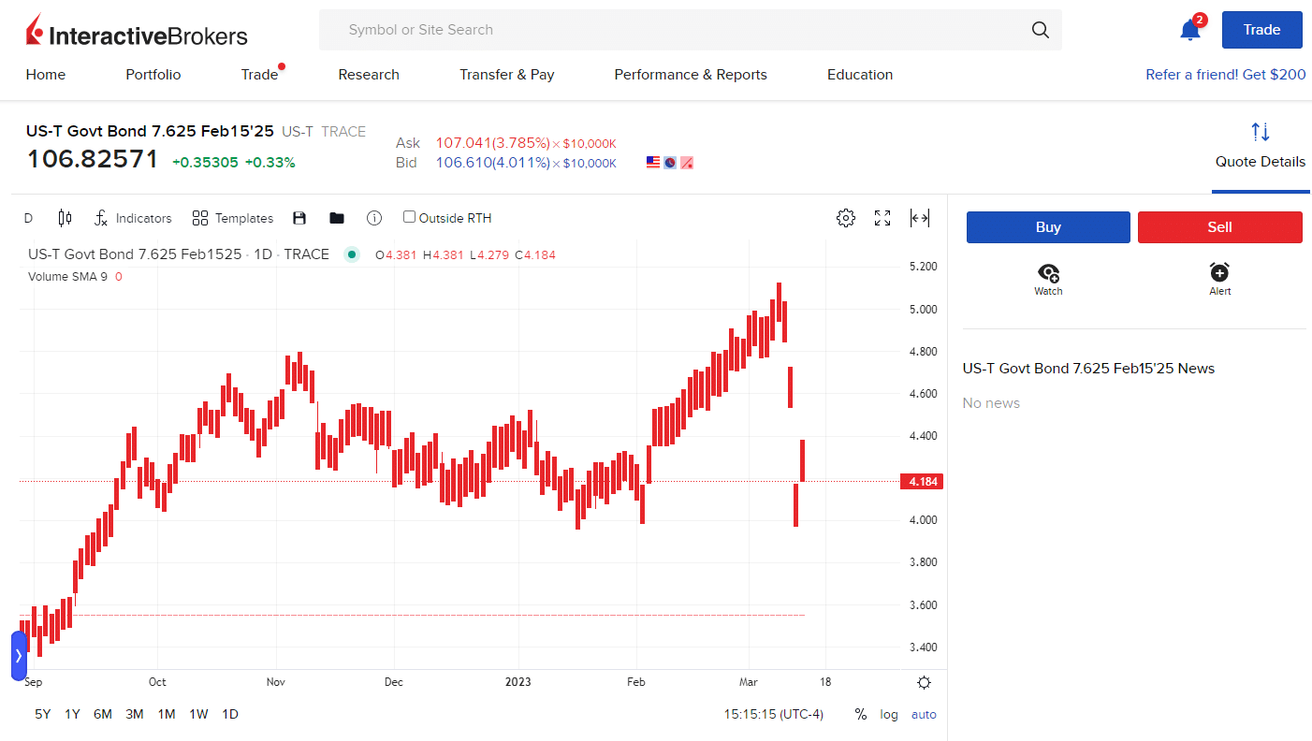
IBKR bond trade
Option 2: buy an ASX-listed Treasury bond ETF
When choosing a government bond ETF, two figures matter most. Yield to maturity is the expected return if the bonds are held to maturity. Duration tells you how sensitive the fund is to interest rates: a duration of 6 means that, roughly, a 1% rise in rates cuts the price by about 6%.
The main ASX-listed option is the Global X US Treasury Bond (Currency Hedged) ETF (ASX: USTB):
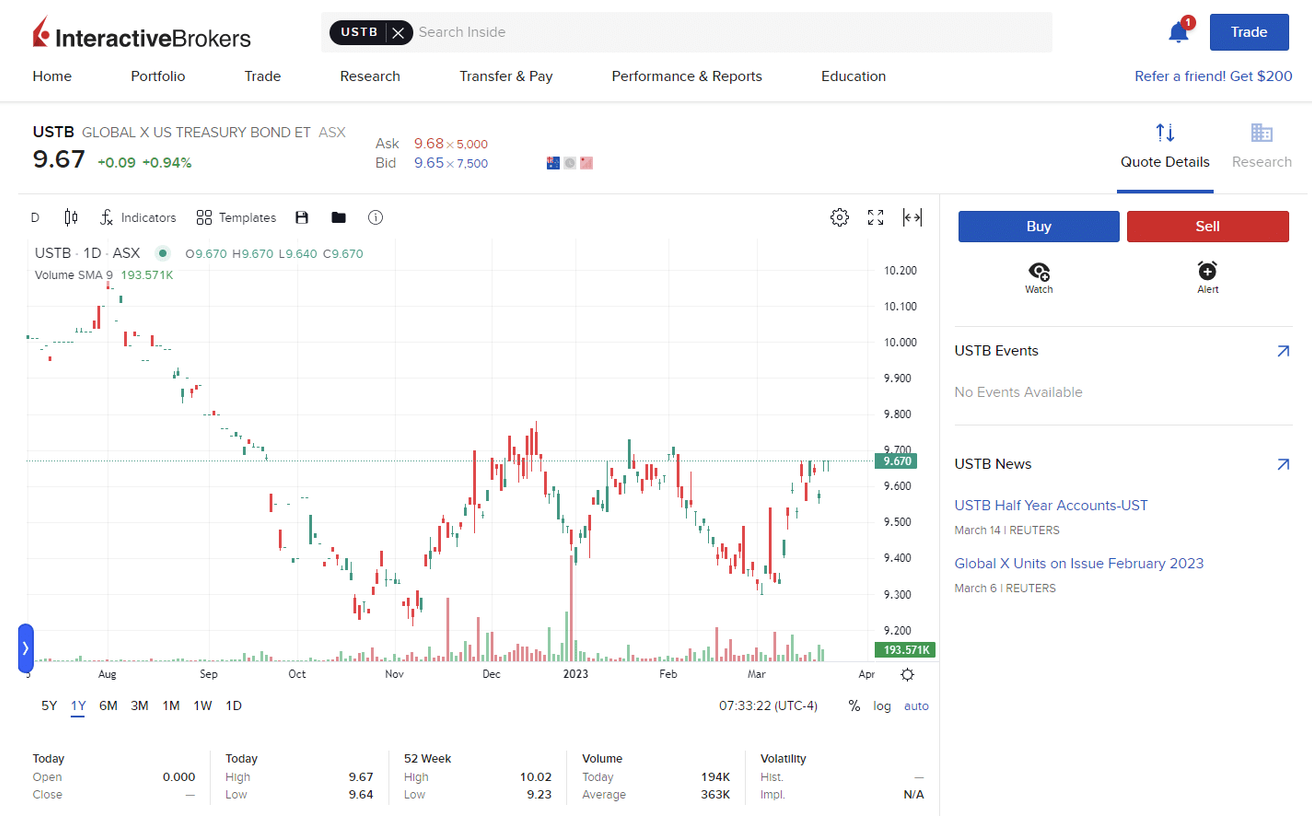
US Treasury Bond ETF (ASX: USTB)
USTB gives Australian investors exposure to US Treasuries across the whole yield curve, from 1 to 30 year maturities, hedged back to Australian dollars so your return isn’t affected by the AUD/USD rate.
As of 7 October 2026, USTB had a yield to maturity of 5.07% and a modified duration of 5.57, so a 1% rise in US rates would cut its price by roughly 5.6%. Keep in mind that the yield of a hedged fund also reflects the cost or benefit of the currency hedge.
| Feature | USTB |
| Management fee and costs | 0.19% a year |
| Benchmark | iBoxx $ Treasuries Index (AUD Hedged) |
| Yield to maturity | 5.07% (7 October 2026) |
| Modified duration | 5.57 (7 October 2026) |
| Fund size | A$453 million (8 October 2026) |
| Distribution frequency | Quarterly |
| Currency hedged to AUD | Yes |
| Domicile | Australia |
| Legal form | Managed investment scheme |
| SMSF eligible | Yes |
| Inception | 1 July 2022 |
Source: Global X USTB fund page, checked on 12 October 2026.
Option 3: buy a US-listed Treasury ETF
This is the option most articles skip. Unlike European investors, who are blocked from US-listed ETFs by the PRIIPs rules, Australian investors can buy US-listed ETFs through a broker such as Interactive Brokers.
That opens up the largest and cheapest Treasury ETFs in the world, where you can pick the part of the curve you want: short-dated funds for stability, long-dated funds if you want more sensitivity to falling rates. Fees on the largest US Treasury ETFs are typically around 0.03% to 0.15% a year, below the ASX-listed alternatives.
The trade-offs:
- Currency: US-listed funds are unhedged and priced in dollars, so your return depends on the AUD/USD rate as well as on the bonds. You also pay a conversion fee when moving between AUD and USD.
- US estate tax: US-domiciled assets, such as US-listed ETFs, can fall under US estate tax for non-residents above USD 60,000, although the Australia-US estate tax treaty can reduce the bill. US Treasury bonds held directly are generally exempt for non-residents. Worth checking with an accountant if you plan to hold a large position.
- Paperwork: you need a W-8BEN form on file with your broker, which is normally part of the account opening process.
- Costs: at Interactive Brokers, AUD to USD conversion costs 0.002% (minimum USD 2), so currency costs are small compared with most brokers.
How US Treasury income is taxed in Australia
Tax is where many guides stop short, so here is the general picture. This is not tax advice, and an accountant is worth the fee if you are investing a meaningful amount.
- Interest from Treasuries is generally assessable income in Australia, taxed at your marginal rate in the year you receive it.
- US withholding tax generally does not apply to Treasury interest paid to foreign investors, provided your W-8BEN is on file. ETF distributions can be treated differently depending on where the fund is domiciled.
- Capital gains on selling bonds or ETF units are subject to capital gains tax. Units held for more than 12 months may qualify for the CGT discount, although the income component of a distribution does not.
- Currency movements on unhedged holdings can create a taxable gain or loss of their own, separate from the bond’s performance.
Pros and cons of investing in US Treasury bonds from Australia
Pros
- High credit quality: US Treasuries are backed by the US government and are treated as the global benchmark for creditworthiness.
- Liquidity: the US Treasury market is the deepest bond market in the world, so you can buy and sell easily at tight spreads.
- Predictable income: a bond held to maturity pays a known coupon and returns its face value, whatever happens to prices in between.
- Diversification: Treasuries often behave differently from shares, which can smooth a portfolio's returns.
Cons
- Interest rate risk: when rates rise, bond prices fall, and the longer the maturity the sharper the fall.
- Inflation risk: a fixed coupon can lose purchasing power if inflation runs higher than the yield.
- Currency risk: unhedged USD exposure means the AUD/USD rate affects your return, and hedging has its own cost.
- Lower long-run returns: over long periods, bonds have historically returned less than shares.
- Complexity: bond pricing moves inversely to interest rates, and most brokers require you to request trading permission before you can buy individual bonds.
Conclusion
Investing in US Treasury bonds from Australia is straightforward once you know the routes available. Through a broker like Interactive Brokers you can buy Treasuries directly on the secondary market, which suits you if you want a known payout at a known date.
If you prefer to keep it simple, an ETF does the work for you. USTB gives you AUD-hedged exposure across the curve on the ASX, while US-listed Treasury ETFs are cheaper and let you target a specific maturity range, at the cost of currency exposure.
Whichever route you choose, check the yield to maturity and the duration before buying, and be clear about whether you want the currency exposure hedged. Those two decisions will drive most of your result.
Risk disclaimer: When investing, your capital is at risk and you may get back less than invested. Past performance doesn’t guarantee future results. This article is for information only and is not investment or tax advice.