Tesla, known globally for its iconic electric vehicles, remains among the ten largest companies in the world by market capitalisation – with a market cap of approximately $1.5 trillion as of mid-2026, making it the world’s largest automaker by far (more valuable than the next 15 automakers combined). Tesla’s story has evolved significantly: while the automotive segment still represents the bulk of revenue, Tesla’s energy generation and storage business has emerged as the fastest-growing segment, while investor enthusiasm increasingly focuses on Tesla’s AI, robotaxi, and humanoid robot (Optimus) ambitions alongside its core EV business.
In this article, we’ll share tips for choosing a stockbroker to buy Tesla stock from South Africa, provide a step-by-step guide to making your first purchase, highlight exchange-traded funds (ETFs) with high exposure to Tesla, and explore Tesla’s reporting structure, business segments, and the South Africa-specific tax and regulatory considerations that affect Tesla investments from South Africa.
How to buy Tesla stock (step-by-step guide)
1. Choose a good stock broker
Since Tesla is one of the ten largest companies in the world, you can choose from a wide range of brokers to make the purchase. That said, you need to ensure the broker (i) works with South African residents and (ii) provides reasonable fees for the size of your investment. Below, we highlight four low-cost brokers that work with South Africans and are suitable for beginner to intermediate investors:
| Broker | Stock commission (US) | Minimum deposit | Regulators | ZAR base currency | FX conversion fees |
| Interactive Brokers | Tiered pricing from $0.0035 per share, $1.00 minimum | $0 | SEC, FINRA, SIPC, CFTC, FCA, CBI, ASIC, SFC, MAS, CIRO | No | 0.20 bps, $2.00 minimum (industry-low) |
| XTB | 0% commission up to €100k monthly turnover (then 0.2%, €10 min) | €/$/£1 | FCA, KNF, CySEC, DFSA, FSC (Belize) | No | 0.5% |
| IG | $0.02 per US CFD share, $15.00 minimum | $0 | FSCA (South Africa), FCA (UK), ASIC, NFA, MAS, FINMA, FMA | Yes | 0.5% |
| Pepperstone | $0.02 per US CFD share | $0 | FSCA (South Africa), ASIC, FCA, BaFin, CySEC, DFSA, SCB, CMA Kenya | No | Markup embedded in spread (not separately disclosed) |
As you can see from the table above, IG is the only broker offering the South African rand (ZAR) as a base currency, while the other brokers require funding in USD or another base currency. Either way, your Tesla trades will be executed in USD, meaning you’ll incur ZAR-to-USD conversion costs at some point – either upon funding your account or upon trade execution. Given persistent rand volatility, currency conversion costs are a meaningful consideration for South African Tesla investors over multi-year holding periods.
Two important regulatory and tax considerations for South African residents:
- FSCA-regulated vs offshore brokers: IG (South Africa) and Pepperstone Financial Services (Pty) Ltd hold direct FSCA authorisation in South Africa – subject to local FAIS Act compliance and South African client protections. International brokers like IBKR and XTB serve South African residents under their international entities without FSCA registration, which means client funds are held under foreign regulatory frameworks rather than South African ones.
- Annual foreign investment limits: South African residents can move up to R1 million per calendar year abroad under the Single Discretionary Allowance (SDA) without prior SARS clearance, and an additional R10 million per year under the Foreign Investment Allowance (FIA) with a SARS Tax Compliance Status (TCS) PIN. Worth keeping in mind for larger Tesla positions.
You can learn more about individual broker specifics in our dedicated article on the best trading platforms in South Africa.
2. Open and fund your account
Once you’ve weighed the pros and cons of each broker, you’re ready to open an account. The process is fully digital and typically completes within a few business days as the broker verifies your identity (you’ll need your South African ID document, proof of address, and proof of bank account, plus your SARS tax number for tax reporting purposes). Once approved, you fund the account via international bank transfer from your South African bank – converting ZAR to USD (or your chosen base currency) along the way. Remember the SDA (R1M/year) and FIA (R10M/year with TCS PIN) limits when planning the funding amount.
3. Place a buy order
Once you’ve opened an account and funded it, you’re ready to buy Tesla stock. Search for Tesla (ticker: TSLA) within your broker’s platform and place a buy order. For this example, we’ll use the mobile version of Interactive Brokers GlobalTrader:
a) Search for Tesla stock ( or the ticker “TSLA”) and select it from the list:

b) Click “Buy”:

c) Choose the order details. Now, it’s time to choose how to invest:

The three most important order parameters to set:
- Order type: by default, IBKR sets your order type to Limit – letting you set a maximum price you’re willing to pay per share. Other options include Market (buys immediately at the best available price) and Stop (triggers a market order once a specified stop price is reached).
- Limit price: if using a Limit order, set the maximum price you’re willing to pay per share. Market orders skip this; Stop orders use a Stop price instead.
- Quantity: the number of shares (or dollar amount, since IBKR supports fractional shares from $1).
IBKR GlobalTrader also lets you set two secondary parameters:
- TIF (Time in Force): defaults to Day (cancelled if not executed by end of day). The alternative is Good ‘Til Cancel (active for up to 90 days or until manually cancelled).
- Market Hours: defaults to Extended (regular hours + pre/post-market). For liquidity reasons, most retail investors should set this to Regular (regular trading hours only), where spreads are tightest. The Overnight option lets your order participate only after regular hours.
d) Preview the order: Finally, it is a good idea to click Preview and double-check everything is in order. A new window will appear:

e) Place the order: Once you have double-checked the order parameters, you may close the preview window (tap anywhere outside it, or click Cancel) and drag Slide to Buy to the right to finish the process.
ETFs – an alternative way to gain Tesla exposure
ETFs let you gain exposure to dozens or even hundreds of companies through a single investment. ETFs can be a good option if you:
- Want to complement your Tesla position with similar companies in the same sector;
- Want to limit portfolio volatility (ETFs spread your investment across many companies, reducing exposure to single-stock risks like Tesla’s well-known price swings);
- Are interested in following a specific theme (technology, EVs, AI, consumer discretionary, etc.);
- Want to avoid the SDA/FIA limits being consumed by a single concentrated Tesla position – ETFs let you allocate the same offshore investment more broadly.
Some ETFs with meaningful Tesla exposure worth considering:
- Consumer Discretionary Select Sector SPDR Fund (XLY): tracks ~50 stocks in the US Consumer Discretionary sector, heavily weighted to large-cap companies. The ETF distributes dividends, with an expense ratio of 0.09%. Tesla is one of the largest holdings (typically 15-20%), alongside Amazon, Home Depot, McDonald’s, and others. This gives meaningful Tesla exposure with sector diversification.
- Invesco QQQ Trust (QQQ): tracks the Nasdaq-100 Index, the 100 largest non-financial companies on the NASDAQ. The ETF distributes dividends, with an expense ratio of 0.20%. Tesla typically sits in the top 10 holdings (around 2-3% weight), alongside heavyweights like NVIDIA, Apple, Microsoft, Alphabet, Amazon, Meta, and Broadcom. A solid choice if you want Tesla exposure combined with broader US tech exposure.
- Global X Autonomous & Electric Vehicles ETF (DRIV): tracks ~75 companies positioned to benefit from EV and autonomous vehicle adoption. The ETF distributes dividends, with an expense ratio of 0.68%. Tesla is typically a top holding (around 3-5%), alongside NVIDIA, Alphabet, Microsoft, Honeywell, Qualcomm, and various automakers. A thematic option for investors specifically bullish on the broader EV/AV trend rather than Tesla alone.
- ARK Innovation ETF (ARKK): Cathie Wood’s flagship active ETF focused on disruptive innovation. Tesla has historically been one of the largest ARKK holdings (often 5-10%), alongside other growth-oriented tech names. Expense ratio is 0.75% – higher than passive ETFs, but reflects active management. Suits investors who want concentrated thematic exposure to disruptive tech.
Important PRIIPs note for South African investors: while these US-listed ETFs are technically accessible to South African residents through international brokers (IBKR, eToro, etc.) – South Africa doesn’t apply the EU’s PRIIPs retail restrictions – South African investors may still prefer Irish-domiciled UCITS alternatives where available (such as iShares Nasdaq 100 UCITS ETF or similar) for tax-efficiency reasons. US-listed ETFs are subject to 15% US dividend withholding tax (under the South Africa-US tax treaty, if you complete a W-8BEN form) and US estate tax exposure above the $60,000 non-resident threshold.
Tesla’s financials and performance
Once you’ve purchased Tesla shares, it’s worth keeping track of how the company and its competitors are performing. This gives you better insight into whether to add to your position, hold, or sell to pursue other opportunities. Tesla is a particularly volatile stock with significant revenue concentration in the automotive segment plus growing exposure to AI, robotics, and energy storage – so understanding the underlying business performance helps separate signal from short-term price noise.
Key sources for tracking Tesla’s financial performance:
- Tesla Investor Relations: the official source for quarterly reports, earnings calls, and investor presentations, available here.
- Koyfin: a specialised financial data platform giving you access to company overviews, key statistics, financials, earnings transcripts, segment data, peer comparisons, and more. Get a 20% discount on Koyfin through our partner link.
- Earnings calendar: Tesla typically reports earnings in late January (Q4), late April (Q1), late July (Q2), and late October (Q3) – mark these dates as they’re typically when the stock moves most.
For example, Koyfin lets you quickly visualise how Tesla’s revenue and margins (gross profit, operating margin) are evolving over time – particularly useful for understanding the relative contribution of automotive, energy generation/storage, and services segments to overall performance:
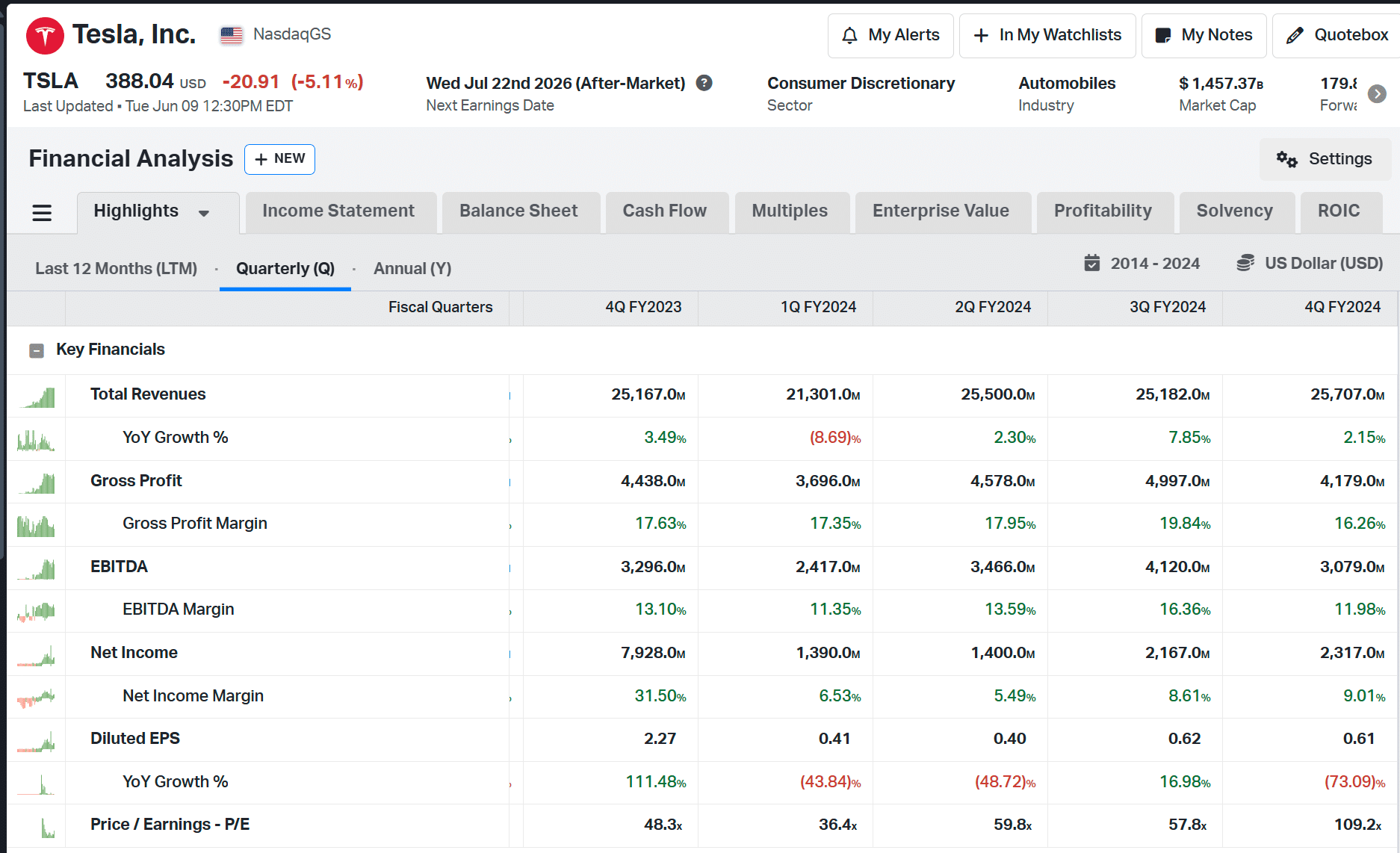
While these platforms can’t fully replace your own due diligence, they’re useful tools in the research process – saving you time, providing structured peer comparisons, and surfacing new investment ideas. For Tesla specifically, paying attention to delivery numbers (quarterly), energy storage deployments, AI/robotaxi milestones, and capital expenditure trends is particularly important given the stock’s heavy reliance on forward-looking narratives.
Tesla company overview
The primary source for up-to-date information on Tesla is its Investor Relations section. Below is a current overview of Tesla’s operations and financials based on the company’s most recent reporting.
In 2017, Tesla changed its name from “Tesla Motors” to simply “Tesla” to reflect its expansion beyond automotive manufacturing. Tesla now reports revenue across three main business segments:
- Automotive: approximately 75% of total revenue.
- Energy Generation and Storage: approximately 12% of total revenue and growing rapidly.
- Services and Other: approximately 12% of total revenue.
Automotive segment
The automotive segment includes revenue from vehicle sales (Model 3, Model Y, Model S, Model X, Cybertruck), regulatory credits, and vehicle leasing. As of recent quarterly reporting, automotive revenue grew modestly year-over-year, while automotive regulatory credit revenue has fallen sharply (down ~44% year-over-year in recent quarters) as US EV credit policy has shifted. Automotive gross margins have compressed (around 17% in recent quarters, down from over 20% a year earlier), reflecting pricing pressures, mix effects, and tariff impacts – partially offset by lower raw material costs.
Energy Generation and Storage segment
This division includes the Powerwall (residential battery storage), Megapack (utility-scale battery storage), and solar energy products. Energy revenue has been growing rapidly – up around 44% year-over-year in recent quarters – reaching $3.4 billion+ per quarter. Gross margins of around 31% (and rising) make this Tesla’s most profitable segment. The Megapack business in particular has emerged as a major growth driver as grid-scale storage demand accelerates globally.
Services and Other segment
This segment covers used vehicle sales, Supercharging fees, vehicle insurance, maintenance and repair services, and various other revenue streams. Recent reporting shows revenue growth of around 25% year-over-year (reaching $3.4 billion+ per quarter), driven by used vehicle sales, paid Supercharging sessions opened to third-party EVs (Ford, GM, Rivian, and others), maintenance and repair activity, and insurance growth.
AI, robotics, and autonomy
Tesla continues to invest heavily in AI and autonomy, including Full Self-Driving (FSD), custom compute infrastructure (Dojo), Robotaxi, and Optimus (humanoid robot). Recent reporting confirms first-generation Optimus production lines being installed for higher-volume production, alongside elevated R&D spending tied to AI and other technology programmes. Robotaxi expansion (initially launched in Austin in 2025) continues to be a major investor narrative driver. These initiatives don’t yet generate meaningful revenue but underpin much of Tesla’s premium valuation.
Financial position
Tesla maintains a strong balance sheet, reporting $41+ billion in cash, cash equivalents, and investments as of recent quarters. The company has been generating substantial operating cash flow ($6+ billion per quarter) and free cash flow ($4+ billion per quarter), giving it significant financial flexibility to fund AI and automation investments without external capital needs.
Stock volatility and investor considerations
Tesla’s stock remains notably volatile, with investors weighing strong growth in energy storage and services against tighter automotive margins, declining regulatory credit revenue, and rising costs tied to AI/R&D investments and tariff impacts. The stock’s premium valuation (PE ratio frequently above 100x) reflects investor enthusiasm for the AI/robotaxi/Optimus optionality rather than current automotive fundamentals alone. For South African investors with rand exposure, Tesla also adds USD currency risk on top of the inherent stock volatility – meaning the ZAR-denominated return on a Tesla position depends on both the share price and the ZAR/USD exchange rate over your holding period.
The bottom line
To sum it up, here’s what South African investors need to do to buy Tesla stock in 2026:
- Find a suitable stockbroker: ensure the broker works with South African residents. Compare fees, FX conversion costs, available markets, and regulatory protection. For South African residents specifically, FSCA-regulated options (IG South Africa, Pepperstone) offer local regulatory protection, while international brokers (IBKR, XTB) offer broader market access and typically lower FX costs.
- Open an account and fund it: complete the account opening process (typically a few business days), have your South African ID, proof of address, proof of bank account, and SARS tax number ready. Fund via international bank transfer from your South African bank, mindful of the SDA (R1M/year) and FIA (R10M/year with TCS PIN) offshore investment limits.
- Place your buy order: search for the TSLA ticker, choose between Market and Limit orders (Limit orders give you price control; Market orders execute immediately), and consider whether to buy whole shares or fractional shares (IBKR and several others support fractional shares from $1).
- Keep track of Tesla’s developments: Tesla stock is volatile and increasingly driven by AI, robotaxi, and Optimus narratives alongside automotive fundamentals. Platforms like Koyfin can help you stay on top of earnings, segment data, and competitor comparisons.
- Understand the South African tax framework: Tesla dividends are subject to 15% US withholding tax (with W-8BEN form), with additional South African tax obligations on dividend income and capital gains. Capital gains on offshore assets are subject to South African CGT (effectively ~18% for individuals via the inclusion rate). Always consult a qualified South African tax advisor for guidance specific to your situation.
We hope this guide has addressed your key questions about investing in Tesla from South Africa. Always do your own research to determine the best investment strategy for your specific situation – particularly given Tesla’s high volatility, the currency exposure inherent in offshore investing, and South Africa’s specific regulatory and tax framework.
Happy investing.
This article is for informational purposes only and does not constitute financial or investment advice. Investments can go down as well as up, particularly for volatile stocks like Tesla – past performance is not a reliable indicator of future returns. Always do your own research and consider consulting a qualified South African financial or tax advisor about your specific situation, particularly around offshore investment allowances, tax reporting obligations, and currency risk management.