South Africa is an upper-middle-income country, with its residents enjoying a growing level of disposable income. With money to spend, the question that naturally comes to mind is how to make the most of it. One easily accessible way to build and preserve wealth is through the stock market.
In this article, we’ll delve into ways for South Africans to pick stocks, how to buy shares on the international markets, gain exposure to the national stock market, the exchange control and tax rules you need to work within, tips for choosing a stock broker, opportunities for foreigners to gain exposure to South African shares, and more.
Before you start: allowances and tax
Two things shape how a South African should approach this, and both are worth settling before you choose a broker.
Exchange control limits how much you can send offshore. You cannot simply wire an unlimited amount to a foreign broker. South African residents over 18 have a Single Discretionary Allowance that can be used without prior approval, and a separate Foreign Capital Allowance that requires an Approval International Transfer tax compliance status from SARS. Your bank will handle the mechanics, but you need clearance before moving larger sums, and the process takes time. Check the current limits with SARB or your bank before committing to a plan, as they are periodically revised.
The Tax-Free Savings Account should usually come first. A TFSA lets your investments grow free of income tax, dividends tax and capital gains tax, and withdrawals are tax-free too. From 1 March 2026 the annual contribution limit rose to R46,000, up from R36,000, the first increase in five years. The lifetime limit remains R500,000.
Three rules catch people out:
- The annual limit applies per person, not per account. If you hold TFSAs with two providers, the R46,000 covers both combined.
- Exceeding the annual or lifetime limit attracts a 40% penalty on the excess, added to your normal tax assessment.
- Withdrawals do not restore contribution room. Money you take out and put back counts as a fresh contribution.
TFSAs are offered by South African providers such as banks, collective investment scheme managers and local investment platforms. A foreign broker cannot give you one. For most readers the sensible sequence is to use the TFSA allowance first through a local platform, then invest anything beyond that wherever suits you best.
Outside a TFSA, capital gains for individuals are taxed via an inclusion rate applied to your marginal rate, with an annual exclusion, and local dividends attract dividends tax. Confirm the current rates and thresholds with SARS or a tax practitioner, since these change at each Budget.
Choose a stock to buy
Since there are tens of thousands of public companies around the world, there is no silver bullet when it comes to choosing a stock to purchase. That said, companies are generally divided in two ways:
- Value stocks: these companies are usually attractively priced in terms of price-to-earnings or other ratios but face slower growth going forward;
- Growth stocks: these companies offer a higher long-term growth rate but are more expensive from a valuation perspective in the near term.
You can favour one type or diversify across both, with value companies in your portfolio to meet medium-term goals while growth companies work towards your long-term aspirations.
Resources you can use are:
- Stock screeners such as Finviz
- Company reports, filings and presentations
- Macroeconomic and industry publications
In any case, consider several companies, evaluate their performance relative to competitors, and try to pick the most attractively priced business.
Worth saying plainly: picking individual stocks well is hard, and most investors do better with a diversified fund. The ETF section below covers that route, and there is no shame in taking it.
How to buy shares on the international markets (Step-by-step guide)
1. Choose a good stock broker
Once you have chosen the stock you want to invest in, you need a broker where you can make the purchase, and it must accept residents of South Africa. Below we highlight Interactive Brokers, which is available to South Africans and offers the widest market access of the international options:
| Broker | Stock commission, US | Minimum Deposit | Regulators |
| Interactive Brokers | Tiered: USD 0.0035 per share (min. USD 0.35). Fixed: USD 0.005 per share (min. USD 1.00) | €/$/£0 | FINRA, SIPC, SEC, CFTC, CIRO, FCA, CBI, AFSL, SFC, SEBI, MAS, MNB |
A note on the two pricing plans: Tiered is cheaper for most retail-sized orders, while Fixed is simpler to predict. You choose when you open the account and can change it later.
Also weigh the currency conversion cost, not just the commission. If you are converting rand to dollars to buy, and back again when you sell, that conversion is often the larger expense on a modest trade. Interactive Brokers charges around 0.002% with a USD 2 minimum, which is among the lowest available.
2. Open and fund your account
Once you have weighed the pros and cons of each broker, you are set to open an account. The process usually takes a few days while the broker verifies your identity. After that, you deposit money into your account.
For South African residents there is an extra step here. Sending funds offshore has to happen within your allowances, and larger amounts need SARS clearance in advance. Speak to your bank before you plan the transfer rather than after you have opened the account.
3. Place a “Buy Order”
If you have found an online broker that suits your needs, opened an investment account, and made the initial deposit, you are set to buy your stock. Find the share within your chosen broker and place a buy order. For this example, we use Interactive Brokers.
1 – Click the Trade button in the top right corner:

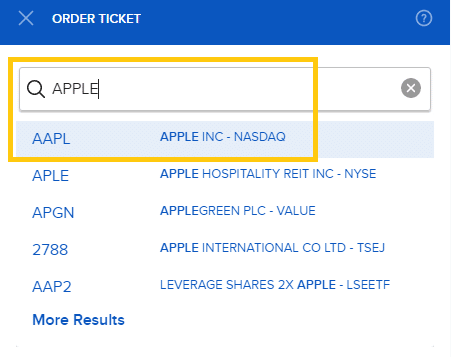
2 – Search for the chosen stock (we will use Apple, ticker “AAPL”):
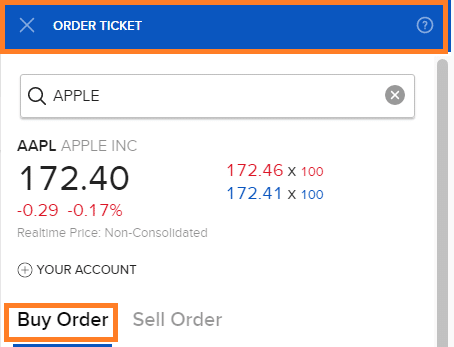
3 – Make sure the order ticket is set to “Buy Order” (blue at the top) rather than “Sell Order” (red at the top):
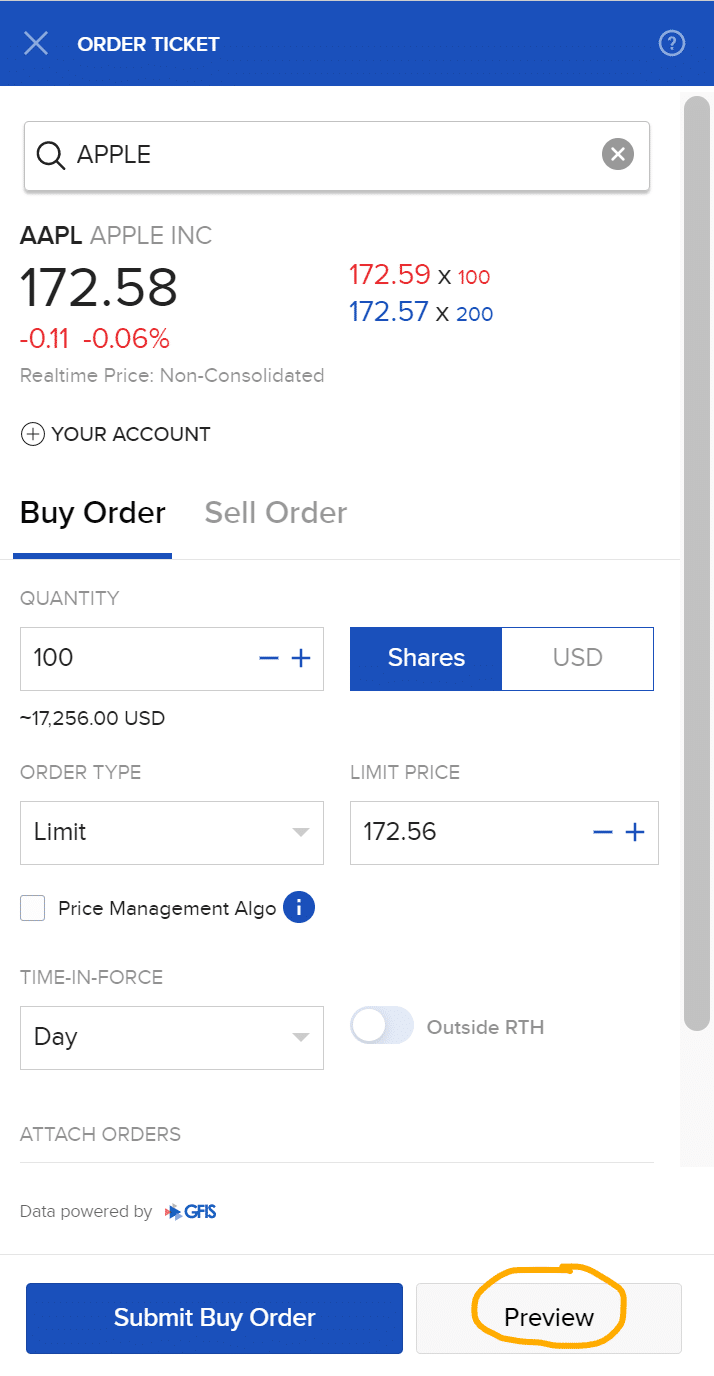
4 – Choose the order details. Now it’s time to fill in the boxes highlighted below:
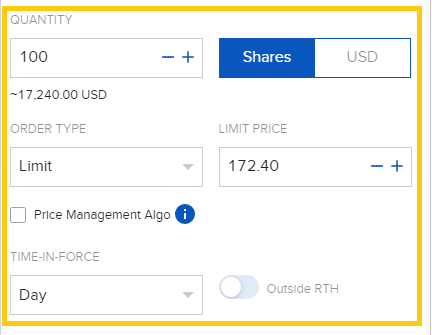
- Quantity: the number of shares you want to purchase. By default “Shares” is selected instead of “USD“. If you select “USD”, you enter a dollar amount and the system calculates how many shares that buys.
- Order Type: by default, Interactive Brokers sets your order type as Limit. This is useful because it lets you set a maximum price you are willing to pay. The most common alternative is a market order.
- Limit Price: if you keep “Limit” as the order type, set the maximum price you will pay per share. With a market order you leave this blank and buy at the best available ask price.
- Time-in-force is set to “Day” by default, meaning the order expires at the end of the trading day if it has not filled.
A practical note for South African investors: US markets open at 15:30 SAST and close at 22:00 SAST during northern hemisphere winter, shifting an hour when daylight saving applies. A market order placed outside those hours will not execute until the market opens, and the price may have moved by then. This is one reason limit orders are worth using.
5 – Preview the order: click “Preview” to double-check all order parameters (believe it or not, mixing up buy and sell orders is a mistake everyone can make):
6 – Send the order: after checking all parameters (if you made a mistake, click “Back”), select “Transmit Order”:

ETFs – an alternative way to gain exposure
ETFs, or exchange-traded funds, let you gain exposure to dozens or hundreds of companies with a single investment. ETFs can be a good option if you:
- Are unsure which specific stock to choose;
- Want to limit your portfolio volatility, since ETFs typically hold companies across several sectors affected by different factors, limiting your exposure to any single company;
- Are interested in following a specific theme (South African stocks, technology stocks, real estate stocks, and so on).
Some ETFs you may want to consider are:
- iShares MSCI South Africa ETF (ticker EZA), which holds around 40 South African companies. Fund size is roughly $400 million with an expense ratio of 0.59%.
- VanEck Africa Index ETF (AFK), which holds around 78 companies across Africa, with South Africa the largest single exposure, followed by countries such as Egypt, Morocco, Nigeria and Kenya. The expense ratio is around 0.76%.
Both are considerably more expensive than a broad developed-market ETF, which typically costs under 0.25%. That gap is the price of concentrated, single-region exposure, and it compounds against you over time.
If you are a South African resident, note that JSE-listed ETFs from local providers give you rand-denominated exposure without any currency conversion, and can be held inside a TFSA. Offshore-listed ETFs cannot.
You are free to choose from thousands of ETFs investing all around the world.
Buying shares on the Johannesburg Stock Exchange
The process of buying shares directly on the local market is very similar to the one outlined above for international securities. The exchange even has a section dedicated to beginners. You can find a list of members active on the exchange here, and all instruments available for trading here.
Alongside the traditional stockbrokers on that list, South Africa has low-cost online investment platforms aimed at retail investors, which offer fractional share investing, JSE-listed ETFs and TFSA accounts. For someone starting out with modest amounts, these are usually the more practical entry point than a full-service broker.
The main benefit of buying on the local market is that you avoid foreign exchange conversion costs, because JSE shares trade in rand. If you buy Apple stock through an offshore broker instead, you would have to:
- Sell ZAR and buy USD to open the trade;
- Sell USD and buy ZAR to close it.
So you incur two currency conversions. You also stay inside your exchange control allowances by investing locally, and JSE-listed instruments can sit inside a TFSA.
The downside of the local market is that you are limited to the instruments available there, many of which are closely tied to South Africa’s economic fortunes. If you want to diversify your wealth across the world, the options are to invest offshore, buy an export-oriented local company, or buy a JSE-listed ETF that tracks a global index, which gives you offshore exposure in rand without using your foreign allowance.
Accessing South African equities as a foreigner
If you are an investor outside South Africa and want exposure to the country’s growth potential, the most straightforward route is an ETF as described above. The downside is that country-specific ETFs carry higher expense ratios than broad developed-market funds, so you need to judge whether the excess return you expect will cover the higher cost.
If you want to buy a specific South African company, you have two options. Some international brokers, Interactive Brokers among them, offer direct access to the JSE, which is the simpler route. Otherwise you would need to open an account with a local exchange member. Either way you will incur currency conversion costs converting into rand and back again.
Additional resources
If you would like to learn more, explore our website and YouTube channel, where we cover the top brokers in various regions and offer step-by-step guides for investing on these platforms.
For further assistance, feel free to reach out to us or book a meeting with us directly.
Bottom line
To sum it up, here’s what you need to do:
- Use your tax-free allowance first. The TFSA lets R46,000 a year grow free of income tax, dividends tax and capital gains tax, up to R500,000 over your lifetime. It is available only through South African providers, and for most investors filling it is the highest-value step available.
- Choose a stock or fund to buy. If you want to invest outside South Africa, consider carefully which company or ETF to pick. A broad global ETF is a reasonable default if you would rather not pick individual companies.
- Find a suitable stock broker. For international markets, check the broker accepts South African residents, and compare currency conversion costs as well as commissions. For the JSE, use a local exchange member or one of the online investment platforms.
- Open an account and deposit money. If you are sending funds offshore, confirm your allowances and get SARS clearance where required before you transfer.
- Send a buy order to your broker. That is the easiest part. Once you have the account and know what you want to buy, you just place the trade.
We hope this post addressed some of your questions. Make sure to do your own research to find the best investing strategy for you.