Kenya has a young, growing population at the start of its wealth-building journey, and the stock market remains one of the more accessible routes to building and preserving capital over time.
In this article we cover how Kenyans can choose stocks, buy shares on international markets, gain exposure to the Nairobi Securities Exchange, and select a broker – along with how foreign investors can access Kenyan equities.
One point to establish upfront: brokers serving Kenyan residents fall into two categories. Locally licensed firms are authorised by the Capital Markets Authority (CMA) and can trade on the NSE. International brokers serve Kenyan clients from overseas entities, giving global market access but under foreign regulation. Both are legitimate routes, and which suits you depends on where you want to invest.
Choose a stock to buy
With tens of thousands of listed companies worldwide, there is no formula for picking one. Broadly, companies fall into two categories:
- Value stocks: attractively priced on measures such as price-to-earnings, but typically facing slower growth ahead;
- Growth stocks: offering higher long-term growth potential, but more expensively valued in the near term.
You can favour one or hold both, with value companies serving medium-term goals and growth companies longer-term ones.
Useful research resources:
- Stock screeners such as Finviz;
- Company reports, regulatory filings, and investor presentations;
- Macroeconomic and industry publications.
Compare several companies, assess each against its competitors, and consider valuation carefully before committing.
Worth adding a realistic note: picking individual stocks successfully is difficult, and the majority of professional fund managers underperform a simple index over long periods. If you are starting out, a diversified ETF is usually the more reliable foundation, with individual stocks as a smaller allocation alongside it.
How to buy shares on international markets (step-by-step guide)
1. Choose a broker
Once you have identified what you want to buy, you need a broker to execute the trade. Confirm the broker accepts Kenyan residents before going further – many do not. Below are two solid options available to Kenyans.
| Broker | US stock commission | Minimum deposit | Regulators |
| Interactive Brokers | From $0.0035 per share (minimum $0.35, capped at 1% of trade value) | $0 | SEC, FINRA, FCA, CBI, BaFin, ASIC, CIRO, MAS, SFC |
| Saxo | 0.03% to 0.08% of trade value (minimum $1), depending on account tier | $0 (Classic tier; may vary by country) | DFSA, FCA, MAS, FINMA, ASIC, SFC |
Note that Saxo also applies a custody fee of up to 0.15% per year on stock, ETF, and bond positions, avoidable by opting into securities lending. Verify current terms with each broker before opening an account.
2. Open and fund your account
Once you have weighed the options, you can open an account. Verification typically takes a few days. After approval, you fund the account – and note that converting Kenyan shillings to US dollars carries a cost that recurs on every deposit and withdrawal, so it is worth comparing conversion rates alongside trading commissions.
3. Place a buy order
With an account open and funded, search for the share and place your order. A limit order gives you price control that a market order does not, which matters particularly on less liquid stocks. Here is an example using Interactive Brokers:
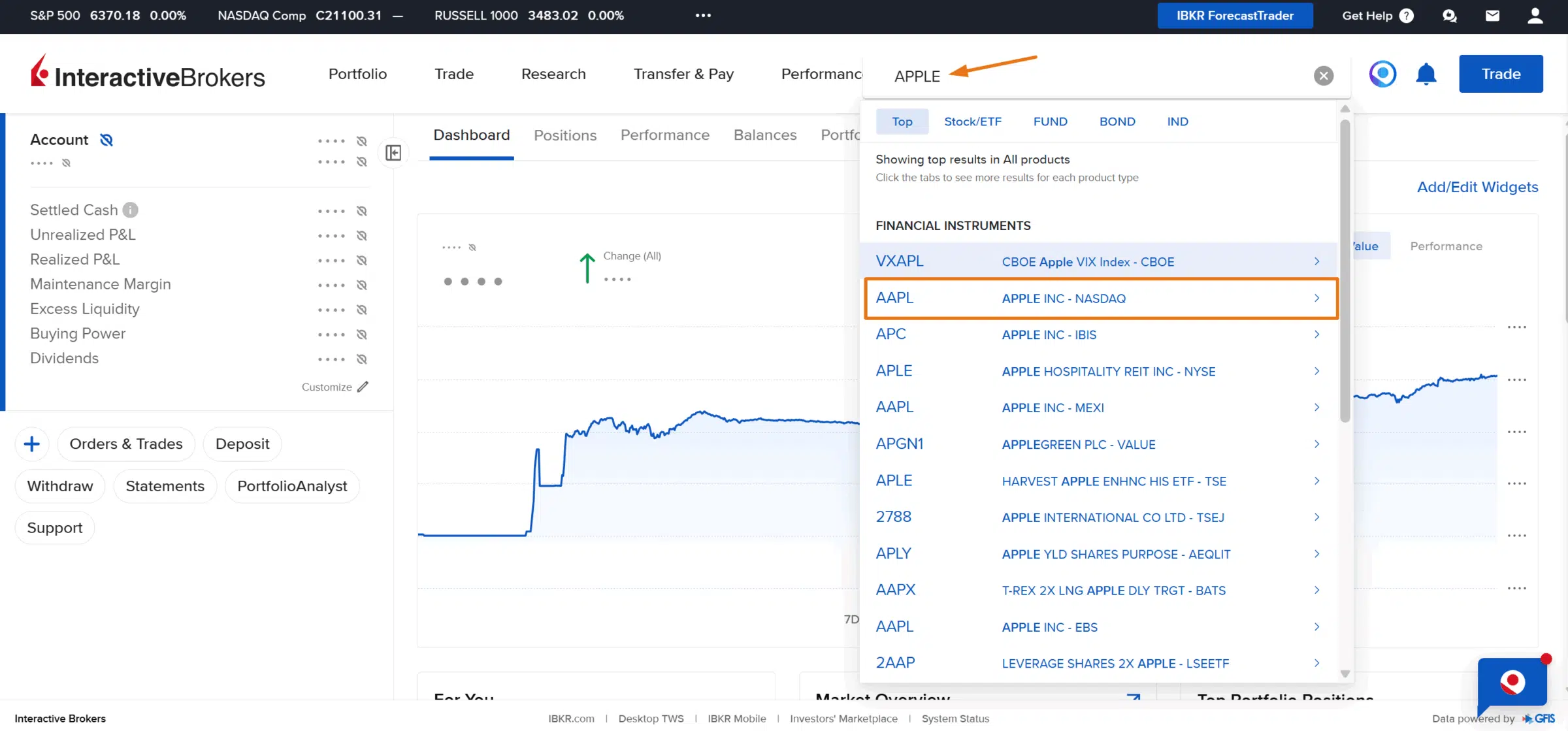
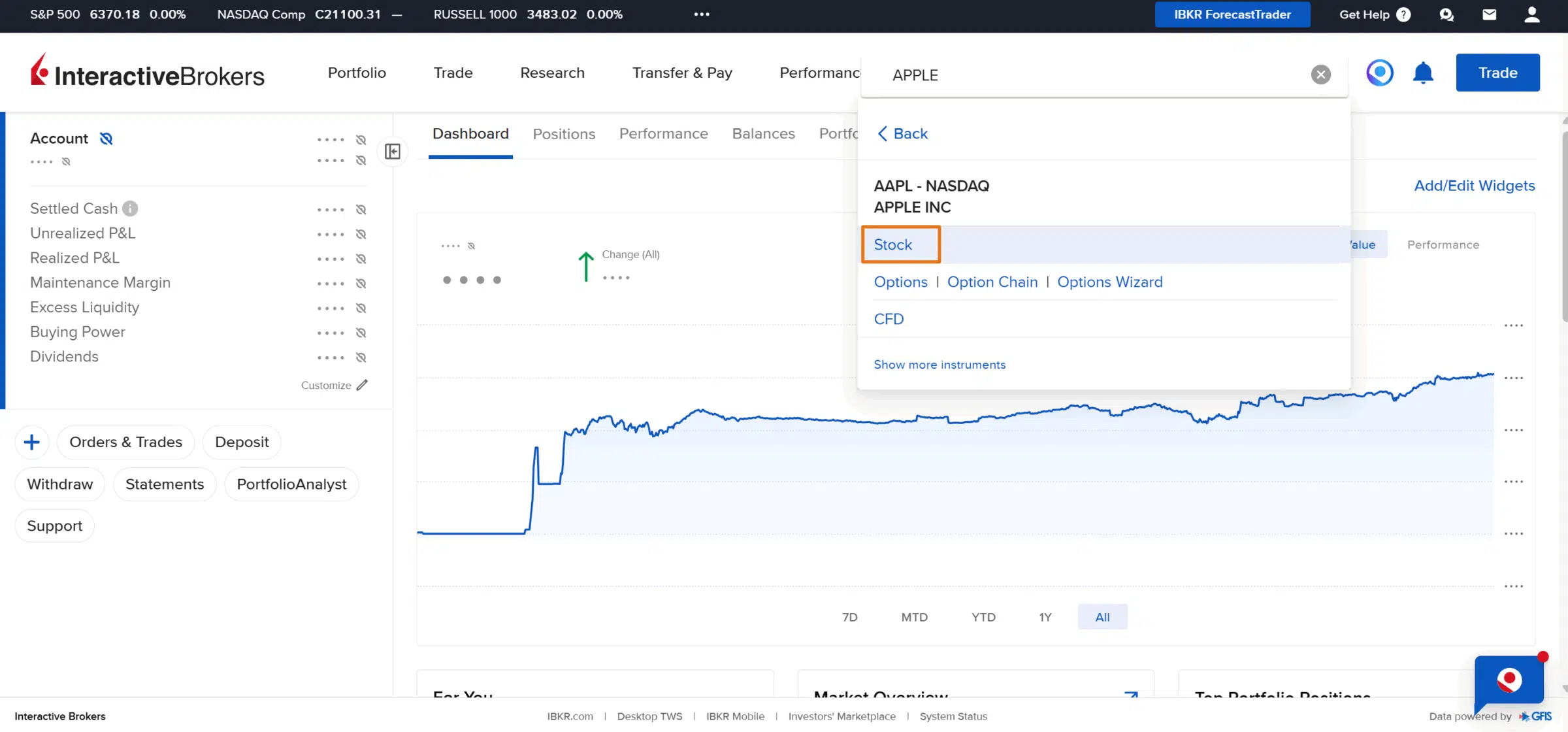
1 – Search for the chosen stock (we will use Apple, ticker “AAPL”):
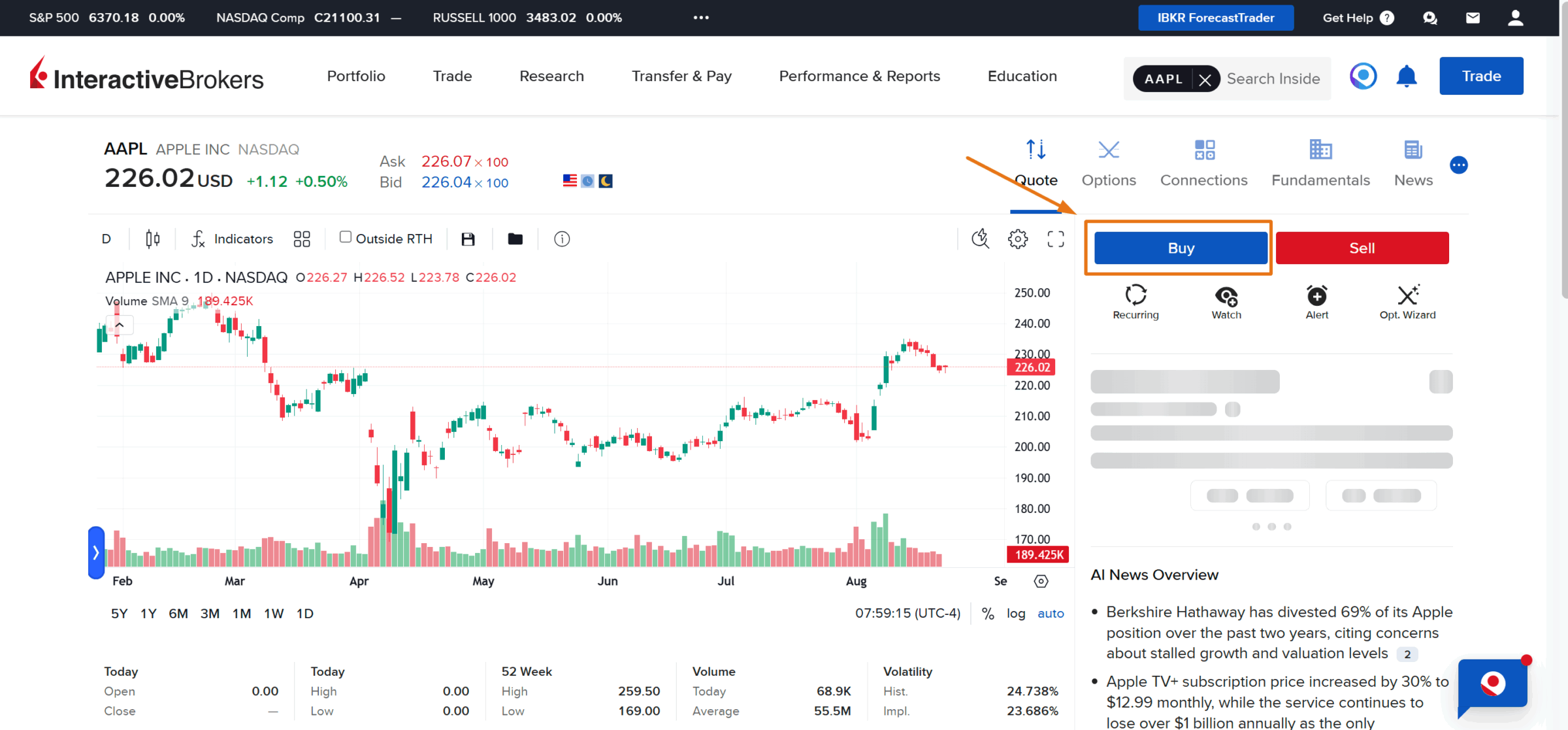
2 – Click “Buy”:
3 – Choose the order details. Now, it’s time to fill all boxes highlighted below:
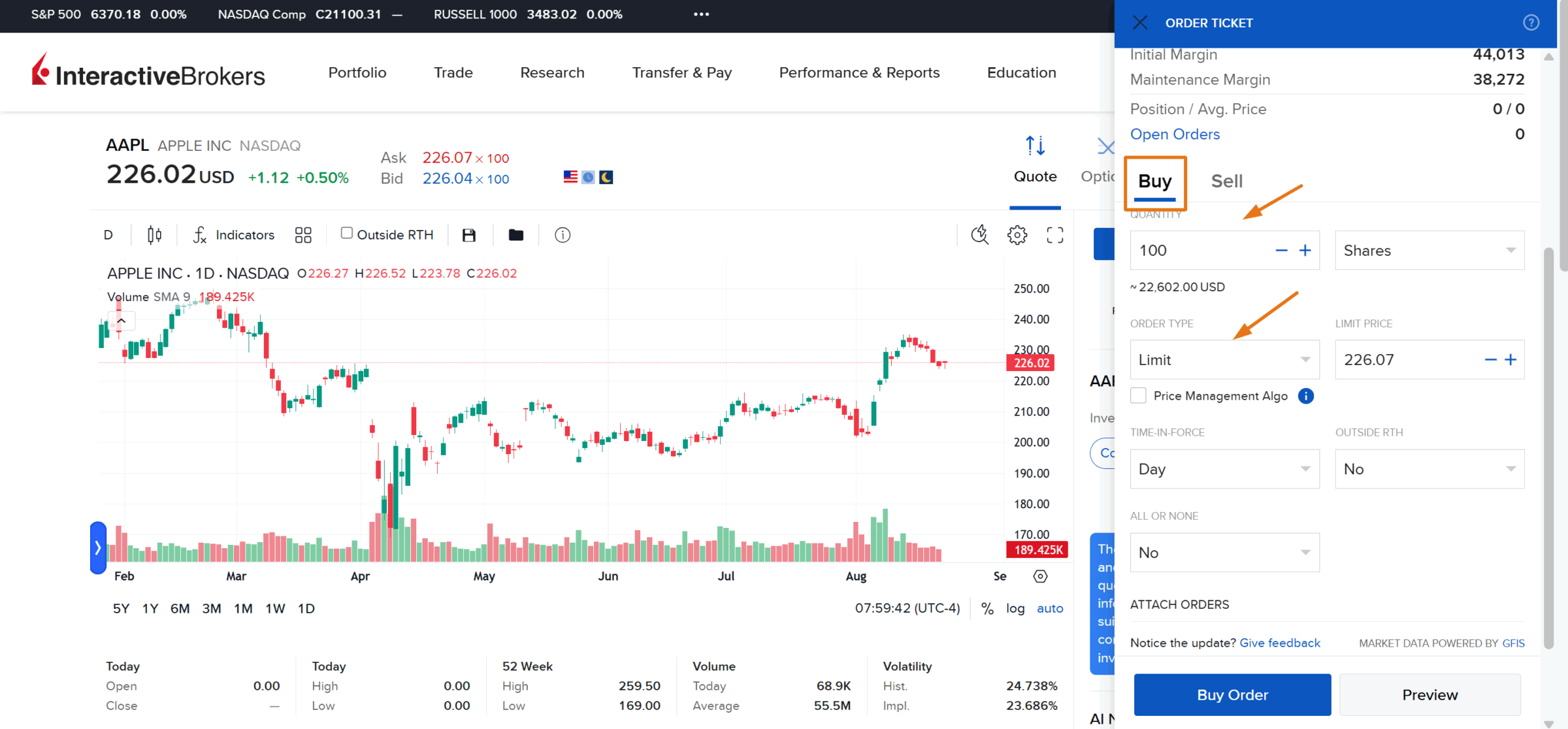
- QTY: Short for quantity. Here you define the number of shares you want to purchase;
- Type of order: By default, Interactive Brokers sets your order type as LMT, short for Limit Order. This is good since it allows you to set a maximum price at which you are willing to buy the shares. The alternative is MKT or market order.
- Limit Amount: Assuming you kept the “LMT” as the type of order, you need to set the maximum price you are willing to pay per share. If you use Market order, you do not need to fill this and will buy at the best available Ask price.
- Order duration is set to DAY by default.
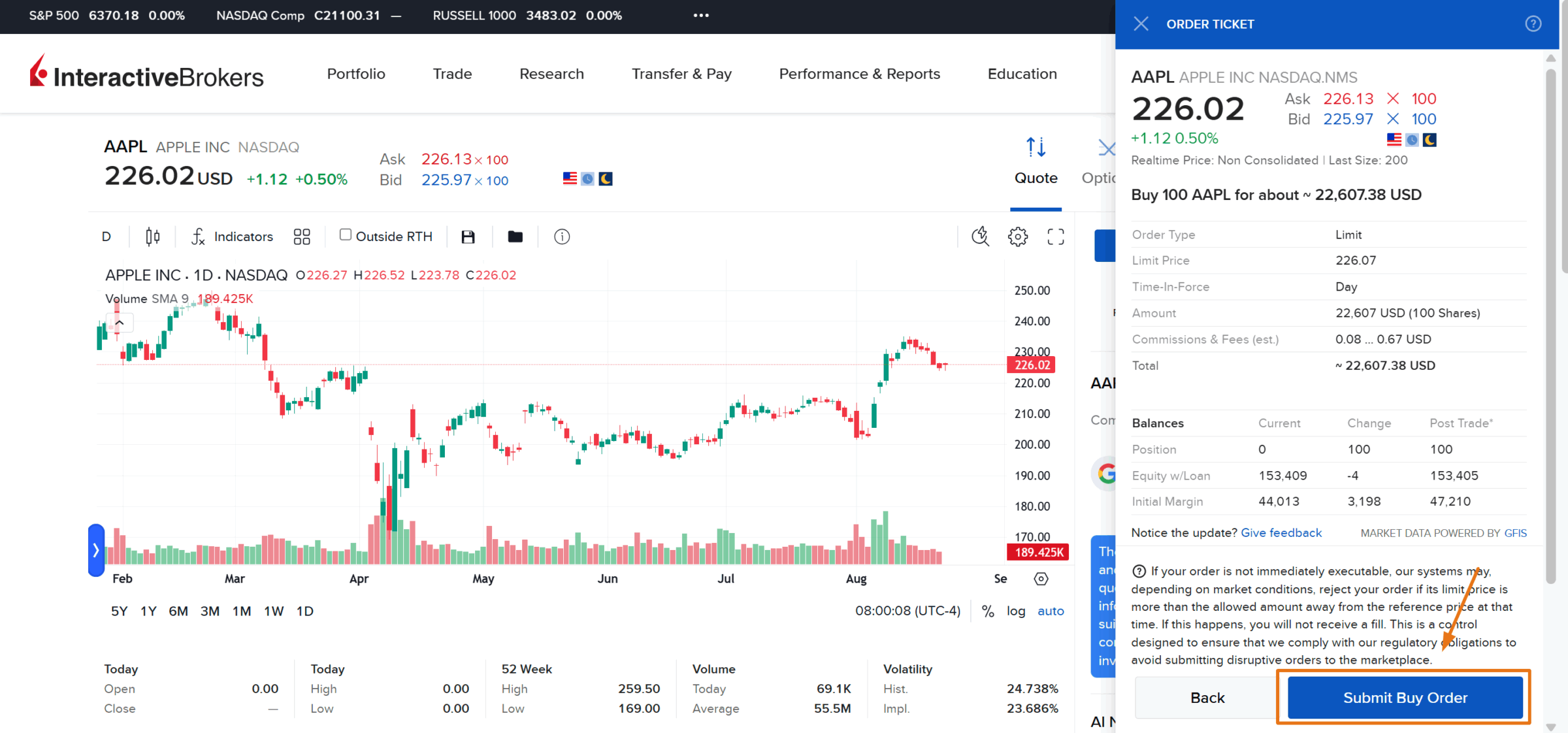
4 – Place the order:
Finally, click “Preview” and a new window will show up. Here, you can take a final look at all the details, including the commissions. Then “Submit Buy Order”:
ETFs: an alternative route to exposure
Exchange-traded funds give you exposure to dozens or hundreds of companies through a single holding. ETFs suit you if you:
- Are unsure which individual stock to choose;
- Want to reduce portfolio volatility, since ETFs spread risk across sectors affected by different factors;
- Want exposure to a specific theme – a region, sector, or strategy.
Options offering Kenyan exposure include:
- VanEck Africa Index ETF (AFK), holding around 80 companies primarily in South Africa, Morocco, and Nigeria, with a smaller Kenyan allocation;
- iShares MSCI Frontier and Select EM ETF (FM), holding over 350 companies primarily in Vietnam, Kazakhstan, Romania, and the Philippines, with a modest Kenyan weighting.
Note that both are US-domiciled, which has tax implications: US-listed ETFs are subject to 30% withholding tax on dividends for investors without a favourable treaty, and US-situs assets above $60,000 can fall within scope of US estate tax for non-resident aliens. Irish-domiciled UCITS equivalents often handle withholding more efficiently, so it is worth checking whether a UCITS version of the exposure you want exists.
Country allocations within these funds change with index rebalancing, so verify current weightings on the provider’s factsheet rather than relying on any published figure.
Buying stocks on the Nairobi Securities Exchange
Buying shares on the local market follows a similar process to international trading. A list of licensed trading participants is available here, all authorised by the Capital Markets Authority.
The NSE lists a relatively small number of companies, organised by sector here.
The main advantage of the local market is that you avoid currency conversion entirely, since NSE shares trade in Kenyan shillings. Buying Apple stock internationally requires:
- Selling shillings and buying dollars to open the position;
- Selling dollars and buying shillings to close it.
That means two conversion charges on a single round trip, which on smaller positions can outweigh the trading commission substantially.
Local trading also brings CMA regulatory protection and access to the Investor Compensation Fund, which international brokers serving Kenya from overseas do not provide.
The trade-off is concentration. The NSE offers a limited instrument range, much of it closely tied to Kenya’s economic performance. If your aim is diversifying across economies and currencies, international exposure or export-oriented Kenyan companies serve that better. In practice, holding both – local shares for shilling-denominated exposure and international ETFs for diversification – is a reasonable approach.
Accessing Kenyan equities as a foreign investor
If you are outside Kenya and want exposure to the country’s growth, an ETF is the most straightforward route, as covered above. The limitation is that no Kenya-specific ETF exists, leaving the pan-African VanEck Africa Index ETF (AFK) as the closest available option.
AFK carries a considerably higher expense ratio than developed-market ETFs, so consider whether the expected return justifies that cost over your holding period. Frontier market funds also tend to be less liquid, with wider bid-ask spreads adding to the real cost.
To buy a specific Kenyan company, you would need to work with one of the CMA-licensed brokers listed above, and would incur currency conversion costs. Some international brokers offer NSE access, though coverage varies – worth verifying directly rather than assuming.
Bottom line
To summarise the process:
- Choose what to buy: investing internationally means selecting from an enormous universe of companies and ETFs. The local market offers a much narrower choice, which makes the decision simpler but the diversification weaker;
- Find a suitable broker: for international markets, confirm the broker accepts Kenyan residents. For the NSE, use a CMA-licensed trading participant. Weigh fees, market access, and which regulator supervises your account;
- Open an account and deposit: complete verification and fund the account, factoring in conversion costs if investing in a foreign currency;
- Place your order: search for the company and place a trade, using a limit order where liquidity is thin.
Two points worth carrying forward. Currency conversion is a recurring cost that compounds against you when investing internationally from Kenya, so factor it in alongside commissions rather than treating it as incidental. And consider holding both local and international exposure – the NSE gives shilling-denominated assets without conversion cost, while international markets provide the diversification a single small economy cannot.
We hope this has been useful. Do your own research to identify the approach that fits your goals and time horizon.
If you are still unsure, feel free to reach out to us.