Not sure whether to choose Trading 212 or Trade Republic?
In this comparison, we look at how the two apps compare on fees, products, interest on cash, safety and features, so you can make a better-informed decision.
Below, you’ll find a comparison table, the pros and cons of each broker and answers to the most common questions.
Trading 212 vs Trade Republic
- Trading 212 is best for commission-free investing in stocks and ETFs (other fees may apply, see terms and fees), with a demo account and flexible Pies.
- Trade Republic is best for beginners and for savings plans in ETFs and stocks.
The two platforms are quite similar: both pay interest on uninvested cash, both are user-friendly and both offer a card. In our view, Trading 212 has a slight edge for one-off investments, while Trade Republic stands out for savings plans and for holding cash with a bank.
Trading 212 offers new users a free fractional share* with our promo code IITW, while Trade Republic holds a German banking licence, and cash is protected by deposit guarantee schemes up to €100,000.
Keep reading to learn more, and read our Trading 212 review.
*Sponsored Link. To get free fractional shares worth up to 100 EUR/GBP, you can open an account with Trading 212 through this link. Terms apply. When investing, your capital is at risk and you may get back less than invested. Past performance doesn’t guarantee future results.
Side-by-side comparison
| Category | Trading 212 | Trade Republic |
| Interest on EUR cash | 2.50% (4.2% promotional rate for new Trading 212 EU GmbH clients, for 4 months) | 2.50% (3.00% on up to €50,000 for new clients in several countries) |
| Interest on other currencies | USD: 3.30%, GBP: 3.80% | EUR only |
| Stocks and ETFs | €/£0 commission (other fees may apply) | €0 commission+ €1 external fee per trade (savings plans free) |
| Savings plans | €0 with Pies & AutoInvest | €0 |
| Currency conversion fee | 0.15% | No explicit fee (orders in EUR) |
| Demo account | Yes | No |
| Bonds | No | Yes |
| Card | 212 Card (not available with every entity) | Yes, with 1% Saveback |
| Clients | 5M+ funded accounts | 10M+ customers |
| Regulators | FCA, CySEC, BaFin, ASIC, FSC (Bulgaria) | BaFin and Deutsche Bundesbank |
Rates are variable and were checked in September 2026. The 4.2% promotional rate applies to new Trading 212 EU GmbH clients who deposit and opt in to interest within 10 days of opening an Invest account, after which the standard rate applies (promotion details). When investing, your capital is at risk. If you enable interest, Trading 212 will hold your cash in qualifying money market funds and banks. Otherwise, your cash will be held only in banks. Interest applies on cash in an investment account. Terms apply. The rates shown may no longer be current. Please refer to Trading 212’s Terms and Fees page for the live rates. 0,15% FX fee applies when converting funds. Other fees may apply.
Which is cheaper: Trading 212 or Trade Republic?
For most retail investors, Trading 212 costs less for one-off trades, while both are free for automated monthly investing.
Trading 212 charges no commission on stocks and ETFs (other fees may apply, see terms and fees). Trade Republic charges a €1 external fee on every single trade (except savings plans), so buying and selling costs at least €2.
For recurring investments, Trade Republic’s savings plans are free, with no €1 fee, on thousands of ETFs and stocks. Trading 212’s Pies & AutoInvest are also commission-free.
On currency conversion, Trading 212 charges a 0.15% FX fee when you buy assets in a currency other than your account currency. Trade Republic doesn’t charge an explicit FX fee, because its standard orders are executed in euros, but currency costs can be built into the price. Since July 2026, Trade Republic has also offered Direct Price orders on 30 venues worldwide (including Xetra, Euronext and Nasdaq), which cost €2 per order.
Practical example: an investor who buys and sells €500 of US stocks five times a month (10 orders, €5,000 in total) would pay about €7.50 a month in FX fees at Trading 212 (0.15% of €5,000), and €10 a month in external fees at Trade Republic (10 × €1). For someone investing €500 a month in a EUR-listed global ETF through a savings plan or AutoInvest, both brokers charge €0.
Verdict: if you place many individual orders, Trading 212 usually costs less. If you invest passively with monthly plans, both are essentially free.
How do Trading 212 and Trade Republic protect your money?
Both brokers are regulated by European authorities, but there is one important difference: Trade Republic has a full banking licence, while Trading 212 is regulated as an investment firm.
Trade Republic Bank GmbH is a German bank supervised by BaFin and the Deutsche Bundesbank. Cash is protected by deposit guarantee schemes up to €100,000 per client, as at a traditional bank. Securities are held separately, and if the bank failed and could not return them, the German investor compensation scheme would cover 90% of the loss, up to €20,000.
Trading 212 operates through several entities, depending on your country: Trading 212 UK Ltd (FCA), Trading 212 Markets Ltd (CySEC in Cyprus) and Trading 212 EU GmbH (BaFin in Germany), among others. Since September 2026, new clients in some countries, such as Portugal and the Netherlands, open their accounts with Trading 212 EU GmbH. Investor compensation depends on the entity: up to £85,000 under the UK FSCS and up to €20,000 under the Cyprus Investor Compensation Fund, for example. Cash is held in segregated client accounts at banks and, if you enable interest, partly in qualifying money market funds (QMMFs). QMMFs are investments, not bank deposits.
The practical difference: if you keep large cash balances at the broker, Trade Republic’s deposit guarantee is a clear advantage. For your investments, both brokers keep client assets separate from their own, and compensation schemes only cover the failure of the firm, not investment losses.
Read more in our articles on whether Trading 212 and Trade Republic are safe.
Which is better for ETF investing?
For long-term, buy-and-hold ETF investors, both brokers work well, but they suit slightly different styles.
Trade Republic is built around savings plans. You can invest automatically in thousands of ETFs and stocks, from €1 per execution, with fractional shares and no execution fee. Popular UCITS ETFs such as VWCE, IWDA and SXR8 are available, and you can choose weekly, biweekly, monthly or quarterly plans.
Trading 212 uses Pies & AutoInvest. A Pie is a basket of stocks and ETFs where you set target weights (for example, 60% global equity ETF, 30% bond ETF and 10% gold ETC), and AutoInvest executes your scheduled deposits according to those weights. This gives you more flexibility for multi-ETF portfolios. Trading 212 also lets you buy ETFs in one-off orders with no commission (other fees may apply, see terms and fees).
- Choose Trade Republic if you want to set up a simple plan in one or a few ETFs and let it run.
- Choose Trading 212 if you want to build a multi-ETF portfolio with target weights, or want a demo account to practise first.
Cost of investing €500 a month in VWCE: €0 at Trade Republic with a savings plan, and €0 at Trading 212 with AutoInvest (VWCE is EUR-listed, so there is no FX fee).
About Trading 212
Trading 212 is a fintech company based in London that aims to make investing simple through its web and mobile apps.
It has more than 5 million funded accounts and offers commission-free investing in more than 13,000 stocks and ETFs (other fees may apply, see terms and fees), fractional shares, Pies & AutoInvest, a Stocks and Shares ISA and a SIPP in the UK and, in many EU countries, crypto assets. Sponsored Code. New users can get a free fractional share worth up to €100 with the promo code IITW. Terms apply. On the downside, its product range is narrower than at full-service brokers, with no bonds or listed options.

Disclaimer: When investing, your capital is at risk and you may get back less than invested. Past performance doesn’t guarantee future results. Pies & Autoinvest is an execution-only service. Not investment advice or portfolio management. Automatic investing refers to executing scheduled deposits. You are responsible for all investment and rebalancing decisions.
Crypto-assets are high-risk and volatile. You could lose your invested capital and they are not covered by protection schemes. Make sure you understand the risks before investing. Crypto Account is provided by Trading 212 Markets Ltd.
Trading 212 pros and cons
Pros
- Commission-free real stock, ETFs and crypto trading (other fees may apply. See terms and fees)
- AutoInvest & Pies feature (execution-only service, not financial advice)
- Fast and easy account opening process
- Demo account
- Top Tier Regulators
- Free fractional shares worth up to €100
- High interest on uninvested cash
Cons
- Limited product portfolio (no Options, Bonds, Mutual Funds or Futures)
- No relevant Fundamental tools
- 0.15% of Foreign exchange fees
About Trade Republic
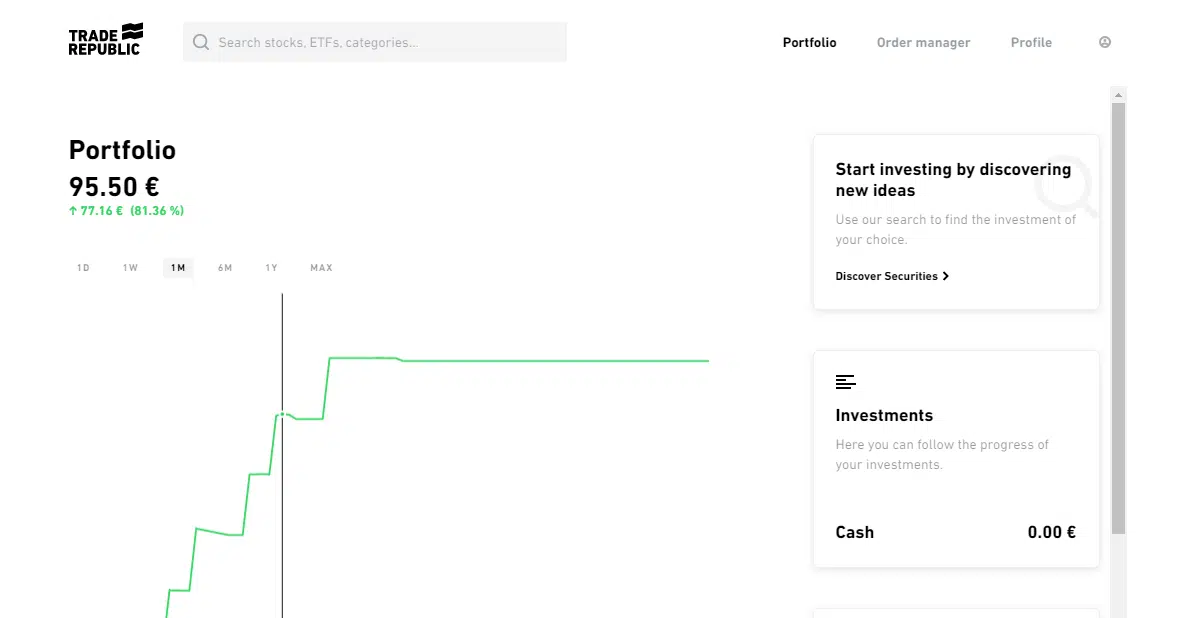
Trade Republic is a German bank and broker based in Berlin, with more than 10 million customers and over €150 billion in assets. It offers stocks, ETFs, bonds, crypto, derivatives and savings plans, plus a card and interest on cash. In 2026 it added access to IPOs (from June) and best-price execution across exchanges with Direct Price orders (from July).
It markets itself as a platform with no order fees, but a €1 external fee applies to every single trade (except savings plans), so buying and selling costs at least €2 in practice.
Trade Republic pros and cons
Pros
- Automatic saving plans
- Interest paid in idle cash balances
- Invest from only €1
- No minimum deposit
- Direct debit in the share-saving plans
- Supervised and regulated by a top-tier regulator
- Has a banking license - deposits are protected by deposit guarantee scheme
Cons
- €1 flat external fee in every single trade (Except saving plans)
- No demo account
- Only one base currency (EUR), except in Poland where it accepts Zloty.
- No direct access to US Stock Exchanges - you might not be able to buy some popular US-listed companies, such as Reddit
- Currency conversion fees apply
- Engages in PFOF - Payment for Order Flow
How to invest in the S&P 500 on Trading 212 and Trade Republic (videos)
If you’re still unsure which platform to choose, watch our step-by-step videos on how to invest in the S&P 500 with Trading 212 and with Trade Republic:
Trade Republic vs Trading 212: our verdict
Trading 212
Best for commission-free stock and ETF investingTrade Republic
Best for beginners and savings plans in stocks and ETFs
Choosing between these two brokers isn’t always obvious. The differences come down to platforms, products, fees and how your cash is held. Do you place many one-off orders? Do you only want to invest in ETFs with a monthly plan? Do you keep a lot of cash at your broker?
The best broker for you depends on your profile, preferences and goals.
Want to know more? Explore our broker reviews, comparison table and BrokerMatch tool. You can also compare Trading 212 with DEGIRO or with Revolut’s trading platform.
Frequently asked questions
Can I have both a Trading 212 and a Trade Republic account?
Yes, you can hold accounts at both brokers. Some investors use Trade Republic for automated ETF savings plans and Trading 212 for one-off orders or its demo account.
Do Trading 212 and Trade Republic offer fractional shares?
Yes. Trading 212 lets you buy fractions of most stocks and ETFs from €1. Trade Republic offers fractional shares through savings plans, from €1 per execution, and on a selection of stocks and ETFs through market orders.
Can I transfer my portfolio from Trading 212 to Trade Republic (or vice versa)?
Transfers of securities between brokers are possible in the EEA, but support varies and some products may not be transferable. Check with both brokers before you start. If you sell and rebuy instead, remember that selling can trigger tax on any gains.
Does Trading 212 or Trade Republic offer a card?
Yes. Trade Republic’s card includes 1% Saveback, which invests 1% of your card spending into your savings plan, up to €15 a month, if you invest at least €50 a month through weekly, biweekly or monthly savings plans. Trading 212 offers the 212 Card, available with a T212 Invest Account, although availability depends on your country and entity. 212 Cards are issued by Paynetics which provide all payment services. T212 provides customer support and user interface.
Which broker pays more interest on uninvested cash?
In September 2026, both paid 2.50% on EUR as a standard rate (Trading 212 Markets Ltd and Trade Republic). New clients can get more: 4.2% for 4 months at Trading 212 EU GmbH (accounts opened between 16 September and 2 November 2026), and 3.00% on up to €50,000 at Trade Republic in several countries. Trading 212 also pays interest on USD and GBP. Rates are variable, so check both brokers before deciding.
Is Trade Republic available in the UK?
No. Trade Republic doesn’t serve UK residents. UK investors can consider Trading 212, Lightyear, Freetrade or Interactive Brokers.
Does Trading 212 charge withdrawal fees?
No, Trading 212 doesn’t charge withdrawal fees. Other fees may apply, such as the 0.15% FX fee on currency conversion.
Can I trade options on Trading 212 or Trade Republic?
Neither broker offers exchange-listed options. Trade Republic offers leveraged products such as warrants and knock-out certificates, which are structurally different from listed options. Trading 212’s Invest account doesn’t offer options.
Which broker is regulated by more authorities?
Trading 212 has entities regulated by several authorities, including the FCA in the UK, CySEC in Cyprus, BaFin in Germany, ASIC in Australia and the FSC in Bulgaria. Trade Republic is a German bank supervised by BaFin and the Deutsche Bundesbank. The number of regulators matters less than the entity that holds your account and the protection it offers.
Are deposits covered at Trading 212 and Trade Republic?
Trade Republic cash deposits are covered by the German deposit guarantee scheme up to €100,000. Trading 212 is not a bank: it holds client cash in segregated bank accounts and, if you enable interest, partly in QMMFs, which are investments. If Trading 212 failed, investor compensation of up to €20,000 (Cyprus ICF) or £85,000 (UK FSCS) could apply, depending on the entity.