Trying to decide between eToro and Trade Republic for your investing needs? Both are popular platforms in Europe, but they serve quite different types of investor, and the right choice depends on what you want to do.
In this side-by-side comparison, we analyse eToro vs Trade Republic on the features that matter most: fees, products, platforms, interest on cash, safety and more. Below, you’ll find a quick verdict, a comparison table, worked fee examples and the pros and cons of each broker.
eToro vs Trade Republic: quick take
- eToro is best for social and copy trading, real crypto and access to many asset classes in a single platform
- Trade Republic is best for low-cost, long-term ETF investing with free savings plans and interest on euro cash
eToro vs Trade Republic in a nutshell
| Category | eToro | Trade Republic |
| Founded | 2007 | 2015 |
| Clients | 4.28M funded accounts, 40M registered users | 10M+ customers in 18 European countries |
| Account minimum | $50 in most countries | €1 |
| Stock fees | $1 per trade on most exchanges, $2 on some (on opening and closing) | €1 per order, €2 for Direct Price orders |
| ETF fees | $0 | €1 per order, free in savings plans |
| Savings plans | Recurring investments | Yes, free, from €1 |
| Interest on cash | USD balance: 3% up to $50,000, 3.80% above (EU and UK) | 2.50% on EUR (3% for new clients in some countries, up to €50,000) |
| Account currency | EUR, GBP or USD account | EUR |
| Social trading | Yes (CopyTrader) | No |
| Demo account | Yes ($100,000 virtual) | No |
| Regulators (EU clients) | CySEC (plus FCA, ASIC, FSRA) | BaFin and Bundesbank |
| Listed on | Nasdaq (ETOR) | Not listed |
As of 10 October 2026, taken from each broker’s website.
1. Overview
About eToro
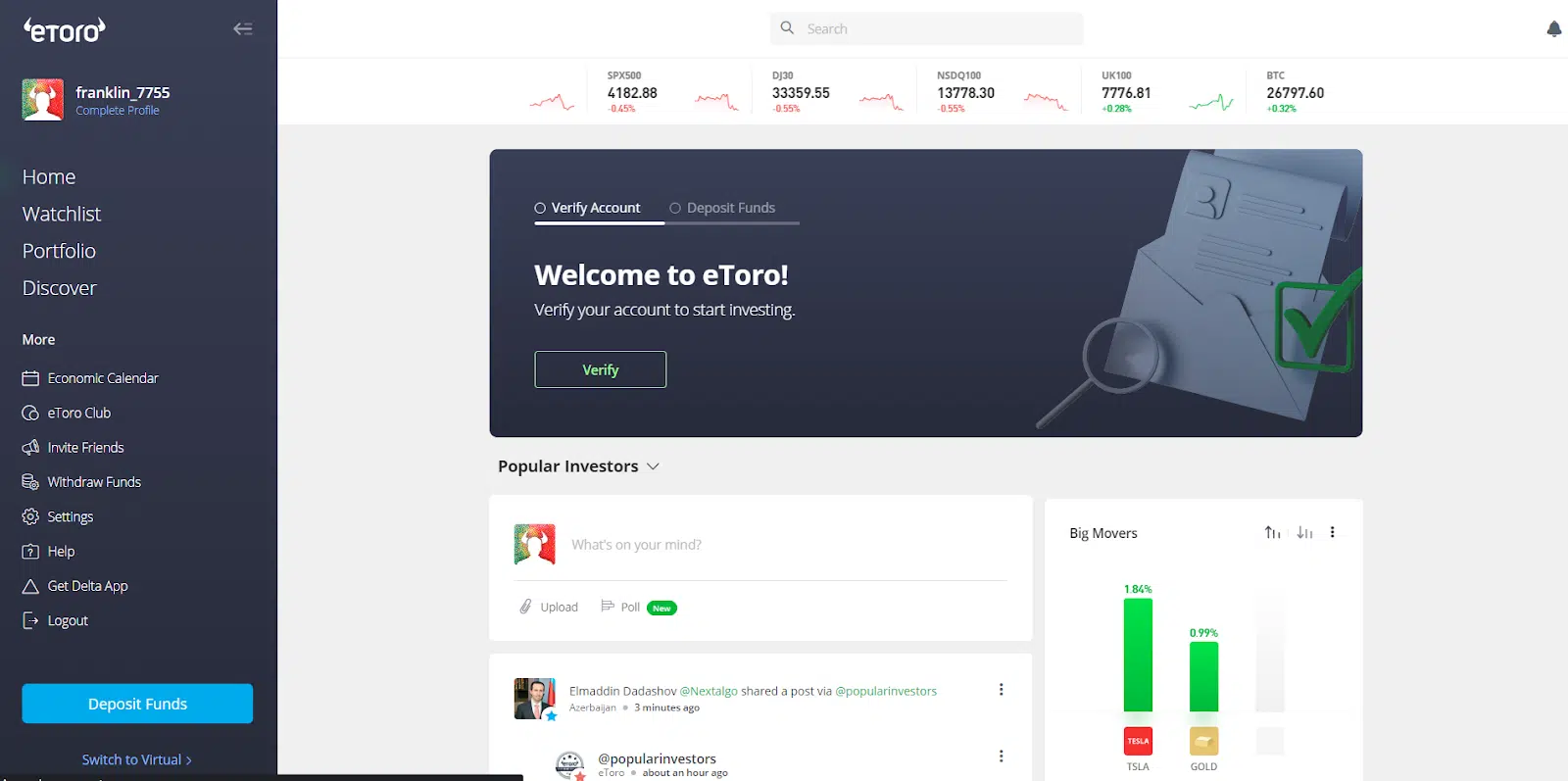
Founded in 2007, eToro is a global fintech and the leader in social trading, with 4.28 million funded accounts (June 2026) and around 40 million registered users. It went public on Nasdaq in May 2025 (ticker: ETOR), which means it publishes audited financial results.
eToro offers real stocks, ETFs and crypto, plus CFDs on many markets, through an intuitive platform. European clients are served by eToro (Europe) Ltd, regulated by CySEC, and can hold a EUR account, which avoids currency conversion when funding the account and buying euro-denominated assets.
eToro is a multi-asset investment platform. The value of your investments may go up or down. Your capital is at risk.
About Trade Republic
Trade Republic is a Berlin-based broker founded in 2015 that holds a full banking licence (Trade Republic Bank GmbH), supervised by BaFin and the Bundesbank. With more than 10 million customers in 18 European countries and over €150 billion in client assets, it is one of the largest investment platforms in Europe.
It offers stocks, ETFs, bonds, crypto and derivatives, with free savings plans from €1, a card with 1% Saveback (cashback reinvested into your portfolio) and interest on uninvested cash. After the EU ban on payment for order flow (PFOF) took effect in mid-2026, Trade Republic moved to a new execution model on 1 July 2026, with a €1 fee per order and €2 for “Direct Price” orders on a venue of your choice, such as Xetra, Euronext, NYSE or Nasdaq.
2. Products and market access
| Products | eToro | Trade Republic |
| Stocks and ETFs | ✔️ Real stocks and ETFs, plus CFDs | ✔️ Real stocks and ETFs |
| Savings plans | ✔️ Recurring investments | ✔️ Free, from €1 |
| Bonds | ❌ | ✔️ Government and corporate bonds |
| Crypto | ✔️ Real crypto and CFDs | ✔️ Real crypto |
| Derivatives | ✔️ CFDs | ✔️ Warrants and certificates (in some countries) |
| Copy trading | ✔️ CopyTrader and Smart Portfolios | ❌ |
Product availability depends on your country of residence. As of 10 October 2026, taken from each broker’s website.
eToro is the more versatile platform, with CFDs on forex, indices and commodities and the option to copy other investors. Trade Republic is built for long-term investors, adding bonds and free savings plans, which eToro does not match. CFDs are complex, leveraged instruments and most retail accounts lose money trading them.
3. Trading platforms
eToro offers a web platform and mobile app built around a social feed, where you can follow and copy other investors, plus a $100,000 demo account to practise.
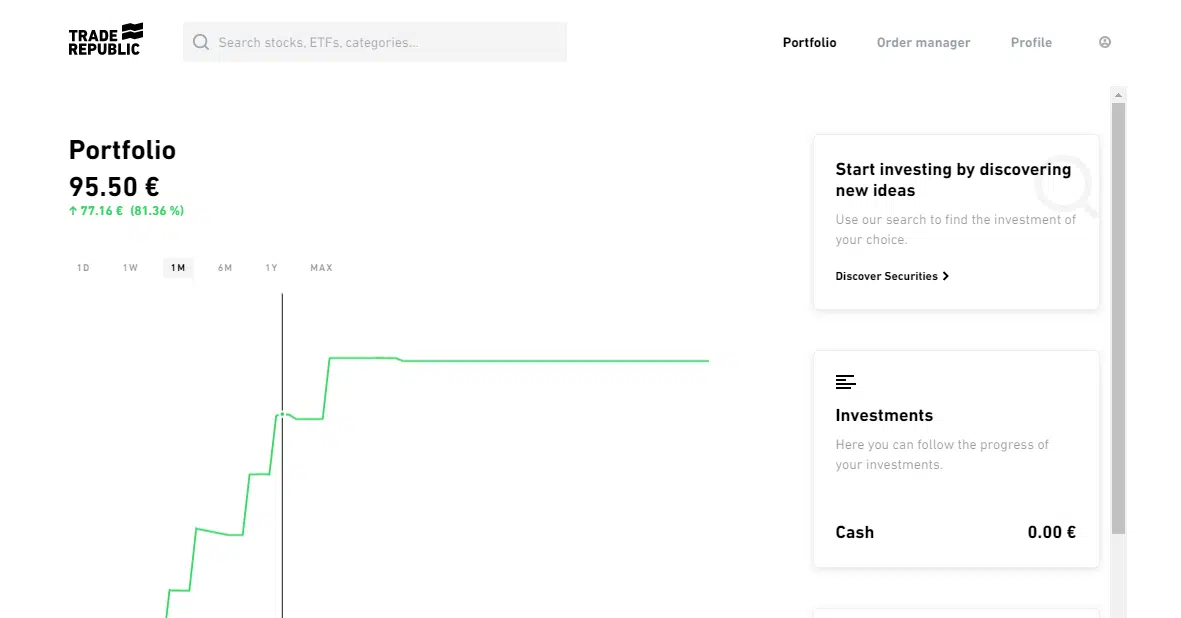
Trade Republic is mobile-first, with a clean app designed for savings plans and simple orders. Since July 2026 it also offers a browser-based Web Terminal for more active investors, at no extra cost. It does not offer a demo account.
4. Interest on uninvested cash
Trade Republic pays interest on uninvested euro cash at the ECB deposit facility rate, currently 2.50% a year, with no balance cap. In some countries, new clients get a promotional 3% on up to €50,000. Interest is paid monthly.
eToro pays interest only on the available USD balance. For residents of the EU and the UK, the rate is 3% on a total balance up to $50,000 and 3.80% above that, and you need to opt in.
If you keep your cash in euros, Trade Republic is the clear winner. If you hold dollars, eToro’s rate is higher.
5. Account types
eToro offers individual and corporate accounts and a Club programme (from Bronze to Diamond) with discounts on currency conversion and crypto fees as your balance grows.
Trade Republic focuses on individual accounts for private investors, with the investment account, the cash account and the card in a single app.
6. Account opening
Both brokers have a fully digital account opening process. You will need a valid ID, proof of address and your tax identification number. eToro requires a first deposit of $50 in most countries, while at Trade Republic you can start investing from €1.
7. Pricing
| Trading fees | eToro | Trade Republic |
| Stocks | $1 per trade on most exchanges, $2 on some (on opening and closing) | €1 per order (€2 for Direct Price orders) |
| ETFs | $0 | €1 per order |
| Savings plans | No commission on recurring investments in ETFs | Free |
| Crypto | 1% (Bronze to Gold Club levels, lower above) | Spread and order fee apply |
| Currency conversion | Varies by currency and Club level | Not charged on euro accounts trading in euros |
Trading fees. As of 10 October 2026, taken from each broker’s website.
| Non-trading fees | eToro | Trade Republic |
| Account minimum | $50 in most countries | €1 |
| Withdrawal fee | None from EUR or GBP accounts, $5 from USD accounts (min. $30) | None |
| Inactivity fee | None | None |
| Custody fee | None | None |
Non-trading fees. As of 10 October 2026, taken from each broker’s website.
Investing €100 a month in an ETF
At Trade Republic, a monthly savings plan in an ETF costs €0. At eToro, ETFs have no commission either, so recurring ETF purchases also cost $0 in commission if your account currency matches the ETF’s. For small, regular ETF investments, both are cheap, but Trade Republic’s savings plans are its core product.
Buying and selling a US stock
At eToro, you pay $1 when you open and $1 when you close the position, so $2 in total, plus any currency conversion fee if your account is in euros. At Trade Republic, each order costs €1, so €2 for the round trip, with no separate conversion fee on your euro account.
See eToro’s fee page for the full list of eToro charges.
8. Safety and regulation
| Safety indicators | eToro | Trade Republic |
| Regulators | CySEC, FCA, ASIC, FSRA and others | BaFin and Bundesbank |
| Cash protection | Covered by the investor compensation scheme | Up to €100,000 (German deposit guarantee scheme) |
| Securities protection | Up to €20,000 (Cyprus Investor Compensation Fund) | Held in segregated custody, plus up to €20,000 (90%) under the German investor compensation scheme |
| Private insurance | ✔️ For Platinum, Platinum+ and Diamond clients, covering losses above €20,000 up to €1 million (real crypto excluded) | ❌ |
| Listed on exchange | ✔️ Nasdaq | ❌ |
As of 10 October 2026, taken from each broker’s website.
Trade Republic’s banking licence gives cash balances the protection of the German deposit guarantee scheme up to €100,000, which matters if you hold a lot of uninvested cash. eToro, as a listed company, publishes audited quarterly results. Investor compensation schemes protect against the failure of the firm, not against investment losses.
9. Customer support
eToro offers support through live chat and a ticket system, with a detailed help centre.
Trade Republic rebuilt its customer service in 2026 and now offers phone and chat support 24/7 directly in the app, with more than 1,000 agents in eight languages.
CFDs are complex instruments and come with a high risk of losing money rapidly due to leverage. 52% of retail investor accounts lose money when trading CFDs with this provider. You should consider whether you understand how CFDs work and whether you can afford to take the high risk of losing your money.eToro is a multi-asset investment platform. The value of your investments may go up or down. Your capital is at risk.
Copy Trading does not amount to investment advice. The value of your investments may go up or down. Your capital is at risk.
CFDs are complex instruments and come with a high risk of losing money rapidly due to leverage. You should consider whether you understand how CFDs work and whether you can afford to take the high risk of losing your money.
10. eToro pros and cons
Pros
- Low stock trading fees (from $0 per trade)
- Commission-free ETFs (other fees apply)
- Social trading and other innovative products
- Wide variety of financial products
- Slick, modern, and easy for anyone to use
- European users have access to three account currencies: EUR, USD and GBP
- Top tier regulators
Cons
- Limited disclosed financial information
- Withdraw and inactivity fees
- Spread, overnight, inactivity, and currency conversion fees higher than average
- Doesn’t offer bonds, futures, or options
11. Trade Republic pros and cons
Pros
- Automatic saving plans
- Interest paid in idle cash balances
- Invest from only €1
- No minimum deposit
- Direct debit in the share-saving plans
- Supervised and regulated by a top-tier regulator
- Has a banking license - deposits are protected by deposit guarantee scheme
Cons
- €1 flat external fee in every single trade (Except saving plans)
- No demo account
- Only one base currency (EUR), except in Poland where it accepts Zloty.
- No direct access to US Stock Exchanges - you might not be able to buy some popular US-listed companies, such as Reddit
- Currency conversion fees apply
- Engages in PFOF - Payment for Order Flow
How to invest in the S&P 500 on eToro and Trade Republic
If you’re still unsure which platform to choose, check our videos where we explain step by step how to invest in the S&P 500 on eToro and on Trade Republic:
eToro vs Trade Republic: our verdict
eToro
Best for social trading and multi-asset investingTrade Republic
Best for interest and creating savings plans with stocks/ETFs
Choose Trade Republic if you are a long-term investor who wants free ETF savings plans, interest on your euro cash, bonds and the protection of a German bank.
Choose eToro if you want to copy other investors, own real crypto alongside stocks and ETFs, or trade a wider range of markets through CFDs, and you are comfortable with the $1 stock commission.
Ultimately, the best online broker for you will depend on your profile, preferences and objectives. Want to know more? Explore our in-depth broker reviews, comparison table and BrokerMatch tool, or these related comparisons: