Choosing between eToro and Interactive Brokers (IBKR) is one of the most common dilemmas for European retail investors. Both brokers are widely available, well-regulated, and offer different strengths depending on your investing style.
Here’s a quick TL;DR before we dive into the detail:
- Interactive Brokers is the better choice for serious, long-term investors – widest product range (170+ markets, stocks, ETFs, options, futures, bonds, forex), lowest commissions across all major asset classes, and institutional-grade safety (NASDAQ-listed, S&P 500 since 2024);
- eToro is the better choice for beginners and social traders – the most intuitive platform, $0 commission on real stocks, CopyTrader for following experienced investors, Smart Portfolios, and a strong fit for users who value simplicity over breadth;
- Fees: IBKR is materially cheaper for active trading and FX conversion (0.0020% vs eToro’s ~0.50%), but eToro is competitive on commission-free stock trading;
- Product range: IBKR offers a far broader range across all asset classes; eToro doesn’t currently offer bonds, futures, or options on real assets;
- Cash interest: IBKR pays interest across multiple currencies (USD, EUR, GBP, and more); eToro pays interest only on USD balances, but at higher headline rates for larger accounts;
- Account type fit: IBKR supports retail, professional, joint, corporate, and trust accounts; eToro is focused primarily on retail individual accounts.
Below, you’ll find a detailed side-by-side comparison covering fees, products, regulation, interest on uninvested cash, and the pros and cons of each platform – plus our verdict on which one fits which investor profile best. Keep reading.
IBKR vs eToro: quick verdict
- Interactive Brokers: our recommended choice overall – best for serious long-term investors, active traders, and anyone needing global market access with the lowest commissions in the industry;
- eToro: best for social trading and beginners – ideal for those who value CopyTrader, $0 commission on real stocks, and a polished, easy-to-use platform.
Side-by-side comparison
| Category | Interactive Brokers | eToro |
| Founded | 1978 (NASDAQ: IBKR, S&P 500 since 2024) | 2007 (NASDAQ: ETOR since May 2025) |
| Demo account | Yes (paper trading) | Yes ($100,000 virtual portfolio) |
| Account minimum | $0 | $50 first deposit (varies by country) |
| Number of users | 3M+ client accounts | 40M+ users globally |
| Markets covered | 170+ markets in 36+ countries | 3,000+ instruments across major markets |
| Interest on uninvested cash (annually)* | EUR: up to 1.5%; USD: up to 3.12%; GBP: up to 3.207% (above tier thresholds) | Up to 3.55% in USD only (tiered by balance and region) |
| US stock fees | Tiered: $0.0035 per share (min. $0.35; max. 1% of trade value) | $0 commission on real stocks (other fees apply, $5 withdrawal) |
| EU stock fees | Tiered: 0.05% of trade value (min. €1.25; max. €29) | $0 commission on real stocks (other fees apply, $5 withdrawal) |
| ETF fees | Tiered: 0.05% of trade value (min. €1.25; max. €99) | $0 commission |
| Currency conversion fee | Up to 0.0020% (min. $2) | Starts from ~0.50% (varies by deposit method and country) |
| Inactivity fee | None | $10/month after 12 months of inactivity |
| Product range | Stocks, ETFs, options, futures, bonds, forex, mutual funds, crypto | Real stocks, ETFs, CFDs (forex, indices, commodities, crypto), Smart Portfolios |
| Social/copy trading | No | Yes (CopyTrader, Smart Portfolios) |
| Account currencies | EUR, USD, GBP, and 20+ others | EUR, USD, GBP, AUD |
| Regulators | SEC, FINRA, SIPC, CFTC, FCA, Central Bank of Ireland, BaFin, ASIC, SFC, SEBI, MAS, MNB | SEC, FINRA, FCA, CySEC, ASIC, FSA (Seychelles), SCA (Abu Dhabi) |
*As of June 2026 – cash interest rates are variable and tied to central bank policy. Both IBKR and eToro adjust rates as central bank rates change.
About Interactive Brokers
Founded in 1978 and publicly listed on NASDAQ (ticker: IBKR, S&P 500 constituent since 2024), Interactive Brokers is a global online broker that has weathered multiple major financial crises – demonstrating resilience and a rigorous risk management process. With over 3 million client accounts and a market capitalisation in the tens of billions, IBKR is one of the most established names in the brokerage industry.
It offers an advanced investment platform spanning a wide range of products – stocks, options, mutual funds, ETFs, futures, bonds, forex, and crypto – across 170+ markets in 36+ countries. New users can also benefit from a referral bonus.
The flagship platform Trader Workstation (TWS) offers institutional-grade tools, with extensive educational resources through IBKR Campus (formerly Traders’ Academy). Beginners and intermediate investors will find the learning curve steep but the depth of features unmatched. For those wanting a simpler experience, Interactive Brokers also launched IBKR GlobalTrader – a modern mobile trading app for stocks, options, and ETFs – well-suited to newer investors.
If you’re wondering whether Interactive Brokers is safe and the right platform for you, read our full review on IBKR for deeper insights.

Interactive Brokers pros and cons
Pros
- Low commissions on US stock trading
- No monthly inactivity fee
- The broadest product and markets range in the brokerage industry
- Demo account
- Excellent reputation (founded in 1978)
- Extensive research and Education tools
- Has a modern mobile trading app to trade Stocks, Options and ETFs, ideal for novice investors, IBKR GlobalTrader.
- Offers interest on uninvested cash balances
Cons
- Complicated and lengthy account opening process (but fully online)
- Steeper learning curve for beginners
- Website is difficult to navigate
- Interactive Advisors (Robo-advisor feature) is only available for US customers
About eToro
Founded in 2007 and publicly listed on NASDAQ (ticker: ETOR since May 2025), eToro is a worldwide fintech and the established leader in the social trading space – allowing users to follow and automatically replicate the trades of other investors. The platform has grown to over 40 million users worldwide across 140+ countries, making it one of the most widely used retail investment platforms globally.
You can invest in a broad range of products through the platform, including real stocks, ETFs, cryptocurrencies, and CFDs across multiple asset classes. The interface is intuitive and visually polished – one of the cleanest user experiences in the industry – making eToro a strong choice for beginners and intermediate investors who prefer a more accessible platform over complex institutional tools.
Key differentiators include CopyTrader (real-time automated copying of selected traders) and Smart Portfolios (thematic, professionally curated portfolios covering themes like AI, renewable energy, dividend stocks, and crypto). Opening an account is straightforward, with a $50 minimum first deposit and a $100,000 virtual portfolio available for risk-free practice.
On the downside, spreads on certain CFD products can be wider than at specialist competitors, and eToro doesn’t currently offer bonds, futures, or real options – which may be limiting for more advanced investors. Currency conversion fees also apply when funding the account in a currency other than USD.
If you’re wondering whether eToro is safe to use, read our full eToro review for deeper insights into the pros and cons of the platform.

eToro’s pros and cons
Pros
- Low stock trading fees (from $0 per trade)
- Commission-free ETFs (other fees apply)
- Social trading and other innovative products
- Wide variety of financial products
- Slick, modern, and easy for anyone to use
- European users have access to three account currencies: EUR, USD and GBP
- Top tier regulators
Cons
- Limited disclosed financial information
- Withdraw and inactivity fees
- Spread, overnight, inactivity, and currency conversion fees higher than average
- Doesn’t offer bonds, futures, or options
Trading platforms compared
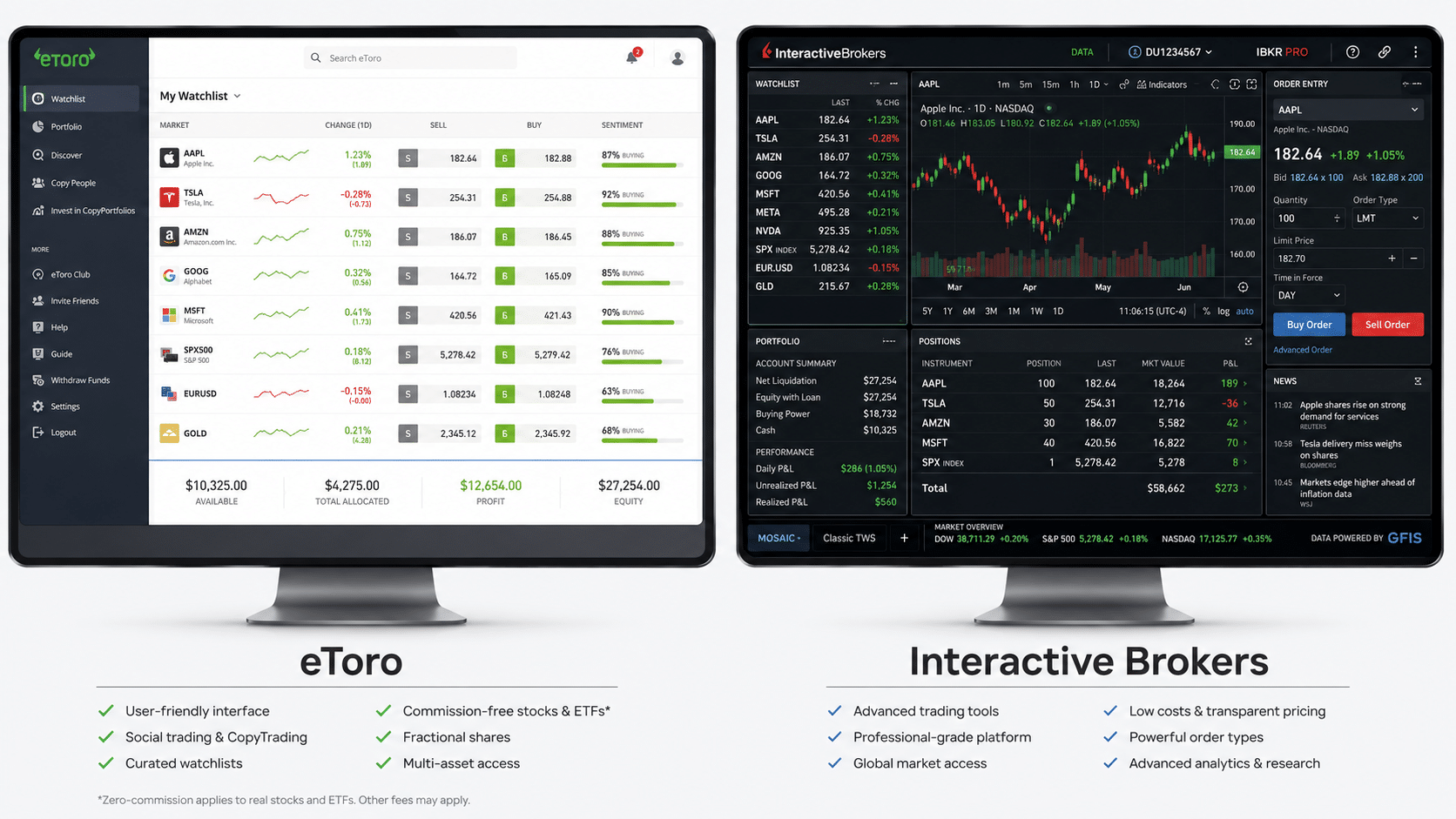
The trading platform is often the deciding factor in choosing a broker – especially since you’ll be interacting with it daily. Interactive Brokers and eToro take fundamentally different approaches, which suits different investor profiles.
Interactive Brokers’ platforms
IBKR offers a tiered platform ecosystem designed to scale with experience level:
- Trader Workstation (TWS): the flagship desktop platform – institutional-grade with advanced charting, multi-leg options builders, algorithmic trading capabilities, and real-time risk analytics. The learning curve is steep, but the depth is unmatched in the retail brokerage space;
- IBKR Web Trader: a streamlined browser-based interface for less advanced users who prefer a cleaner experience without installing software;
- IBKR Mobile: the full-featured mobile app with most TWS functionality;
- IBKR GlobalTrader: a simplified mobile app designed for newer investors – covers stocks, options, and ETFs with a much cleaner interface than the main IBKR Mobile app;
- API access: TWS API, Client Portal Web API, and FIX CTCI – supporting algorithmic and institutional trading.
eToro’s platform
eToro takes a unified approach – one platform across web and mobile, with consistent functionality everywhere:
- eToro web platform: clean, modern interface with the social feed front and centre – one of the most intuitive trading platforms in the retail space;
- eToro mobile app: full functionality of the web platform, optimised for on-the-go trading and social interaction;
- Built-in social trading features: CopyTrader, Smart Portfolios, and a community feed integrated directly into the trading experience;
- No API access: eToro doesn’t currently offer API access for algorithmic traders, which can be a meaningful limitation for systematic strategies.
Platform verdict
Choose Interactive Brokers if you want: institutional-grade tools, advanced charting and analytics, API access for systematic trading, or expect your needs to grow over time. Choose eToro if you want: a polished, intuitive experience focused on simplicity, social features, and visual clarity over depth.
Fees compared in detail
Fee structures at Interactive Brokers and eToro are fundamentally different in approach – IBKR uses a transparent, tiered commission model across all asset classes, while eToro relies primarily on spreads and currency conversion fees with $0 headline commissions on real stocks.
US stock and ETF trading fees
Interactive Brokers charges $0.0035 per share on the tiered plan (minimum $0.35, maximum 1% of trade value). For a typical $1,000 stock order of 50 shares, that’s roughly $0.35 – meaningfully cheaper than fixed-commission brokers for small orders.
eToro offers $0 commission on real stocks and ETFs, but other fees apply (notably the FX conversion when funding in non-USD currencies and a $5 withdrawal fee). For US investors funding in USD, eToro’s commission-free structure is genuinely cost-efficient for buy-and-hold investing.
European stock fees
Interactive Brokers: 0.05% of trade value on the tiered plan (minimum €1.25, maximum €29 per order) – competitive for active traders with larger positions.
eToro: $0 commission on real stocks regardless of exchange, though European investors should factor in the USD-base FX cost when funding from EUR/GBP.
Currency conversion fees
This is where the two platforms diverge most sharply:
- Interactive Brokers: up to 0.0020% (minimum $2) – effectively the cheapest FX conversion available to retail investors anywhere. For a €10,000 conversion, you’ll pay approximately $2;
- eToro: starts from approximately 0.50%, varying by deposit method and country. For the same €10,000 conversion, you’d pay around $50 – meaningfully more than IBKR.
For investors who plan to deposit in non-USD currencies regularly or hold multi-currency portfolios, IBKR’s FX advantage is substantial and compounds over time.
Other fees to consider
- Inactivity fees: IBKR charges none; eToro charges $10/month after 12 months of inactivity;
- Withdrawal fees: IBKR offers one free withdrawal per month; eToro charges a flat $5 per withdrawal;
- Account maintenance: neither broker charges account maintenance fees;
- Deposit fees: neither broker charges deposit fees, though some payment methods (eToro card deposits) may incur conversion costs.
Fees verdict
For active traders, multi-currency investors, or larger portfolios, Interactive Brokers is materially cheaper overall – particularly when factoring in FX conversion costs. For casual buy-and-hold investors funding in USD, eToro’s commission-free model can be competitive, but the FX cost erodes the advantage as soon as non-USD funding is involved.
Products and markets compared
Product breadth is one of the clearest differentiators between these two brokers – Interactive Brokers offers significantly more variety across asset classes and geographic markets, while eToro focuses on a more curated set of products optimised for retail simplicity.
Asset class comparison
| Asset class | Interactive Brokers | eToro |
| Real stocks | ✔ (170+ markets) | ✔ (3,000+ instruments) |
| ETFs | ✔ (extensive selection) | ✔ (260+ ETFs) |
| Options | ✔ (US and global exchanges) | ✘ (not currently offered) |
| Futures | ✔ (global commodity, index, FX futures) | ✘ (not currently offered) |
| Bonds | ✔ (corporate and government) | ✘ (not currently offered) |
| Forex | ✔ (real currency conversion + spot FX) | ✔ (CFDs only) |
| Mutual funds | ✔ (40,000+ funds) | ✘ (not currently offered) |
| Cryptocurrencies | ✔ (real crypto via partner) | ✔ (real crypto + crypto CFDs) |
| CFDs | ✔ (limited – mostly on indices) | ✔ (extensive across asset classes) |
| Social/copy trading | ✘ | ✔ (CopyTrader + Smart Portfolios) |
Market coverage
Interactive Brokers provides access to 170+ markets across 36+ countries, including all major US, European, Asian, and emerging-market exchanges. This is genuinely one of the broadest market footprints in the brokerage industry.
eToro offers around 3,000+ instruments across major US, European, and global exchanges – sufficient for most retail needs but not comprehensive. Niche markets, smaller exchanges, and certain emerging markets aren’t covered.
Products verdict
If you want to invest across multiple asset classes – including options, futures, bonds, and mutual funds – Interactive Brokers is the only viable choice between these two. If your investing is focused on stocks, ETFs, and crypto, with copy-trading and Smart Portfolios as features you value, eToro can absolutely meet your needs.
Cash interest and money management compared
With central bank rates remaining elevated through 2025-2026, interest on uninvested cash has become a meaningful differentiator between brokers. Both Interactive Brokers and eToro now offer cash interest, but with very different structures.
Interactive Brokers cash interest
IBKR pays interest on uninvested cash across 22+ currencies, with rates tied to each currency’s central bank reference. As of June 2026 (current published rates):
- USD: up to 3.12% on IBKR Pro (above $10,000, NAV $100K+);
- EUR: up to 1.5% (above €10,000, NAV $100K+ equivalent);
- GBP: up to 3.207% (above £8,000, NAV $100K+ equivalent).
Key conditions: no interest on the first tier threshold (e.g., $10,000 USD, £8,000 GBP), and the full rate requires a NAV of $100,000 or equivalent. Below $100K NAV, the rate is reduced proportionally. Cash interest is paid monthly and accrues daily.
eToro cash interest
eToro pays interest only on USD cash balances, with tiered rates based on total realised equity:
- EU/UK clients: 2.75% (from first dollar) up to 3.55% AER (at $50,000+ total equity);
- German clients: 3.55% AER from the first dollar (regional outlier);
- Other regions: 3.55% AER requires $250,000+ total equity.
Interest is paid monthly and credited automatically once you opt in via the Club Dashboard. Important caveat: eToro does not pay interest on EUR or GBP balances, so non-USD investors face FX conversion costs and currency risk if they want to earn interest.
Cash interest verdict
For investors holding cash in multiple currencies (especially EUR or GBP), Interactive Brokers offers a more useful structure – you earn interest in your native currency without forced conversion. For investors comfortable holding cash in USD, eToro can offer higher headline rates (3.55% vs IBKR’s 3.12%), particularly attractive for German clients who get the top tier from the first dollar.
Cash interest rates are variable and tied to central bank policy at both brokers – expect rates to adjust as ECB, Fed, and Bank of England rates change.
Regulation and safety compared
Both Interactive Brokers and eToro are well-regulated across multiple jurisdictions, but their regulatory structures and investor protection frameworks differ in important ways.
Interactive Brokers’ regulatory framework
IBKR operates through multiple regional subsidiaries, each regulated by the relevant local authority:
- Interactive Brokers LLC: SEC, FINRA, CFTC, NYSE, NFA (US);
- Interactive Brokers UK Limited: FCA (UK);
- Interactive Brokers Ireland Limited: Central Bank of Ireland (Ireland, serving EEA clients);
- Interactive Brokers Central Europe Zrt.: MNB (Hungary, serving certain EEA clients);
- Interactive Brokers Australia Pty Ltd: ASIC (Australia);
- Interactive Brokers (Singapore) Pte. Ltd.: MAS (Singapore);
- Interactive Brokers Securities Japan, Inc.: FSA (Japan);
- Interactive Brokers Hong Kong Limited: SFC (Hong Kong);
- Interactive Brokers India Pvt. Ltd.: SEBI (India).
Investor protection varies by entity: SIPC coverage up to $500,000 (including $250,000 cash) for IBKR LLC accounts, FSCS protection up to £85,000 for IBKR UK clients, and equivalent national schemes for other regional entities.
eToro’s regulatory framework
eToro also operates through regional entities, each authorised by the relevant regulator:
- eToro (Europe) Ltd: CySEC (Cyprus, serving EEA clients via passporting);
- eToro (UK) Ltd: FCA (UK);
- eToro USA LLC and eToro USA Securities Inc.: SEC, FINRA, FinCEN (US);
- eToro AUS Capital Pty Ltd: ASIC (Australia);
- eToro (Seychelles) Ltd: FSA (Seychelles, serving certain international clients);
- eToro Middle East: SCA (Abu Dhabi);
Investor protection: Cyprus Investor Compensation Fund (ICF) up to €20,000 for EU clients via the Cyprus entity, FSCS protection up to £85,000 for UK clients via eToro UK Ltd, and SIPC coverage up to $500,000 for US clients via eToro USA Securities Inc.
Corporate transparency
Both brokers are now publicly listed, which adds an extra layer of accountability through regulatory financial disclosures:
- Interactive Brokers: NASDAQ-listed since 2007 (ticker IBKR), and a constituent of the S&P 500 since 2024;
- eToro: NASDAQ-listed since May 2025 (ticker ETOR) – a major institutional milestone that brings increased regulatory transparency.
Safety verdict
Both brokers offer strong regulatory protection through tier-1 authorities. Interactive Brokers has the longer track record (47+ years since founding, public for nearly 20 years) and broader regulatory footprint, which may matter more to safety-conscious investors. eToro’s recent NASDAQ listing brings increased financial transparency that addresses some of the historical “limited disclosed financial information” criticism that applied when the company was private. For most retail investors, both platforms are safe choices within the limits of their respective compensation schemes.
Who should choose Interactive Brokers?
Interactive Brokers is a strong fit for several distinct investor profiles:
- Active traders: low commissions, deep liquidity through SmartRouting, and tier discounts for high-volume trading make IBKR the most cost-efficient platform for frequent traders;
- Multi-asset investors: if you want stocks, ETFs, options, futures, bonds, mutual funds, forex, and crypto in a single account, IBKR is one of the very few brokers that can deliver all of this at retail accessibility;
- Multi-currency investors: the 0.0020% FX conversion fee is genuinely one of the cheapest in the industry, particularly valuable for European investors trading US markets or vice versa;
- Long-term portfolio investors: no inactivity fees, competitive cash interest across 22+ currencies, and low underlying costs make IBKR cost-efficient for long-term holding;
- Algorithmic and systematic traders: comprehensive API support (TWS API, Client Portal Web API, FIX CTCI) for building custom trading strategies;
- Investors needing institutional features: corporate accounts, trust accounts, joint accounts, and advanced order types – all available through IBKR;
- Anyone who expects their investment needs to grow: IBKR scales from beginner-friendly (via IBKR GlobalTrader) to institutional-grade (via TWS) without requiring a broker change.
The main drawbacks for newer investors are the steep learning curve on TWS and the lengthy (though fully online) account opening process. For investors willing to invest some time in learning the platform, IBKR’s depth and value rewards the effort.
Who should choose eToro?
eToro is the better fit for several distinct investor profiles:
- Beginners and first-time investors: the intuitive interface, $50 minimum deposit, $100,000 virtual portfolio, and educational content make eToro one of the most accessible ways to start investing;
- Social and copy traders: if you want to learn from or replicate the trades of experienced investors, eToro’s CopyTrader is the established market leader in this space (no equivalent at IBKR);
- Thematic investors: Smart Portfolios offer professionally curated thematic exposure (AI, renewable energy, dividend stocks, crypto, ESG, and more) without requiring you to research individual stocks;
- USD-based investors: if you primarily fund in USD, eToro’s commission-free stock trading and competitive USD cash interest rates (up to 3.55%) can be cost-efficient;
- Casual buy-and-hold investors: those who trade infrequently and value simplicity over depth will find eToro’s interface much less overwhelming than IBKR’s;
- Crypto-curious investors: eToro offers both real crypto and crypto CFDs (with leverage) within the same platform as their stock investments – useful for diversified exposure;
- Mobile-first traders: eToro’s mobile app is one of the most polished in the industry, designed for users who primarily trade and check their portfolio on a phone.
The main drawbacks for more sophisticated investors are the lack of bonds, futures, and options on real assets, the higher FX conversion fees compared to IBKR, and the more limited API/algorithmic trading capabilities.
eToro vs IBKR: our veredict
Interactive Brokers
Our recommended choice overalleToro
Best for social trading and commission-free stock trading
Choosing between these two online brokers isn’t always an obvious decision. The differences between eToro vs Interactive Brokers come from the trading platforms, products, fees, and security. Do you prefer a basic trading platform? Do you want to invest in ETFs only? Do you value security more?
Ultimately, the best online broker for you will depend on your profile, personal preferences, and objectives. Explore the websites above and decide for yourself!
Want to know more about eToro vs Interactive Brokers? Explore our in-depth broker reviews, comparison table, and BrokerMatch tool.
Disclaimer
CFDs are complex instruments and come with a high risk of losing money rapidly due to leverage. 52% of retail investor accounts lose money when trading CFDs with this provider. You should consider whether you understand how CFDs work and whether you can afford to take the high risk of losing your money.
eToro is a multi-asset investment platform. The value of your investments may go up or down. Your capital is at risk.
Copy Trading does not amount to investment advice. The value of your investments may go up or down. Your capital is at risk.
Don’t invest unless you’re prepared to lose all the money you invest. This is a high-risk investment and you should not expect to be protected if something goes wrong. Take 2 mins to learn more.