


Are you trying to decide between DEGIRO and Trade Republic for your investing?
In this side-by-side comparison we look at how the two brokers compare on fees, products, interest on cash, regulation and safety, so you can work out which one fits you.
Below you’ll find the pros and cons of each broker, plus a comparison table with the fees charged, the instruments supported and the regulation of each. Keep reading!
DEGIRO vs Trade Republic
- Trade Republic is our recommended choice for beginners, for earning interest and for savings plans in stocks and ETFs.
- DEGIRO is the better fit for investors who want a wider product range and access to local European exchanges. Investing involves risk of loss.
DEGIRO pays nothing on uninvested cash and charges a commission on most trades, so it is usually the more expensive of the two for a simple portfolio. In exchange you get more than 50 exchanges in 30 countries, bonds, funds, options and futures, and a broker that has been around since 2008 inside a licensed German bank.
Trade Republic is the simpler and cheaper option for most people: a flat €1 per order, free savings plans, interest paid on your cash balance and a bank licence of its own. The gap that used to count against it has closed too. Since July 2026 you can choose your execution venue, including the NYSE and Nasdaq, so the US-listed companies that were previously out of reach no longer are.
Side-by-side comparison
| Category | Trade Republic | DEGIRO |
| Where you can open an account | 18 European countries | Residents of the EEA and Switzerland |
| Demo account | No | No |
| Account minimum | €0 | €0 |
| Interest on uninvested cash | 2.50% standard, 3% promotional for new clients in some countriesGross, on balances up to €50,000. Varies by country and follows the ECB deposit facility rate (2.50% since September 2026). | None |
| US stocks | €1 per orderBest Price execution, whatever the order size. Direct Price, to choose the venue yourself, costs €2. | €2 per order€1 commission on NASDAQ, NYSE and NYSE Arca, plus the €1 handling fee. |
| EU stocks | €1 per orderBest Price execution, whatever the order size. | €2 to €6 per order€1 on Euronext Lisbon, €3.90 on Xetra, Tradegate, the LSE and most Euronext markets, €5 on Börse Frankfurt, plus the €1 handling fee. Commissions depend on your home market. |
| ETFs | €1 per order, €0 on savings plansThe €1 settlement fee applies to every trade except savings plan executions. | €1 on the ETF SelectionSelection ETFs (Tradegate-listed) pay no commission, only the €1 handling fee. Other ETFs cost €2 plus the handling fee. |
| Savings plans | €0 per execution, from €1 | Not available |
| Bonds, funds, options and futures | Bonds and derivatives, no funds or futures | Yes, with options and futures at €0.75 per contract |
| Currency conversion | No separate fee, the conversion sits inside the execution spread | 0.25% with AutoFX |
| Entity and regulator | Trade Republic Bank GmbH, BaFin and the Bundesbank | flatexDEGIRO Bank SE, BaFin, registered with DNB and supervised by AFM in the Netherlands |
| Deposit protection | €100,000 per partner bank | €100,000 under the German deposit guarantee |
DEGIRO figures from its fee schedule in force since 1 January 2026 (Portuguese version), Trade Republic figures from its published pricing, checked in October 2026. Commissions depend on your country, and interest rates are variable.
Which one fits you better?
- You invest a fixed amount every month: Trade Republic, where savings plan executions are free from €1. DEGIRO has no savings plan feature and no fractional shares, so a small monthly order is awkward and costs at least €1.
- You buy occasional lump sums of European shares: it depends on the exchange. A purchase on Xetra costs €4.90 at DEGIRO and €1 at Trade Republic, but if the stock is on your DEGIRO home market the gap narrows.
- You keep cash between trades: Trade Republic, which pays interest from the first euro (2.50% gross in Germany in October 2026). DEGIRO pays nothing.
- You want bonds, funds, options or futures: DEGIRO, the only one of the two that covers all of them.
- You want to pick the exchange yourself: both now allow it. Trade Republic charges €2 for a Direct Price order, DEGIRO routes to the exchange you choose as standard.
About DEGIRO
DEGIRO is a European low-cost broker that built its reputation on price. It has more than three million clients and a do-it-yourself philosophy, and since 2020 it has been part of flatexDEGIRO Bank SE, a licensed German bank supervised by BaFin, which brings deposit protection of up to €100,000.
It offers a wide range of assets: stocks and ETFs across more than 50 exchanges in 30 countries, bonds, investment funds, options, futures, warrants and leveraged products. In October 2025 it added spot crypto in selected markets, at 0.5% per trade.
Pricing is built on two blocks: a commission that depends on the exchange, plus a flat €1 handling fee per order. The ETF Selection, made up of Tradegate-listed funds, carries no commission at all, so you pay only the handling fee. There is also a connectivity fee of up to €2.50 a year (0.25% of your account value, capped at €2.50) for each exchange you use outside your home market and the ETF Selection.
The mobile app and web platform are basic but efficient. The main downsides are the absence of serious fundamental research, the lack of price alerts, no fractional shares and no interest on cash.

DEGIRO pros and cons
Pros
- ETF Core Selection: full range of ETFs/ETCs/ETNs on Tradegate (1,000+ products) for only the €/£1 handling fee, with no connectivity fee (external fees apply)
- User-friendly web and mobile app
- Wide range of investment options
- Education material: Investor’s Academy and Investing with DEGIRO
- Low overall commission structure
- No account opening, inactivity, or withdrawal fee
Cons
- 0.25% currency conversion fee (charged if you deposit or invest in a different currency than your base currency)
- €/£1 flat handling fee (charged in most transactions)
- €/£2.50 of connectivity fee (paid annually), per exchange where you’re invested
- Does not offer Forex or CFDs
- No ISA account (for UK residents)
- Low-quality customer support
- No interest paid on cash balances
About Trade Republic
Trade Republic is a Berlin-based broker that became a licensed bank in 2023. It has more than 10 million customers and around €150 billion in client assets, which makes it one of the largest brokers in Europe, and it has grown well beyond trading: it issues its own IBAN, offers a card with 1% Saveback and pays interest on cash, although it does not lend.
You can invest in stocks, ETFs, bonds, derivatives and crypto, with savings plans on most of them. There is no order commission, but a €1 settlement fee applies to every trade except savings plan executions, so a full round trip costs at least €2.
July 2026 brought the biggest change in its history. With the EU ban on payment for order flow taking full effect on 30 June, Trade Republic rebuilt its execution. Best Price, the default, aggregates quotes across the relevant exchanges and fills your order at the best available price for the usual €1, with Trade Republic as counterparty. Direct Price lets you choose the venue from around 30 exchanges, including Xetra, Euronext, the NYSE and Nasdaq, for €2 per order regardless of size. It also launched a free Web Terminal with charting, screeners and live data.
That is worth underlining, because until then Trade Republic routed everything through a single German venue and US-only listings were out of reach. Now they are not.
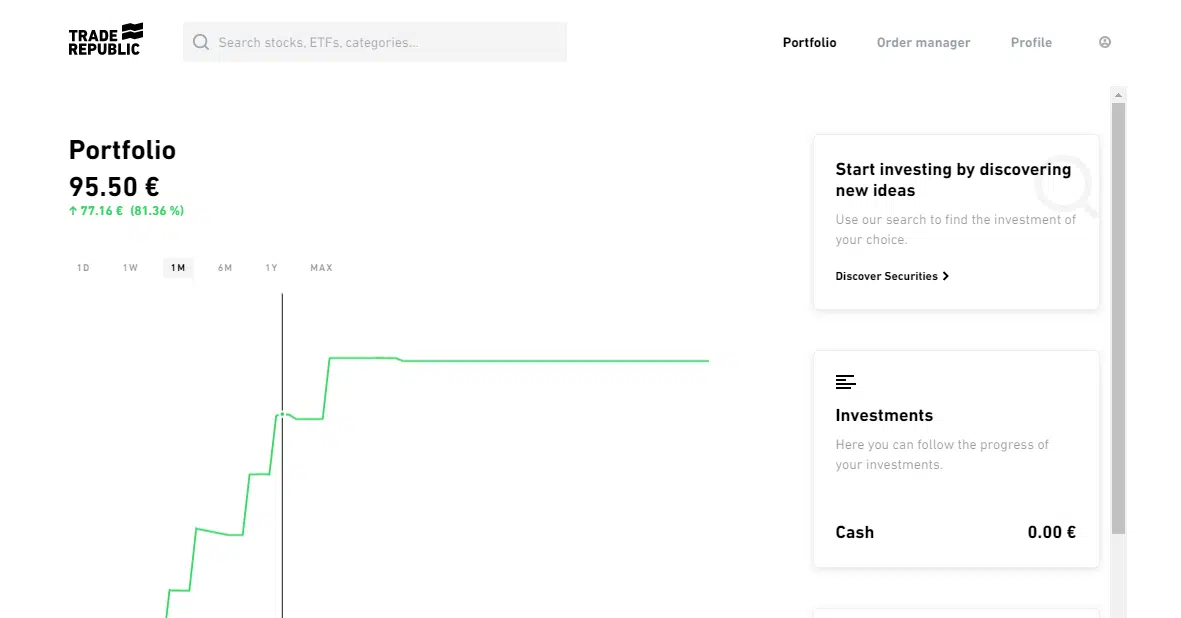
Trade Republic pros and cons
Pros
- Automatic saving plans
- Interest paid in idle cash balances
- Invest from only €1
- No minimum deposit
- Direct debit in the share-saving plans
- Supervised and regulated by a top-tier regulator
- Has a banking license - deposits are protected by deposit guarantee scheme
Cons
- €1 flat external fee in every single trade (Except saving plans)
- No demo account
- Only one base currency (EUR), except in Poland where it accepts Zloty.
- No direct access to US Stock Exchanges - you might not be able to buy some popular US-listed companies, such as Reddit
- Currency conversion fees apply
- Engages in PFOF - Payment for Order Flow
How safe is your money at each broker?
Both are German banks supervised by BaFin, and in both cases your securities are held separately from the broker’s own assets, so they stay yours if the company fails. The compensation schemes only come into play if that segregation fails.
- Cash: covered by the German deposit guarantee up to €100,000. Trade Republic spreads client deposits across partner banks, and the limit applies per bank.
- Securities: held in custody in your name and, on top of that, covered by the German investor compensation scheme, which pays 90% of a claim up to €20,000.
The difference in track record is real but smaller than it used to be. DEGIRO has been operating since 2008 and Trade Republic since 2015, and both are now supervised as banks rather than as investment firms. Neither scheme protects you against markets falling.
How to invest in the S&P 500 on DEGIRO and Trade Republic
Want to learn how to invest in the S&P 500 on both DEGIRO and Trade Republic?
Check our step-by-step videos below. They are also a good way to judge which app feels more comfortable before you commit:
Trade Republic vs DEGIRO: our verdict
DEGIRO
Best for product range and local European exchangesTrade Republic
Best for beginners and creating savings plans with stocks/ETFs
Choosing between these two is not always obvious, and they have grown closer together: both are German banks, both charge around a euro per order and both are built for long-term investors rather than traders.
Trade Republic wins on price for a simple portfolio, on interest paid directly in the account, on savings plans and, since July 2026, on execution, with the choice of venue and access to the US markets. DEGIRO wins on breadth, with bonds, funds, options and futures, and on access to local European exchanges that Trade Republic does not cover.
Ultimately, the best broker for you will depend on your profile, your preferences and what you actually hold. Explore both websites and decide for yourself.
Want to know more? Explore our in-depth broker reviews, our comparison table and our BrokerMatch tool.
FAQs
Can I buy US stocks on Trade Republic and DEGIRO?
Yes, on both. Since July 2026 Trade Republic lets you route an order directly to the NYSE or Nasdaq with a Direct Price order at €2, on top of the default Best Price execution at €1. DEGIRO has always offered direct access to the US exchanges, at €1 in commission plus the €1 handling fee.
Which one is cheaper?
Trade Republic, in most cases. It charges a flat €1 per order whatever the size, and nothing on savings plans. At DEGIRO the same trade costs €2 on the US exchanges, €4.90 on Xetra and €1 on an ETF from its Selection. DEGIRO is only cheaper when you are buying something Trade Republic does not offer at all.
Does DEGIRO pay interest on uninvested cash?
No. DEGIRO’s published fee schedules do not include a credit interest rate on cash balances. Trade Republic does pay interest, at a variable rate that follows the ECB and differs by country (2.50% gross in Germany in October 2026, on balances up to €50,000).
Can I set up a savings plan on DEGIRO?
No. DEGIRO has no recurring investment feature and no fractional shares, so a monthly contribution has to be placed manually and in whole units. Trade Republic offers free savings plans from €1 on stocks, ETFs, bonds and crypto.
Is my money safe at these brokers?
Both are licensed German banks supervised by BaFin. Cash is covered by the German deposit guarantee up to €100,000 per bank, and securities are held in custody in your name, with the German investor compensation scheme covering 90% of a claim up to €20,000 on top. None of this covers losses caused by markets falling.
Disclaimer: Investing involves risk of loss.



