Are you unsure whether to choose DEGIRO or Revolut Trading for your investing?
In this side-by-side comparison we analyse both, so you can see how they differ on the features that matter and decide which suits you.
Below you will find the pros and cons of each broker, plus a comparison table covering fees, the instruments supported, regulation and more. Keep reading.
DEGIRO vs Revolut Trading
- DEGIRO is our recommendation overall, and the better fit for a dedicated investment account in Europe.
Disclaimer: Investing involves risk of loss. - Revolut is the more convenient option if you already bank there and want to invest alongside your everyday money.
The two are built for different things, and that is the useful way to compare them. DEGIRO is an investment-only broker with a long track record, access to dozens of exchanges and a fee structure designed for people buying and holding securities. Revolut is a bank with investing attached: a smaller product range, but everything sits in one app next to your current account, and the plan you already pay for includes a monthly allowance of free trades.
If investing is the main activity, DEGIRO usually wins on breadth and running costs. If you invest occasionally and value having it all in one place, Revolut is hard to beat on convenience.
Side-by-side comparison
| Brokers | DEGIRO | Revolut Trading |
| Demo account | No | No |
| Account minimum | €/£1 | €/£1 |
| Products | Stocks, ETFs, bonds, options, futures, warrants, funds and leveraged products | Stocks, ETFs, commodities and crypto |
| Interest on uninvested cash | 0% | Available in several markets, varying by plan and currency |
| Trading fees | US stocks: €/£1 (+ €/£1 handling fee). European stocks: from €/£3.90 (+ handling fee) | A monthly allowance of commission-free trades depending on your plan, then 0.25% per order (min. €1), or 0.12% on Ultra |
| ETFs | Core Selection: €/£0 (+ €/£1 handling fee). Other ETFs: €/£2 (+ handling fee) | Available, priced under the same commission structure as stocks |
| Recurring investments | No automated savings plan | Recurring buys available on eligible instruments |
| Currency conversion fee | 0.25% | Free up to a monthly allowance, then a markup that varies by plan |
| Ongoing costs | €2.50 per exchange per year (connectivity fee) | Your Revolut plan subscription, if you are on a paid tier |
| Regulators | AFM, DNB (part of flatexDEGIRO Bank AG) | EEA: Revolut Securities Europe UAB (Bank of Lithuania). UK: Revolut Trading Ltd (FCA) |
| Investor protection | 90% of securities up to €20,000 (German scheme) | Up to €22,000 in the EEA; FSCS cover in the UK |
Revolut’s fees, allowances and product availability differ by country and by subscription plan, so check the figures shown in your app before comparing. DEGIRO’s commissions vary by exchange.
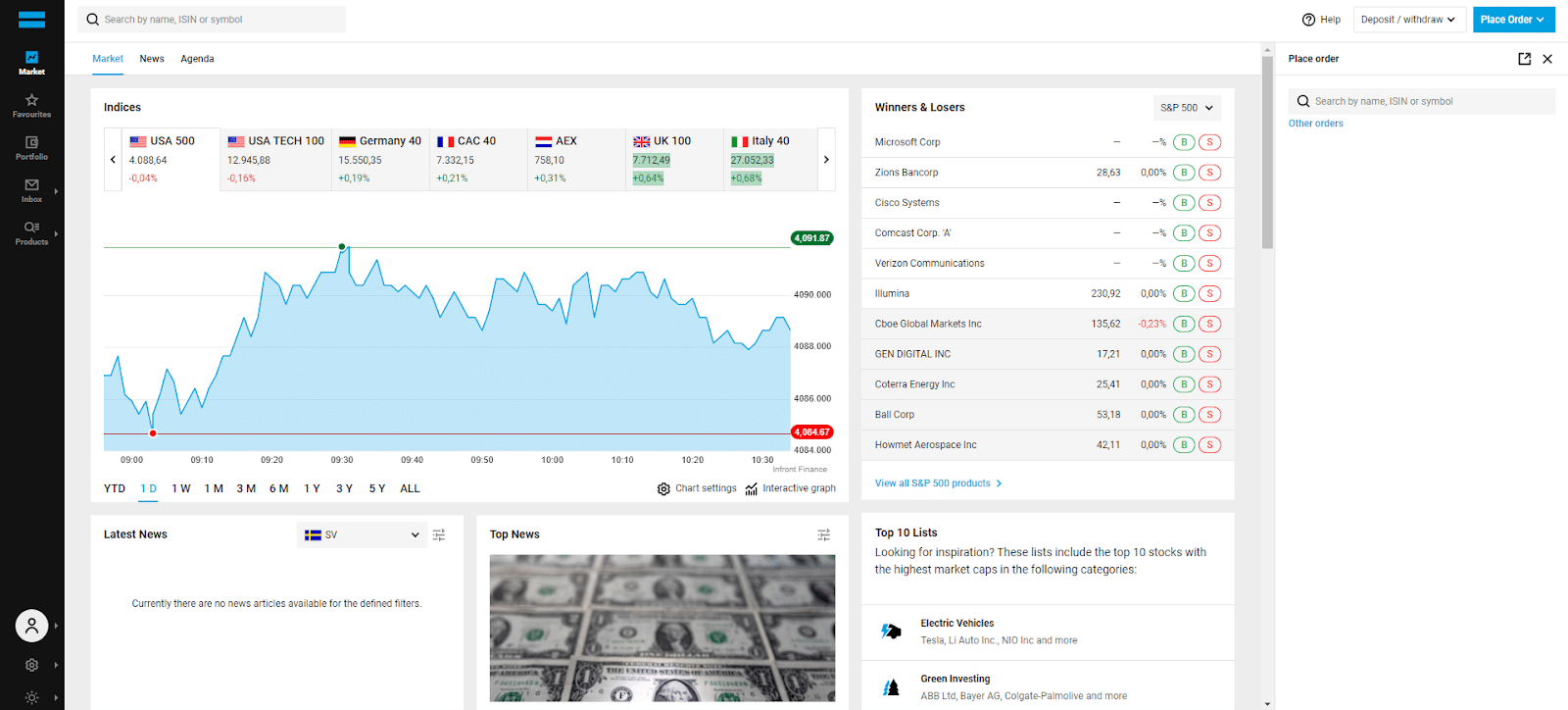
About DEGIRO
DEGIRO is a European low-cost brokerage firm that became popular on the strength of its rates. With millions of users across Europe, it is known for its do-it-yourself philosophy.
It offers a wide range of assets, including stocks, ETFs (with a Core Selection you can trade at low cost), bonds, options, futures, warrants, investment funds and some leveraged products, across dozens of exchanges worldwide.
The mobile app and web platform are basic but efficient and straightforward. The main downsides are the lack of meaningful fundamental research and the absence of price alerts.
DEGIRO is the Dutch branch of flatexDEGIRO Bank AG, a German-regulated bank, supervised by the Dutch AFM. Securities are covered by the German Investor Compensation Scheme, which pays 90% of non-returned assets up to €20,000.
DEGIRO’s pros and cons
Pros
- ETF Core Selection: full range of ETFs/ETCs/ETNs on Tradegate (1,000+ products) for only the €/£1 handling fee, with no connectivity fee (external fees apply)
- User-friendly web and mobile app
- Wide range of investment options
- Education material: Investor’s Academy and Investing with DEGIRO
- Low overall commission structure
- No account opening, inactivity, or withdrawal fee
Cons
- 0.25% currency conversion fee (charged if you deposit or invest in a different currency than your base currency)
- €/£1 flat handling fee (charged in most transactions)
- €/£2.50 of connectivity fee (paid annually), per exchange where you’re invested
- Does not offer Forex or CFDs
- No ISA account (for UK residents)
- Low-quality customer support
- No interest paid on cash balances
About Revolut Trading
Revolut was created to disrupt banking by stripping out the fees attached to traditional banks, and it has since become a licensed bank in its own right.
Alongside its everyday accounts, it lets you invest in stocks, ETFs, commodities and cryptocurrencies from the same app. In the EEA, investing services are provided by Revolut Securities Europe UAB, supervised by the Bank of Lithuania, with investor compensation of up to €22,000. UK clients are served by Revolut Trading Ltd, authorised by the FCA, and can hold their investments in a Stocks and Shares ISA.
The appeal is the combination: your money, your card and your portfolio in one place, with a monthly allowance of commission-free trades included in whichever plan you already pay for. What you give up is breadth. The instrument range is a curated selection rather than access to whole exchanges, so if you are looking for a specific ETF, check it is there before switching.

Revolut Trading pros and cons
Pros
- Simple trading platform
- Easy account opening process
- At least, one free trade per month
- Low trading commissions
- No inactivity fee
- Portfolio transfers now supported (stocks and crypto)
Cons
- Limited range of investment instruments
- Investments not covered by the Financial Services Compensation Scheme
Which one costs less?
The answer depends on how often you invest, and the two structures reward opposite behaviour.
Revolut is cheaper if you trade rarely. Your plan includes a monthly allowance of commission-free trades, so an investor making one purchase a month may pay nothing at all in commission. There is no per-exchange annual fee, and small trades are not penalised.
DEGIRO is cheaper if you invest regularly or in larger amounts. Once you exhaust Revolut’s allowance, the 0.25% commission scales with the size of your order, while DEGIRO’s costs are largely fixed per trade. On a €5,000 purchase, a percentage fee costs considerably more than a flat one.
Two costs are easy to overlook. DEGIRO charges a €2.50 connectivity fee per exchange per year, so a portfolio spread over three exchanges costs €7.50 annually just to hold. On Revolut, the equivalent hidden cost is the subscription: if you pay for a plan mainly for the free trades, that fee belongs in your investing costs.
Currency conversion matters on both, since most popular ETFs and all US stocks are priced in dollars. DEGIRO charges 0.25%; Revolut gives you a free monthly allowance and then applies a markup that depends on your plan and the day of the week.
How to invest in the S&P 500 on DEGIRO and Revolut
Want to see how it works on each platform?
The step-by-step videos below may also help you judge which app feels more usable to you:
DEGIRO vs Revolut Trading: verdict
DEGIRO
Best overall, and for regular investing across many marketsRevolut Trading
Best for convenience if you already bank with Revolut
Choosing between these two is not obvious, because they are not really the same kind of product. DEGIRO is a broker; Revolut is a bank that also lets you invest.
Pick DEGIRO if investing is a deliberate, regular activity, if you want access to European and global exchanges rather than a curated list, or if you need instruments Revolut does not offer, such as bonds, options or futures.
Pick Revolut if you already use it for banking, if you invest occasionally in well-known stocks and ETFs, and if having everything in one app matters more to you than the last few basis points.
There is no rule against using both, and plenty of investors do: a broker for the long-term portfolio and the banking app for occasional purchases.
Want to know more? Explore our in-depth broker reviews, comparison table and BrokerMatch tool.
Disclaimer: investing involves risk of loss. Fees and product availability change and vary by country, so confirm the current terms with each provider before opening an account.