
Saxo (formerly Saxo Bank, majority-owned by the Swiss private bank J. Safra Sarasin since March 2026), a renowned European online broker, announced significant changes to its global operations in 2024.
From 1 July 2024, Saxo ceased onboarding new clients in several countries, including South Africa, as part of a strategic shift to consolidate its operations across core European and key international markets.
This article explains what that decision means for former Saxo clients in South Africa and which platforms you can use instead.
Is Saxo available in South Africa?
No. Since 1 July 2024, Saxo has stopped accepting new clients from South Africa, and according to Saxo’s notice to partners it planned to offboard all existing clients in the countries it left by the end of 2024.
You can check Saxo’s full list of accepted and restricted countries here.
If you try to open a Saxo account from South Africa, you won’t find “South Africa” in the country selector:
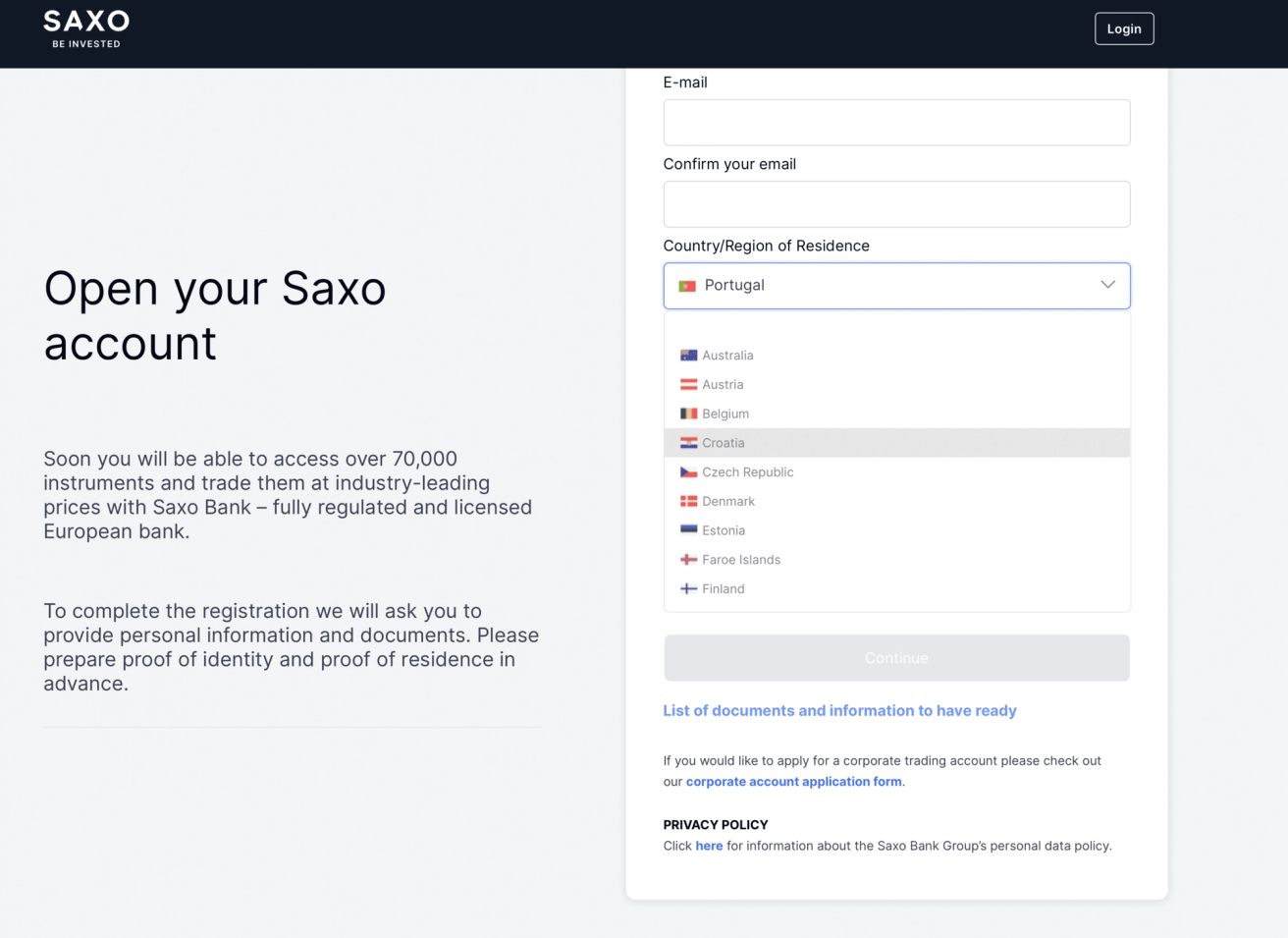
Saxo Bank available countries
Impact on current clients
Existing clients in South Africa did not face immediate offboarding when the decision was announced. Saxo notified them directly about the process and set the end of 2024 as the target to close all accounts in the countries it left.
If you were a Saxo client based in South Africa, you should have received instructions to transfer your assets to another broker or sell them. If you still hold anything at Saxo, contact its support directly, and use one of the alternatives below for new investments.
Alternatives for South African investors
For affected investors, these are the alternatives we recommend:
- Interactive Brokers: best alternative platform overall. Interactive Brokers (IBKR) is Saxo’s closest equivalent globally. It is listed on NASDAQ, has been part of the S&P 500 since August 2025 and offers access to 170+ markets in 40 countries, with a wide range of products (stocks, exchange-traded funds or ETFs, bonds, options, futures, forex and crypto) and low commissions.
- XTB: best for commission-free stocks and ETFs. South African clients are served by XTB International, regulated by the FSC (Financial Services Commission) of Belize. There is no minimum deposit and 0% commission on stocks and ETFs up to €100,000 of monthly turnover (0.2%, min. €10, above that), with a 0.5% currency conversion fee.
- Plus500*: best for contracts for difference (CFDs). Plus500 is listed on the London Stock Exchange and is a FTSE 250 constituent. In South Africa it operates through Plus500AU Pty Ltd, an authorised financial services provider (FSP 47546) supervised by the FSCA (Financial Sector Conduct Authority). It offers CFDs only, not real shares.
*82% of retail CFD accounts lose money.


The table below shows how each alternative serves South African residents.
| Broker | Entity for South Africans | What you can buy | Minimum deposit |
| Interactive Brokers | Group entity assigned at sign-up | Real stocks, ETFs, bonds, options, futures, funds | $0 |
| XTB | XTB International (FSC Belize) | Real stocks and ETFs, plus CFDs | No minimum |
| Plus500 | Plus500AU Pty Ltd (FSCA, FSP 47546) | CFDs only | Varies by payment method |
Source: XTB International account and fees, Plus500 South Africa and Interactive Brokers (October 2026).
What South African investors should know before moving abroad
All three alternatives are offshore platforms, so the money you send them counts towards your foreign investment allowances set by the South African Reserve Bank:
- Single discretionary allowance (SDA): up to R2 million per calendar year without a tax clearance, since 8 April 2026.
- Foreign investment allowance: up to R10 million more per year with an approved Approval for International Transfer (AIT) from SARS (the South African Revenue Service).
Plus500 states on its website that South African clients warrant they have the tax clearance certificates required by their foreign investment allowances.
On taxes, you remain liable in South Africa on your worldwide income. Capital gains above the R50,000 annual exclusion are taxed with a 40% inclusion rate, which means a maximum effective rate of 18% for individuals (SARS capital gains tax rates). For US dividends, filing the W-8BEN form with your broker lowers the US withholding tax from 30% to 15% under the South Africa and United States tax treaty, and that 15% counts towards the South African dividends tax on foreign dividends.
Why did Saxo leave South Africa?
In its notice to partners, Saxo summed up the goal of the exit as optimising resources, ensuring regulatory compliance and mitigating risks. In practice, these were the factors behind it:
- Regulatory compliance: aligning with regulatory requirements across multiple jurisdictions is increasingly complex. Different countries have varied regulatory environments, and maintaining compliance across numerous markets is challenging and resource-intensive.
- Operational efficiency: by reducing its presence in selected markets, Saxo could streamline its operations and concentrate resources on countries that align more closely with its strategic goals and operational capabilities.
- Risk management: exiting certain markets helped Saxo manage financial, legal and operational risks more effectively, including those from regions with more volatile economic conditions or evolving regulatory frameworks.
- Resource optimisation: by concentrating on fewer markets, Saxo can optimise the use of its resources, ensuring it provides high-quality services and innovative solutions in its core markets.
- Strategic focus: this decision was part of Saxo’s broader strategy to enhance service quality and innovation in markets that offer significant business potential and long-term stability. J. Safra Sarasin, which became the majority shareholder in March 2026, has kept the same focus.
Conclusion
Saxo’s exit from South Africa forced its local clients to move, and more than two years later Saxo still does not accept South African residents.
For most former Saxo clients, Interactive Brokers is the closest replacement in range of markets and products. XTB suits those who mainly buy stocks and ETFs and trade less than €100,000 a month, while Plus500 is only for CFD traders. For more options, see our guide to the best trading platforms in South Africa.
FAQ
Can I still open a Saxo account from South Africa?
No. South Africa is not in Saxo’s country selector, and applications from South African residents have been rejected since 1 July 2024.
Can I transfer my shares from Saxo to another broker?
Saxo offered former clients the option to transfer their positions or sell them. If you still have assets there, contact Saxo support and ask your new broker for its incoming transfer form.
Is XTB regulated in South Africa?
No. XTB serves South Africans through XTB International, regulated in Belize. Its South African subsidiary held an FSCA licence but never served clients, and XTB agreed to sell it in 2026.
Which alternative is regulated by the FSCA?
Of the three, only Plus500 operates in South Africa as an FSCA-authorised financial services provider (FSP 47546).