Managing investments takes time, and the tools available changed a lot recently: Mint closed in 2024, and Morningstar retired its free Instant X-Ray and Portfolio Manager tools in 2025. Knowing which tools are still worth using is half the problem.
The right one depends on what you need: simple tracking, dividend and tax reporting, asset allocation analysis, or a full view of your net worth across accounts.
Here are the 6 best portfolio management and tracking tools in 2026, checked in September 2026:
- Empower: best free all-in-one portfolio and net worth tracker (US only).
- Quicken: best for personal finance and budgeting alongside investments (US and Canada).
- Sharesight: best dedicated tracker for dividends, performance and tax reporting.
- Morningstar Investor: best for in-depth fund and portfolio analysis (Portfolio X-Ray).
- Kubera: best for net worth across traditional and alternative assets, including crypto.
- getquin: best free option for European investors.
The 6 best portfolio management tools compared
Empower | Best free all-in-one tracker
Empower, formerly Personal Capital, combines investment tracking, portfolio analysis and financial planning in a free dashboard, linking bank, brokerage and retirement accounts into one view of your net worth. Its limitation is geographic: it works properly only for US accounts.
Quicken | Best for budgeting alongside investments
Quicken covers budgeting, bills, debt, retirement planning and investment tracking in one subscription, with several tiers. It is designed for the US and Canada only.
Sharesight | Best dedicated investment tracker
Built specifically for investors, Sharesight tracks the true performance of your holdings, including dividends, fees and currency effects, with strong tax reporting. Free for up to 10 holdings.
Morningstar Investor | Best for portfolio analysis
The paid subscription that now contains Portfolio X-Ray, alongside Morningstar’s research, ratings and analyst reports. Around $249 a year.
Kubera | Best for alternative assets
Consolidates stocks, bank accounts, crypto, property, vehicles and other assets into one balance sheet, with worldwide coverage and multi-currency support. Subscription only.
getquin | Best free option in Europe
A free European tracker, popular in Germany, that imports positions from European brokers and shows allocation, dividends and performance, with a social feed alongside.
| Tool | Cost | Best for | Where it works |
| Empower | Free | Net worth, allocation and retirement planning | US |
| Quicken | From about $4 to $8 a month | Budgeting plus investment tracking | US and Canada |
| Sharesight | Free up to 10 holdings, then paid | Dividends, performance and tax reports | Worldwide, strongest in AU, NZ, UK and CA |
| Morningstar Investor | About $249 a year | Research and Portfolio X-Ray analysis | Mainly US securities |
| Kubera | About $249 a year | Crypto, property and alternative assets | Worldwide |
| getquin | Free, with an optional paid tier | Tracking European portfolios | Europe |
Prices checked in September 2026 and subject to change. Check each provider’s pricing page before subscribing.
1. Empower
Empower, formerly Personal Capital, is one of the most established tracking and planning platforms, with over 3.3 million registered users. Founded in 2009 and renamed in 2023 after its acquisition by Empower Retirement, it pairs a free dashboard with an optional paid wealth management service. The free dashboard is what matters here, and it is excellent.
Once you link your accounts, bank, cards, brokerage, retirement (401(k), IRA), mortgages and even property, Empower aggregates everything into a real-time view of your net worth. The standout features for investors:
- Investment Checkup: compares your combined allocation across all accounts against a target, flagging where you are over or under-weight.
- Fee Analyzer: scans your holdings for fund fees that are quietly eroding returns.
- Asset allocation view: combines the same holding across accounts, so an ETF held in both an IRA and a 401(k) shows as one position.
- Retirement Planner: models different retirement scenarios and tests whether you are on track.
The tracking, net worth and planning tools are free. Revenue comes from the wealth management service for clients with $100,000 or more, with fees from about 0.89% down to 0.49% as balances grow. One thing to expect: the free dashboard doubles as lead generation, so an adviser will call after you sign up. You can decline and keep using the free tools.
Available on web, iOS and Android. Its main limitation is that it is built for US accounts, and it is weaker on dividend and tax reporting than a dedicated tool like Sharesight.

2. Quicken
Quicken is one of the longest-running personal finance tools, with more than 30 years behind it. It covers the whole picture, budgeting, bills, debt, retirement planning and investment tracking, which suits people who want one tool rather than a dedicated portfolio tracker.
It comes in tiers:
- Quicken Simplifi (about $4 to $6 a month): cloud-based web and mobile app with an investments dashboard showing real-time prices, cost basis and performance.
- Quicken Classic Deluxe (about $6 a month): the desktop product for Windows and Mac, covering budgeting, debt, retirement and core investment tracking.
- Quicken Classic Premier (about $96 a year): adds Portfolio Analyzer, Portfolio X-Ray and a Capital Gains Estimator, plus tax schedules and tax export.
Quicken aggregates 401(k), IRAs and taxable brokerage accounts from over 14,000 institutions, giving a consolidated view of holdings, allocation and performance. Recent versions added AI-assisted forecasting and better tax analysis.
Two limitations matter. Quicken is an aggregation and planning tool, not a trading platform, and it is built for the US and Canada only, so it does not suit European investors. It is also more desktop-centric than newer cloud tools.

3. Sharesight
Sharesight is a portfolio tracker built specifically for investors, used by over 500,000 self-directed investors and professionals. Based in New Zealand, it takes a different approach from budgeting apps: rather than spending and bills, it tracks how your investments have actually performed.
Its biggest strength is true performance tracking. Where a broker statement shows the difference between buy and sell prices, Sharesight calculates your annualised return including dividends, brokerage fees, capital gains and currency movements, which is the only number that answers “how am I really doing”.
Key features:
- Automatic dividend tracking: dividends, yields and reinvestment plans are tracked automatically, with a dividend calendar showing paid, pending and announced payments.
- Tax reporting: taxable income reports split local and foreign income, with capital gains reports for tax time. Country-specific reports are strongest for Australia, New Zealand, the UK and Canada.
- Diversity and exposure reports: these look through your ETFs and funds to show your real allocation by market, sector and asset class, revealing overlaps.
- Coverage: price and dividend data on over 700,000 instruments across 60+ exchanges, with automatic trade imports from 200+ brokers, email confirmations or spreadsheet upload.
- Benchmarking: compare your portfolio against an index over any period.
The free plan covers up to 10 holdings. Paid plans add more holdings, multiple portfolios and advanced reporting such as multi-currency valuation and contribution analysis.
Sharesight suits dividend investors and anyone with accounts at several brokers who wants accurate, tax-ready reporting. Its limitation is scope: no budgeting or spending, so it works alongside a broader tool rather than replacing it. Since Morningstar retired its own portfolio tools in 2025, Sharesight now powers the portfolio manager inside Morningstar Investor.

4. Morningstar Investor
Morningstar is one of the most respected names in investment research, and Morningstar Investor is its consumer subscription. Important context: Morningstar retired its free Instant X-Ray and Portfolio Manager tools in April 2025, folding Portfolio X-Ray into this paid subscription. The tool many investors relied on still exists, but it is no longer free.
The subscription is built around research and analysis. On research you get analyst reports, fair value estimates, Star Ratings, forward-looking Medalist Ratings and the Economic Moat framework across more than 48,000 securities. On the portfolio side:
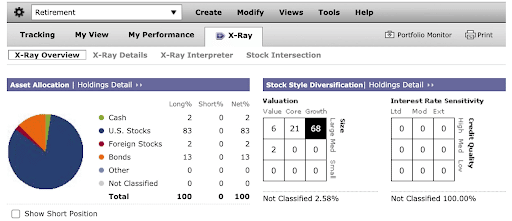
- Portfolio X-Ray: breaks your holdings down by allocation, sector, geography, style and fees, showing where you sit against a benchmark. It is most useful for portfolios holding several funds or ETFs.
- Stock Intersection: shows where your funds overlap, revealing hidden concentration when several “diversified” funds hold the same large caps.
- Account aggregation: links accounts so the portfolio updates automatically, with research and rating changes on your holdings.
It costs around $249 a year, often with a discounted first year and a free trial, with no upsells or premium tiers.
The considerations: it is not cheap next to the free tools here, and its value is in the research rather than the tracking, so if you only want to watch your portfolio’s value, Empower or Sharesight’s free tier will do. Coverage is strongest for US securities, and the platform takes some learning. For long-term fundamental investors who will actually use the research, it is hard to replicate elsewhere.
5. Kubera
Kubera is a net worth tracker for people whose wealth goes beyond a brokerage account. Where traditional trackers focus on stocks and funds, Kubera consolidates everything: stocks, ETFs, bank and retirement accounts, crypto, property, vehicles, collectibles, domains and private holdings, into one balance sheet. Users track over $47 billion in assets on the platform.
Its strengths:
- Connectivity: 20,000+ banks, brokerages and fintechs worldwide, through aggregators including Plaid, Yodlee, Flinks and Salt Edge, with multi-currency tracking.
- Crypto and alternative assets: connects wallets and exchanges (Coinbase, Kraken, MetaMask and others) and tracks DeFi across several chains, plus hard-to-value assets like property, cars and domains.
- Privacy: ad-free, and it does not sell user data, a deliberate contrast with free dashboards that monetise through advertising or lead generation.
- Extras: AI-assisted imports from spreadsheets and screenshots, a projection tool, and a feature that helps a beneficiary locate your assets if something happens to you.
Kubera is subscription only, around $249 a year with a 14-day trial and no free tier. It uses bank-level encryption and does not store login credentials.
The consideration is price against purpose: it is a tracking tool, not an analysis or budgeting platform. For investors with crypto, property or assets spread across countries, it gives the cleanest single view of total net worth.

6. getquin
Most of the tools above are built for US accounts, which leaves European investors short. getquin fills that gap: a free tracker, popular in Germany and across Europe, that imports positions from European brokers and shows performance, allocation and dividends in one place.
It covers stocks, ETFs, funds, crypto and cash, with automatic dividend tracking and a look-through view of what your ETFs actually hold. Connections to major European brokers import positions automatically, and anything unsupported can be added manually or by spreadsheet. There is also a social feed where users share portfolios and discuss holdings, which you can ignore entirely if it isn’t for you.
The core product is free, with an optional paid tier that adds deeper analysis. It is a tracking tool rather than a research platform, and it doesn’t do budgeting or tax reports at Sharesight’s level, but for a European investor who wants to see everything in one dashboard without paying, it is the most practical starting point.
How to choose
Four questions narrow it down quickly:
- Where do you live? Empower and Quicken work properly only in the US, and Quicken in Canada. European investors are down to Sharesight, Kubera or getquin.
- Do you need tax reports? If you file capital gains and dividends yourself, Sharesight saves the most time, especially if you hold assets in more than one currency.
- Tracking or analysis? Tracking answers “what do I own and how is it doing”. Analysis answers “is this portfolio well built”. Only Morningstar Investor really does the second.
- What else do you own? If a meaningful part of your wealth sits in crypto, property or other assets, Kubera is the only one here that handles them properly.
One caution on linking accounts: these tools connect through aggregators using read-only access, so they cannot trade on your behalf. Even so, you are granting a third party visibility over your finances, so check the provider’s security page and enable two-factor authentication.
What is portfolio management software?
It is a tool that tracks and analyses your investments, typically offering portfolio tracking, performance analysis, allocation breakdowns, dividend and tax reporting, and consolidated reporting across accounts.
Most also link to your brokerage and bank accounts, giving one view of your holdings. That makes it easier to monitor performance, spot overexposure to a sector or asset and understand your real allocation, including the effect of dividends, fees and currency.
Bottom line
Portfolio software helps in four ways: it consolidates accounts in one place, gives you accurate performance numbers to decide with, shows your real diversification and overlaps, and automates the manual work of dividend and tax tracking.
In 2026 there is a good option at every price point. Empower if you are in the US and want a free dashboard, Quicken if you want budgeting in the same tool, Sharesight if you want accurate performance and tax reports, Morningstar Investor if you want research and analysis, Kubera if your wealth spans crypto and property, and getquin if you are in Europe and want something free.
If you have questions, get in touch.
FAQs
Which portfolio tracker is best?
It depends on what you need and where you live. For free tracking in the US, Empower. For accurate performance and tax reporting anywhere, Sharesight. For research and analysis, Morningstar Investor. For crypto and alternative assets, Kubera. For a free option in Europe, getquin.
Is there a portfolio tracker for the UK?
Yes. Sharesight has specific UK tax reports and handles multi-currency portfolios well, which matters if you hold US shares. Kubera works in the UK too, and getquin covers UK brokers. Empower and Quicken do not.
Is there a portfolio tracker for Europe?
Yes. getquin is the free option built for European brokers, Sharesight works across Europe with strong multi-currency tracking, and Kubera covers European institutions through its aggregators. Empower and Quicken are US-focused and won’t connect to European accounts.
Is there a portfolio tracker for Canada?
Yes. Sharesight offers Canada-specific tax reports, and Quicken supports Canadian accounts alongside US ones. Kubera also connects to Canadian institutions.
Is there a portfolio tracker for Australia?
Yes. Sharesight was built in New Zealand and its Australian tax reporting, including franking credits, is the strongest of any tool here. Kubera also supports Australian institutions.
Are free portfolio trackers safe?
They connect through aggregators with read-only access, so they cannot trade or move money. The trade-off with free tools is how they make money: Empower uses the dashboard to find wealth management clients, so expect a call. Whichever you choose, check the security page and turn on two-factor authentication.
What replaced Morningstar's free Instant X-Ray?
Morningstar retired the free Instant X-Ray and Portfolio Manager in April 2025 and moved Portfolio X-Ray into its paid Morningstar Investor subscription. If you want the look-through analysis without paying for research, Sharesight’s diversity and exposure reports cover much of the same ground.