
Hello there. Everyone is looking for stocks that double or triple in value, and penny stocks are certainly an attractive option for investors hoping to grow their money quickly. However, penny stocks are not available on every broker’s platform. So if you have a DEGIRO account, or are planning to open one, you may be wondering whether you can trade penny stocks there.
In this article, you will find out whether you can trade penny stocks on DEGIRO and how to find them. We also briefly cover what penny stocks are, the risks involved, and some practical tips that may help. Let us get right into it.
What are penny stocks?
As the name implies, a penny stock is typically:
- A micro-cap company that trades at a very low share price.
- Highly speculative and risky due to low trading volume, wide bid-ask spreads, and limited publicly available information.
- Appealing to many investors because it allows them to buy a large number of shares, hoping they are buying the next Amazon or Apple and anticipating a substantial price increase.
Although penny stocks are often assumed to trade below $1, €1 or £1, the US Securities and Exchange Commission (SEC) says the term generally refers to shares of very small companies trading at less than $5. Some trade on regulated exchanges, while others trade over-the-counter (OTC). As a result, not all brokers give you access to buy and sell them. Penny stocks can rise sharply, but they carry significant risks from low liquidity, high volatility and limited disclosure.
Some examples of low-priced stocks listed on exchanges that DEGIRO covers:
| Company | Exchange | Approx. share price |
| Nextedia | Euronext Growth Paris | €0.30 |
| Sporting SAD | Euronext Lisbon | €0.99 |
| Vista Alegre Atlantis | Euronext Lisbon | €1.07 |
| Lloyds Banking Group | London Stock Exchange | 108p |
| Vodafone | London Stock Exchange | 125p |
| Solocal Group | Euronext Paris | €3.86 |
| Arcadia Biosciences | Nasdaq | $0.28 |
Prices from late September to mid-October 2026, rounded. Solocal Group trades above €1 after a 1-for-1,000 share consolidation in 2024, but still qualifies under the SEC’s $5 threshold, as do Lloyds and Vodafone.
Note: share prices change constantly, and a company classified as a penny stock at one point may no longer qualify later. Rolls-Royce, for example, fell as low as 64p in September 2022 but traded at around £14 in October 2026, so it no longer fits the category. The opposite also happens: companies such as Meyer Burger and A.S. Roma, which used to appear in lists like this one, have since been delisted. Always verify the current share price and listing venue before trading.
Can you trade penny stocks on DEGIRO?
Yes, you can trade some penny stocks on DEGIRO, since the broker provides access to a large number of European and international exchanges where low-priced shares are listed. However, availability depends on the specific exchange where a given stock trades. Importantly, DEGIRO does not let you buy securities on over-the-counter (OTC) markets, so penny stocks quoted only on OTC venues (such as OTC Markets Group’s Pink or OTCQB tiers in the US) are not available, as its helpdesk confirms.
Keep in mind that DEGIRO charges an exchange connectivity fee of €2.50 per exchange per year (or 0.25% of your account value, if lower) for every exchange you trade on outside your home market. Trading penny stocks across several international venues can therefore add up. These are the main DEGIRO fees for Irish clients:
| Fee | Amount |
| US stocks (NYSE and Nasdaq) | €1 + €1 handling fee per order |
| European stocks (Euronext, Xetra, LSE, SIX) | €3.90 + €1 handling fee per order |
| Exchange connectivity fee | €2.50 per exchange per year |
| Currency conversion (auto FX) | 0.25% |
Source: DEGIRO Ireland fees, October 2026. Fees vary slightly by country of residence.
Fixed fees weigh heavily on the small positions typical of penny stocks. For example, buying and later selling €200 of Nextedia costs €9.80 in commissions and handling fees, or 4.9% of the amount invested, before the bid-ask spread. The same round trip on €200 of a US-listed stock costs €4 plus €1 of currency conversion, or 2.5%.
How to trade penny stocks on DEGIRO
To start trading penny stocks on DEGIRO, you simply have to follow the below steps:
- Open an account at DEGIRO. If you want, you can check our review before proceeding.
Disclaimer: Investing involves risk of loss. - After opening an account at DEGIRO, you have to identify the right penny stock. You can navigate the screener, which gives you access to more than 45 exchanges in 30 countries, and find stocks that trade at very low prices.
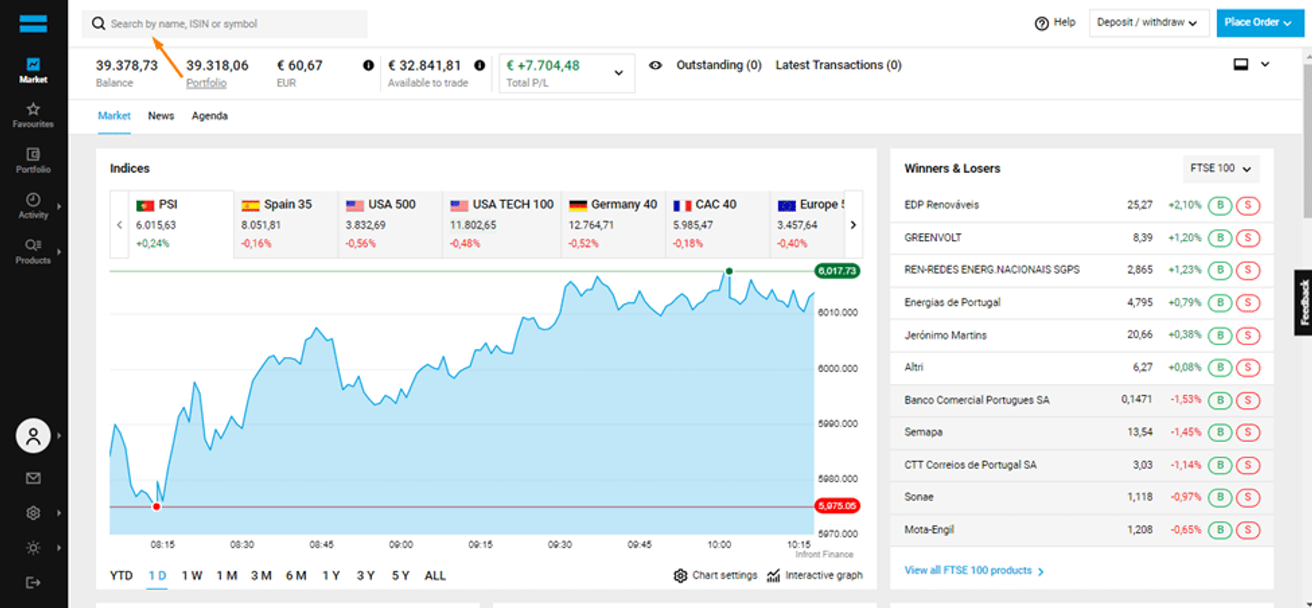
- We recommend in-depth research before deciding which penny stock to buy. You can check the historical prices to see whether the stock has been trading for some time below $5 or if it has plunged recently due to some information. You must also research the company to determine if it is worth the investment. As it is listed on an exchange, you can check its financial statements and website and read what analysts say about its outlook.
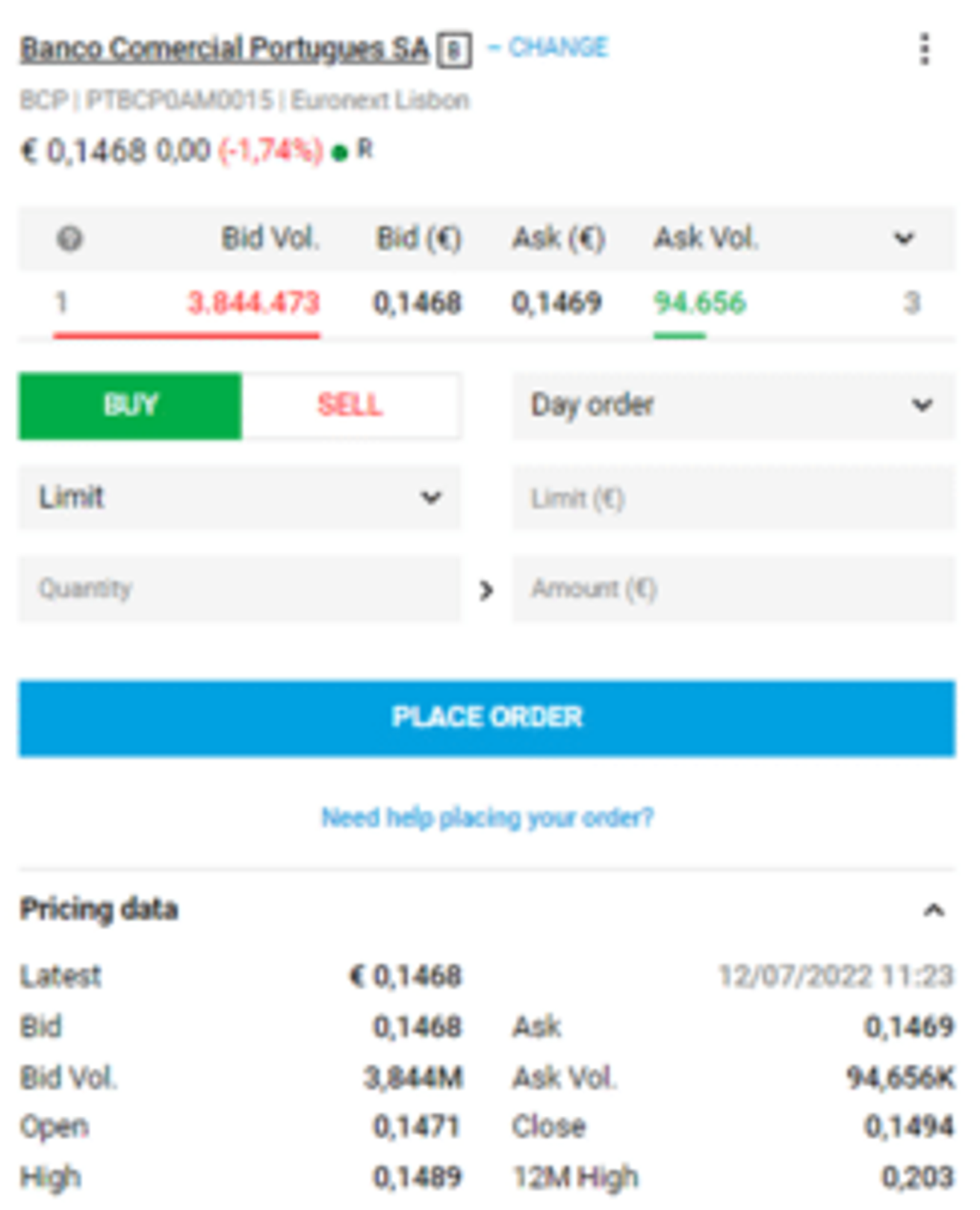
- Decide if you want to buy or sell the penny stock and click on the “Buy” or “Sell” button. Choose the order type (market, limit, stop loss or stop limit) and the size of your trade. Limit orders are usually the safer choice for illiquid penny stocks, as they cap the price you pay. DEGIRO doesn’t offer a take-profit order, so to lock in gains you need a separate limit sell order. Then click on the “Place order” button.
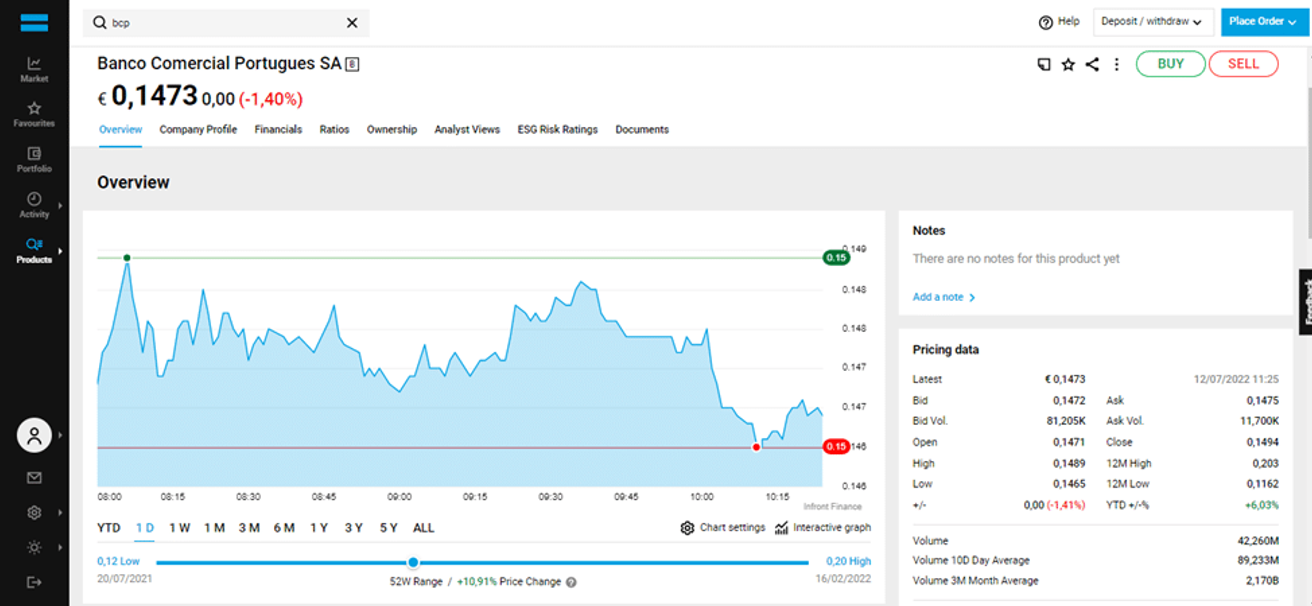
- You can now begin monitoring your position and regularly checking the news for any company announcements or updates.
Penny stocks pros and cons
Pros
- Potential for high returns
- Very low price per share
- You can get exposure to penny stocks with a very small amount of money
Cons
- Limited information available on the company
- Low trading volume
- Price easily manipulated
- Very risky investments
Penny stocks investment tips
After this brief overview of the risks and potential returns of penny stocks, here are a few practical tips worth keeping in mind when investing in them:
- Research the company thoroughly: only invest in businesses you genuinely understand. Look at revenue, cash position, debt levels, and whether the company has a viable path to profitability rather than relying on narrative alone.
- Use stop-loss orders: it is best to determine a stop-loss level before entering a trade, setting a price limit representing the maximum loss you are willing to accept. Once reached, it triggers an automatic closure of your position. Note that in illiquid stocks, slippage can mean execution occurs meaningfully below your stop level.
- Be alert to penny stock fraud schemes: misleading promotional information is sometimes circulated to artificially inflate prices (“pump and dump”). Stay sceptical of unsolicited tips and update your order limits regularly. This applies particularly to OTC-traded stocks, which face far lighter disclosure requirements.
- Check the total cost of the trade: commissions, exchange connectivity fees, currency conversion (FX) costs, and the bid-ask spread can consume a large share of the potential return on a small position. Assess the cost/benefit before executing.
- Size positions appropriately: given the elevated probability of permanent capital loss, penny stocks should represent only a small, deliberately limited portion of a diversified portfolio.
Bottom line
DEGIRO does allow you to trade penny stocks, but availability depends on the exchange where the shares are listed, and DEGIRO does not provide access to OTC penny stocks.
Remember that penny stocks are high-risk investments due to elevated volatility, low trading volume, wide spreads, and limited visibility into a company’s financials and operations. The probability of permanent capital loss is materially higher than with established, larger-capitalisation companies.
For that reason, we believe penny stocks are only suitable for investors with a genuinely high risk tolerance, who fully understand the risks involved and can comfortably absorb significant losses without it affecting their broader financial position. For most investors building long-term wealth, diversified low-cost ETFs remain a more common foundation.
FAQs
Can I buy OTC penny stocks on DEGIRO?
No, DEGIRO does not give you access to trade OTC penny stocks. You can only trade instruments that are listed on regular exchanges.
What is the best penny stock?
There are no best penny stocks. Penny stocks are highly volatile and speculative investments, and you need to do appropriate research before investing in penny stocks.
Can you make money on a penny stock?
Although penny stocks are considered among the riskiest stocks on the market, some investors make large gains by picking the right ones. Many penny stocks also lose most of their value or are delisted, as the examples in this article show.
Should you invest in penny stocks?
It depends on your willingness to accept risk. Penny stocks are highly risky, so you should be prepared to lose a large part of the amount invested.
What happens if a stock I hold on DEGIRO moves to the OTC market?
If a stock you already hold is delisted and continues trading OTC, DEGIRO may let you sell it, but sell orders are reviewed manually and very low-priced securities can be rejected. You cannot buy more.
How much does it cost to trade penny stocks on DEGIRO?
For Irish clients, US stocks cost €1 plus a €1 handling fee per order, and most European stocks €3.90 plus €1. On top of that come the €2.50 yearly connectivity fee per foreign exchange and 0.25% for currency conversion.