DEGIRO is one of the largest European online brokerage firms, with over 3.5 million customers across Europe.
Yes, DEGIRO offers real cryptocurrency trading across most of its key European markets. Following the rollout that began in Germany in early 2025 and expanded through Austria, the Netherlands, France, and Spain later that year, DEGIRO clients can now trade around 20 cryptocurrencies (including Bitcoin and Ethereum) 24/7, from a minimum order size of just €1, directly within their DEGIRO account at a low 0.5% per-trade fee.
For investors in markets where real crypto isn’t yet available, or for those who prefer indirect exposure for tax or regulatory reasons, DEGIRO also offers crypto-related ETPs (Exchange Traded Products).
In this article, we’ll cover both options – how to gain exposure to cryptocurrencies on DEGIRO through real crypto trading (where available) and through ETPs, alongside their respective pros and cons. We’ll also look at alternative platforms for investors who want broader crypto access.
Can you buy crypto on DEGIRO?
Yes – DEGIRO offers real crypto trading across most of its key European markets, including Germany, Austria, the Netherlands, France, and Spain. Clients in these markets can directly buy and sell around 20 cryptocurrencies (including Bitcoin, Ethereum, and other major coins) within their DEGIRO account, 24/7, with a minimum order size of €1 and a flat fee of 0.5% per trade.
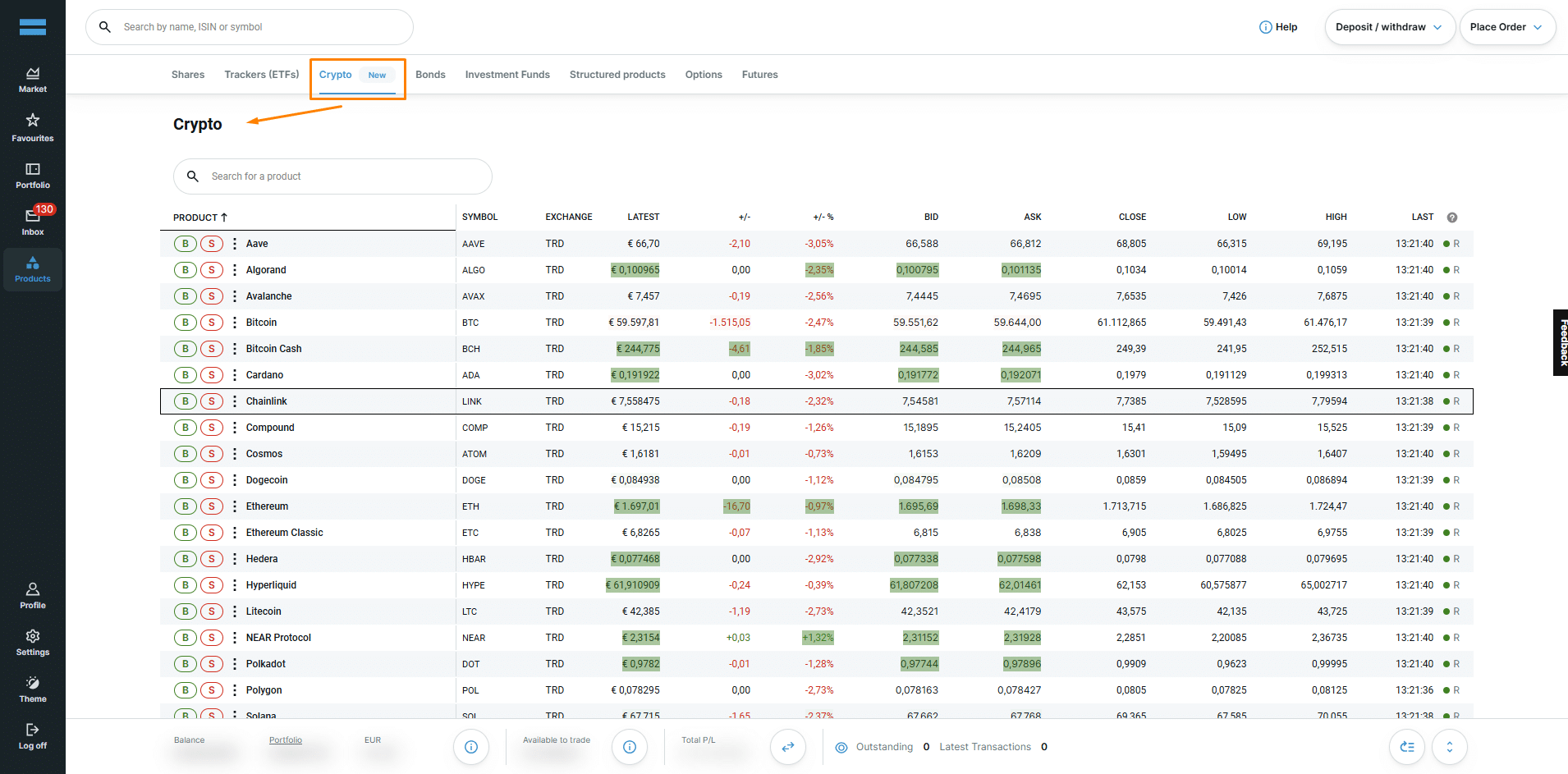
That said, real crypto trading isn’t yet available in every market DEGIRO serves. In countries where direct crypto trading hasn’t launched, clients can still gain crypto exposure through ETPs (Exchange Traded Products) that track the price of cryptocurrencies like Bitcoin and Ethereum – essentially providing similar price exposure without holding the underlying coin.
An ETP is a financial instrument that tracks an underlying security, index, or asset. ETPs can be benchmarked to commodities, currencies, equity indices, bonds, or – as in this case – cryptocurrencies. They’re a useful option if your goal is to mirror the price movement of an asset within a regulated brokerage account, particularly where direct ownership isn’t possible or preferred.
Cryptocurrency ETPs at DEGIRO
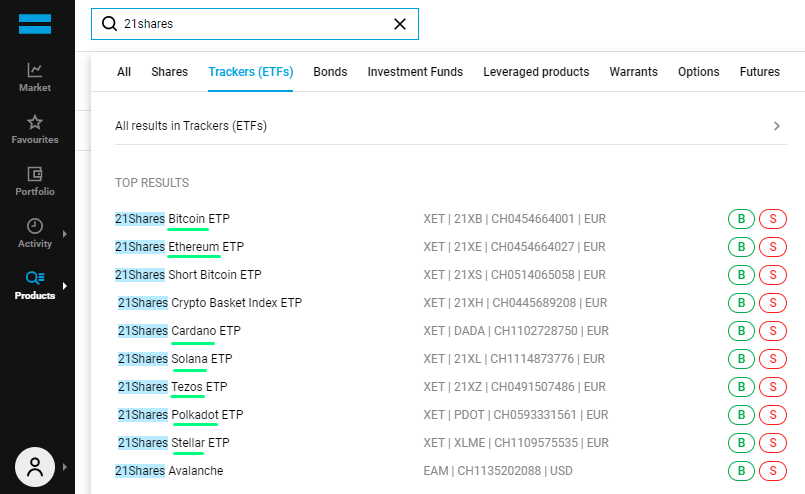
Through 21Shares ETPs, you can gain exposure to Bitcoin, Ethereum, Cardano and other cryptocurrencies at DEGIRO, as you can see:
The 21Shares ETPs are non-interest bearing bonds fully physically backed by holdings of the cryptocurrencies that it gives you exposure to. For instance, the “21Shares Bitcoin ETP” (Ticker: ABTC) is designed to provide exposure to the performance of Bitcoin (BTC), the underlying asset, and it does an excellent job of doing precisely that:
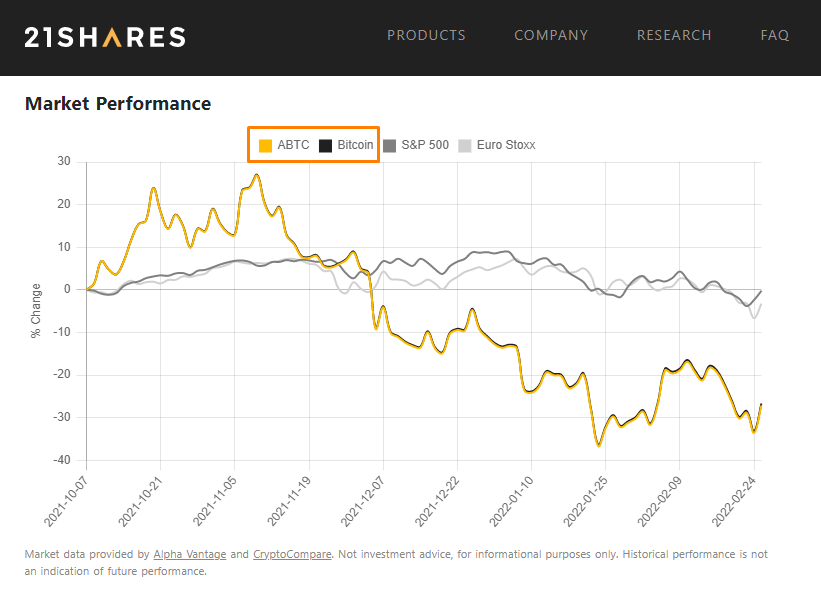
The image clearly shows the overlap between the yellow line (21Shares Bitcoin ETP) and the black one (bitcoin itself). There is no divergence between those prices. Given those results, you may wonder: “Why should I invest through a third party (the ETP issuer – 21Shares in this case) when I can simply buy the underlying asset?”
To answer that question, we need to address the advantages and disadvantages of using ETPs to invest in cryptocurrencies.
Pros and Cons of investing in crypto ETPs
Pros
-
Easy way to invest in crypto through your broker. The hassle of opening a new account in an exclusively dedicated crypto broker or another traditional broker with direct exposure to cryptos may not be entirely justified (for organizational purposes, for example).
- The 21Shares ETPs are a highly regulated Swiss product with custody provided by Coinbase. So, you are pretty safe that the company itself will not close doors with no natural consequence, as it happened in other instances.
Cons
-
You have no direct ownership of crypto. Since you do not directly own the cryptos, you can't transfer into another wallet, make peer to peer transactions, use voting rights, and other keyholder rights.
-
Whereas Cryptocurrencies can be traded 24/7, ETPs only transact during market hours. In the first image of this article, you may have noticed the symbol “XET” in all ETPs. “XET” is the short version for Xetra, a german exchange, trading between 9 a.m. to 5:30 p.m. So, you can only buy or sell between those hours.
- You pay a management fee for owing an ETP. 21Shares charges a 1.49% annual fee for its ETP products (automatically deducted in the price of the ETP), which may be pretty expensive in the long term.
Alternatives for real exposure to cryptocurrencies
If your main goal is to own all the cryptos you buy, DEGIRO is not the right platform. As such, here are other alternatives:
eToro
Trusted by over 35 million users worldwide, it gives you access to over 100 cryptocurrencies. You can trade by yourself or copy other investors’ trades through social trading features. Read our eToro summary.
Coinbase
Coinbase is a top crypto exchange in the US and the second-largest exchange worldwide by trading volume. It has over 95 million users spread across 103 countries. Explore our Coinbase summary.
Crypto.com
A crypto investment and staking platform (earn interest). It created a native cryptocurrency called Cronos (CRO). It enables customers to pay for goods and services using the Crypto.com DeFi Wallet App. Explore our Crypto.com summary.
Kraken
Kraken is the fifth largest Bitcoin exchange globally, according to trade volumes. Kraken is operational in over 200 countries, with a chunk of its 12 million users resident in Europe. Read our Kraken summary.
Disclaimer: You should be aware that the risk of loss in trading or holding digital currencies can be substantial. As with any asset, the value of digital currencies can go up or down, and there can be a considerable risk that you lose money buying, selling, holding, or investing in digital currencies.
1# eToro

eToro at a glance
Founded in 2007, eToro is a well-known global fintech and leader in social trading (the ability to follow and copy other investors’ trades), with over 40 million users worldwide. It went public on NASDAQ (ticker: ETOR) in May 2025 – a notable credibility milestone. In addition to a broad range of crypto products, eToro also offers stocks, ETFs, commodities, forex, and CFDs.
Commissions for crypto trading on eToro are 1% per trade (built into the spread), with no separate trading commission beyond that.
Opening an account and depositing is straightforward, and you can practise with a free demo account before committing real money. You can fund your account via several payment methods including credit/debit card, bank transfer, PayPal, and other regional options. On the downside, the only base currency is USD – so European investors funding in EUR (or other currencies) will incur a currency conversion fee on deposits and withdrawals. Withdrawals also carry a $5 fee (with a $30 minimum), and spreads on some products can be wider than at specialist brokers.
Want to know more about eToro? Read our full eToro review.
*Both credit cards and PayPal are not available for the UK and FCA users.
Don’t invest unless you’re prepared to lose all the money you invest. This is a high-risk investment and you should not expect to be protected if something goes wrong. Take 2 mins to learn more.
2# Coinbase

Coinbase at a glance
Coinbase is one of the world’s largest and most established cryptocurrency exchanges, listed on NASDAQ (ticker: COIN) since April 2021. With over 100 million verified users globally, Coinbase serves both retail and institutional clients – offering simple buy/sell tools for beginners through Coinbase, and more advanced features (formerly Coinbase Pro) through Coinbase Advanced Trade.
The range of cryptocurrencies available is extensive, covering major coins (Bitcoin, Ethereum, Solana) as well as a wide spread of altcoins. The platform offers a polished web interface and a highly functional mobile app, allowing users to buy, sell, stake, and manage their crypto holdings on the go. In recent years Coinbase has also significantly expanded its offering – launching US perpetual futures in 2025 and completing the acquisition of Deribit (a leading crypto derivatives exchange) the same year.
On the downside, the standard “simple” Coinbase interface carries higher fees than Coinbase Advanced Trade, particularly for smaller transactions, and the fee structure can feel complex. For active traders, Advanced Trade typically offers significantly better pricing.
Coinbase is licensed in most US jurisdictions and is registered with FinCEN as a Money Services Business. In Europe, Coinbase Europe Limited is regulated by the Central Bank of Ireland and operates across the EU under the EU’s MiCA framework (in force since December 2024). UK clients are served via Coinbase’s FCA-registered entity.
3# Crypto.com

Crypto.com at a glance
Crypto.com is an all-in-one crypto platform founded in 2016 (originally as Monaco Technologies). It lets users trade, spend, and store cryptocurrencies, with a particularly strong consumer brand thanks to high-profile sponsorships in sports (including the Crypto.com Arena in Los Angeles) and entertainment. The platform has also expanded significantly into the US institutional market, with a 2025 partnership with Trump Media to launch CRO Strategy, a Nasdaq-listed company holding Crypto.com’s native CRO token as a treasury asset.
Crypto.com offers a robust feature set: 250+ cryptocurrencies to trade, a popular pre-paid Visa card that allows crypto spending and earns CRO rewards, staking products with attractive yields, a DeFi wallet, and an NFT marketplace.
That said, newer crypto investors may find Crypto.com’s trading interface complex, educational resources can be limited compared to peers like Coinbase, and fees on lower-volume trades are higher than on the platform’s Advanced/Exchange tier. The card programme has also seen its reward rates reduced over time compared with the original 2021 levels.
4# Kraken

Kraken at a glance
Founded in 2011, Kraken is one of the oldest and most established crypto exchanges in the world. It supports trading in 250+ cryptocurrencies with competitive fees (Pro tier maker fees from 0.00% and taker fees from 0.10%, scaling down further at higher volumes), versatile funding options, 24/7 customer support, and a strong track record on security and transparency (including regular Proof-of-Reserves attestations).
Kraken has a dedicated educational section (“Kraken Learn“) with guides on crypto fundamentals, trading strategies, and security best practices – genuinely useful for newer investors before they make their first trade. In recent years Kraken has also significantly broadened its offering: it now supports staking, derivatives (Kraken Futures), institutional services, and a fast-growing presence in the US market following its resolution with the SEC in 2025 and the platform’s continued expansion into regulated services.
The “Instant Buy” feature on the consumer app is convenient but more expensive – fees start at around 0.9% for stablecoin purchases and 1.5% for other cryptocurrencies. For lower costs, the Kraken Pro interface offers significantly tighter pricing and more advanced trading tools, though it has a steeper learning curve. Kraken’s main consumer app remains intentionally simple, which can feel basic to advanced users.
Which crypto platform should you choose?
Before making your final decision, weigh up the key factors: exchange security and Proof-of-Reserves transparency, fees (both headline and FX/conversion costs), liquidity on the coins you want to trade, regulation (particularly important in the EU post-MiCA), available features (staking, derivatives, fiat on/off ramps), and overall user experience. Finding the right crypto platform takes some research, but it’s worth the effort.
The best crypto exchange for you will depend on your experience, preferences, and objectives. For European investors, DEGIRO’s direct crypto offering (where available) is a uniquely convenient option if you want to keep crypto and traditional assets in a single regulated brokerage account. For those wanting a broader coin selection, staking, or more advanced trading features, dedicated crypto exchanges like Coinbase, Kraken, or Crypto.com remain stronger choices.
Explore the platforms above and decide which best fits your needs.
This article is for informational purposes only and does not constitute financial or investment advice. Cryptocurrencies are highly volatile and speculative assets – their value can fluctuate dramatically and you can lose your entire investment. Always do your own research, consider your own financial situation and risk tolerance, and only invest amounts you can afford to lose.