BlackBull and Pepperstone look similar on paper. Both are ECN-style brokers with raw spreads, both support MetaTrader 4, MetaTrader 5, cTrader and TradingView, and both let you open an account with no minimum deposit. If you knew BlackBull as BlackBull Markets, it is the same company: it rebranded and now trades simply as BlackBull, on blackbull.com.
To help you choose, we put together an unbiased comparison of BlackBull and Pepperstone with a UK focus, covering safety, costs, products, platforms, account opening and what real users say. We also tried opening a BlackBull account from the UK ourselves, and what we found is the key to this whole comparison.
Here’s our quick take:
- Pepperstone: Our recommended choice, and the clear winner for UK traders. FCA-regulated with FSCS protection up to £85,000, raw spreads from 0.0 pips, no inactivity or withdrawal fees on standard methods, tax-efficient spread betting and every major trading platform.
- BlackBull: A legitimate New Zealand broker with very competitive pricing, a huge instrument list including real shares through BlackBull Invest and one of the highest Trustpilot scores in the industry. The problem for UK traders is that it is not authorised by the FCA, so UK sign-ups land on its offshore Seychelles entity with no compensation scheme behind it.
BlackBull vs Pepperstone in a nutshell
| Area | BlackBull | Pepperstone |
| Product offering | CFDs on forex, indices, commodities, shares and crypto, plus real shares through BlackBull Invest (26,000+ instruments claimed) | Spread betting and CFDs on forex, indices, commodities, shares and ETFs (1,000+ markets) |
| Interest on cash | Not applicable | Not applicable |
| Trading platforms | MetaTrader 4, MetaTrader 5, cTrader, TradingView, BlackBull CopyTrader, BlackBull Invest app | MetaTrader 4, MetaTrader 5, cTrader, TradingView, Pepperstone platform and app |
| Account types | ECN Standard, ECN Prime, Prime+ | Standard, Razor, spread betting, professional |
| Account currencies | USD, GBP, EUR, AUD, NZD, CAD, JPY, SGD and others | GBP, USD, EUR, AUD, CHF, SGD, HKD and others |
| Account opening, cash and portfolio transfers | Fully online, no minimum deposit, free deposits, $5 withdrawal fee | Fully online, no minimum by bank transfer (£10 by other methods), free deposits and withdrawals except international bank wires |
| Fees | ECN Prime: EUR/USD from 0.0 pips plus $3 per lot per side. ECN Standard: from 0.8 pips, no commission | Razor: EUR/USD from 0.0 pips plus £2.25 per lot per side. Standard: from 1 pip, no commission |
| Education, research and demo account | It’s a tie – both have solid education and free demo accounts. | It’s a tie – both have solid education and free demo accounts. |
| Security | Regulated by the FMA in New Zealand (NZ clients) and the FSA in Seychelles (everyone else, including UK sign-ups). Not FCA-authorised. No investor compensation scheme | FCA-regulated in the UK, FSCS cover up to £85,000, plus ASIC, BaFin, CySEC and DFSA licences elsewhere |
| Customer support | 24-hour live chat, phone and email. Trustpilot around 4.7/5 | 24-hour live chat, phone and email during the trading week. Trustpilot around 4.3/5 |
| Verdict | Best for non-UK traders who want a huge instrument list and top-rated support | Best overall and the clear winner for UK traders |
Source: BlackBull and Pepperstone UK websites, September 2026
1. Flash overview of BlackBull and Pepperstone
BlackBull was founded in Auckland, New Zealand, in 2014 as BlackBull Markets. In 2025 it rebranded to BlackBull and moved to blackbull.com. It is an ECN-style broker built around third-party platforms (MetaTrader 4, MetaTrader 5, cTrader and TradingView) and it markets a very large instrument list, including real share investing through BlackBull Invest.
BlackBull operates through two trading entities. Black Bull Group Limited is registered in New Zealand and licensed by the Financial Markets Authority (FMA) as a derivatives issuer under FSP403326. BBG Limited is incorporated in the Seychelles and licensed by the Seychelles Financial Services Authority (FSA) under SD045. New Zealand residents are onboarded by the first. Everyone else, including UK residents, is onboarded by the second..

Pepperstone was founded in Melbourne in 2010 and has grown into one of the largest forex and CFD brokers in the world, with over 900,000 accounts across the group as of March 2026.
UK clients are served by Pepperstone Limited, authorised and regulated by the FCA under reference number 684312. The wider group also holds licences from ASIC in Australia, CySEC in Cyprus, BaFin in Germany and the DFSA in Dubai.
Pepperstone is a pure trading specialist: spread betting and CFDs on forex, indices, commodities, shares and ETFs, with raw spreads, fast execution and support for every major third-party platform. It does not offer share ownership.

2. Product offering
On paper BlackBull offers far more. Its headline figure is over 26,000 instruments, most of them shares available through BlackBull Invest. On the trading side, the list you actually see on MetaTrader is much smaller, from a few hundred to a couple of thousand symbols depending on the platform. Pepperstone offers over 1,000 CFD markets across forex, indices, commodities, shares and ETFs. The table below summarises the products available with each broker.
| Asset class | BlackBull | Pepperstone |
| Forex CFDs | ✔ | ✔ |
| Index and commodity CFDs | ✔ | ✔ |
| Share CFDs | ✔ | ✔ |
| ETF CFDs | ✘ | ✔ |
| Crypto CFDs | ✔ (offshore entity) | Not available to UK retail clients |
| Spread betting | ✘ | ✔ (UK residents) |
| Real shares (ownership) | ✔ (BlackBull Invest) | ✘ |
Source: BlackBull and Pepperstone UK websites, September 2026. Crypto CFDs are not available to retail clients of FCA-regulated brokers.
The UK trump card: spread betting
For UK traders, Pepperstone has one product BlackBull cannot match. Spread betting gives you the same markets and the same tight spreads as CFDs, but profits are currently free from capital gains tax and stamp duty for UK residents. Tax treatment depends on your individual circumstances and tax law may change, but for many British traders this is a serious advantage. BlackBull does not offer spread betting at all.
So if you want to collect shares from around the world, BlackBull’s range is genuinely wider. If you are a UK trader, Pepperstone takes this round.
3. Trading platforms
This is the one area where the two brokers are almost identical, and it is a tie.
BlackBull trading platforms
BlackBull has no proprietary trading platform for CFDs. Instead it gives you MetaTrader 4, MetaTrader 5, cTrader and TradingView, plus BlackBull CopyTrader for copy trading and a separate BlackBull Invest app for share investing. Expert Advisors, cBots and VPS hosting are all supported, which makes it a natural home for algorithmic traders.
Pepperstone trading platforms
Pepperstone offers the same four third-party platforms (MetaTrader 4, MetaTrader 5, cTrader and TradingView) and adds its own Pepperstone platform and mobile app, all connected to the same account and pricing. Whatever setup you already use, you can bring it to either broker.
4. Interest on cash
Neither broker pays interest on uninvested cash. Both are trading-first brokers, so idle balances earn nothing at either.
| Currencies | BlackBull | Pepperstone |
| GBP / USD / EUR | Not applicable | Not applicable |
Source: BlackBull and Pepperstone UK websites, September 2026
5. Account types
Both brokers only offer leveraged (margin) accounts, where you deposit a fraction of the position value and both profits and losses are magnified.
Pepperstone offers two CFD accounts that differ only in pricing (Standard and Razor), a spread betting account for UK residents and a professional account for clients who meet the FCA’s elective professional criteria. As an FCA-regulated broker, Pepperstone caps retail leverage at 1:30 on major forex pairs, 1:20 on major indices and gold, 1:10 on other commodities and 1:5 on shares, and provides negative balance protection.
BlackBull offers three tiers: ECN Standard (spread only, no commission), ECN Prime (raw spreads plus commission) and Prime+ (the same pricing as Prime with lot-based commission rebates for high-volume traders). None of them has a minimum deposit. The Seychelles entity offers leverage of up to 1:500. Higher leverage is not an advantage in itself: it means a small adverse move can wipe out the account, and the 1:30 cap that applies at Pepperstone exists precisely to limit that risk for retail clients. Negative balance protection at BlackBull is a broker policy rather than a regulatory requirement.
6. Account opening, cash and portfolio transfers
Account opening
Both brokers run a fully online application with ID and address verification, and both approve most accounts within one business day. Neither requires a minimum deposit on its entry accounts: Pepperstone has no minimum by bank transfer and £10 by other methods, BlackBull has no minimum on ECN Standard or ECN Prime.
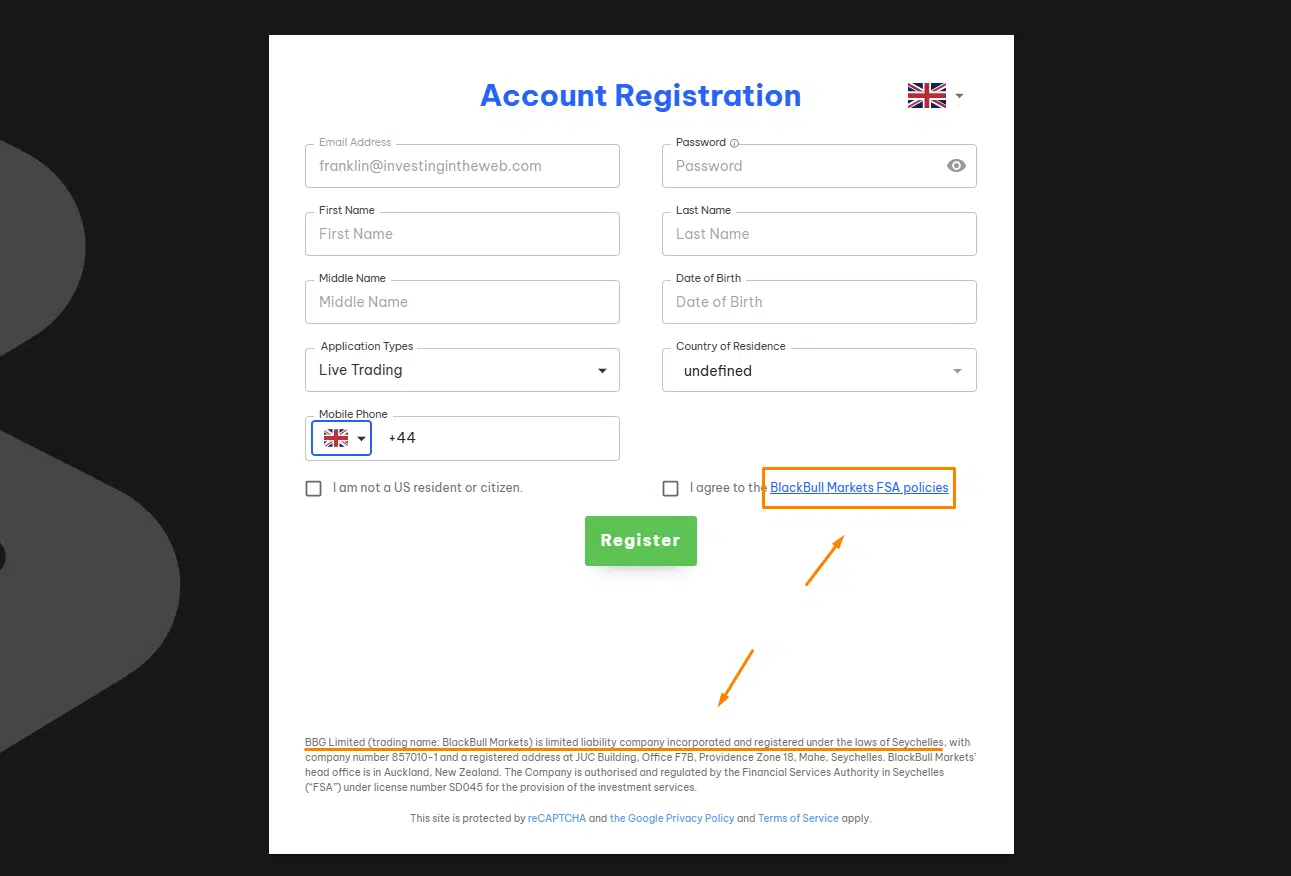
The difference is what you are signing up to. When we started a BlackBull application from the UK, the form accepted “United Kingdom” as the country of residence without objection. But the box you tick says you agree to BlackBull’s FSA policies, and that FSA is the Financial Services Authority of the Seychelles. The terms and conditions attached to the application belong to BBG Limited, the offshore entity. We cover what that means in the security section below.
Cash transfers
Pepperstone accepts bank transfers, cards, PayPal and other e-wallets, free of charge. The one exception is a £15 charge on withdrawals by bank wire to an international bank account. BlackBull accepts bank transfers, cards and a wide range of e-wallets and local payment methods. Deposits are free, but BlackBull charges a $5 fee per withdrawal, and international bank withdrawals can cost more.
Portfolio transfers
Pepperstone has no custody service, so there is nothing to transfer. BlackBull Invest holds real shares, but it is a separate platform from the CFD account and it is not designed as a UK custody or ISA product.
7. Pricing – trading and non-trading fees
Credit where it is due: on pure trading costs this one is tight. First, remember the two types of cost: trading fees (spreads and commissions) and non-trading fees (withdrawal, inactivity and conversion charges).
Trading fees
| Fees | BlackBull | Pepperstone |
| EUR/USD spread (raw account) | ECN Prime: from 0.0 pips + $3 per lot per side ($6 round turn) | Razor: from 0.0 pips + £2.25 per lot per side (£4.50 round turn) |
| EUR/USD spread (commission-free account) | ECN Standard: from 0.8 pips | Standard: from 1 pip |
| EUR/USD spread (spread betting) | Not applicable | From 0.6 points |
| Index CFDs | Spread only, no commission | Spread only, no commission |
| Share CFDs | Commission per side, varies by market | UK 0.10% per side, US 2 cents per share per side |
| Overnight funding | Swap rates published in the platform | Swap rates published in the platform |
| Currency conversion fee | Converted at spot rate when the account currency differs | Converted at spot rate when the account currency differs |
Source: BlackBull and Pepperstone UK websites, September 2026. Pepperstone’s Razor commission is £2.25 per lot per side on MT4 and MT5 with a GBP account. On cTrader it is $6 round trip, on TradingView $7 round trip and on the Pepperstone platform $3.50 per side. BlackBull’s Prime+ account has the same $3 commission with lot-based rebates for high-volume traders.
On the raw accounts the two are within a few pence of each other. One standard lot of EUR/USD costs about $6 in round-turn commission at BlackBull and about £4.50 (roughly $6) at Pepperstone, and both quote raw spreads that in practice sit around 0.1 to 0.2 pips. On the commission-free accounts BlackBull’s headline spread is slightly tighter (0.8 pips against 1 pip), although real average spreads on both tend to land around 1 pip. This is basically a draw.
Non-trading fees
| Fees | BlackBull | Pepperstone |
| Deposit fees | $0 | £0 |
| Withdrawal fees | $5 per withdrawal (more for international bank wires) | £0 (£15 for international bank wires) |
| Inactivity fee | $0 | £0 |
| Minimum deposit | $0 (ECN Standard and ECN Prime) | £0 by bank transfer, £10 by other methods |
Source: BlackBull and Pepperstone UK websites, September 2026
The only real difference on non-trading fees is BlackBull’s $5 withdrawal charge, which adds up if you move money often. Pepperstone charges nothing for deposits, standard withdrawals or inactivity. Overall, costs are a draw with a slight edge to Pepperstone on withdrawals.
8. Investor security
This is where the two brokers really separate, and for a UK trader it is the section that decides the comparison.
Pepperstone regulation and protection
UK clients deal exclusively with Pepperstone Limited, authorised and regulated by the FCA. That gives every UK retail client four things:
- Segregated client money: your funds are held in separate accounts, apart from the broker’s own money.
- Negative balance protection: you can never lose more than the balance in your account.
- Leverage caps: retail leverage is limited to 1:30 on major forex pairs and lower on other assets.
- FSCS cover: if the firm itself fails and cannot return your money, the Financial Services Compensation Scheme protects eligible claims up to £85,000 per person. It applies to spread betting and CFD accounts at FCA-regulated brokers. What it does not cover is losses from your own trading.
You also get access to the UK Financial Ombudsman Service if a complaint is not resolved. Beyond the UK, Pepperstone holds licences from ASIC in Australia, BaFin in Germany, CySEC in Cyprus and the DFSA in Dubai.
BlackBull regulation and protection
BlackBull is a legitimate broker. Black Bull Group Limited is licensed by New Zealand’s FMA, a serious regulator, with segregated client funds and membership of a New Zealand dispute resolution scheme. But that entity only onboards New Zealand residents.
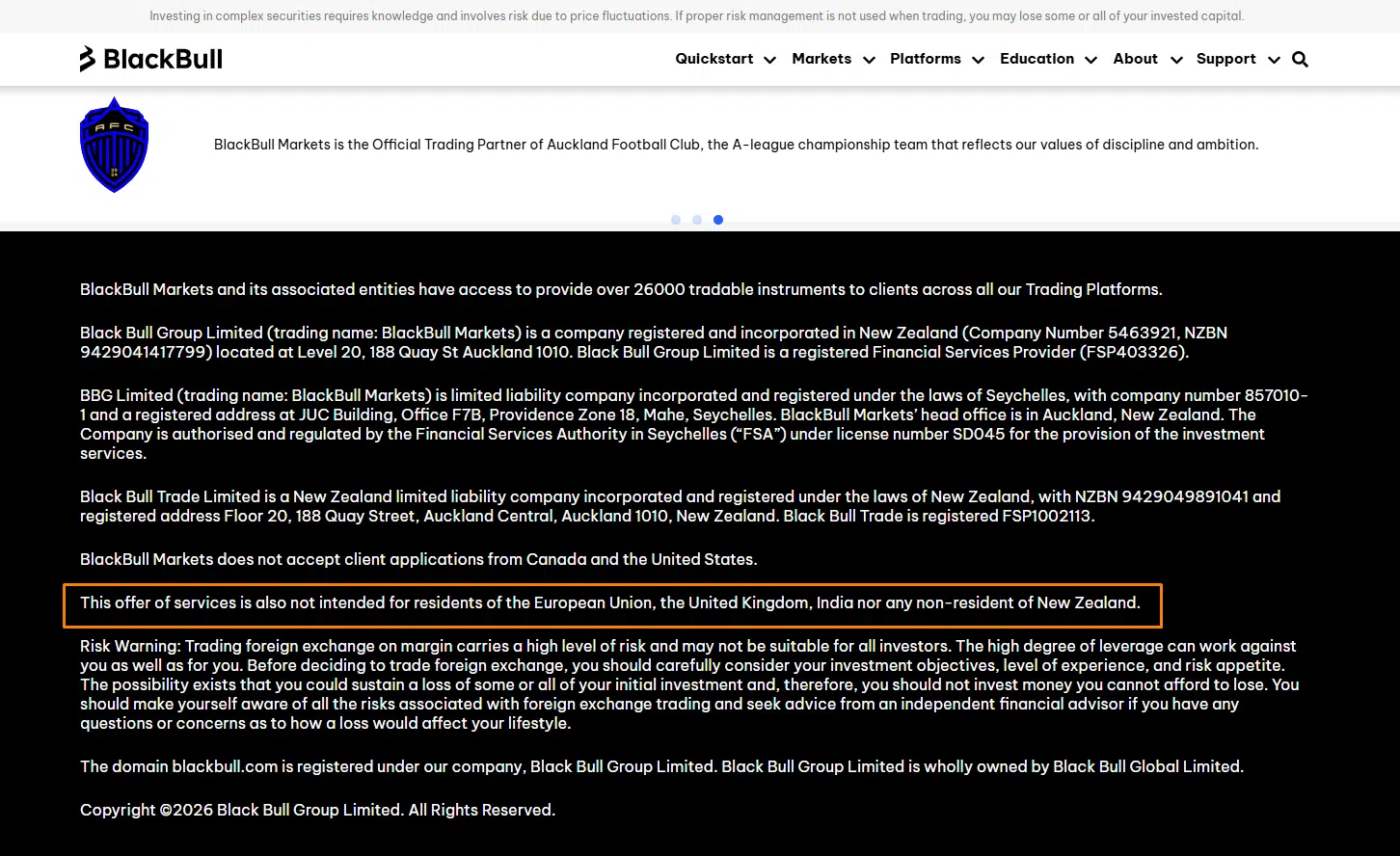
For UK residents the picture is different, and BlackBull’s own website spells it out. Its footer states that its offer of services is “not intended for residents of the European Union, the United Kingdom, India nor any non-resident of New Zealand”. Yet the sign-up form accepts UK residents and routes them to BBG Limited, the Seychelles entity licensed by the Seychelles FSA under SD045.
The FCA has also published a warning notice stating that BlackBull Markets is not authorised or registered by the FCA and may be providing financial services in the UK without permission.
What that means in practice if something goes wrong:
- No FSCS: neither BlackBull entity is covered by an investor compensation scheme. New Zealand’s FMA does not operate one and the Seychelles FSA does not either.
- No UK Financial Ombudsman: because the firm is not FCA-authorised, you cannot take a complaint to the UK ombudsman.
- Your contract sits in the Seychelles: any dispute would be governed by Seychelles law and BlackBull’s own dispute process.
If the worst happened, there is no safety net. For UK traders this round is not close: Pepperstone wins on safety.
9. Customer support and what real users say
Both brokers offer 24-hour support by live chat, phone and email, and this is an area where BlackBull genuinely shines.
On Trustpilot, BlackBull scores around 4.7 out of 5 from roughly 3,300 reviews, one of the highest ratings in the industry, with users consistently praising the helpfulness and speed of its support team. Some reviewers mention slow withdrawals, which ties in with the withdrawal fee above. Pepperstone sits at around 4.3 out of 5 from roughly 3,400 reviews, also rated Excellent, with praise for fast support and quick withdrawals. Both scores were checked in September 2026 and may have moved since.
One more signal we always look at: Pepperstone is one of the brokers endorsed by the r/Forex subreddit, the largest forex community on the internet. BlackBull is not on that list.
10. Pros and cons
Pepperstone
Pros
-
FCA-regulated, with FSCS protection up to £85,000
-
Raw spreads from 0.0 pips and low overall costs on the Razor account
-
Spread betting for UK residents
-
MT4, MT5, cTrader, TradingView and its own platform
-
No minimum deposit by bank transfer, no deposit, withdrawal or inactivity fees on standard methods
- Endorsed by the r/Forex community
Cons
-
CFD and spread betting only: you do not own the underlying assets
- Smaller instrument range than BlackBull's headline numbers
BlackBull
Pros
-
Very competitive pricing on the ECN Prime account
-
Huge instrument list, including real shares via BlackBull Invest
-
Same platform choice: MT4, MT5, cTrader and TradingView
-
Outstanding Trustpilot rating and responsive support
- No minimum deposit and no inactivity fee
Cons
-
Not authorised by the FCA, and named on the FCA warning list
-
No FSCS and no investor compensation scheme on any of its entities
-
UK sign-ups land on its offshore Seychelles entity, while the site says the offer is not intended for UK residents
-
No spread betting
- $5 withdrawal fee
BlackBull vs Pepperstone – comparison verdict
To sum it up, here is our verdict:
- Pepperstone: Best overall and the clear winner for UK traders
- BlackBull: Best for non-UK traders who want a very wide instrument list and top-rated support
If you are trading from the UK, this is not really a fair fight. Pepperstone gives you FCA regulation, FSCS protection up to £85,000, access to the UK Financial Ombudsman and tax-efficient spread betting. BlackBull cannot offer you any of those, and its own website says its services are not intended for UK residents.
BlackBull deserves credit for its pricing, its platform choice and its customer service, and for traders in the markets it is built for it is a strong broker. But when the safety net is missing, tight spreads are not enough. For UK traders, the winner is clear: Pepperstone.
For more information on Pepperstone, read our full review.
You can also read some of our other comparisons, such as the one between IG and Pepperstone.
Disclaimer: Investments in securities and other financial instruments always involve the risk of loss of your capital. The forecast or past performance is no guarantee of future results. It is essential to do your own analysis before making any investment.
Pepperstone risk warning: Spread bets and CFDs are complex instruments and come with a high risk of losing money rapidly due to leverage. 72.9% of retail investor accounts lose money when trading spread bets and CFDs with this provider. You should consider whether you understand how spread bets and CFDs work, and whether you can afford to take the high risk of losing your money.