Futures markets play an important role in the global financial system, allowing participants to hedge risk or gain exposure to movements in commodities, equity indices, interest rates, and currencies. Futures are highly liquid, centralised exchanges that offer standardised contracts.
Futures trading platforms differ widely in terms of execution quality, costs, available markets, risk management tools, and user experience. In the United States, futures trading is strictly regulated and limited to exchange-traded products overseen by authorities such as the
CFTC and the NFA.
In contrast, international traders may have access to a broader range of platforms and structures, including both direct exchange access and futures-based derivatives offered under different regulatory regimes.
This article aims to provide a structured and impartial overview of the best futures trading platforms for day trading, taking into account the needs of both US-based and international traders. Each platform is evaluated using consistent criteria, such as regulatory oversight, trading fees, execution reliability, platform functionality, market access, and overall suitability for different levels of trading experience.
Best futures trading platforms for day trading
Here are our bullet-point picks for the best futures trading platforms for day trading, ordered to help you pick the right platform:
- Plus500 Futures: Best for US futures traders
- Interactive Brokers: Best overall international futures trading platform
- NinjaTrader: Best for active and technical futures day traders
- TradeStation: Best for professional and systematic futures traders
- tastytrade: Best for active retail futures traders in the US
Overall, if you’re a US trader, Plus500 Futures is the best overall.
Although Interactive Brokers offers one of the best futures trading infrastructures globally, futures trading is not automatically enabled. Traders must request futures permissions and demonstrate sufficient trading knowledge and experience. As a result, IBKR may not be suitable for beginners who want immediate access to futures markets.
For a list of trading platforms we do not recommend, you can visit our full list of brokers, and filter by “Not recommended”.
Futures Trading platforms comparison


Other resources
- Check our YouTube channel! You will find step-by-step guides on how to invest through different trading platforms, as well as other educational videos about trading and brokers.
- Explore our tools: Check our comparison tool, reviews, broker bonuses, and others.
Short reviews
Plus500 Futures at a glance

Plus500 Futures is the US-based futures trading arm of the Plus500 group, explicitly designed to give US traders direct access to regulated US futures exchanges such as the CME Group.
Plus500 Futures allows users to trade real futures contracts, making it a more transparent and exchange-driven trading solution. The platform is fully regulated by US authorities, including the CFTC and NFA, which ensures a high level of investor protection and operational transparency.
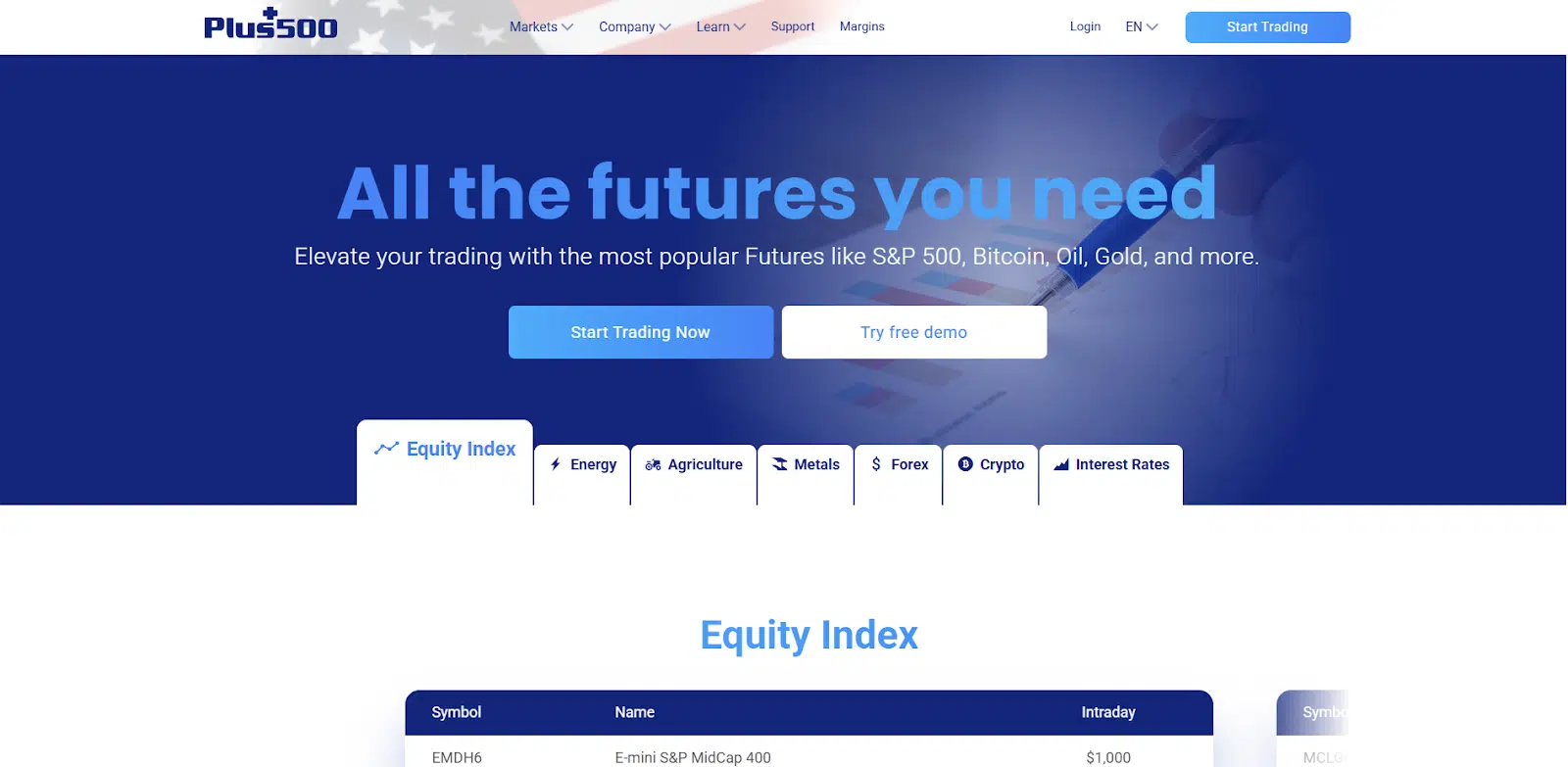
Plus500 Futures stands out for its intuitive, straightforward platform design, which reduces much of the complexity typically associated with futures trading. Order placement, margin requirements, and contract specifications are clearly presented, making the platform especially suitable for beginners who want to learn futures day trading without being overwhelmed by advanced tools.
Pricing is transparent. The only fees directly charged by Plus500 are the following: $0.89 per side on Standard & E-Mini contract commission, $0.49 per side on Micro contract commission and, finally, a liquidation fee per contract of $10. There are no platform or market data fees.
In addition, Plus500 Futures offers a commission credit trading bonus for new users who make their first deposit. Bonus amounts scale with the initial deposit, ranging from $20 for a $500 deposit to $200 for a $10,000 deposit, subject to the platform’s bonus terms and conditions.
On the downside, the platform offers limited advanced trading tools, such as in-depth custom indicators or extensive algorithmic trading capabilities. This may make it less attractive to professional or high-frequency traders who rely on complex strategies. Additionally, access is restricted to US-based traders, meaning international users cannot open accounts.
Overall, Plus500 Futures is best suited for US traders who are starting in futures day trading, value a clean, beginner-friendly interface, and want the reassurance of strong US regulation, combined with direct access to major futures exchanges.
For a deeper analysis, please read our Plus500 Futures review.
Interactive Brokers at a glance

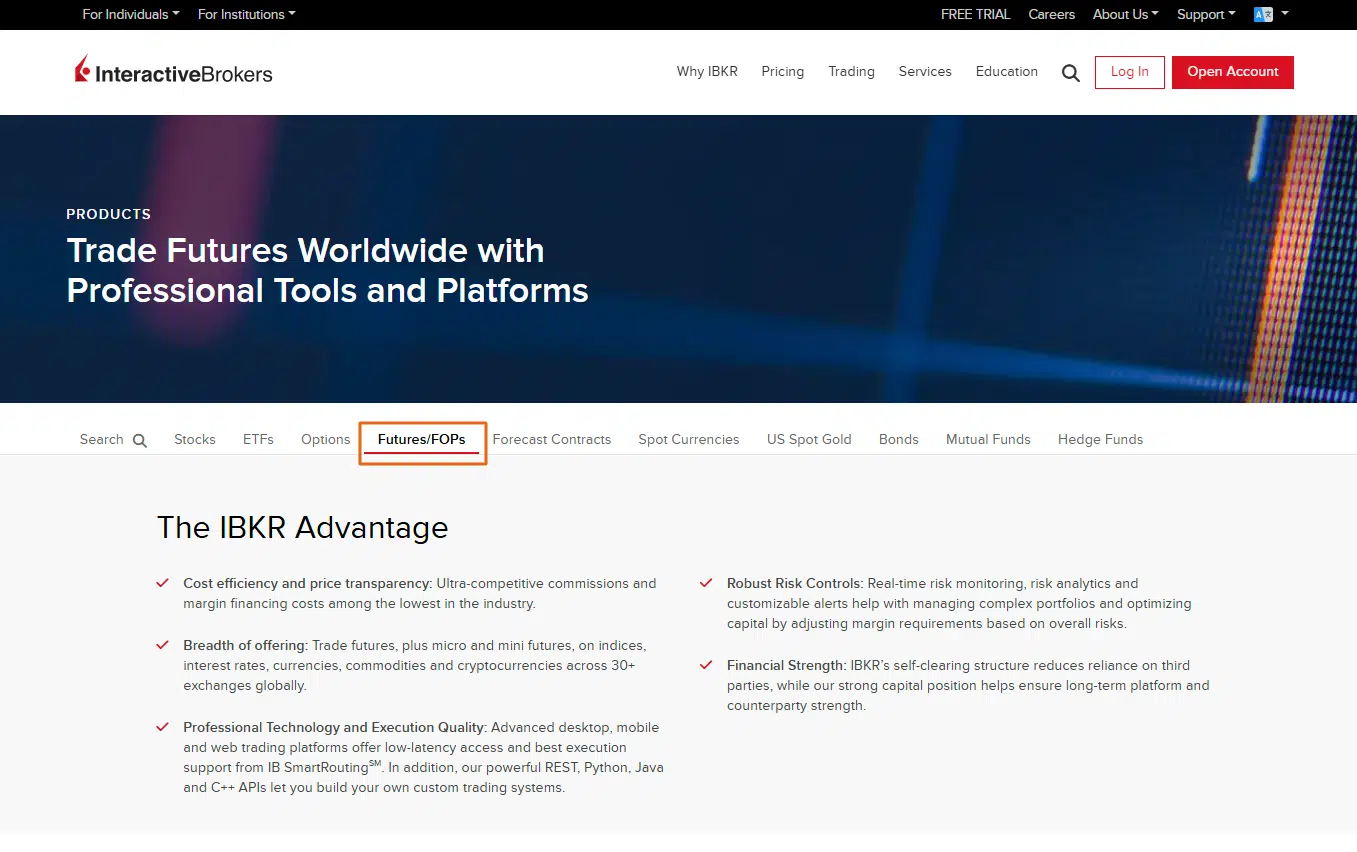
Interactive Brokers (IBKR) is one of the most established and globally recognised brokers for futures trading, offering access to real futures contracts across more than 30 exchanges worldwide, including CME, CBOT, NYMEX, ICE and Eurex.
Interactive Brokers operates under multiple top-tier regulators globally, including the SEC and CFTC in the US, which reinforces its reputation for safety, transparency and financial stability. This strong regulatory framework makes IBKR a trusted choice for both retail and professional futures traders.
Futures trading is conducted primarily through Trader Workstation (TWS), Interactive Brokers’ flagship platform. TWS provides advanced tools, including professional charting, depth of market (DOM), advanced order types, spread trading, and direct exchange routing. These features make it particularly attractive for experienced traders, active day traders, and those running complex futures strategies.
Interactive Brokers’ fees for futures trading start at $0.25 per contract, but most users will likely be charged $0.85 per contract, as this is the fee applied to trading volumes below 1,000 contracts per month. Margin requirements are also transparent and generally competitive, especially for intraday futures trading.
However, the platform’s depth and flexibility come at the cost of a steep learning curve. Beginner traders may find the interface complex and overwhelming compared to simpler futures platforms. Furthermore, traders must request futures permissions and demonstrate sufficient trading knowledge and experience; otherwise, IBKR won’t enable futures trading for you.
Overall, Interactive Brokers is best suited for intermediate to advanced futures traders who require broad global market access, advanced trading tools, and consistently low commissions, and who are comfortable navigating a professional trading environment.
For more information on Interactive Brokers, please read our full review of the trading platform.
NinjaTrader at a glance

NinjaTrader is a US-based brokerage and trading platform specialised exclusively in futures trading, with direct access to CME Group exchanges, including CME, CBOT, NYMEX and COMEX. It is widely used by active futures day traders due to its strong focus on execution speed, advanced charting and granular cost control.
NinjaTrader is regulated by the CFTC and NFA, providing a solid US regulatory framework and full access to real futures contracts rather than derivatives or CFDs.
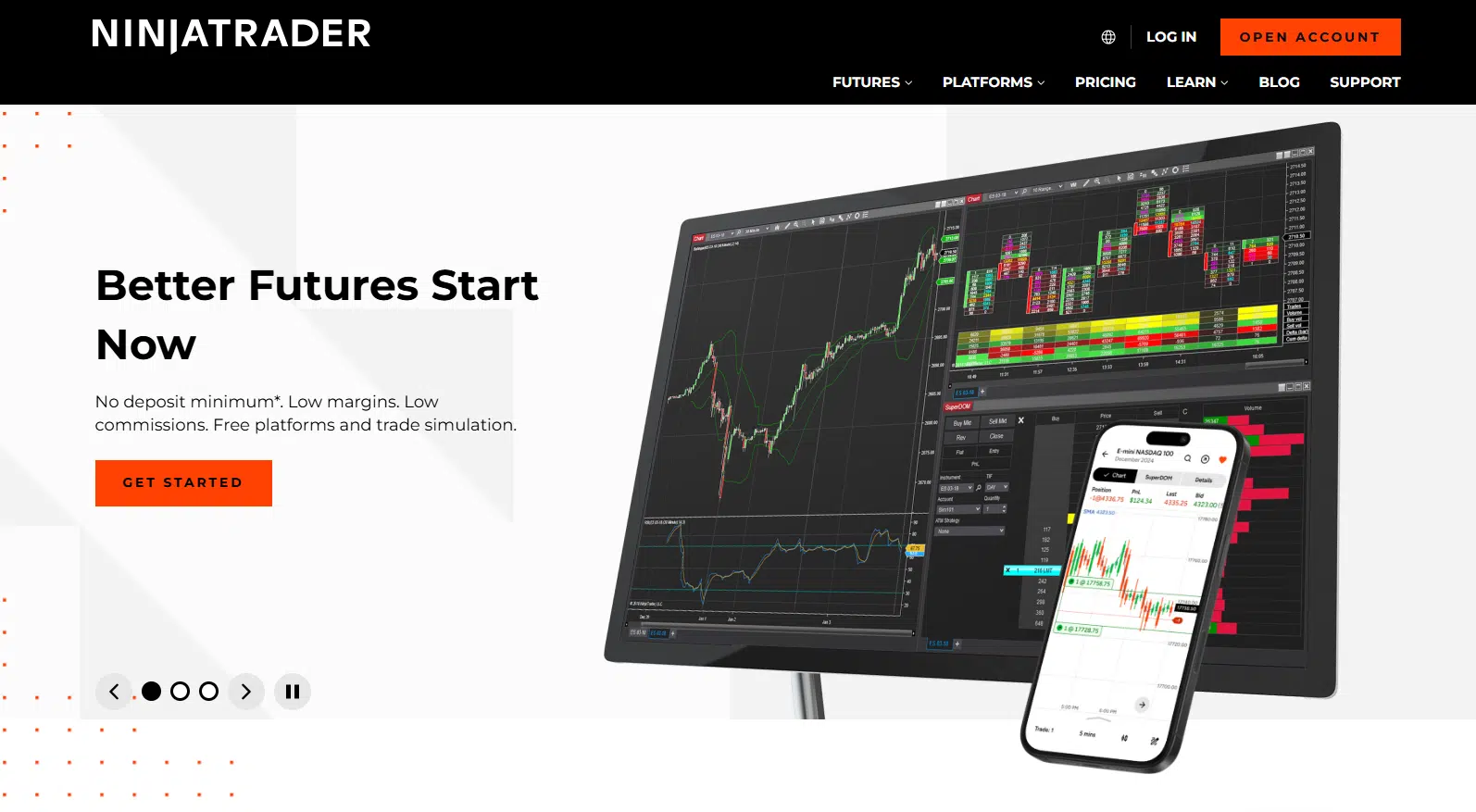
One of NinjaTrader’s strongest advantages is its clearly defined and highly competitive commission structure, which varies depending on the pricing plan selected:
- Free plan: Commission of $1.29 per side on standard contracts and $0.39 per side on micro contracts, plus exchange and regulatory fees.
- Monthly plan ($99/month): Commission reduced to $0.99 per side on standard contracts and $0.29 per side on micro contracts, plus exchange and regulatory fees.
- Lifetime plan ($1,499 one-time payment): Commission reduced to $0.59 per side on standard contracts and $0.09 per side on micro contracts, plus exchange and regulatory fees.
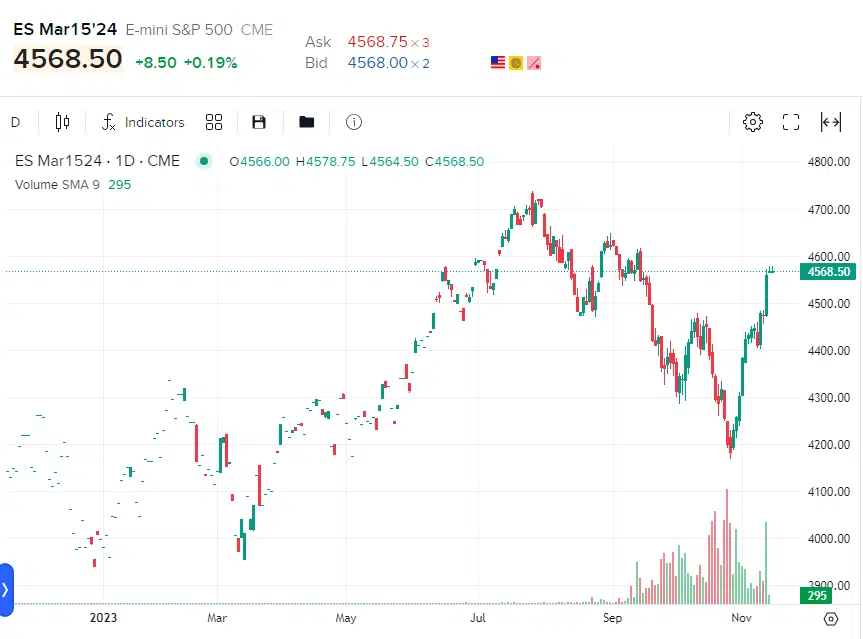
NinjaTrader also offers reduced intraday margin requirements, with popular contracts such as the E-mini S&P 500 (ES) requiring as little as $50 intraday margin, compared to significantly higher overnight margins set by the exchange. These reduced margins apply only during intraday trading hours and increase to full exchange margin if positions are held overnight.
On the downside, NinjaTrader does not offer stocks or ETFs, and there are no trading bonuses or deposit incentives. The platform’s advanced features and customisation options can also present a learning curve for beginner traders, particularly those new to futures.
Overall, NinjaTrader is best suited for active futures day traders and scalpers who prioritise precise cost control, low per-contract commissions, advanced charting, and reduced intraday margins, and who are comfortable operating within a professional futures-only trading environment.
TradeStation at a glance

TradeStation is a well-established US brokerage known for combining professional-grade trading technology with competitive pricing. Its futures offering provides direct access to CME Group exchanges (CME, CBOT, NYMEX and COMEX) and focuses on real, exchange-traded futures contracts.
TradeStation operates under strict US regulation by the CFTC and NFA, reinforcing its reputation for transparency and investor protection. This regulatory oversight, combined with long-standing market presence, makes it a trusted futures broker in the US market.
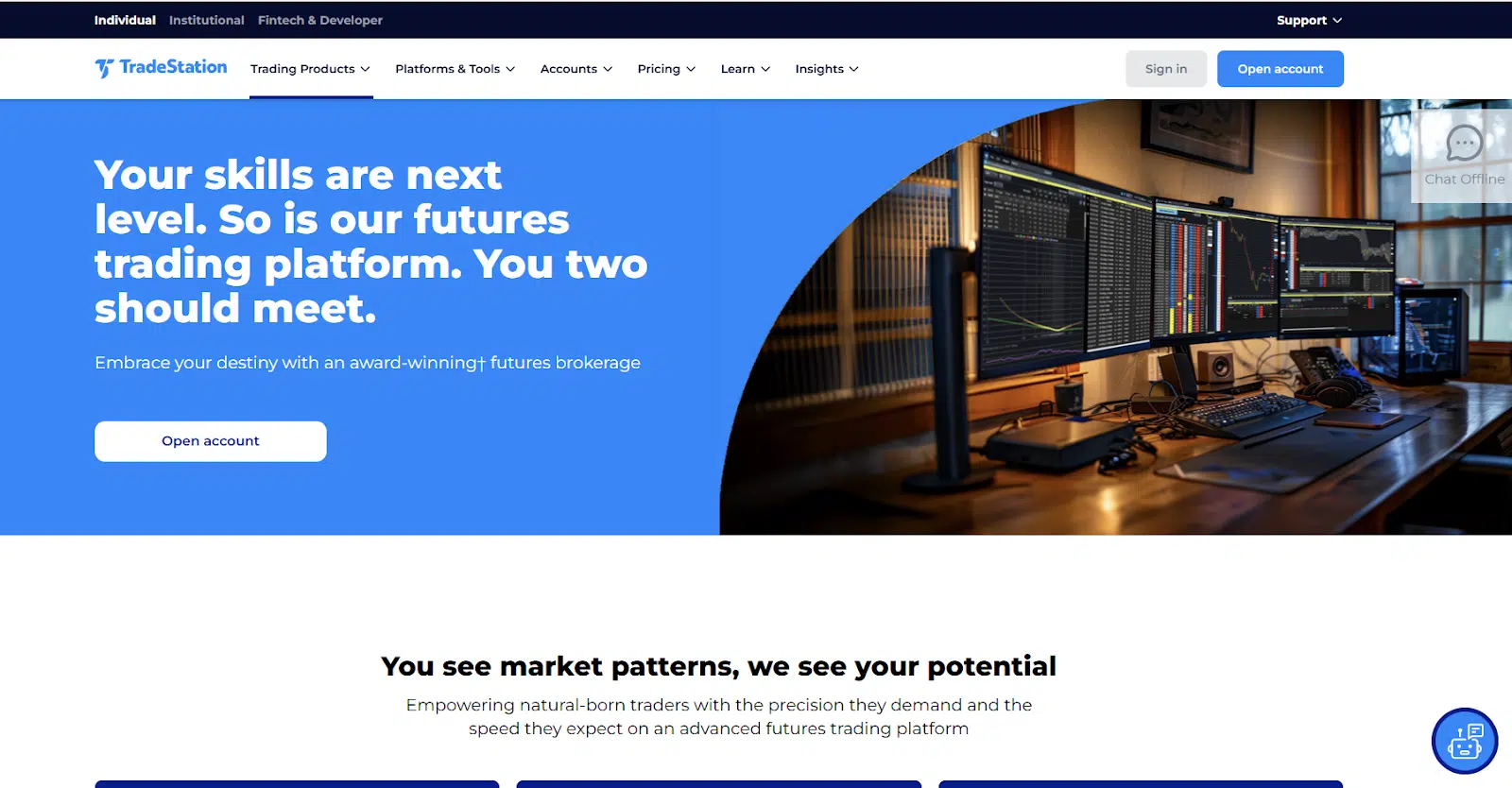
TradeStation uses a tiered futures commission model where costs decrease as monthly trading volume increases. Once a volume threshold is reached, the new tier applies for the rest of the month and the following month.
U.S. & international clients – broker commissions (per contract, per side):
- Standard Futures: 0–500 contracts: $1.75; 501–1,000: $1.00; 1,001–10,000: $0.80; 10,000+: $0.50
- Micro Futures: 0–500 contracts: $0.50; 501–1,000: $0.40; 1,001–10,000: $0.30; 10,000+: $0.25
Exchange, clearing, and regulatory fees apply in addition to broker commissions. There are no platform fees for futures trading, and TradeStation does not require a minimum account balance to maintain an active futures account.
TradeStation is also competitive when it comes to margin requirements, particularly for day traders. The broker offers reduced intraday margins, significantly lower than exchange-set overnight margins. For example, E-mini S&P 500 (ES) intraday margin can be as low as $50 per contract, depending on market conditions.
On the downside, TradeStation does not offer trading bonuses or deposit incentives, and its platform can feel complex for beginners who are new to futures trading or advanced charting tools.
Overall, TradeStation is best suited for US-based futures traders who want flexible pricing options, powerful analytics, and access to low intraday margin requirements, while still operating within a highly regulated and professional trading environment.
tastytrade at a glance

tastytrade is a US-based brokerage built primarily for active derivatives traders, with a strong focus on futures and options trading. The platform emphasizes simplicity, fast execution, and transparent pricing rather than complex professional-grade analytics. Its futures offering provides access to CME Group exchanges, including CME, CBOT, NYMEX and COMEX.
tastytrade operates under strict US regulatory oversight from the SEC, FINRA and NFA, ensuring a high level of investor protection. The broker is widely recognized for its trader-first approach, combining education, content, and straightforward cost structures.
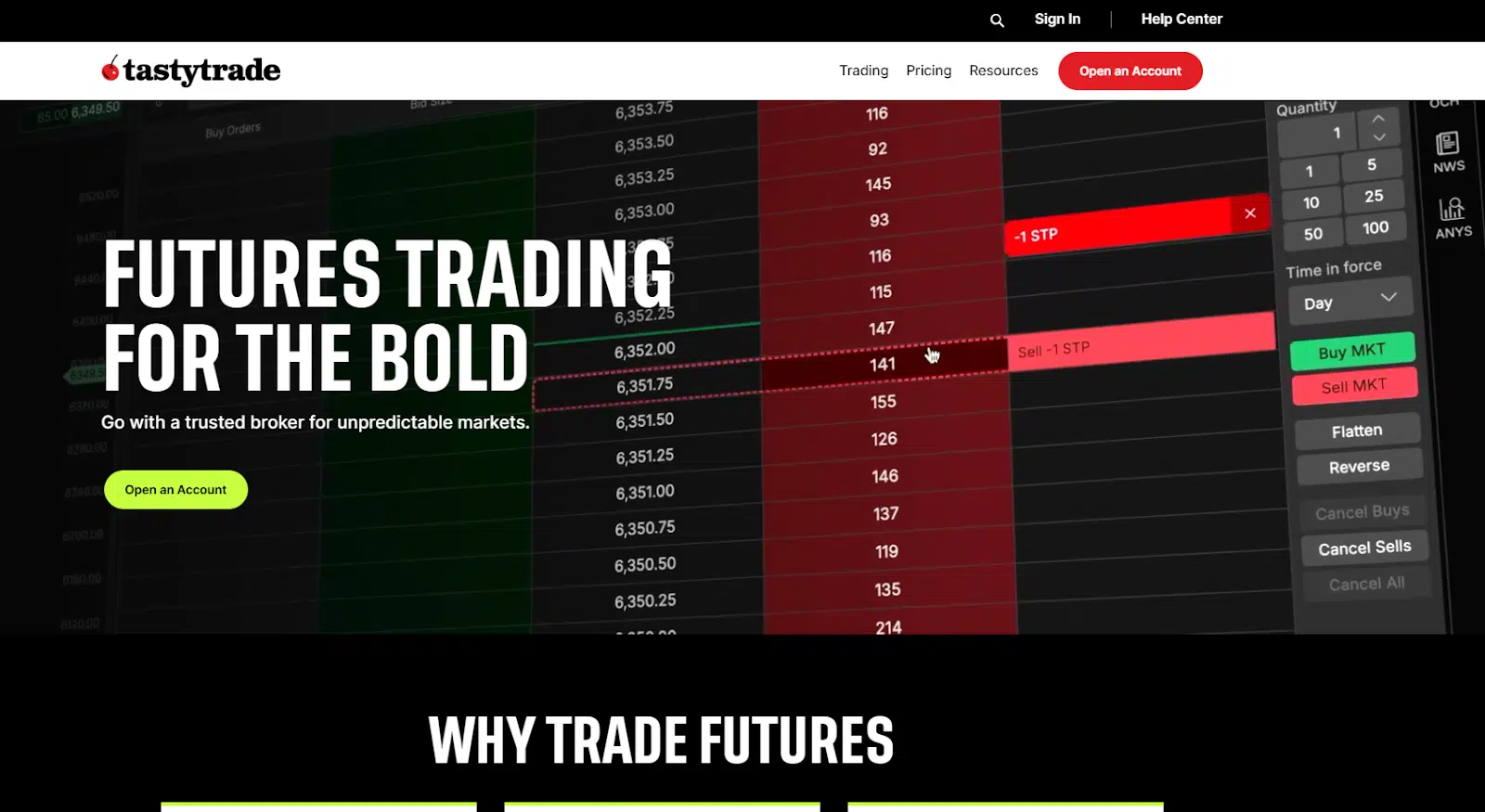
tastytrade uses a flat futures commission model, meaning all traders pay the same rates regardless of monthly volume: $1.00 to open a contract and $1.00 to close it (maximum $1.00 per contract). Exchange, clearing, and regulatory fees apply in addition to broker commissions. There are no platform fees for futures trading, and no minimum balance is required to keep an account active.
tastytrade also offers competitive intraday margin requirements, often lower than exchange overnight margins, making it accessible for active day traders and smaller accounts. Margin levels vary by contract and market conditions.
On the downside, tastytrade does not provide a dedicated demo or simulated futures trading account, and its platform is more execution-focused, offering fewer advanced charting and customization tools compared to some professional trading platforms.
Overall, tastytrade is best suited for US and eligible international futures traders who value simple, predictable pricing, strong educational resources, and an intuitive trading platform, rather than complex analytics or volume-based commission discounts.
How to choose a futures trading platform for day trading
Choosing the right futures trading platform is one of the most important decisions a day trader will make. A poor choice can quietly drain your edge through slippage, fees, or technical failures, while a good one can support consistency and confidence.
Let’s break down the key factors that truly matter.
1. Regulation & Safety
Before looking at charts, tools, or pricing, verify that your broker is properly regulated. This protects you from fraud, poor business practices, and counterparty risk.
In the U.S., the gold standard regulators are:
- Commodity Futures Trading Commission (CFTC)
- National Futures Association (NFA)
Internationally, look for equivalent top-tier regulators in regions such as the UK, EU, Australia, or Singapore.
Why this matters for day traders
- Client funds are segregated from broker funds
- Strict capital requirements reduce bankruptcy risk
- Clear dispute resolution processes
- Transparent reporting and compliance
If a broker is unregulated or “lightly regulated,” it’s not worth the risk, no matter how attractive the platform looks (you can filter for “not recommended” brokers in our broker list).
2. Fees & Commissions
For futures day traders, costs compound quickly. Even a difference of $0.20 per contract can add up to thousands per year.
You should compare:
a) Commissions per contract
This is usually quoted “per side” (entry or exit). Make sure you understand:
- Round-turn cost (in + out)
- Volume-based discounts
- Whether micros and standard contracts are priced differently
b) Exchange and clearing fees
These are passed through from the exchange and clearing firm and are not negotiable, but brokers sometimes bundle them in confusing ways. Always ask for the all-in cost per contract.
c) Margin requirements
Day-trading margins are often much lower than overnight margins, but:
- They can change suddenly during volatility
- They may increase before major news events
- Brokers differ significantly in intraday margin policies
3. Execution & Platform Stability
For day trading futures, execution quality is non-negotiable.
You want:
- Low-latency order routing
- Minimal slippage
- Fast order acknowledgements
- No freezing during high-volume periods
A platform that lags, disconnects, or crashes during volatile markets can turn a winning trade into a loss, or worse, remove your ability to exit at all.
What to look for
- Proven performance during high-impact events (FOMC, CPI, NFP)
- Stable servers and backup systems
- Ability to quickly flatten positions
- Reliable connection to the exchange (not simulated execution)
Practical tip: Ask current users, by searching in Trustpilot or Reddit, how the platform behaved during recent major market events. Marketing pages won’t tell you this, traders will.
4. Tools & Analytics
Day trading futures requires precision, speed, and control. The platform should support your decision-making, not slow it down.
Key tools active traders should prioritize:
a) Advanced charting
Look for:
- Tick, volume, and range charts
- Multiple timeframes
- Custom indicators or scripting (if relevant to your strategy)
- Fast chart loading and smooth zooming
b) Depth of Market (DOM)
The DOM is essential for many futures traders, especially scalpers. It allows you to:
- See resting liquidity
- Enter and exit with precision
- Manage orders directly from the ladder
c) Bracket orders & risk controls
Your platform should allow:
- Automatic stop-loss and take-profit orders
- OCO (one-cancels-other) functionality
- Daily loss limits
- Position size controls
5. Market Access
Not all futures platforms offer access to every market. Before committing, ensure the platform supports the contracts you plan to trade, such as:
- Equity indices (e.g., S&P 500, Nasdaq)
- Commodities (oil, gold, agricultural products)
- Interest rates
- Currencies
- Micro contracts for smaller accounts
Also check:
- Trading hours and session access
- Data feed quality
- Whether real-time data is included or billed separately
Conclusion
There is no single “best” futures trading platform for day trading. The right choice depends on your experience level, trading style, and cost sensitivity.
What matters most over time is not feature overload, but reliable execution, transparent fees, stable margin rules, and strong regulation.
A platform that performs consistently during high-volatility sessions will protect your edge far more than one that simply looks impressive on paper.
As a final reference, here is how each platform in this guide is best positioned:
Plus500 Futures
Best for beginner to intermediate US tradersInteractive Brokers
Best overall platform for US and international tradersNinjaTrader
Best for active and technical futures day tradersTradeStation
Best for professional and systematic traderstastytrade
Best for active retail futures traders
Before committing capital, test platforms in simulation, calculate realistic all-in trading costs based on your expected volume, and assess how well each platform supports your risk management. In futures day trading, the right platform won’t make you profitable, but the wrong one can quietly hold you back.
FAQs
Are futures suitable for day trading?
Yes. Futures are among the most popular instruments for day trading due to liquidity, leverage, and low transaction costs.
Can international traders trade US futures?
Yes, but only through globally regulated brokers such as Interactive Brokers or region-specific futures brokers.
Are futures riskier than stocks?
Futures involve leverage, which increases both potential returns and losses. Proper risk management is essential.