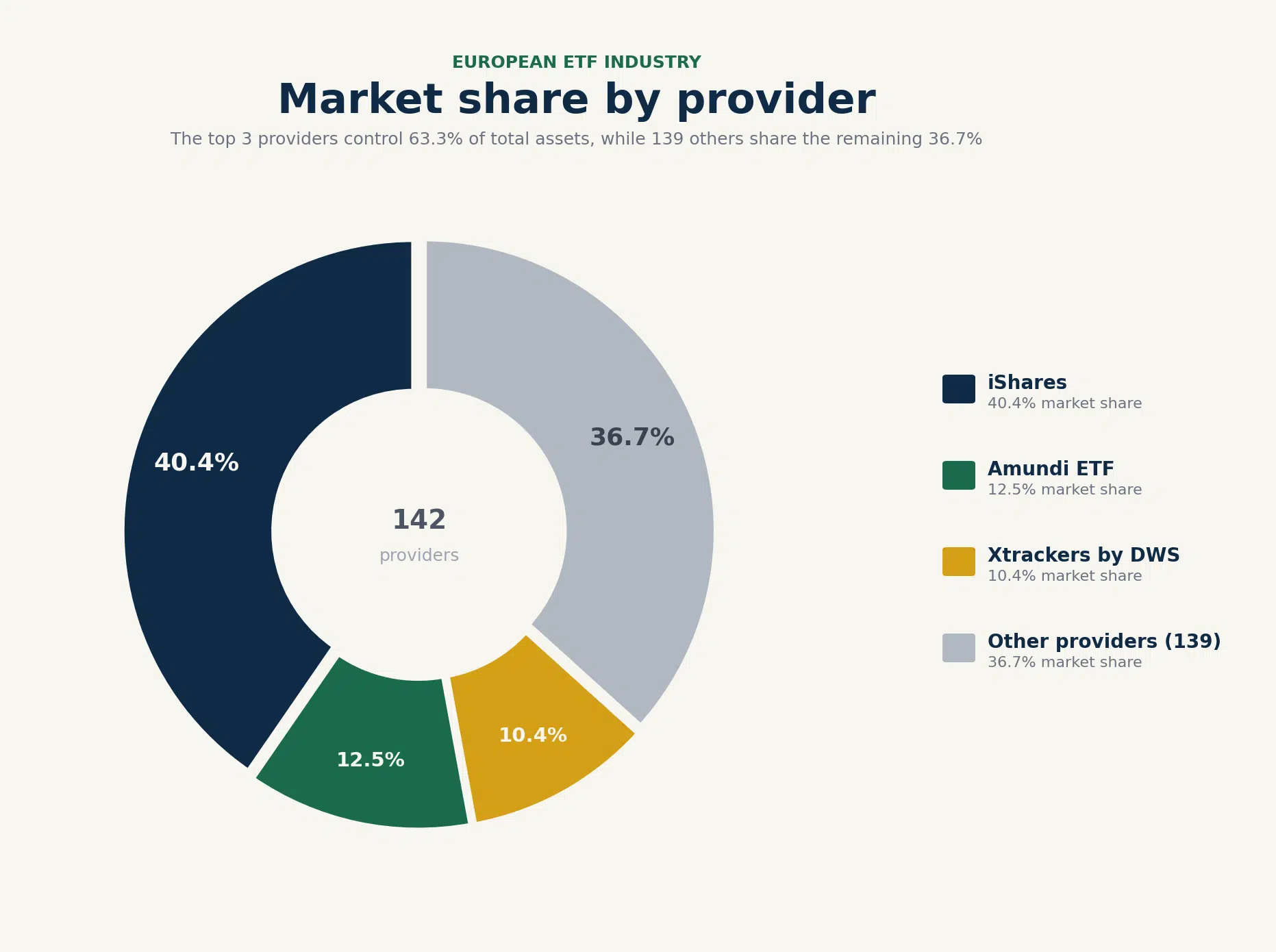
Vanguard and iShares (by BlackRock) are two of the best-known ETF providers. iShares dominates the European ETF space with a market share of 40.4% as of January 2026.
Vanguard, despite being the second biggest asset manager in the world, sits fourth in the European ETF market with a share of around 8%, behind Xtrackers and Amundi:
In this article we compare Vanguard and iShares to help you decide which to use.
One development worth knowing before you read on: Vanguard cut the TER on VWCE, its flagship all-world ETF, to 0.14% with effect from 28 July 2026. That changes the fee arithmetic against iShares meaningfully, and a lot of comparisons still quote the old rate.
What are Vanguard and iShares?
Vanguard is a US company founded in 1975, and one of the two largest asset managers in the world. Worldwide it offers mutual funds, ETFs, money market funds, certificates of deposit, stocks and bonds. In Europe, the focus is the ETF market.
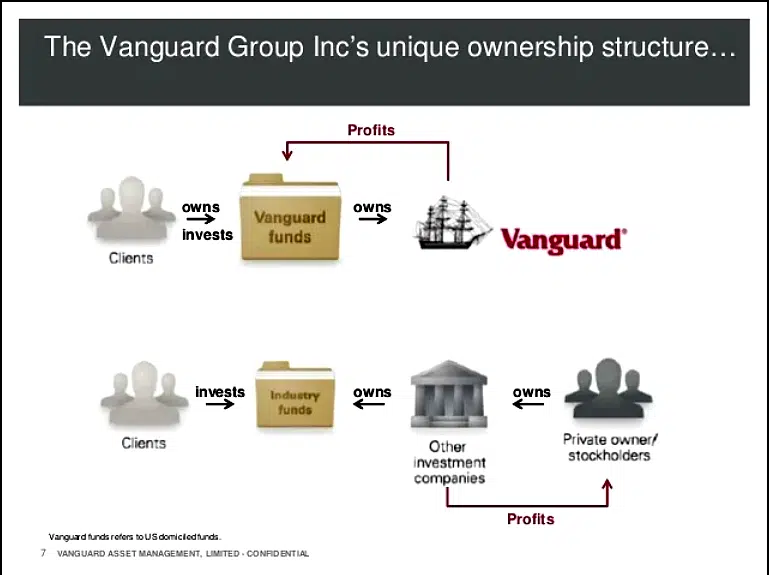
One particularity about Vanguard is its ownership structure. The company is owned by its funds, which are in turn owned by their shareholders. There are no outside owners taking a profit, which is the mechanism behind its long record of cutting fees rather than distributing margin.
iShares is the ETF arm of BlackRock, the largest asset manager in the world, and is dedicated to the ETF market in Europe and internationally. It runs well over a thousand funds globally and is by some margin the largest ETF brand by assets.
The practical difference in structure: BlackRock is a listed company answerable to its own shareholders, while Vanguard is owned by its funds. Whether that matters to you as an investor is debatable, but it explains why the two behave differently on pricing over time.
What is the difference between Vanguard and iShares?
For any given index, there is little to separate them beyond cost and the benchmark tracked. Both offer diversified, low-cost access to global markets, and both structure their ETFs similarly: physical replication (full or optimised sampling), distributing or accumulating share classes, and Irish domicile for most European products.
Take a direct like-for-like comparison:
- Vanguard S&P 500 UCITS ETF (USD) Accumulating (ISIN: IE00BFMXXD54)
- iShares Core S&P 500 UCITS ETF USD Acc (ISIN: IE00B5BMR087)
Both track the S&P 500, and side by side they are close to identical:
| ETF/characteristics | Vanguard S&P 500 | iShares Core S&P 500 (CSPX) |
| Benchmark | S&P 500 | S&P 500 |
| TER (annual cost) | 0.07% | 0.07% |
| Distribution policy | Accumulating | Accumulating |
| Replication | Physical | Physical |
| Domicile | Ireland | Ireland |
| Inception | May 2019 | May 2010 |
| AUM | ~€22 billion | ~$159 billion |
CSPX figures from the iShares factsheet as at 31 August 2026. Fund-level net assets; the USD accumulating share class alone holds around $156 billion.
The main difference is size. CSPX is far larger, which the inception dates largely explain: it launched in May 2010, the Vanguard equivalent in May 2019.
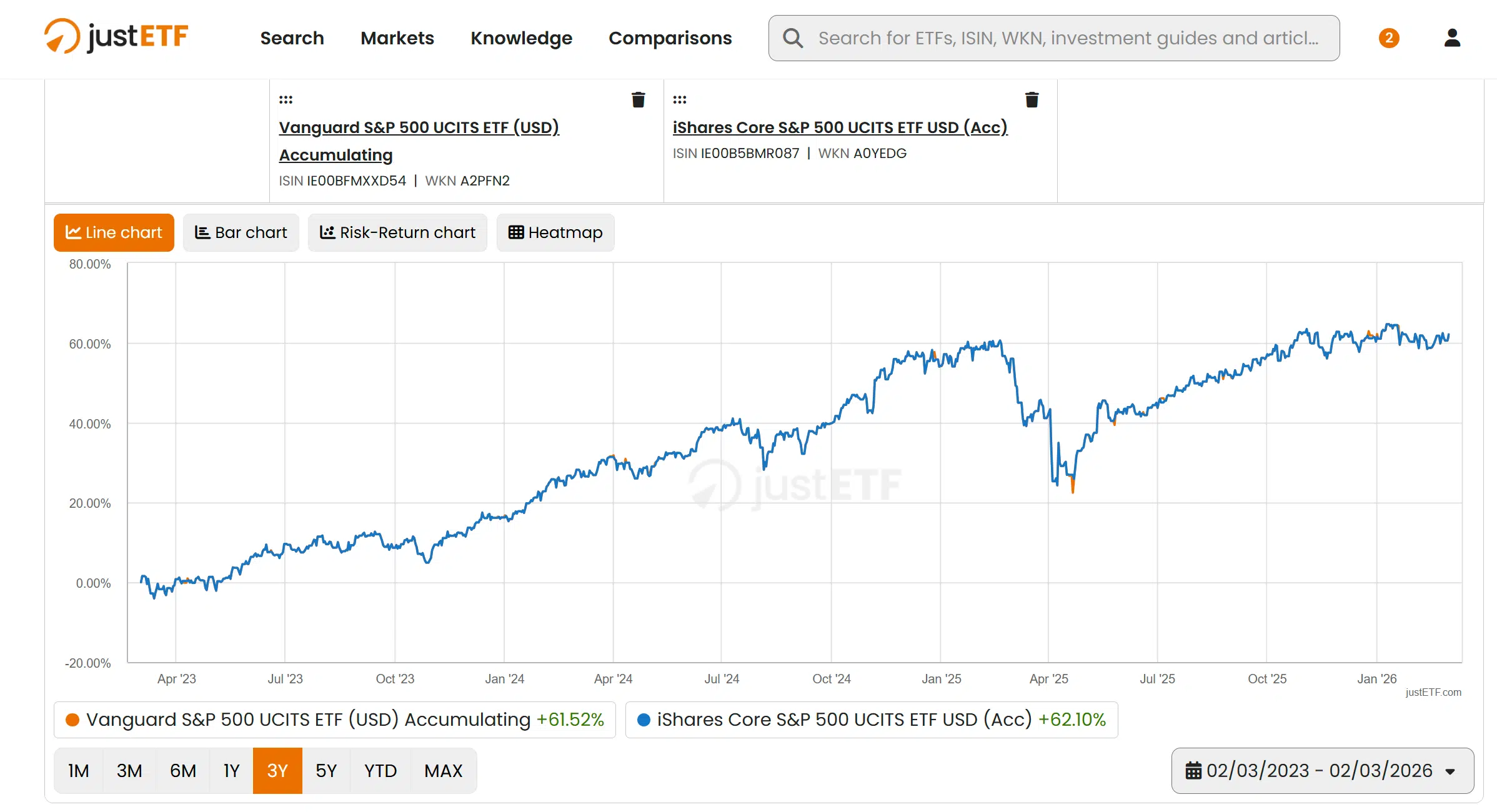
Does size matter here? Mostly through liquidity and bid-ask spreads, and both are large enough that it makes no practical difference for retail-sized orders. The fee is identical at 0.07%, and performance is effectively the same, with the lines overlapping:
VWCE or IWDA: the comparison most people actually want
The VWCE (Vanguard FTSE All-World UCITS ETF) and IWDA (iShares Core MSCI World UCITS ETF) are the two most popular global equity ETFs in Europe, and they are often presented as direct rivals. They are not quite: they track different indices covering different universes.
VWCE tracks the FTSE All-World, covering large and mid-cap stocks across developed and emerging markets, roughly 3,700 holdings across around 49 countries. IWDA tracks the MSCI World, covering large and mid-cap stocks across 23 developed markets only. Emerging markets currently make up around 10% to 11% of an all-world fund, including China, Taiwan, India, South Korea and Brazil.
So the real question is not Vanguard versus iShares. It is whether you want emerging markets bundled in or prefer to add them separately.
| ETF/characteristics | VWCE | IWDA |
| Benchmark | FTSE All-World index | MSCI World index |
| Coverage | Developed and emerging markets | Developed markets only (23 countries) |
| TER (annual cost) | 0.14% (from 28 July 2026) | 0.20% |
| Distribution policy | Accumulating | Accumulating |
| Replication | Physical (optimised sampling) | Physical |
| Inception | July 2019 | September 2009 |
| AUM | ~€40 billion | ~€121 billion |
The fee cut changes the usual advice. The conventional route for investors wanting emerging market exposure alongside IWDA has been to add EIMI (iShares Core MSCI Emerging Markets IMI, TER 0.18%) in roughly an 88/12 split. That blend now costs around 0.197% a year, which is more than VWCE’s 0.14%. On a €50,000 position the difference is roughly €30 a year in VWCE’s favour, before any extra commission to rebalance the second fund.
In other words, the two-fund approach no longer saves money on fees. It still has one advantage: it lets you set your own emerging markets weight rather than accepting the index weight, and it can make sense at brokers with free ETF savings plans where the extra trade costs nothing.
Naturally, performance differs, since the underlying indices differ:
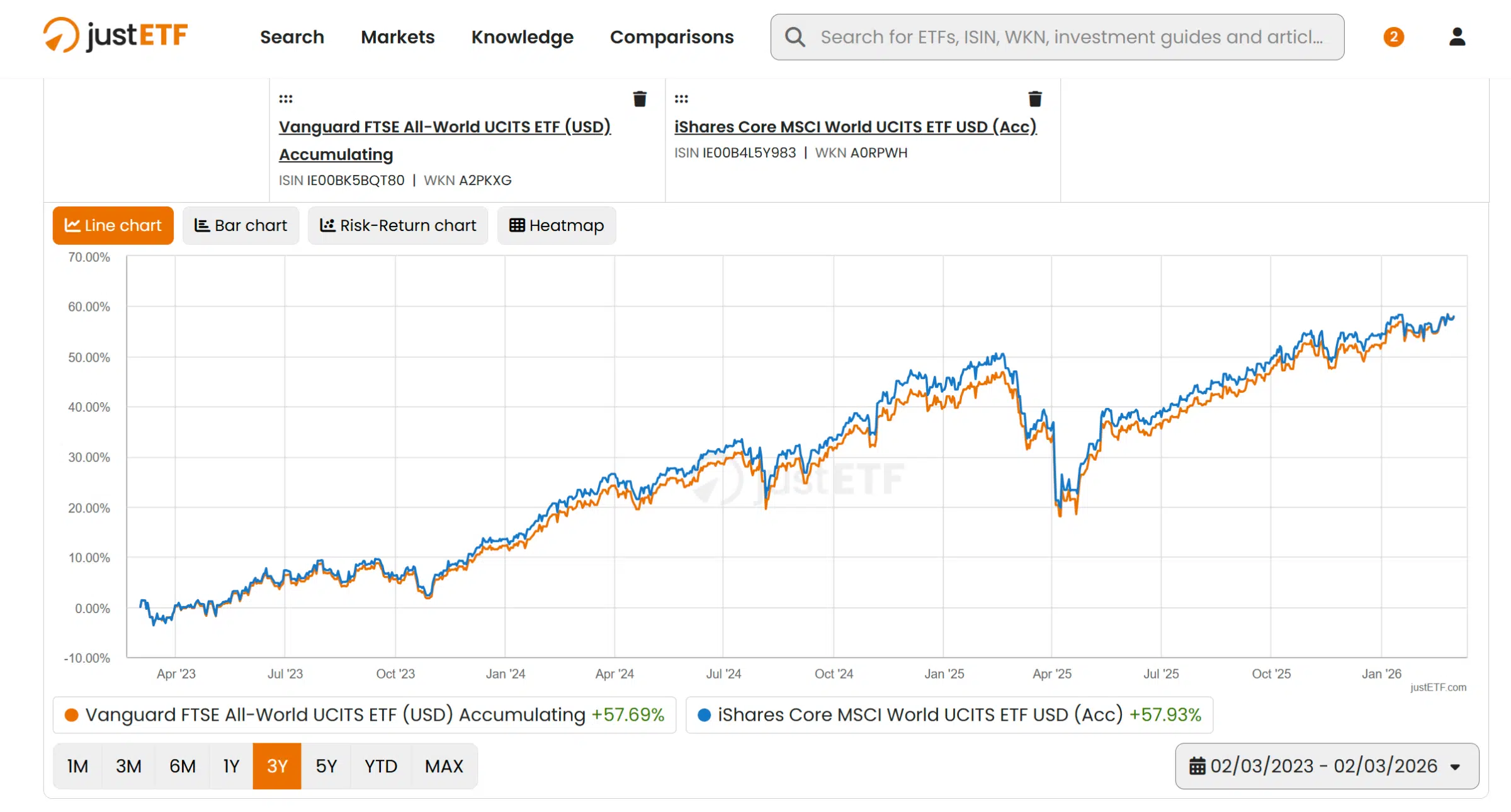
Do both providers offer all-world and developed-world options?
Yes, and this is worth stating plainly because it is often misreported.
iShares does offer an all-world alternative to VWCE. The iShares MSCI ACWI UCITS ETF (IE00B6R52259) covers developed and emerging markets in a single fund, available in both accumulating (IUSQ, trading as SSAC on the LSE) and distributing (ISAC) forms. It tracks MSCI ACWI rather than FTSE All-World, but the two indices cover near-identical ground and the performance difference is negligible, typically well under 0.3% a year.
Vanguard does offer a developed-world alternative to IWDA. The Vanguard FTSE Developed World UCITS ETF excludes emerging markets in the same way MSCI World does, available as VHVE (accumulating) and VEVE (distributing).
Other providers compete in the same space too. SPDR offers MSCI ACWI and MSCI ACWI IMI funds, the latter adding small caps for broader coverage than either VWCE or IWDA.
So you are not forced to choose a provider in order to get the exposure you want. Pick the index first, then compare the funds tracking it on cost, size and spread.
Are there any major tracking differences between their ETFs?
Tracking difference is the deviation between an ETF’s performance and its benchmark. Here is how the two compare on the factors that drive it.
1. Replication methodology
- iShares: uses a mix of full replication (holding all index constituents) and sampling or optimisation (holding a subset) depending on liquidity, cost and market access.
- Vanguard: primarily uses full replication for large, liquid indices, but samples for complex or less liquid ones. VWCE, for instance, holds around 3,600 of the roughly 4,200 stocks in its index.
2. Securities lending
Both lend out portfolio securities to generate additional revenue, which offsets costs and can narrow tracking difference. The meaningful difference is in how much of that revenue reaches you.
- iShares: engages more actively in securities lending, and retains a share of the revenue generated as its own income.
- Vanguard: lends at a lower scale, and returns essentially all net lending revenue to the fund rather than keeping a cut.
Securities lending also introduces counterparty risk. It is collateralised and both providers manage it conservatively, but it is not zero, and it is worth knowing that a fund’s tracking advantage may partly come from an activity that carries its own small risk.
3. Fee structures
- iShares: often slightly higher expense ratios than Vanguard for equivalent broad-market exposure, though the two match exactly on S&P 500 trackers at 0.07%.
- Vanguard: known for its low-cost structure, and has cut fees repeatedly, most recently on VWCE in July 2026.
4. Performance consistency
- iShares: a broader range of ETFs, including optimised and specialist strategies, which can produce slightly higher tracking differences in some products.
- Vanguard: generally tight tracking on broad market ETFs, helped by full replication and low costs.
In the round, if minimising tracking difference is a priority, Vanguard’s broad-market ETFs tend to perform well on this measure. iShares can run slightly wider differences but offsets this through securities lending and offers far more choice.
One caution: tracking difference is measured after the fact and varies year to year. It is a smaller factor than the TER for most long-term investors, and not worth agonising over when choosing between two well-run funds tracking the same index.
Are iShares and Vanguard safe?
Both operate safe structures. A UCITS fund’s assets are held separately by an independent depositary, not on the manager’s balance sheet, so if either firm failed, the fund’s assets would not be available to its creditors.
Two qualifications worth understanding rather than glossing over. First, this protects you against the failure of the provider, not against investment losses: if the index falls, so does your holding, and no scheme compensates that. Second, both funds engage in securities lending, which introduces a small collateralised counterparty risk that is separate from the safety of the fund structure itself.
Which ETF provider should you choose?
Your choice should mostly be about the benchmark you want to track, and much less about which firm runs the fund.
Go for iShares if you want:
- A wider range of ETFs, including niche, sector and specialist strategies where Vanguard’s European line-up is thin;
- Deeper liquidity, since many iShares funds are larger and longer established, which can mean tighter spreads;
- MSCI-based exposure, whether developed-only through IWDA or all-world through IUSQ and SSAC.
Go for Vanguard if you prefer:
- Lower fees on broad-market exposure, backed by a mutual ownership structure and a track record of cutting them;
- Lending revenue returned in full to the fund rather than shared with the manager;
- FTSE-based exposure, whether all-world through VWCE or developed-only through VHVE and VEVE.
On the S&P 500 comparison specifically, the two are identical in fee, structure and performance, so either is a sound choice and the decision comes down to whatever your broker offers most cheaply.
On global equity, the more consequential decision is developed-only versus all-world, not Vanguard versus iShares. Both providers now offer both. Since the July 2026 fee cut, VWCE is the cheaper single-fund route to global exposure, while IWDA suits investors who want to control emerging markets weighting separately.