Malaysia is an upper-middle-income country, with residents enjoying a growing level of disposable income. With money to spend, the question that naturally comes to mind is how to make the most of it. One way to build and preserve wealth is through the stock market.
In this article, we’ll delve into ways for Malaysians to pick stocks, how to buy shares on the international markets, how to gain exposure to the national stock market, tips for choosing a stockbroker to buy shares, opportunities for foreigners to gain exposure to Malaysian shares, and more!
Choose a stock to buy
Since there are tens of thousands of public companies around the world, there is no silver bullet when it comes to choosing a stock to purchase. That said, generally, companies are divided in two ways:
- Value stocks: these companies are usually attractively priced in terms of price-to-earnings or other ratios but face slower growth going forward;
- Growth stocks: these companies offer a high long-term growth rate but are more expensive from a valuation perspective in the near term.
You can favour one type or diversify across both value and growth, with value companies in your portfolio to meet medium-term goals. In contrast, growth companies should be able to help you achieve your long-term aspirations!
Resources you can use are:
- Stock screeners such as Finviz
- Company reports, filings and presentations (for Malaysian companies, Bursa Malaysia’s announcements page)
- Macroeconomic and industry publications
In any case, make sure to consider several companies, evaluate their performance relative to competitors and try to pick the most attractively priced business!
How to buy shares on the international markets (step-by-step guide)
1. Choose a good stock broker
Once you have chosen the stock you want to invest in, you need to find a broker where you can make the purchase. Make sure the broker you pick works with residents of Malaysia. Below we highlight three solid choices available to Malaysians (fees checked in September 2026):
| Broker | Stock commission, US | Minimum deposit | Regulators |
| Interactive Brokers | $0.005 per share (min. $1 on the Fixed plan; min. $0.35 on the Tiered plan) | €/$/£0 | SEC, FINRA, CFTC, SIPC, CIRO, FCA, CBI, ASIC, SFC, MAS, CBH (not licensed in Malaysia: Malaysian residents are served by IBKR’s foreign entities) |
| Saxo Bank | Between 0.08% (Classic) and 0.03% (VIP) of trade value (min. $1) for US stocks | $0 to $10,000 (varies between countries) | Danish FSA, FCA, FINMA, MAS, ASIC, SFC, DFSA |
| Moomoo Malaysia | 0.03% of trade value + $0.99 platform fee per order (commission waived for the first 180 days for new clients). Bursa Malaysia: 0.03% + RM3 per order | RM0 | Securities Commission Malaysia (CMSL eCMSL/A0397/2024); Bursa Malaysia Participating Organisation |
Moomoo Malaysia is the only one of the three that is licensed by the Securities Commission Malaysia and lets you trade Bursa Malaysia, US, Hong Kong, Singapore and China A-shares from one app, with eligible Malaysian securities covered by the Capital Market Compensation Fund (up to RM100,000). Interactive Brokers and Saxo accept Malaysian residents through their foreign entities and offer far broader global market access.
2. Open and fund your account
Once you have weighed the pros and cons of each broker, you are all set to open an account. The process usually takes a few days as the broker verifies your identity (MyKad or passport and proof of address). After the process is finalised, you must deposit money into your account. Note that Malaysian stamp duty applies to share trades, including US shares bought through a Malaysian-licensed broker.
3. Place a “Buy order”
If you have found an online broker that suits your needs, managed to open an investment account and made the initial deposit, you are all set to buy your stock. All you have to do is find the share within your chosen broker and place a buy order. For this example, we will use Interactive Brokers (Client Portal).
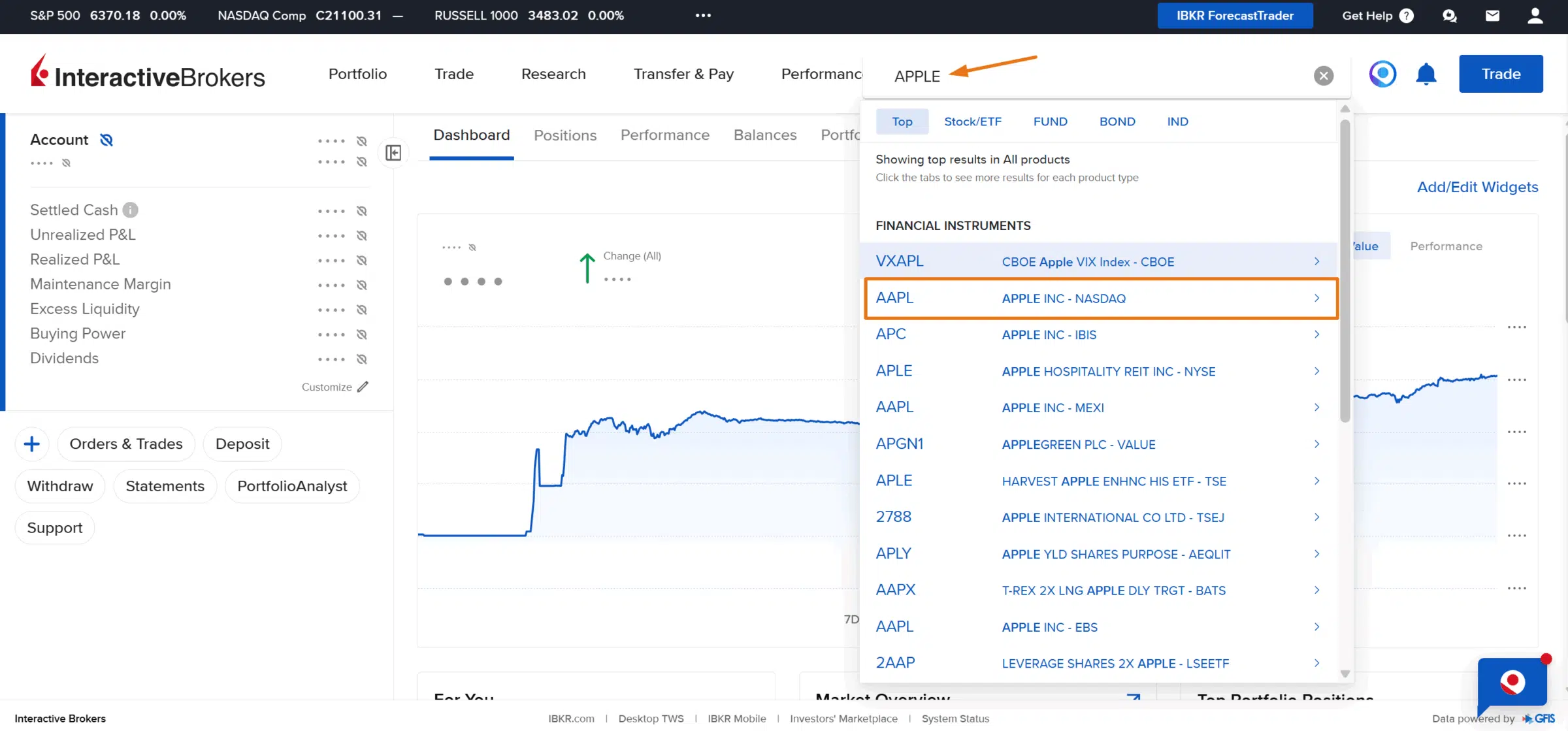
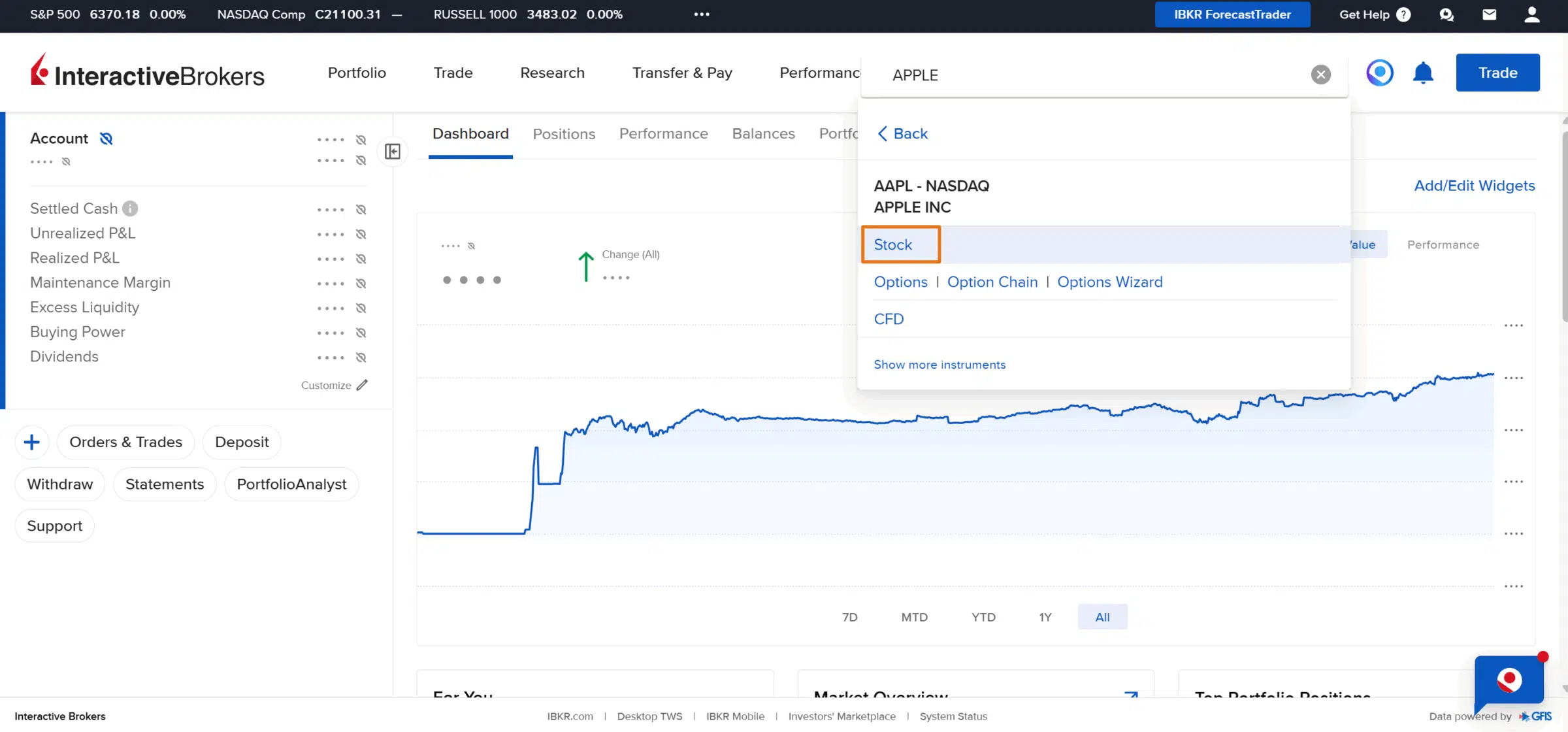
1. Search for the chosen stock (we will use Apple, ticker “AAPL”):
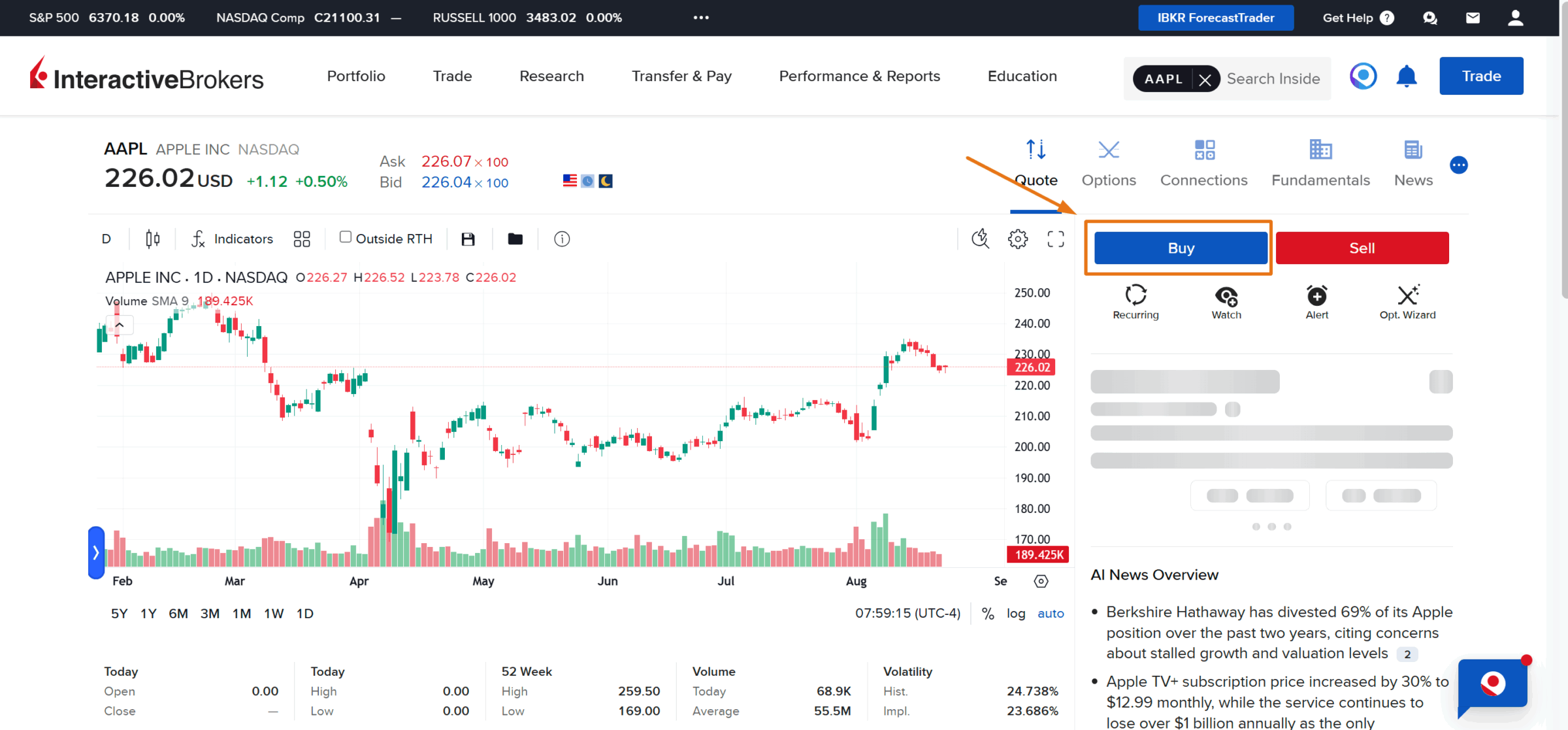
2. Click “Buy”:
3. Choose the order details. Now, it’s time to fill in all the boxes highlighted below:
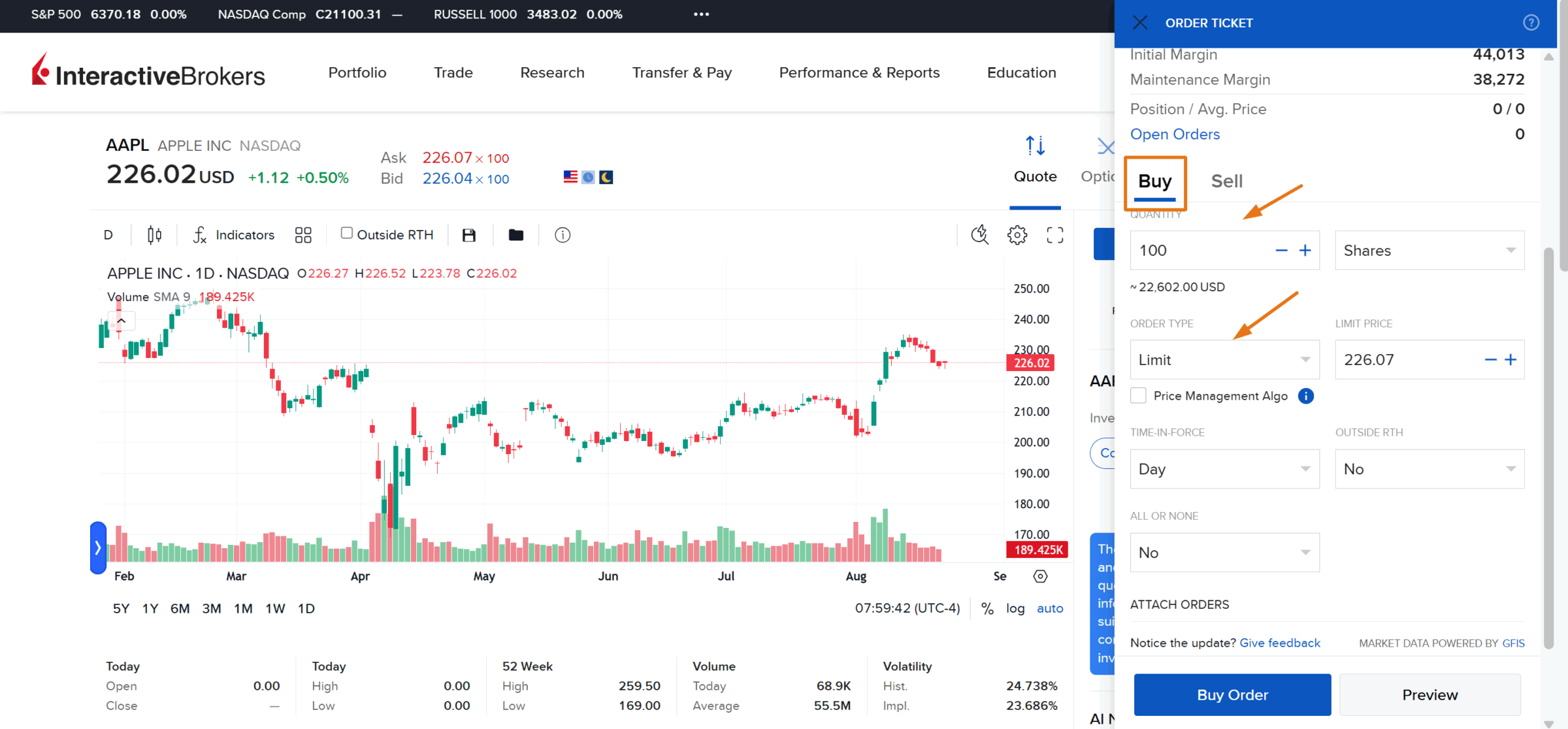
- QTY: short for quantity. Here you define the number of shares you want to purchase.
- Type of order: by default, Interactive Brokers sets your order type as LMT, short for limit order. This is good since it allows you to set a maximum price at which you are willing to buy the shares. The alternative is MKT, or market order.
- Limit amount: assuming you kept “LMT” as the type of order, you need to set the maximum price you are willing to pay per share. If you use a market order, you do not need to fill this in and will buy at the best available ask price.
- Order duration: set to DAY by default.
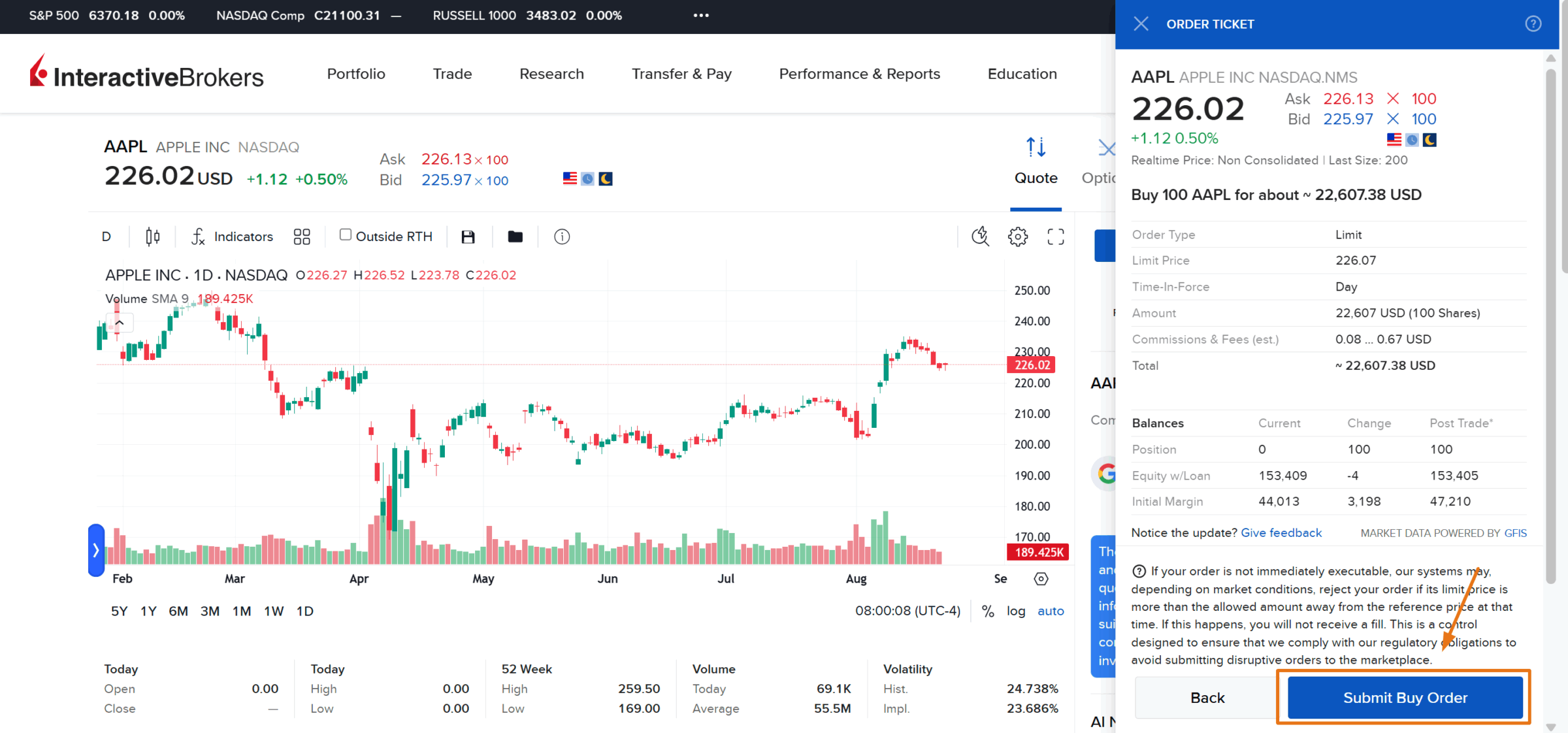
4. Place the order:
Finally, click “Preview” and a new window will show up. Here, you can take a final look at all the details, including the commissions. Then click “Submit Buy Order”:
ETFs: an alternative way to gain exposure
ETFs, or exchange-traded funds, allow you to gain exposure to dozens or even hundreds of companies with a single investment. ETFs can be a good option if you:
- Are unsure which specific stock to choose.
- Want to limit your portfolio volatility (usually ETFs invest in companies in different sectors which are affected by vastly different factors, limiting your exposure to idiosyncratic risks).
- Are interested in following a specific theme in your investments (Malaysian stocks, technology stocks, real estate stocks and so on).
Some ETFs you may want to consider are:
- iShares MSCI Malaysia ETF (ticker EWM), which tracks the MSCI Malaysia Index with around 20 large and mid-cap holdings, more than half of them in financials, and an expense ratio of 0.50% (as at June 2026).
- iShares MSCI Emerging Markets Asia ETF (EEMA), which has several hundred holdings, mainly in China, Taiwan, India and South Korea, with a small allocation to Malaysia.
Both are US-listed ETFs, which Malaysian residents can buy through the brokers above. On Bursa Malaysia you can also find locally listed ETFs, such as the FTSE Bursa Malaysia KLCI ETF, traded in ringgit. You are free to choose from thousands of ETFs investing all around the world.
Buying stocks on Bursa Malaysia
The process of buying shares directly on the local market is very similar to the one outlined above for international securities. You will need a CDS (Central Depository System) account, which your broker opens for you, and you can find a list of brokers active on the exchange here.
There are around 1,000 companies listed on Bursa Malaysia across the Main Market, the ACE Market and the LEAP Market, plus ETFs, REITs and structured warrants. If you want to invest in the safer part of a company’s capital structure, namely its bonds, the local market also offers that option, alongside sukuk (Islamic bonds).
The main benefit of buying shares on the local market is that you will not incur foreign exchange conversion fees from opening an account in USD, JPY or any other currency. This is because shares on Bursa Malaysia trade in Malaysian ringgit. If you buy Apple stock, you would have to:
- Sell ringgit and buy USD to open the trade
- Sell USD and buy ringgit to close the trade
Thus you would incur two foreign exchange fees in the process. On the other hand, Bursa trades carry a stamp duty of 0.1% of the transaction value (capped at RM1,000 per contract) and a clearing fee, so compare the all-in cost before assuming the local market is cheaper.
The downside of the local market is that you are limited to the instruments available to trade there, many of which are tightly correlated with Malaysia’s economic fortunes. Thus if you want to diversify your wealth across the world, the best way is to invest overseas or pick an export-oriented company.
Accessing Malaysian equities as a foreigner
Suppose you are an investor outside Malaysia and want to gain exposure to the country’s growth potential. In that case, the most straightforward way to buy Malaysian equities is through an ETF, as highlighted above. The downside is that country-specific ETFs usually have a higher expense ratio (0.50% for EWM) compared to ETFs for developed markets such as the United States. Thus you must carefully evaluate whether the excess return you expect will cover the higher ETF costs!
If you want to buy a specific Malaysian company, the best way would be to use a global broker that offers Bursa Malaysia, such as Interactive Brokers or Saxo Bank. The drawback is that you will have to incur foreign exchange fees to convert into ringgit.
Other resources
If you’re still unsure which alternative to choose, feel free to explore our website, as well as our YouTube channel, where we dive into the best brokers in several regions, as well as provide step-by-step guides on how to invest on some of these platforms.
If you’re still unsure, feel free to contact us or just book a meeting with us.
Bottom line
To sum it up, here’s what you need to do:
- Choose a stock to buy: if you want to invest outside Malaysia, you need to carefully consider which company or ETF to pick, as there is a myriad of companies to choose from. On the local market, you also have a decent choice between around 1,000 listed companies, plus bonds, REITs and ETFs.
- Find a suitable stock broker: for international markets, make sure the broker you choose works with residents of Malaysia. For Bursa Malaysia, it is best to use a broker licensed by the Securities Commission Malaysia. In any case, consider the fees and market access of the broker.
- Open an account and deposit money: after deciding which trading platform to use, you must go through the account opening process and deposit money.
- Send a buy order to your broker for the stock you like: that’s the easiest part (the process is intuitive)! After having your brokerage account and the name of the company that you want to buy, you just have to place a trade!
We hope that this post addressed some of your concerns. Make sure to do your research to find out the best investing strategy for you!
Happy investing!