

REITs, short for Real Estate Investment Trusts, allow investors to gain exposure to the largest asset class in the world: real estate, ahead of bonds and stocks.
In this article, we’ll delve into how to buy REITs from the UK, including how to choose a good REIT, tips for choosing a REIT broker, and more!
REIT basics
1. REIT varieties
REITs come in all shapes and sizes. Some focus on only one type of real estate, while others operate in several real estate sectors. Generally, you can choose between the following:
- Residential REITs
- Commercial property REITs (office, retail)
- Cell tower and data centre REITs
- Timberland and farmland REITs
- Logistics and self-storage REITs
- Healthcare REITs (GP surgeries, care homes)
- Lodging and casino REITs
- and more!
The above varieties, coupled with different geographical exposures, make every REIT unique. Think about the different factors affecting a multi-family REIT leasing apartments in the Southern United States, a farmland REIT in Eastern Europe or a logistics REIT leasing warehouse space around the world!
2. REIT performance indicators
Once you have settled on a geography and property sector, other REIT characteristics to consider are:
- Rental growth (the higher, the better)
- Occupancy (the higher, the better)
- Leverage or loan-to-value ratio (the higher it is, the higher the potential return and the greater the risk)
- Net asset value (NAV) per share: compare it with the share price to see whether the REIT trades at a discount or a premium
- Dividend cover: whether the earnings from rents comfortably cover the dividend paid
There is no magic formula for choosing the right REIT. Some offer large short-term returns, while others have pipeline projects that will bear fruit in the long term!
3. UK REIT specifics
The main disadvantage of UK REITs is the 0.5% stamp duty (Stamp Duty Reserve Tax) paid on purchases of UK-listed shares. There is no such tax when you buy US REITs, but US dividends are subject to a 15% US withholding tax for UK residents who have filed a W-8BEN form with their broker (30% otherwise).
The main advantage of UK REITs is that property rental profits are exempt from the ordinary corporation tax rate of 25%. In exchange, UK REITs have to distribute at least 90% of their property rental profits to shareholders. These distributions are called property income distributions (PID) and are taxed in your hands as property income, at a rate that depends on your income tax band.
PIDs are paid with 20% tax withheld at source. Depending on your tax band, you may be able to reclaim some or all of that withholding tax, and if you hold the REIT in an ISA or a SIPP the PID can be paid gross. Just pay attention to whether your REIT is distributing ordinary dividends or PIDs: sometimes they distribute a mix of both!
4. REIT research
While starting with the biggest US REITs, such as Prologis (ticker PLD) and American Tower (AMT), or leading UK REITs such as Segro (SGRO) and Landsec (LAND), is a good idea, digging deeper can be rewarding!
Resources you can use are:
- Nareit, the US REIT industry website
- EPRA, the European public real estate association
- Stock screeners such as Finviz
- Company reports, presentations and transcripts
- REIT fund and ETF holdings
- And more!
You can also consider other UK REITs such as Tritax Big Box REIT (BBOX, logistics warehouses), LondonMetric Property (LMP, logistics and retail), Primary Health Properties (PHP, GP surgeries and healthcare centres), Big Yellow Group (BYG, self-storage) and Unite Group (UTG, student accommodation). Keep in mind that the number of listed UK REITs has shrunk considerably since 2022, as many smaller ones were taken over or wound up (Assura, PRS REIT and Ediston Property Investment Company, for example, are no longer listed).
In any case, comparing several REITs and weighing their pros and cons is always a great idea. A good approach is to use industry-accepted performance indicators and rank the REITs from best to worst on each metric.
How to buy REITs from the UK (step-by-step guide)
1. Choose a good REIT broker
Once you have chosen the REIT you want to invest in, you need to find a broker where you can make the purchase. Since REITs trade just like ordinary shares of any other company, the terms offered for trading REITs are no different from those offered for trading stocks.
| Broker | Stock commission, US | Minimum deposit | Regulators |
| eToro | $0 (other fees apply) | $50 | FCA, CySEC, ASIC |
| Interactive Brokers | Tiered pricing: up to $0.0035 per share (min. $0.35) | £0 | FCA (UK clients), SEC, FINRA, CFTC, SIPC, CIRO, CBI, ASIC, SFC, MAS, CBH |
| Trading 212 | £0 commission (other fees may apply) | £1 | FCA, CySEC, BaFin, ASIC |
| Saxo | 0.08% of trade value (min. $1) on the Classic tier | £0 | FCA (UK clients), Danish FSA, FINMA, MAS, ASIC and others |
Disclaimer: When investing, your capital is at risk and you may get back less than invested. Past performance doesn’t guarantee future results. Trading 212: other fees may apply, see terms and fees. eToro is a multi-asset investment platform. The value of your investments may go up or down. Your capital is at risk.
2. Place a “Buy order”
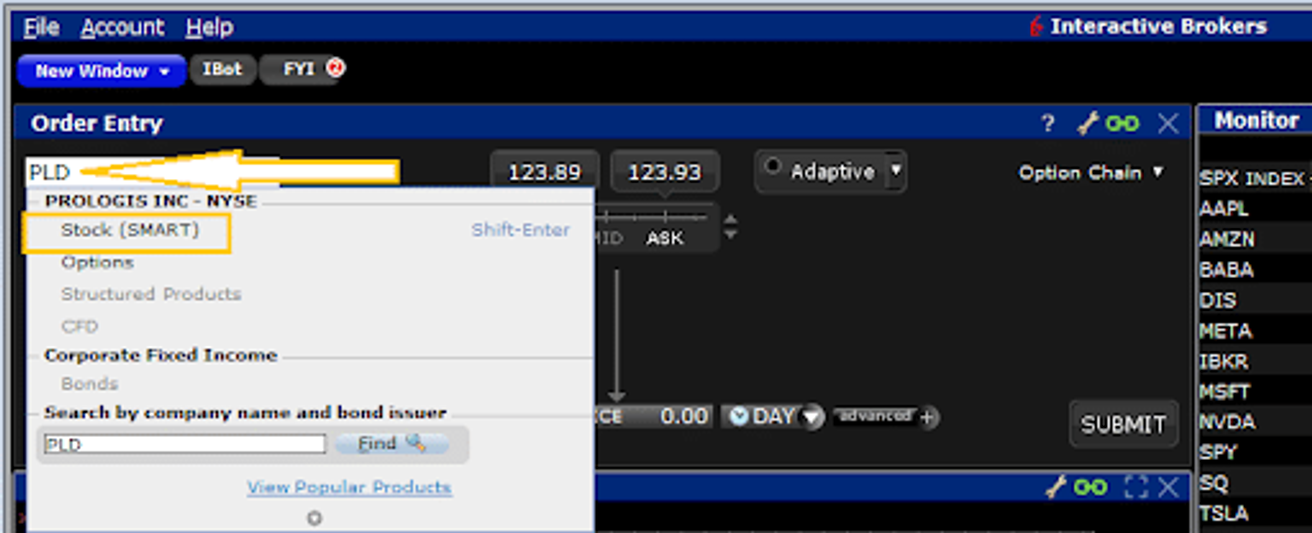
If you have found an online broker that suits your needs, managed to open an investment account and made the initial deposit, you are all set to buy your REIT. All you have to do is find the REIT within your chosen broker and place a buy order. For this example, we will use Interactive Brokers Trader Workstation (TWS).
1. Search for the chosen REIT (we will use Prologis, ticker “PLD”):
PLD buy order
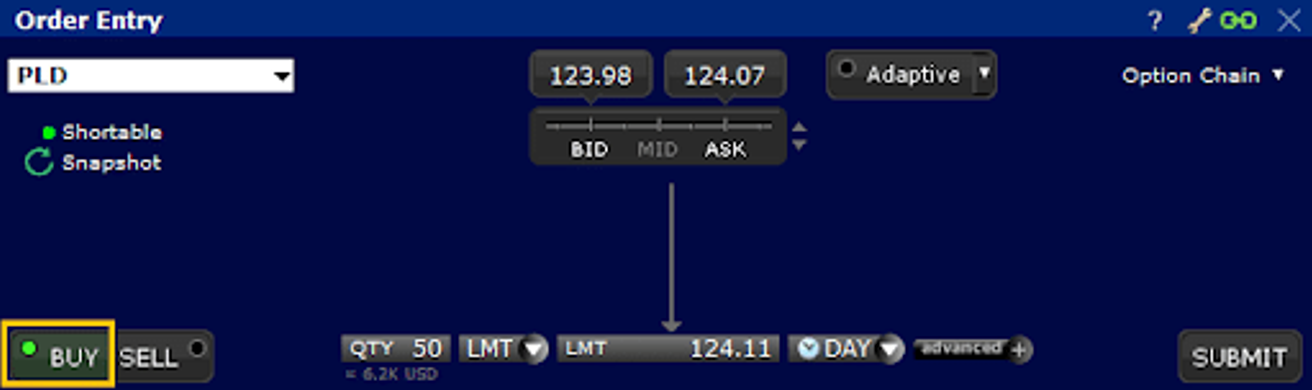
2. Click “Buy”:
PLD buy order
3. Choose the order details
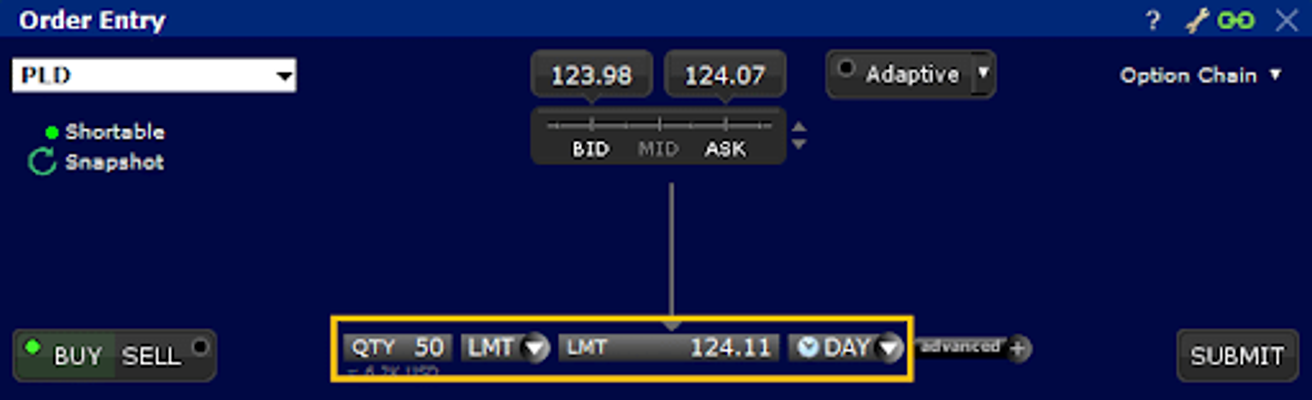
Now, it’s time to fill in all the boxes highlighted below:
PLD buy order
- QTY: short for quantity. Here you define the number of shares you want to purchase.
- Type of order: by default, Interactive Brokers sets your order type as LMT, short for limit order. This is good since it allows you to set a maximum price at which you are willing to buy the shares. The alternative is MKT, or market order.
- Limit amount: assuming you kept “LMT” as the type of order, you need to set the maximum price you are willing to pay per share. If you use a market order you do not need to fill this in and will buy at the best available ask price.
- Order duration: set to DAY by default.
4. Place the order:
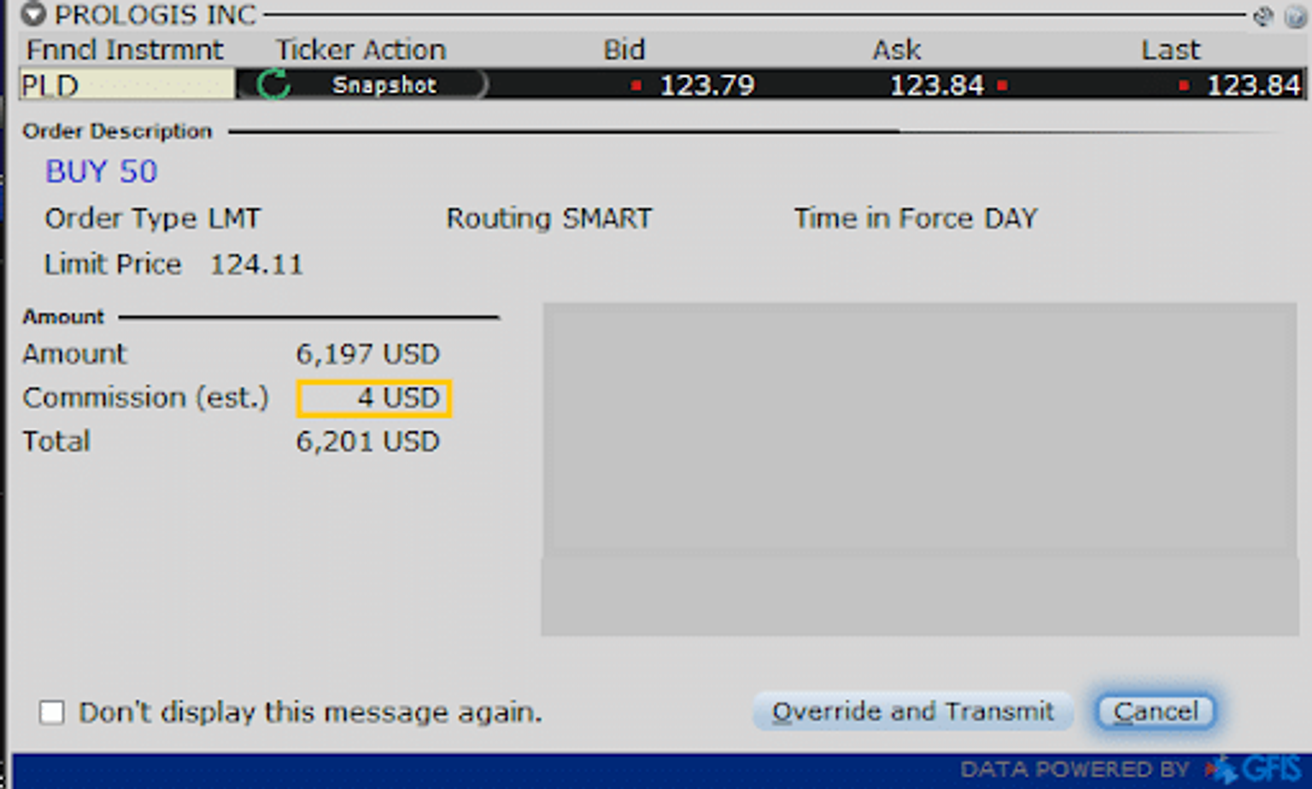
Finally, click “Submit” and a new window will show up. Here, you can take a final look at all the details, including the commissions, before clicking “Transmit”:
PLD confirmation order
REIT ETFs
REIT ETFs, short for exchange-traded funds, offer investors the ability to gain exposure to several REITs in a single trade. In this regard, the investment becomes even more diversified. REIT ETFs are a great pick for investors who are unsure which specific REIT to choose.
One important note for UK investors: US-domiciled ETFs such as the Vanguard Real Estate ETF (VNQ) or the Vanguard Global ex-U.S. Real Estate ETF (VNQI) are generally not available to UK retail investors, because they do not publish the Key Information Document required under the UK PRIIPs rules. You will need to look for UCITS ETFs listed in London or on other European exchanges instead. Some UCITS REIT ETFs to consider are:
- iShares Developed Markets Property Yield UCITS ETF (IWDP): global exposure to developed-market REITs and listed property companies
- iShares US Property Yield UCITS ETF (IUSP): US REITs, the closest UCITS alternative to VNQ
- iShares STOXX Europe 600 Real Estate UCITS ETF (EXI5): tracks the real estate sector of the STOXX Europe 600 index
- iShares MSCI Target UK Real Estate UCITS ETF (UKRE): tracks UK-listed REITs and property companies, combined with UK inflation-linked gilts
Always check the ETF’s factsheet for the current number of holdings, the ongoing charges and whether it distributes or accumulates income before investing.
ISAs
An ISA, short for individual savings account, is a tax-efficient way for UK investors to invest in stocks, including REITs. Gains on shares held in a stocks and shares ISA are not subject to capital gains tax, dividends are not subject to dividend tax and no tax is due when you withdraw money from an ISA. Brokers offering stocks and shares ISAs include:
Referring to the property income distributions (PID) discussed at the beginning, PIDs on REITs held in an ISA can be paid gross, without the 20% withholding tax. Check with your broker how it handles PID payments in its ISA, and whether it reclaims any tax withheld on your behalf.
The limitation of ISAs is that you can only pay in up to £20,000 per tax year across all your ISAs. Hence, as always, it is a good idea to start investing early and use your allowance each year!
Bottom line
To sum it up, here’s what you need to do:
- Choose a REIT to buy: each REIT offers a unique combination of geographical and sector exposure. You should also consider the REIT’s occupancy, leverage and growth potential.
- Find a suitable REIT broker: since REITs trade like ordinary shares, a broker offering excellent terms on stock trading is a great pick. If you want the tax benefits, choose one that offers an ISA.
- Open an account and deposit money: after deciding which trading platform to use, you must go through the account opening process and deposit money.
- Send a buy order to your broker for the REIT you like: that’s the easiest part (the process is intuitive)! After having your brokerage account and the name of the REIT that you want to buy, you just have to place a trade!
We hope that this post addressed some of your concerns. Make sure to do your own research to find out the best investing strategy for you!
Happy investing!
FAQs
What is a REIT?
A REIT, or real estate investment trust, is a company that invests in real estate. The REIT manages the property on behalf of investors, collects rent and pays for maintenance. To qualify as a REIT, a company has to distribute a high percentage of its property income, usually 90%, to investors.
What is the tax treatment of REITs?
REITs do not pay corporation tax on their property rental profits like other ordinary companies. However, they do pay business rates on the buildings they own and transfer taxes when they buy a building, and their shareholders are taxed on the distributions they receive (as property income in the case of UK PIDs).
What is the advantage of REITs compared to a traditional real estate investment?
REITs allow investors to own a small share of a large building. They also allow shareholders to diversify across several cities or even continents. As a publicly listed investment, REITs are also liquid investments, unlike physical real estate. Last but not least, investors do not need to worry about the day-to-day maintenance of the buildings.
What are the disadvantages of REITs?
REIT management has to be paid out of the rent collected, which reduces returns. Shareholders also do not have direct control over rental terms and the buy and sell decisions on individual properties. Due to the high payout of profits as dividends, REITs retain less capital to grow than other companies, and their share prices can be volatile and sensitive to interest rates, unlike the valuations of physical property.
Can the British invest in REITs on other continents?
Yes, British investors can invest in REITs all over the world. While not all countries have a REIT equivalent tax regime, major high-income economies such as the United States, Canada, Japan and Australia offer REIT structures. Medium-income economies such as Mexico and Brazil also have a REIT regime in place. Remember that a UK broker will not let you buy US-domiciled REIT ETFs, only the REIT shares themselves or UCITS ETFs.
What is an Exchange Traded Fund (ETF)?
An ETF is a publicly traded fund that holds assets like stocks. When you invest in an ETF, you indirectly buy a large portfolio of assets. In the case of the iShares MSCI Target UK Real Estate UCITS ETF, that means it will track the performance of underlying UK-listed REITs and property companies. In essence, you can easily gain exposure to dozens of UK property companies with just a single investment!
Is now a good time to invest in REITs in the UK?
If anyone knew the future, they would be rich. Over long periods of time, REITs are able to increase rents in line with inflation. As a result, real estate tends to keep its value in real terms and provides a recurring source of income.
Why should I invest in REITs from the UK?
REITs are a way for investors to earn regular income in the form of dividends, which tends to grow in line with inflation over the long term, and to diversify a portfolio of stocks and bonds with an asset class that behaves differently.