Starlink is the largest satellite constellation ever built, designed to bring global internet coverage to rural and remote areas where fibre is too expensive to deploy. As of 9 October 2026, Jonathan McDowell’s Starlink statistics count 12,988 satellites launched, 11,137 still in orbit and 9,726 in operational orbit, against SpaceX’s own last filed figure of about 9,600 at 31 March 2026. The service reached 12 million subscribers at the end of June 2026 and is sold in “160+ countries, territories, and other markets”.
Starlink is a division of SpaceX (Space Exploration Technologies Corp.), the company Elon Musk founded in 2002 to design, build and launch reusable rockets and spacecraft. Since its Nasdaq listing in June 2026, SpaceX has been one of the largest listed companies in the world and reports to the US Securities and Exchange Commission (SEC). Starlink’s subscriber and revenue figures therefore come from the company’s own IPO prospectus and quarterly reports, rather than being estimated from leaked investor decks as in the private era.
Can you invest in Starlink?
Starlink itself is not a separately listed company. It remains a division of SpaceX. However, the picture changed in June 2026: SpaceX priced its IPO on 11 June 2026 and the shares began trading on June 12, on the Nasdaq under the ticker SPCX. This means that while you cannot buy “Starlink stock” directly, you can now gain exposure to Starlink by investing in SpaceX (NASDAQ: SPCX), since Starlink represents a substantial portion of SpaceX’s overall revenue and valuation.
Key SpaceX IPO details
- Pricing and first trade: priced 11 June 2026, first traded 12 June 2026.
- Ticker and venue: SPCX, on the Nasdaq Global Select Market and Nasdaq Texas.
- IPO price: $135.00 per share.
- First day close: about $161, roughly 19% above the offer price.
- Shares sold: 555,555,555 Class A shares in the base deal, plus an underwriters’ option over 83,333,333 more. The option was exercised, taking the total to 638,888,888 shares.
- Capital raised: the base deal came to roughly $75 billion. With the option exercised, SpaceX reported $85.7 billion in net proceeds, the largest IPO on record, ahead of Saudi Aramco’s 2019 listing.
- Valuation: about $1.77 trillion at the $135.00 offer price. That rose to roughly $2.1 trillion at the first day’s close, which is the figure most widely quoted.
- Retail allocation: the prospectus commits to a directed share programme of “up to five percent” reserved for employees and people identified by executives. Musk had signalled up to 30% for retail investors more broadly, and CNBC reported on pricing day that the figure had been cut to the low-20% range.
- Starlink contribution: SpaceX reports Starlink inside a Connectivity segment, which generated $11.4 billion of $18.7 billion in total 2025 revenue, about 61%.
How SPCX has traded since the IPO
The first four months were volatile, which matters if you are deciding whether to buy now or wait. Since listing, SPCX has traded as high as $225.64 (16 June 2026) and as low as $104.83 (3 August 2026), a range of more than 2 to 1. The June high to the August low was a fall of about 54%. The shares have recovered part of that since, closing at $162.57 on 9 October 2026, for a market capitalisation of about $2.2 trillion.
SPCX is not a pure space company
In February 2026, before the IPO, SpaceX consolidated xAI. The company now reports three segments: Connectivity (Starlink), AI and Space. In the second quarter of 2026, Connectivity brought in $4.3 billion, AI $2.6 billion and Space $1.0 billion, out of $7.8 billion in total. The historical accounts were also recast on a common-control basis, so pre-2025 SpaceX-only revenue figures are not directly comparable with what the company reports today. Buying SPCX for Starlink exposure means also buying an artificial-intelligence business that is already a third of group revenue.
Will Starlink ever IPO separately?
SpaceX previously discussed the possibility of spinning off Starlink as a standalone publicly traded company, but the June 2026 IPO took a different path: a unified SpaceX listing that includes Starlink as part of the broader company. This means that for the foreseeable future, the only direct way to invest in Starlink-related growth is through SpaceX shares (SPCX).
A future Starlink spin-off cannot be ruled out entirely, since the company has discussed it as an option, but no concrete plans have been announced. For now, SPCX is the primary vehicle for Starlink exposure.
How to invest in SpaceX (SPCX): step by step
Now that SpaceX is publicly traded on the Nasdaq under the ticker SPCX, buying shares is straightforward for most retail investors. Here’s a step-by-step walkthrough:
Step 1: choose a broker that offers US market access
To buy SPCX, you’ll need a brokerage account that provides access to Nasdaq-listed US stocks. Some good options include:
- Interactive Brokers: the widest reach of the four. IBKR’s own fact sheet describes serving “clients from over 200 countries and territories” across more than 170 markets. US share dealing on the Tiered plan costs $0.0035 per share, minimum $0.35, capped at 1% of trade value. Currency conversion is 0.20 basis points of trade value (0.002%), minimum $2.00, so on any conversion below $100,000 you pay the $2 minimum rather than the percentage. If you use the automatic conversion service instead of placing an FX order yourself, IBKR states it “will typically add or subtract (at its discretion) 0.03% to the exchange rate”.
- eToro: simpler interface, well-suited to beginners. eToro is no longer commission-free on stocks. It charges $1 when you open and again when you close a stock position on most exchanges, and $2 on stocks listed in Australia, Hong Kong, Dubai, Abu Dhabi and Tokyo, so a round trip in SPCX on the Nasdaq costs $2. Withdrawals cost a flat $5 (minimum withdrawal $30) from a USD account and nothing from a local-currency account (GBP, EUR, DKK, AUD). Deposits in a currency other than USD pay a conversion fee that eToro says varies by location, payment method and Club level, with Diamond members exempt. There is no inactivity fee.
- Saxo: full-service multi-asset broker with strong research tools. US share dealing is 0.08% of trade value, minimum $1, on the Classic tier, falling to 0.05% on Platinum and 0.03% on VIP. Currency conversion is up to 0.25% against the FX spot mid-price.
- Trading 212: real stock investing with fractional shares, across more than 13,000 stocks and ETFs. No commission (other fees may apply, see terms and fees). A 0.15% FX fee applies when converting funds. Other fees may apply. The minimum deposit is €1, or €10 by bank transfer. When investing, your capital is at risk and you may get back less than invested. Past performance doesn’t guarantee future results.
The table further down this page sets out the four side by side.
Step 2: open and fund your account
Account opening is fully digital with all major brokers and typically takes 1-3 business days, depending on identity verification. You’ll need:
- Government-issued ID (passport, national ID, or driving licence).
- Proof of address (utility bill or bank statement from the last 3 months).
- Tax identification number (NIF, TIN, or equivalent depending on your country).
- A signed W-8BEN form, which most brokers auto-complete for non-US residents.
Once verified, fund your account via bank transfer (typically free, 1-3 business days), card payment (instant but sometimes with a small fee), or other locally available methods. For European investors funding in EUR, be aware of the currency conversion cost to USD, which often matters more than the trading commission itself.
Step 3: search for SPCX
Once your account is funded, search for the ticker SPCX on the broker’s trading platform. Confirm you’re looking at:
- Company name: Space Exploration Technologies Corp..
- Exchange: Nasdaq.
- Currency: USD.
- ISIN (International Securities Identification Number): verify this matches the official SPCX listing to avoid accidentally buying a similarly-named ETF or derivative product.
Step 4: place your buy order
You’ll typically have two main order types:
- Market order: buys immediately at the best available price, useful for liquid stocks like SPCX where the bid-ask spread is tight.
- Limit order: sets a maximum price you’re willing to pay, useful if you want to be price-disciplined, particularly during volatile post-IPO trading.
Most brokers also offer fractional shares, meaning you can invest a specific dollar amount (e.g., $100) rather than buying a whole share. This makes SPCX accessible even with small investment amounts.
Step 5: monitor your position
After purchase, you can monitor SPCX through:
- Your broker’s portfolio dashboard: shows real-time price, unrealised gain/loss, and position size.
- SpaceX investor relations: quarterly earnings reports, annual filings (10-K), and material announcements, SpaceX is now subject to SEC reporting requirements as a public company.
- Earnings calendar: SpaceX has reported once so far as a public company. The second-quarter 2026 results came out on 4 August 2026: revenue of $7.8 billion, up 92% year on year, a net loss of $541 million against a $1.0 billion loss a year earlier, and adjusted earnings before interest, tax, depreciation and amortisation (EBITDA) of $3.5 billion. Revenue beat the consensus of about $6.81 billion, and the shares still fell roughly 7.5% in after-hours trading, which tells you something about how much growth the price already assumes. No guidance was issued. Third-quarter results are expected in early November 2026, though SpaceX had not confirmed the date as at 9 October.
Note that SpaceX does not currently pay dividends (consistent with most growth-stage technology companies), so returns will come from share price appreciation rather than income distributions.
Tax considerations for European investors
Investing in US stocks from Europe involves a few tax considerations worth understanding:
- US dividend withholding tax: the IRS typically withholds 30% on US dividends paid to non-residents, reduced to 15% under most tax treaties if you’ve filed a W-8BEN form (auto-completed by major brokers). This only matters once SpaceX starts paying dividends.
- Capital gains tax: gains from selling SPCX are typically taxed in your country of residence rather than in the US (under most tax treaties). The specific rate depends on your jurisdiction. Portugal taxes capital gains at 28% (with some exceptions), Germany applies the Abgeltungsteuer at ~26.4%, France applies 30% flat tax, etc..
- Annual tax reporting: most European brokers provide annual tax statements (or country-specific reports like the German Steuerbescheinigung) to simplify your tax return.
Alternatives for satellite internet exposure
While SpaceX (SPCX) is now the most direct way to gain exposure to Starlink, investors looking for diversified exposure to the satellite internet and broader space economy have several other options:
1. Other satellite internet operators
- Viasat (NASDAQ: VSAT): one of the largest geostationary satellite operators, though it has stepped back from competing for consumers and now sells mainly to government and mobility customers.
- EchoStar Corporation (NASDAQ: ECHO): the parent of Hughesnet. Note the ticker: EchoStar changed it from SATS to ECHO on 24 June 2026, so older articles point at the wrong symbol. Note also what you would be buying. EchoStar has sold spectrum to SpaceX and AT&T for roughly $42 billion combined, taking a stake of about 2% in SpaceX as part of the consideration, which makes ECHO closer to a SpaceX shareholder and Starlink reseller than a Starlink competitor. Its satellite-internet subsidiary is in Chapter 11 bankruptcy protection, covered in the competitors section below.
- Iridium Communications (NASDAQ: IRDM): operates a constellation of 66 low Earth orbit satellites providing global voice and data services, strongest in maritime, aviation, and defence markets.
2. Tech and aerospace giants investing in space
- Amazon (NASDAQ: AMZN): the constellation formerly called Project Kuiper was renamed Amazon Leo on 13 November 2025. Bear in mind that Amazon is a roughly two-trillion-dollar company and Leo is a rounding error in its accounts, so AMZN is a very diluted way to own satellite internet.
- Alphabet (NASDAQ: GOOGL): a Schedule 13G filed on 14 August 2026 disclosed that Google LLC, XXVI Holdings and Alphabet together hold 551,189,500 SPCX Class A shares, 7.2% of the class, valued at roughly $94 billion in Alphabet’s second-quarter filing. That is about 4.5% of Alphabet’s own market capitalisation, so it is real but heavily diluted exposure, and it is no longer an access route now that SPCX can simply be bought.
- Lockheed Martin (NYSE: LMT) and Northrop Grumman (NYSE: NOC): traditional aerospace and defence contractors with significant satellite manufacturing operations.
3. Space-focused exchange-traded funds (ETFs)
- ARKX, renamed the ARK Space & Defense Innovation ETF with effect from 23 November 2025. Actively managed, ongoing charge 0.75%. SPCX is its largest holding at about 10.4%, and the rest of the book has tilted noticeably towards defence names such as L3Harris, Kratos and AeroVironment.
- Procure Space ETF (UFO): tracks the VettaFi Space Index, ongoing charge 0.75%. It was the first ETF to add SpaceX after the listing, at 6.17% on 16 June 2026, and SPCX is now its largest holding at about 14.7%.
- State Street SPDR S&P Kensho Final Frontiers ETF (ROKT): space and deep-sea exploration, ongoing charge 0.45% gross. Worth knowing that ROKT does not hold SPCX, so it is not a way to get SpaceX exposure.
- Tema Space Innovators ETF (NASA): launched 30 March 2026, ongoing charge 0.75%. It holds SpaceX at about 23% of the fund, the largest weighting of any ETF, but does so through a special purpose vehicle (SPV) rather than directly, which adds a layer of structure worth understanding before buying.
Two ETFs now hold SPCX directly, UFO and ARKX, and a third, NASA, holds it through an SPV. ROKT does not. Since the three that hold it charge 0.75% a year for exposure that is partly to a stock you can buy yourself for one commission, it is worth checking the current holdings sheet before assuming a space ETF gives you the SpaceX exposure you are after.
4. The former pre-IPO workarounds
Before June 2026 the only retail routes to SpaceX were closed-end and interval funds holding private shares, and they traded at large premiums because of it. That premium has gone. Destiny Tech100 (DXYZ) still holds SpaceX at about 10.6% of its portfolio, but where it once traded at several hundred percent above net asset value, it closed at $30.62 on 25 September 2026 against its last reported net asset value, at 30 June, of $34.30, a discount of roughly 11%. The ARK Venture Fund (ARKVX) also still holds SpaceX, at 17.02% of net assets as at 31 March 2026, marked to the market price now rather than to a private valuation, with a 2.90% net ongoing charge. Neither now offers anything you cannot get more cheaply by buying SPCX directly.
Investment platforms to buy stocks
| Broker | US stock fee | Minimum deposit | Availability |
| eToro | $1 on opening and again on closing ($2 on Australian, Hong Kong, Dubai, Abu Dhabi and Tokyo listings). $5 withdrawal fee from a USD account, none from a local-currency account | $50 in most countries | Worldwide, through entities regulated by CySEC, the FCA, ASIC and the FSRA |
| Saxo | 0.08% (min. $1) on Classic, 0.05% on Platinum, 0.03% on VIP | $0 on the Classic tier | Europe, the UK, Asia and the Middle East, through local entities |
| Interactive Brokers | $0 per share on IBKR Lite (US residents only). From $0.0035 per share (min. $0.35, max 1% of trade value) on the Tiered plan for everyone else | $0 | Over 200 countries and territories |
| Trading 212 | No commission (other fees may apply). A 0.15% FX fee applies when converting funds | €1 (€10 by bank transfer) | UK and most of Europe |
Pricing data checked in October 2026 against each broker’s own published fee pages. Fees and minimum deposits change often, so verify current rates on the broker’s website before opening an account.
Products and costs of Starlink solutions
Starlink sells under four broad headings, and the plan names have changed more than once, so it is worth checking the current ones. All prices below are Starlink’s own published US rates, checked in September 2026.
- Residential: the consumer product, sold in three tiers. Residential 100 Mbps at $55 a month, Residential 200 Mbps at $85 and Residential Max at $130. The two cheaper tiers are capped at their headline speed and are “only available in select areas”. Max is advertised at “up to 400+ Mbps” on the older hardware, comes with free professional installation and makes you eligible for an optional extra Starlink Mini Kit.
- Roam: for campers, vans, digital nomads and travellers. Roam 100GB at $55 a month, Roam 300GB at $80 and Roam Unlimited at $175. The metered tiers give you an allotment of high-speed data and then unlimited low-speed data.
- Business: sold as Local Priority for fixed and mobile use on land, from $55 a month for 50GB up to $530 for 2TB, and Global Priority, which Starlink describes as “best for maritime and global connectivity”, from $250 a month for 50GB up to $2,150 for 2TB. There is no longer a plan called Maritime: at-sea use now sits inside Global Priority, and the hardware is the Starlink Performance kit, built for ten-year survivability with a three-year warranty.
- Aviation: General Aviation Local 50GB at $200 a month and General Aviation Global 50GB at $1,000, both of which work only with the Starlink Mini. Business aviation runs from Aviation Regional 25GB at $4,000 a month to Aviation Global Unlimited at $20,000. Airline and government fleet plans are quoted on request.
Starlink does not publish a standard kit price. Hardware cost is quoted at checkout once you enter an address, which is why the $349, $499 and $599 figures that circulate cannot be matched to anything the company publishes. What the residential page does advertise, directly under the headline, is “No upfront hardware cost in select areas.” The current generation is the Starlink V5 Kit, described as smaller and more power-efficient than the V4 it replaces, with speeds “up to 375+ Mbps” and available in select areas. There is also a 30-day full-refund trial.
What Starlink costs in Europe
European prices are materially lower than the US equivalents. These are Starlink’s own published monthly rates, checked in September 2026:
| Plan | Portugal | Spain | UK |
| Residential 100 Mbps | 35€ | 35€ | £40 |
| Residential 200 Mbps | 45€ | 45€ | £60 |
| Residential Max | 65€ | 65€ | £80 |
| Roam 100GB | 45€ | 45€ | £55 |
| Roam Unlimited | 95€ | 95€ | £100 |
Starlink’s published monthly rates for Portugal, Spain and the UK, checked in September 2026. The Roam 300GB tier is not sold in these markets. Prices exclude hardware.
There is a wider point here for investors rather than customers. Average revenue per user across Starlink fell from $85 in the second quarter of 2025 to $66 in the second quarter of 2026, even as subscribers doubled. Cheaper entry tiers and expansion into lower-income markets are buying growth at the cost of revenue per customer, and that trade-off is one of the things to watch in each quarterly report.
All Starlink prices in this section vary by country, plan tier and promotional period. Always check the official Starlink website for current pricing in your region.
Coverage of Starlink solutions
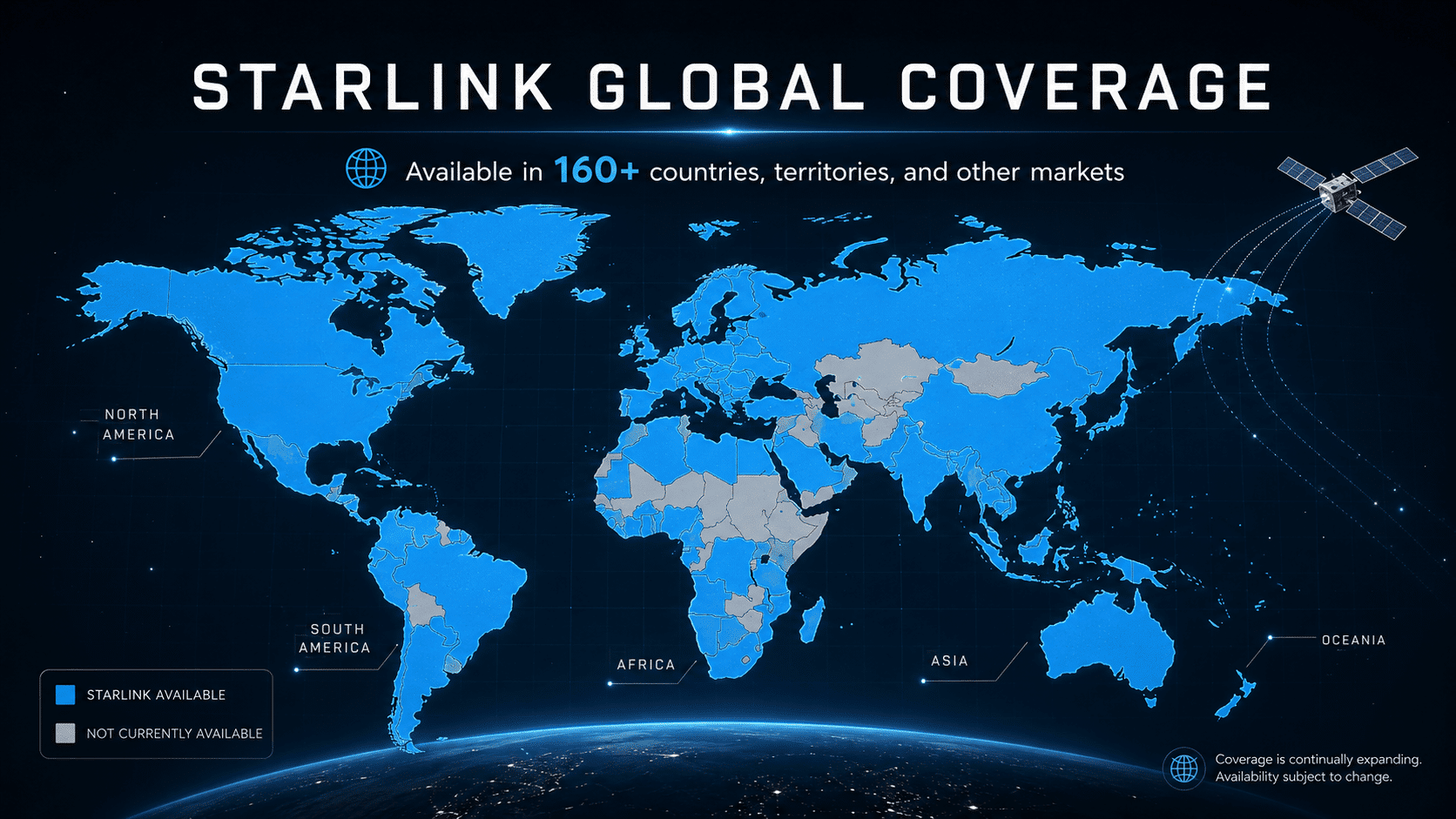
Starlink reported 12.0 million subscribers at the end of June 2026, double the figure a year earlier, and its own site describes coverage as “160+ countries, territories, and other markets”. The most precise filed number is 10.3 million subscribers across 164 countries, territories and other markets as at 31 March 2026, from the IPO prospectus. Both the constellation and demand in underserved regions are driving the growth, though as noted above it is coming with falling revenue per customer.
In the United States, the only figure Starlink itself has published is “more than 2 million active Starlink customers”, in a network update dated July 2025. No company or SEC-filed US subscriber count has been released since. On any measure Starlink is now the dominant provider in rural and remote US broadband.
On performance, Starlink’s own measurements and independent ones differ by a wide margin, so it matters which you are reading.
Starlink’s own published figures, from its network update of July 2025, are a median peak-hour download of nearly 200 Mbps in the US and a median peak-hour latency of 25.7 milliseconds as at June 2025, with fewer than one percent of measurements above 55 ms. Starlink also states that its lowest tier serves customers at 100 Mbps download and 20 Mbps upload in most states and territories.
Independent measurement is lower. Ookla put the US median download at 117.74 Mbps and the median upload at 16.91 Mbps across full-year 2025, the upload figure sitting below the federal minimum standard. Neither Starlink nor Ookla has published a 2026 median for the US.
Future objectives
SpaceX began launching Starlink satellites in 2019, and as set out at the top of this article the constellation now stands at 9,726 satellites in operational orbit out of 11,137 still up there, the difference being hardware retired, replaced or still raising to its working altitude.
The 42,000-satellite figure is the sum of SpaceX’s spectrum filings, not a deployment plan. It comes from roughly 12,000 first-generation satellites authorised by the US Federal Communications Commission (FCC), plus 20 separate International Telecommunication Union (ITU) filings of 1,500 satellites each lodged in October 2019, which come to 30,000. What SpaceX is actually authorised to deploy is about 26,900: 11,926 first-generation satellites, and 15,000 second-generation ones after the FCC granted a second tranche of 7,500 on 9 January 2026. SpaceX had applied for 29,988 second-generation satellites, so 14,988 of that request remains deferred. The grant carries a condition: half the authorised total must be launched by 1 December 2028.
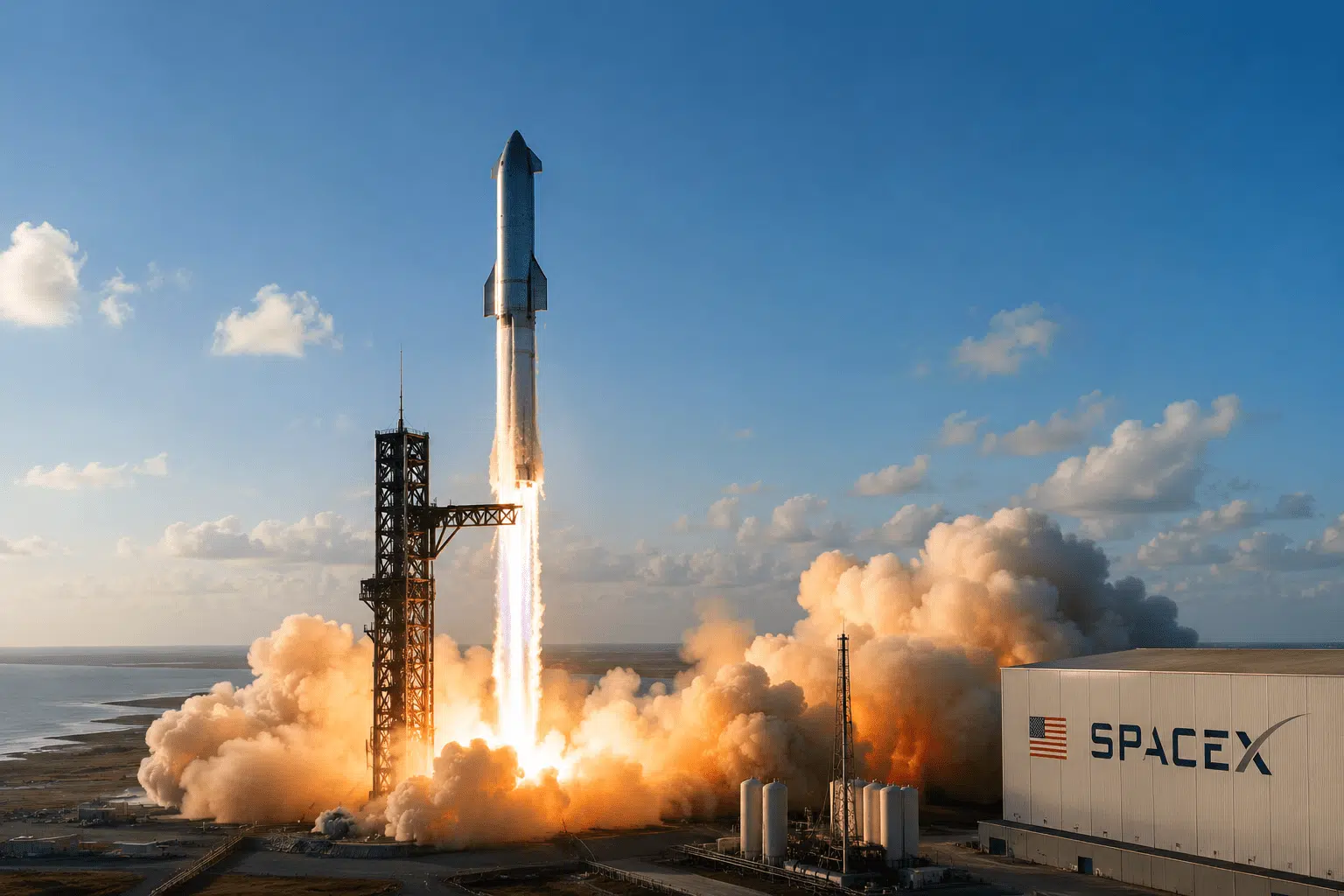
Starship, the vehicle that is meant to carry the next generation of satellites, reached orbit for the first time on 28 September 2026. Flight 12, on 22 May 2026, was the first flight of the V3 vehicle. Flight 13, on 24 July 2026, deployed twenty Starlink V3 satellites on a pre-planned suborbital trajectory, so they burned up on reentry. Flight 14 was the first orbital mission: the ship completed its orbital insertion burn and released 26 Starlink V3 satellites, described as the first operational batch, and SpaceX established contact with each of them. It was not a clean flight. One of the ship’s engines shut down early during ascent, and SpaceX brought the vehicle down after about three hours instead of the planned six orbits. Starship is the mechanism by which the constellation is meant to scale, and it has now shown it can deliver V3 satellites to orbit, but regular, reusable operational flights are still ahead.
On capacity, SpaceX’s Starlink V3 page states that each V3 satellite is designed to support 1 Tbps of downlink and 160 Gbps of uplink, roughly ten times the downlink and twenty-two times the uplink of a V2 satellite, with 2,048 beams each way and six 400-gigabit laser links. SpaceX says a single Starship launch will add about twenty times the capacity of a Falcon 9 launch of V2 satellites, which is why the pace of Starship flights after Flight 14 matters more to the investment case than any single subscriber number.
Following the June 2026 IPO, Starlink’s expansion is better capitalised than at any point in its history, with the net proceeds funding satellite deployment, hardware development and market expansion.
Starlink’s direct-to-cell service now trades as Starlink Mobile, and it is further along than the constellation numbers alone suggest. SpaceX states that 650 satellites, included in the totals above, support “the world’s largest and only satellite-to-mobile constellation”, carrying data, voice and messaging across six continents and reachable by more than 1.7 billion people. The prospectus put usage at approximately 7.4 million monthly unique devices across about 30 countries as at 31 March 2026. Named carrier partners now run to two dozen and include T-Mobile in the US, Deutsche Telekom across ten countries, MasOrange in Spain, VMO2 in the UK, Fastweb in Italy, Airtel Africa across fourteen countries, plus Optus, Telstra, Rogers, KDDI, SoftBank and others. In the US the T-Mobile product is live as T-Satellite with Starlink, included on some plans and $10 a month otherwise. Native calling and video remain future service rather than current.
Revenues and financial performance
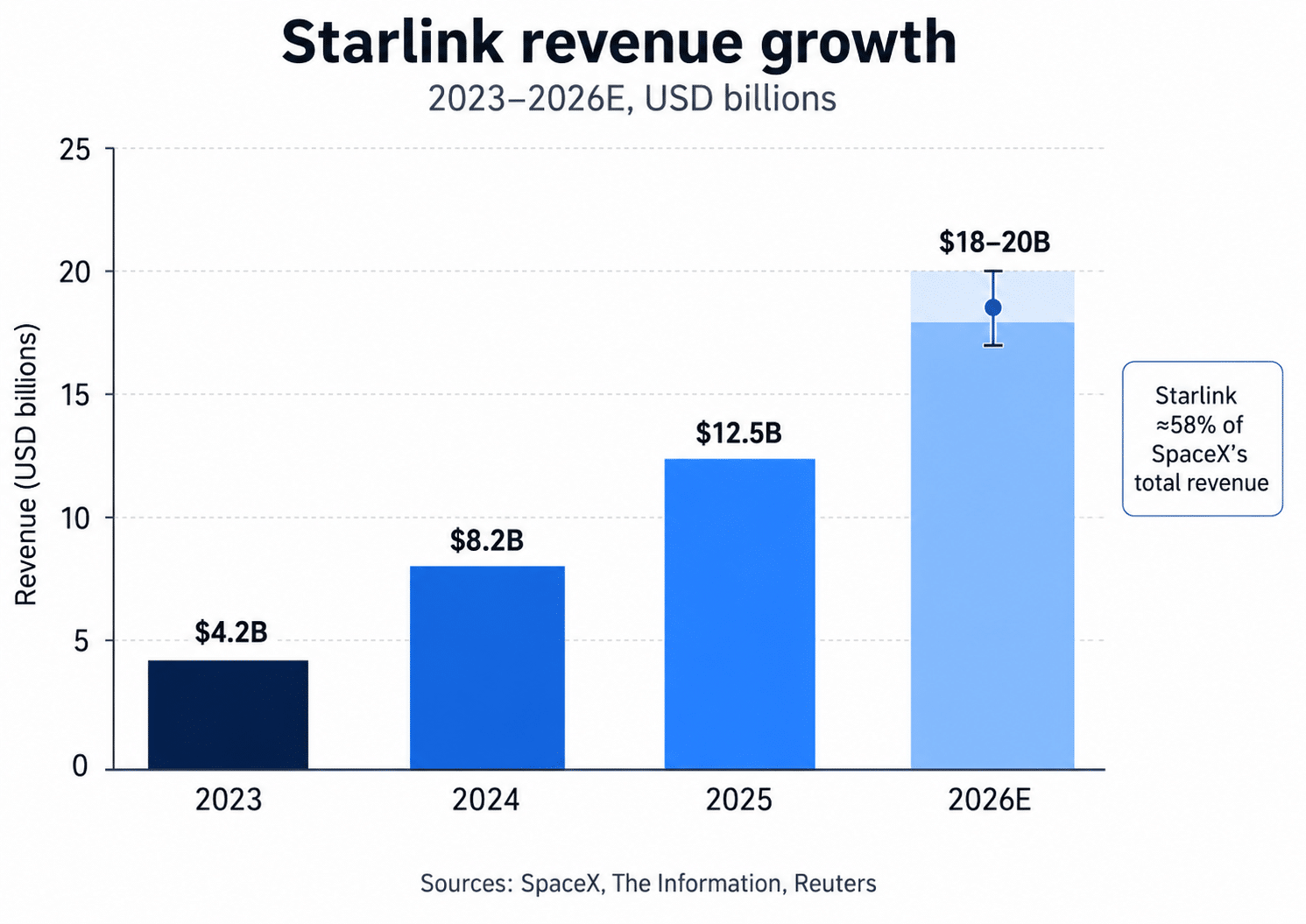
SpaceX now files its accounts, so these figures no longer rest on estimates. Starlink sits inside a reported segment called Connectivity, which covers Starlink consumer, enterprise and government business. There is no line item literally called “Starlink revenue”, so the figures below are the Connectivity segment as filed:
- 2023: $3.9 billion, about 38% of SpaceX’s $10.4 billion total.
- 2024: $7.6 billion, about 54% of a $14.0 billion total.
- 2025: $11.4 billion, about 61% of the $18.7 billion group total, with segment operating income of $4.4 billion.
- First half of 2026: $7.5 billion, split $4.6 billion consumer and $2.9 billion enterprise and government. The second quarter alone was $4.3 billion, up 66% year on year.
The Connectivity share of group revenue fell from 61% across 2025 to about 55% in the second quarter of 2026, because the AI segment is growing faster than Starlink rather than because Starlink slowed: Connectivity revenue itself rose 66% year on year in that quarter.
No full-year 2026 figure exists yet, and the filed first half was $7.5 billion. With $85.7 billion of net IPO proceeds, the constraint on Starlink’s expansion is no longer capital.
Competitors
Starlink faces competition from several players in the satellite internet market, both traditional geostationary (GEO) operators and emerging low Earth orbit (LEO) constellation operators:
Direct LEO competitors
- Amazon Leo, the constellation renamed from Project Kuiper in November 2025, is the most credible long-term challenger and is also badly behind. Amazon’s own last published figure was 396 satellites across 14 missions as at 2 July 2026. The FCC authorisation covers 3,232 satellites and required half of them, 1,616, to be deployed by 30 July 2026. That deadline passed with Amazon at roughly a quarter of it, and the consequence under the FCC’s order is a loss of spectrum priority for up to twenty months plus forfeiture of a surety bond. Amazon says it has invested “more than $10 billion” with billions more committed, and has never published a total programme cost. Consumer service is still not commercially available: an enterprise beta is running with JetBlue, Delta and AT&T, with consumer service promised “later this year”. Amazon had built 1,000 Leo satellites by early October 2026, but launches are held up while the Vulcan Centaur and New Glenn rockets are out of service.
- Eutelsat OneWeb: a constellation of “more than 600” satellites, sold wholesale to businesses and governments rather than to consumers, so it is not really competing for the same customer. It ordered 440 replacement satellites from Airbus across late 2024 and January 2026, which replace end-of-life first-generation hardware rather than expanding the fleet. LEO revenue reached €297.0 million in the year to June 2026, up 69.5% and a quarter of group revenue, but the group posted a net loss of €457.3 million and had to raise about €1.5 billion of equity across late 2025. The French state holds 29.65% and the UK government 10.89%.
- Telesat Lightspeed: the Canadian operator expanded the planned constellation from 156 to 225 satellites after winning a fifteen-year, C$2.7 billion Canadian defence contract in August 2026. First launches are due before the end of 2026 on Falcon 9, with commercial service slipped to early 2028. Enterprise and government focus, not consumer.
- China’s Guowang and Qianfan: together the two state-backed constellations had roughly 434 satellites tracked in orbit in late September 2026, against combined plans of more than 29,000. Tracker counts vary, and neither publishes an operational figure. The relevance is less commercial than geographic: they are aimed at markets where Starlink is not licensed.
Traditional GEO satellite operators
- Viasat (NASDAQ: VSAT): still a major satellite communications company, but in the quarter to 30 June 2026 its US fixed-broadband base was down to about 115,000 subscribers, a decline it described as expected, and it has redirected the business towards government and mobility work rather than defending the consumer market.
- EchoStar / Hughesnet (NASDAQ: ECHO): the starkest illustration of Starlink’s effect on incumbents. Hughesnet’s subscriber base fell from 1.56 million at the end of 2020 to around 641,000 by August 2026, and Hughes Satellite Systems Corporation and eleven subsidiaries filed for Chapter 11 on 2 August 2026, though EchoStar Corporation itself did not file.
- NBN Co (Sky Muster in Australia): Australia’s national broadband provider, with satellite services for remote areas.
Emerging direct-to-cell competition
- AST SpaceMobile (NASDAQ: ASTS): building a constellation for direct satellite-to-smartphone service, with AT&T, Verizon, Vodafone and stc (Saudi Telecom Company) among its partners and more than 60 mobile operators signed up. It had 13 BlueBird satellites in orbit after launches in June and August 2026, and is not yet commercially launched: the company describes 2026 as a year of “scaled non-commercial usage” and continuous US coverage as needing roughly 45 to 60 satellites. Second-quarter 2026 revenue was $31.5 million against a net loss of $230.9 million, with about $2.7 billion of cash. Starlink Mobile, by contrast, is already carrying traffic on 650 satellites.
Key competitive dynamic: the gap is very wide. Starlink has 9,726 satellites in operational orbit, while Amazon Leo has launched 396 in total, a ratio of roughly 24 to 1 even on the basis most favourable to Amazon. Amazon has also missed its first regulatory deployment milestone. Amazon remains the most credible long-term threat on the strength of its balance sheet and AWS integration, but it is not currently selling to consumers anywhere. Direct-to-cell is the more open contest, and there Starlink is ahead of AST SpaceMobile on satellites in orbit and on commercial status, while AST has deeper integration with the US carriers’ spectrum.
Key risks of investing in SpaceX (SPCX)
While SpaceX represents one of the most exciting investment opportunities in the public markets, it also carries substantial risks that investors should weigh carefully before committing capital. The post-IPO price action, a fall of about 54% from the June high to the August low, reflects the genuine uncertainty around how to value this business.
Valuation risk
SpaceX listed at a valuation of about $1.77 trillion at the $135.00 offer price, reached roughly $2.1 trillion after the first day’s close, and was worth about $2.2 trillion in early October 2026. At this valuation:
- SpaceX trades on multiples that would be considered extreme in traditional industries. At the IPO price that was roughly 95 times trailing sales. The valuation reflects expectations of future growth rather than current profitability.
- The company posted a net loss of $4.9 billion in 2025, on an operating loss of $2,589 million. Investors are paying for future cash flows that depend on continued execution, and the second quarter of 2026 was still lossmaking at $541 million.
- Any disappointment in growth metrics, whether subscriber additions, revenue per user or Starship milestones, can move the price hard. It already has: the second-quarter results beat revenue consensus by about 14% and the shares fell roughly 7.5% anyway.
- Analysts disagree sharply, and the aggregators disagree with each other. As at 9 October 2026 stockanalysis.com showed an average twelve-month target of $221.07 across 38 analysts, ranging from $118 to $450. That spread is wider than for any comparable large-cap listing.
- Lock-up expiries are a live overhang. Pre-IPO holders are subject to staggered lock-ups, and Alphabet alone holds 7.2% of the Class A shares, so a large block of stock becomes sellable in stages over the first year of trading.
Single-stock concentration risk
Investing in SPCX is a single-stock bet on:
- Starlink’s continued subscriber growth, the Connectivity segment being the largest of the three.
- Launch services demand from commercial and government customers.
- Starship development success (a major source of capital expenditure and future revenue).
- Continued technological leadership against well-funded competitors.
Unlike a broad index fund or diversified ETF, a single-stock position concentrates all of these risks in one company. Diversification principles suggest that no single stock should typically represent more than 5-10% of a well-balanced portfolio, even for high-conviction holdings.
Capital intensity and free cash flow pressure
SpaceX’s business model is extraordinarily capital-intensive:
- Satellite manufacturing and launch: maintaining a constellation of 9,726 operational satellites, with authorisations covering about 26,900, requires continuous capital expenditure, because satellites are replaced as well as added. Operating cash flow in the first half of 2026 was $3.5 billion, against investing activities that absorbed $34.5 billion, a figure that covers purchases of marketable securities with the IPO proceeds as well as capital spending.
- Starship development: the next-generation launch vehicle has consumed billions in research and development. It reached orbit for the first time on Flight 14 in September 2026, but it is not yet flying regular operational missions.
- Hardware subsidies: Starlink subsidises customer hardware to drive subscriber acquisition, a cost that’s only partially recovered over subscriber lifetimes.
- Global market expansion: each new country requires regulatory approval, ground station infrastructure, and customer support investment.
Free cash flow may therefore remain under pressure for several years despite rising revenues, which could constrain the company’s ability to return capital to shareholders through dividends or buybacks.
Key-person risk (Elon Musk)
SpaceX’s strategic direction, culture, and public perception are heavily tied to Elon Musk’s leadership. This creates several risks:
- Time allocation: Musk also leads Tesla, X (formerly Twitter), xAI, Neuralink, and The Boring Company, meaning his attention is divided across multiple ventures.
- Public statements and controversies: Musk’s public profile has historically created share price volatility at Tesla, and similar dynamics could affect SPCX.
- Succession planning: SpaceX’s long-term success may depend on its ability to maintain its culture and execution capability beyond Musk’s direct involvement.
- Concentration of voting rights: this is no longer a maybe. The prospectus states that Musk holds approximately 82.4% of the voting power after the offering, through Class B shares carrying ten votes each against one for the Class A shares sold to the public, and that he “will have the power to control the outcome of matters requiring shareholder approval, including election of all our directors”. As a minority shareholder you have essentially no say. That can cut either way, buying long-term focus at the cost of accountability, but it should be a conscious choice rather than a surprise.
Competitive risk
Although Starlink currently dominates the LEO satellite internet market, competition is intensifying:
- Amazon Leo has Amazon Web Services (AWS) integration potential and Amazon’s balance sheet behind it, which makes it the most credible long-term threat, though it is well behind schedule and still not selling to consumers.
- AST SpaceMobile directly competes with Starlink Mobile and has deeper integration with US carrier spectrum, though it has far fewer satellites in orbit and is not yet commercially launched.
- China’s national satellite programmes, Guowang and Qianfan, are deploying competing constellations aimed largely at markets where Starlink is not licensed.
- Traditional GEO operators are no longer the competitive risk they were. Hughes is in Chapter 11, EchoStar has become a SpaceX shareholder and Viasat has retreated from residential broadband, so Starlink faces fewer price constraints in US rural broadband than it did two years ago.
Regulatory and geopolitical risk
SpaceX operates in a heavily regulated industry across multiple jurisdictions:
- Spectrum licensing: Starlink requires national spectrum licences in every country it serves, so regulatory denials or revocations could limit growth.
- FCC requirements (US): Starlink must meet specific deployment milestones and orbital debris commitments to maintain its operating licence.
- Geopolitical exposure: Starlink has played a notable role in conflicts (e.g., Ukraine), which can create both opportunities and political complications.
- Government contracts: a significant portion of SpaceX’s launch revenue comes from US government contracts (NASA, Department of Defense), so changes in administration priorities could affect this revenue stream.
- Restricted markets: Starlink is not sold in China, Russia or Iran, and although it was granted an Indian licence in 2025 it has not launched commercially there either. Those four are among the largest possible markets, which caps the addressable total. Availability elsewhere is also patchier than a map suggests. Starlink lists around 44 African markets in its region selector, but not all are selling: Starlink’s South Africa page currently lists no plans at all.
Technological and operational risk
- Starship development: the V3 vehicle flew three times in 2026 and put 26 Starlink V3 satellites into orbit on Flight 14 in September, though that mission was cut short after an engine shut down early. Full operational capability, meaning a regular launch cadence, NASA Artemis lunar landing, Mars missions and rapid reusability, remains in development.
- Orbital debris and Kessler syndrome: with 11,137 Starlink satellites in orbit and authorisations for about 26,900, collision risk and debris management are real operational concerns, and they are increasingly a regulatory one as Chinese and Amazon constellations fill the same shells.
- Satellite obsolescence: each generation is replaced by the next, so the capital expenditure cycle never really ends. Of the 12,988 Starlink satellites launched, 1,851 have already come down.
- Cybersecurity: a constellation of more than 11,000 satellites, plus the ground stations and user terminals behind them, is a large attack surface for state-level threats.
Final notes about investing in Starlink (via SpaceX)
Starlink, a division of SpaceX, has become the dominant player in satellite internet. A subscriber base of 12 million at the end of June 2026, double a year earlier, improving network performance and expansion into business, aviation and direct-to-cell services all point to a business still growing quickly.
With SpaceX’s June 2026 IPO, investors now have a direct way to gain exposure to Starlink’s growth through SpaceX shares (NASDAQ: SPCX). However, it’s important to understand what you’re actually buying:
- You’re not buying “Starlink stock”. You are buying SpaceX, of which the Starlink-based Connectivity segment was about 61% of 2025 revenue.
- You are also buying an artificial-intelligence business, which was about a third of group revenue in the second quarter of 2026. Anyone buying SPCX purely for satellite exposure should understand that.
- The valuation is ambitious. At about $2.2 trillion the price implies successful execution across satellite internet, launch, Starship and artificial intelligence at once.
- The shares are volatile. SPCX has traded between $104.83 and $225.64 in its first four months as a public company.
- Cash flow is under pressure. Operating cash flow was $3.5 billion in the first half of 2026 against continuous heavy investment, so free cash flow may stay negative for years even as revenue rises.
- You have no vote that matters, because of the dual-class structure described in the risks section above.
From an investment perspective, Starlink by way of SpaceX offers a significant opportunity alongside notable risks. Profitability will depend on cost management, pricing power, continued global expansion and execution on the V3 satellites and the Starship programme, and it is worth being clear that Starship has only just completed its first orbital mission. Competition shapes the outlook too, though less than a year ago: Amazon Leo has billions behind it but missed its first deployment milestone and is not yet selling to consumers, while AST SpaceMobile targets direct-to-cell with 13 satellites in orbit and no commercial launch yet.
Starlink’s future success will hinge on holding its technological edge, above all on turning Starship’s first orbital mission into a regular launch cadence so V3 satellites reach service in volume, and on scaling faster than rivals. For investors comfortable with the risk and reward of a large-cap technology company pursuing capital-intensive infrastructure, SPCX is the most direct vehicle for Starlink exposure. For those who would rather spread the exposure across the space economy than hold a single stock, the funds covered earlier remain an option, though it is worth checking a fund’s current holdings rather than its name.
This article does not constitute investment advice. Always conduct your own research and consider your personal financial situation, risk tolerance, and investment goals before investing in any security. Investing involves risk, including the potential loss of capital.