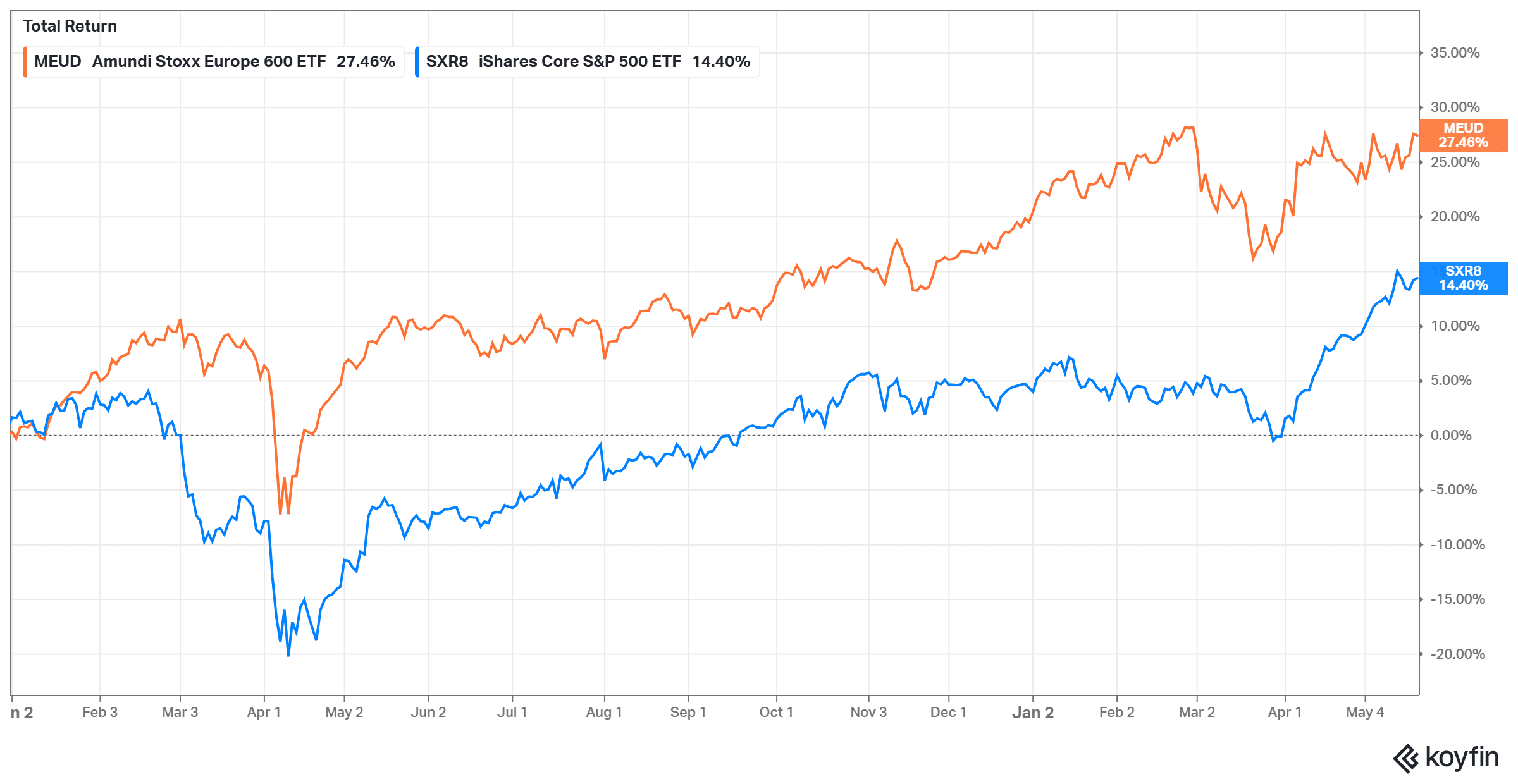
Diversification is essential, and it works! Since Trump took office for a second time, the U.S. stock market has suffered due to instability caused by the new wave of tariffs.
As of May 22, 2026, the S&P 500 is up 14.40% in euros since the start of 2025, while the STOXX Europe 600 (Europe’s equivalent of the S&P 500) is up 27.46%:
Video summary
Overview of the European stock market landscape
The European stock market is a diverse, complex ecosystem spanning multiple countries, currencies, and regulatory frameworks. Unlike the US – where a few major exchanges (NYSE and Nasdaq) dominate – Europe’s capital markets are decentralised, with each country operating its own national exchange.
That said, if you had to pick a single broad-based European index, the STOXX Europe 600 is the most representative choice. It covers 600 large, mid, and small-cap stocks across 17 European countries and provides broad exposure to European equities. You can check the index’s full constituent list here.
To understand how to invest in the European market, it helps to break it down into three layers:
European Union (EU)
The EU is a political and economic union of 27 member states. While the EU promotes financial market integration through regulation like MiFID II, each country still operates its own stock exchange and tax system.
Key stock exchanges in EU countries include:
- Euronext – a pan-European exchange covering France, the Netherlands, Belgium, Portugal, Ireland, Italy, and Norway (via Oslo Børs, which Euronext acquired in 2019).
- Deutsche Börse (Xetra) in Germany.
- SIX Swiss Exchange (technically non-EU, see below) and BME (Bolsa de Madrid) in Spain.
- Warsaw Stock Exchange (GPW) in Poland – one of the largest emerging-market exchanges in Central Europe.
- Nasdaq Nordic – covering Stockholm, Copenhagen, and Helsinki.
United Kingdom (post-Brexit)
Although the UK left the EU in 2020, London remains one of Europe’s most important financial centres. The London Stock Exchange (LSE) lists both domestic and international companies, and remains a major gateway for global investors into European assets. Investing in UK stocks means dealing with the British pound (GBP) and a separate regulatory regime under the FCA rather than ESMA.
Switzerland and other non-EU European markets
Other notable non-EU markets include:
- Switzerland (SIX Swiss Exchange) – home to large multinational companies like Nestlé, Novartis, Roche, and UBS, denominated in Swiss francs (CHF).
- Norway (Oslo Børs) – now part of the Euronext group, but operating in Norwegian kroner (NOK).
- Iceland and Liechtenstein – smaller markets that may be accessible through certain international brokers.
These countries aren’t EU members but are economically linked via the European Economic Area (EEA) or bilateral agreements, making them accessible to most European investors through major international brokers.
How to invest in a European stock (or ETF) – step by step
To invest in a European stock, you first need a broker that gives you access to the relevant exchange. In the example below, we’ll use Interactive Brokers – which gives access to 150+ markets in 30+ countries, including all major European exchanges.
The European stock we’ll buy is ASML Holding N.V., a Dutch multinational and one of the world’s leading manufacturers of chip-making equipment (its customers include Nvidia, TSMC, and Intel). ASML is a particularly clear example because it’s the largest European technology company by market capitalisation and is listed on Euronext Amsterdam.
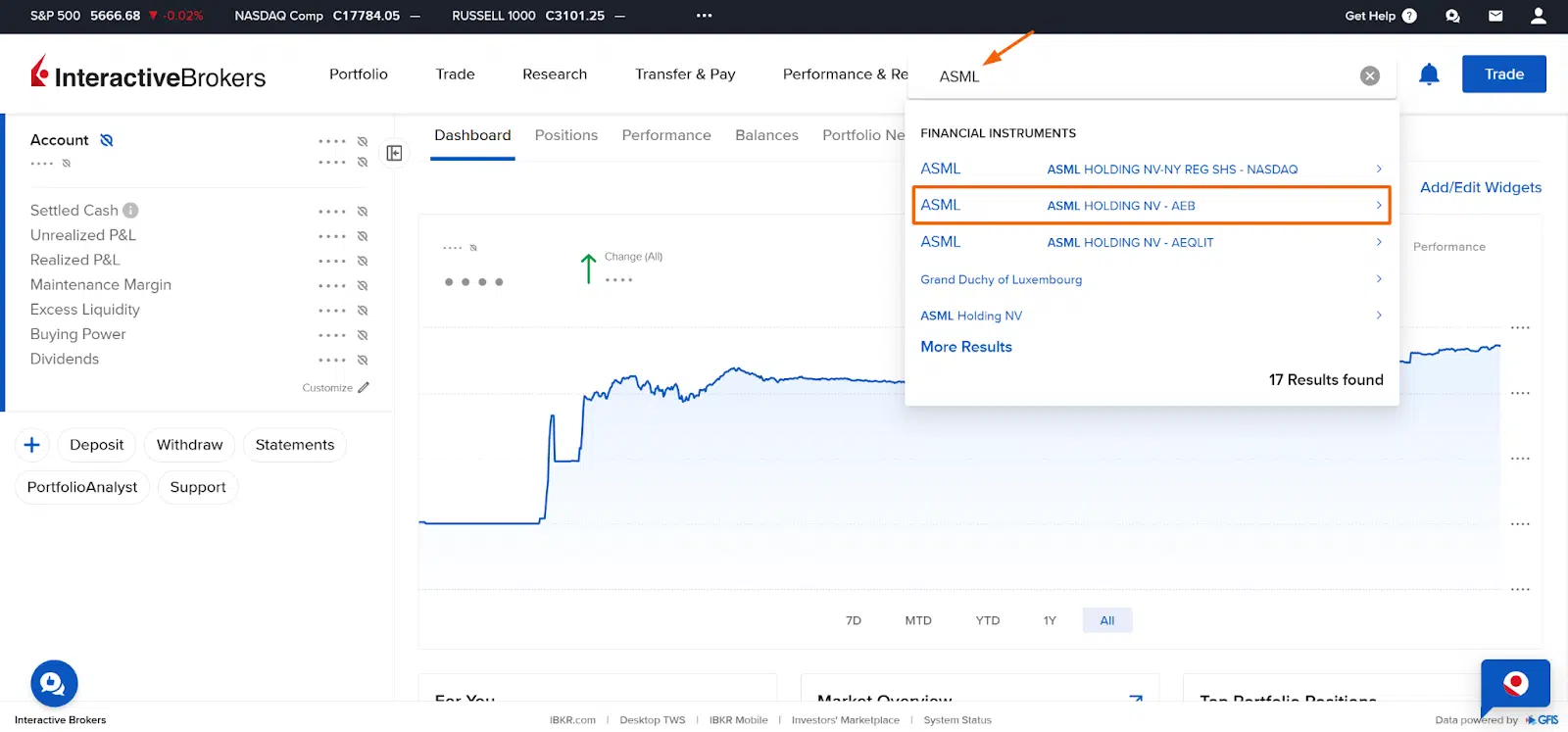
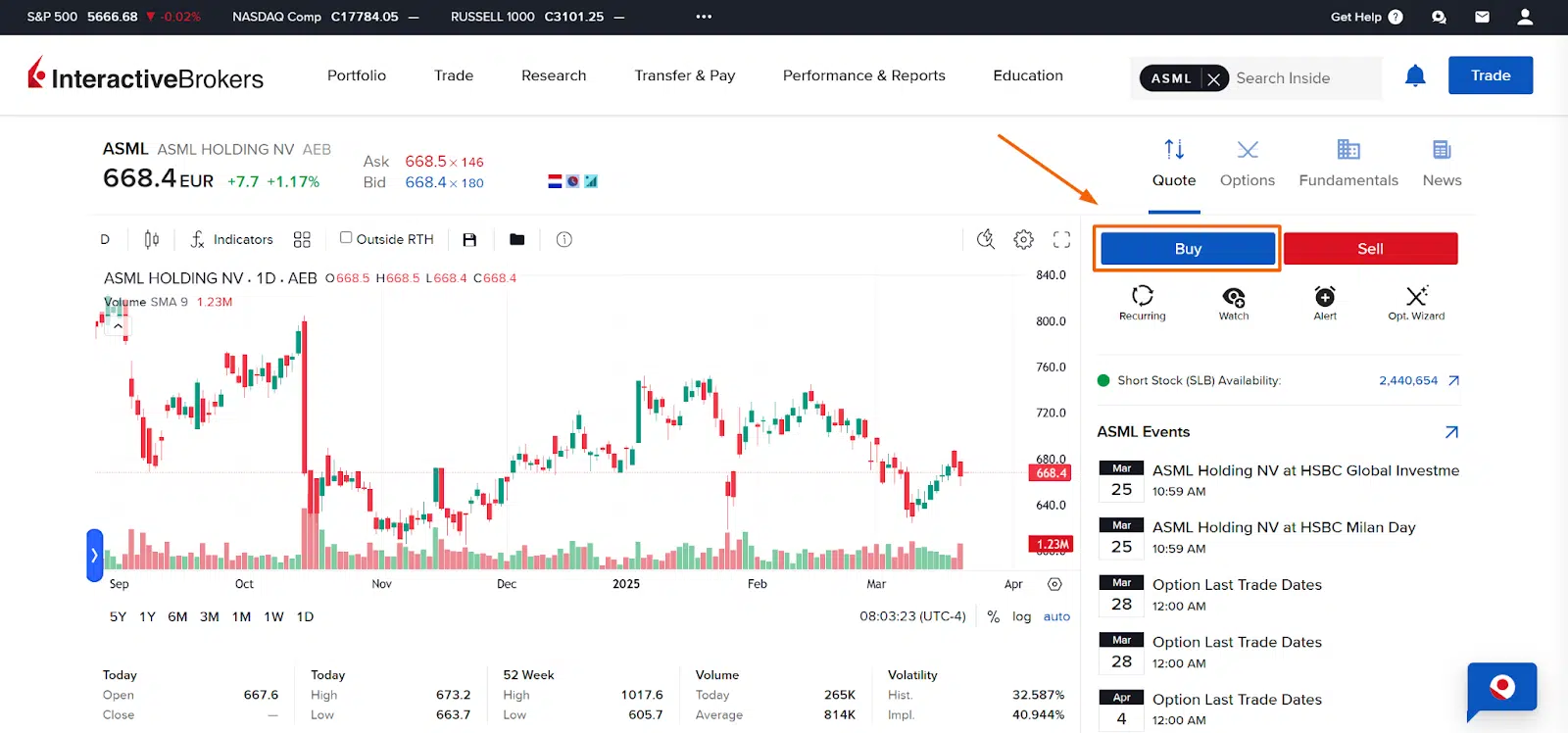
- Step 1: open your Interactive Brokers account, search for “ASML,” and choose the listing on the AEB (Euronext Amsterdam):
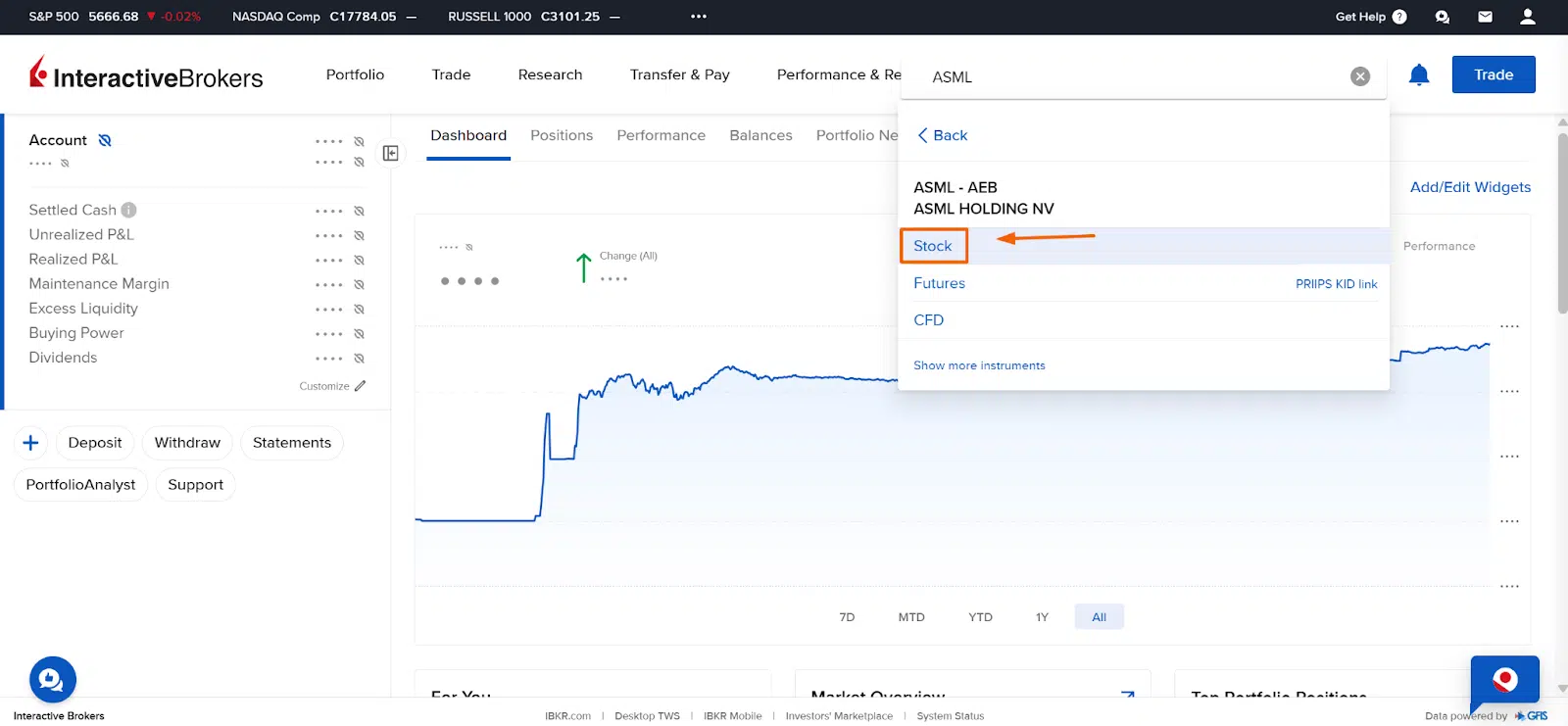
Then, select “stock”:
- Step 2: Click “Buy”:
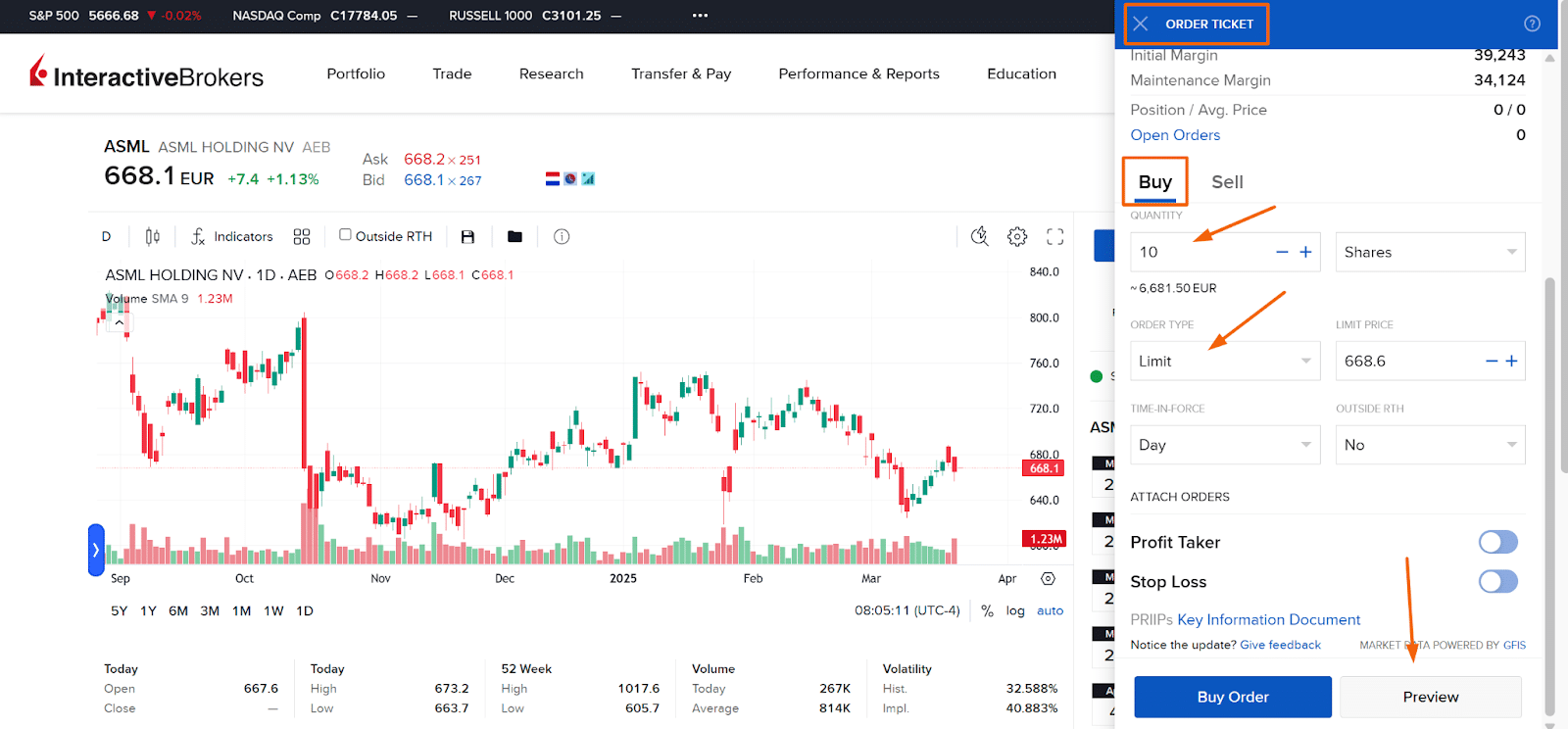
- Step 3: Give your “Buy” order details
Select the number of shares you want to buy (10 shares in our example), the “order type”, which we select as “Limit”, which means that we are willing to buy each share up to a specific price (€668.60 in our case). If you select “Market”, you would instantly buy at the best available market price.
Then click “preview”:
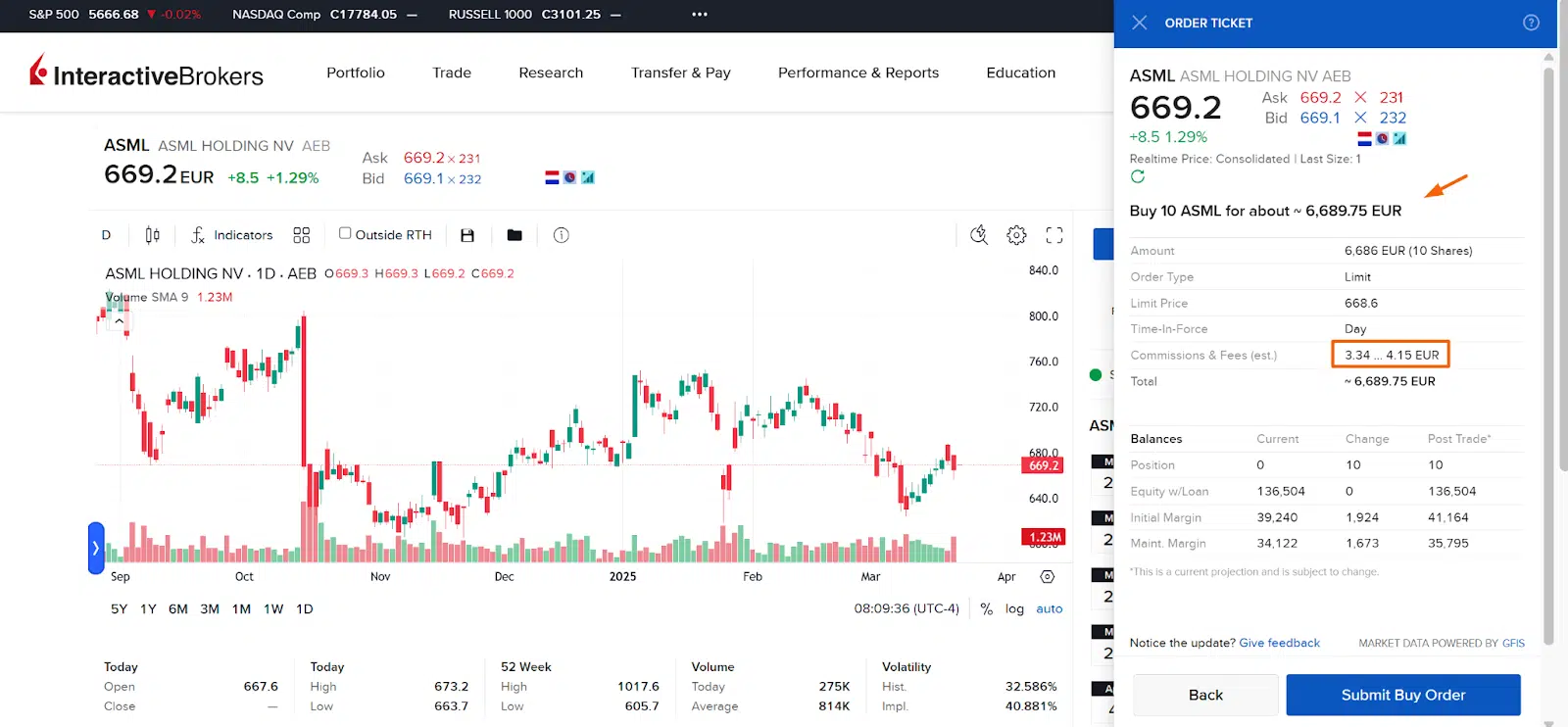
- Step 4: Analyze all the details before submitting your order.
Here, you can give a final check before clicking “Submit buy order”, including the commissions paid for the execution of this order:
- Step 5: Click “Submit buy order” and wait for your order to be fulfilled:
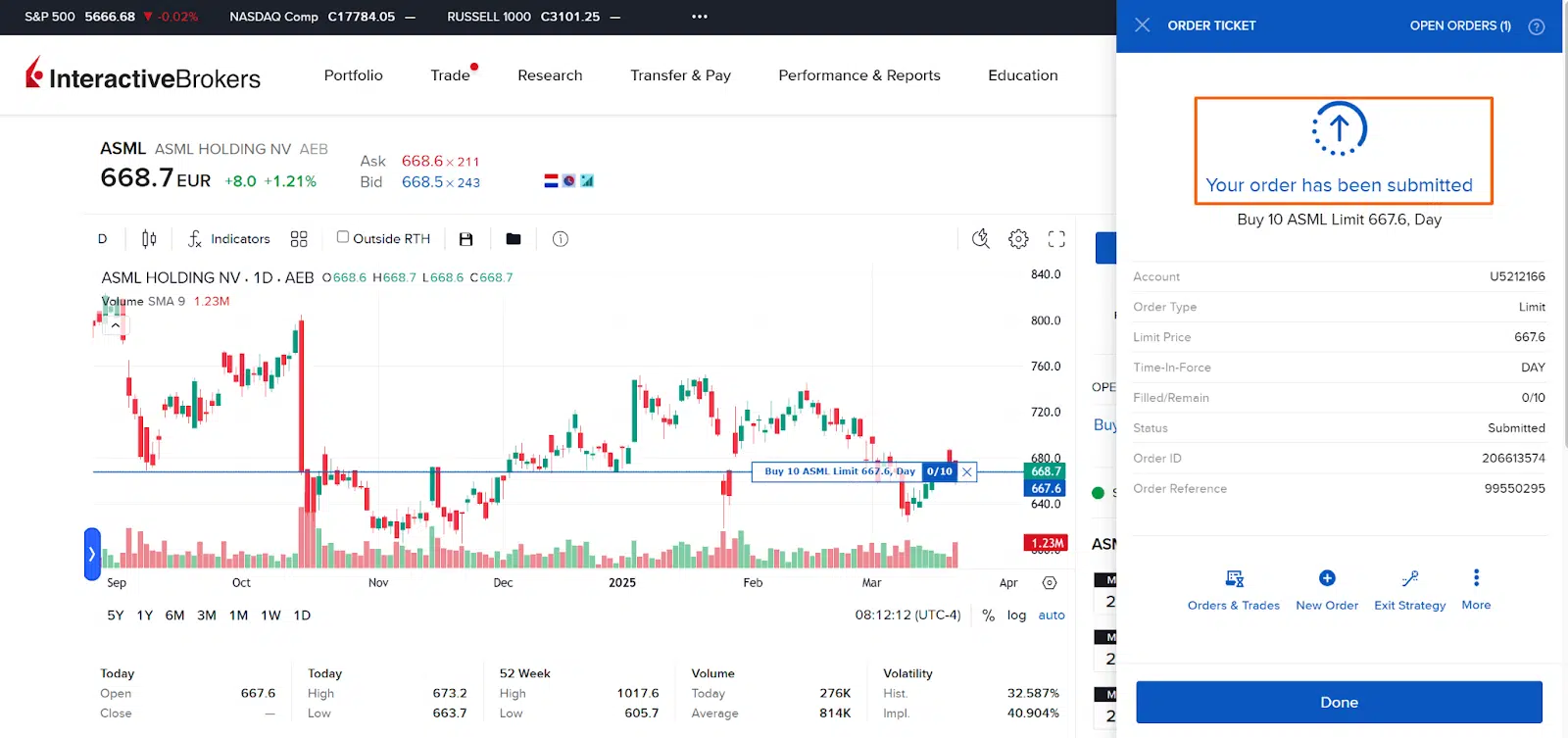
Please remember that if the price exceeds your “limit” price, your order may not be executed if it does not reach the maximum price you are willing to pay (€668.6). If you just want to buy and not wait, give a “market” order.
What about ETFs that track the European stock market?
If picking individual European stocks sounds too time-consuming or risky, ETFs (Exchange-Traded Funds) are a great way to get broad exposure to European markets. They let you invest in dozens or even hundreds of European companies at once, at a very low cost and with one trade.
Whether you’re looking to track a broad index like the STOXX Europe 600, focus on a specific region (Eurozone, UK, Switzerland), or zoom in on a particular country or sector, there’s likely an ETF for it. ETFs trade on stock exchanges just like regular shares and are accessible through most brokers that support European markets.
Below, we cover ETFs for European investors (European-domiciled UCITS funds) and ETFs for non-European investors (US-domiciled, accessible to investors in the US, parts of LATAM, and other non-EU regions).
European ETFs for European investors
Here are four popular European ETFs to consider, in approximate order of size (Assets Under Management – AUM):
Amundi STOXX Europe 600 UCITS ETF Acc
- Description: tracks the STOXX Europe 600 index, which covers the 600 largest European companies across 17 European countries.
- ISIN: LU0908500753
- TER: 0.07%
- Replication method: Physical
- Distribution policy: Accumulating
- AUM: ~€10B+
iShares Core MSCI Europe UCITS ETF EUR (Acc)
- Description: tracks the MSCI Europe index, covering the leading stocks from 15 developed European countries (including the UK and Switzerland alongside EU markets).
- ISIN: IE00B4K48X80
- TER: 0.12%
- Replication method: Physical
- Distribution policy: Accumulating
- AUM: ~€10B+
iShares Core EURO STOXX 50 UCITS ETF EUR (Acc)
- Description: tracks the EURO STOXX 50 index, which covers the 50 largest blue-chip companies in the eurozone – so excludes UK, Swiss, and other non-eurozone companies.
- ISIN: IE00B53L3W79
- TER: 0.10%
- Replication method: Physical
- Distribution policy: Accumulating
- AUM: ~€6B+
iShares Core MSCI EMU UCITS ETF EUR (Acc)
- Description: tracks the MSCI EMU index, covering large and mid-cap stocks across countries in the European Economic and Monetary Union (eurozone members only).
- ISIN: IE00B53QG562
- TER: 0.12%
- Replication method: Physical
- Distribution policy: Accumulating
- AUM: ~€5B+
These ETFs are all UCITS-compliant, meaning they follow EU regulations on investor protection and fund diversification. This is particularly important for European retail investors, as UCITS ETFs are widely accessible across European brokers and offer favourable tax treatment in most European jurisdictions.
European ETFs for non-European investors
Investors outside Europe – in the US, parts of LATAM, and other non-EU regions – often access European equity exposure through ETFs listed on US exchanges. These US-domiciled ETFs (from major providers like Vanguard, iShares, and SPDR) track European indices but trade on US exchanges, making them more practical for many international investors. Note that UK and EU retail investors generally cannot purchase US-domiciled ETFs due to PRIIPs / MiFID II disclosure rules, so this section primarily applies to US investors and those in jurisdictions that don’t enforce PRIIPs.
For US-based investors, US-domiciled ETFs avoid complex offshore-fund tax rules (such as PFIC reporting) and fit naturally inside taxable brokerage accounts, IRAs, and 401(k)s. Here are three popular US-domiciled ETFs offering European equity exposure:
Vanguard FTSE Europe ETF (VGK)
- Description: tracks the FTSE Developed Europe All Cap Index, covering large-, mid-, and small-cap stocks across developed European markets (including the UK and Switzerland).
- ISIN: US9220428745
- TER: 0.06%
- Replication method: Physical
- Distribution policy: Distributing
- AUM: ~$25B+
iShares Europe ETF (IEV)
- Description: tracks the S&P Europe 350 Index, covering 350 leading blue-chip companies from 16 developed European countries.
- ISIN: US4642878618
- TER: 0.59%
- Replication method: Physical
- Distribution policy: Distributing
- AUM: ~$1.5B+
SPDR STOXX Europe 50 ETF (FEU)
- Description: tracks the STOXX Europe 50 Index, covering 50 of the largest and most liquid blue-chip companies in Europe.
- ISIN: US78463X2027
- TER: 0.29%
- Replication method: Physical
- Distribution policy: Distributing
- AUM: ~$250M+
TERs and AUM figures are approximate as of 2026 and change continuously. Always verify the latest data on the issuer’s official website or via justETF.
Which brokers allow you to trade European stocks (or ETFs)?
Here are some of the brokers that give you access to European stocks and ETFs:
- Interactive Brokers: the best overall option. Low commissions on stocks, ETFs, options, and futures, with very tight FX conversion costs and access to 150+ markets across 30+ countries. Available worldwide.
- XTB: 0% commission on real stocks and ETFs up to €100,000 of monthly turnover (then 0.2%, €10 min). Fractional shares from €10 and an Investment Plan for recurring ETF investing. Available globally (entity depends on country of residence).
- Trading 212: 0% commission on stocks and ETFs (other fees may apply – see terms and conditions). High interest on uninvested cash, Pies & AutoInvest for recurring contributions, and 212 Crypto for real crypto trading. Available in the EEA, UK, and select other markets.
- Lightyear: a fast-growing, mobile-first European broker (Estonian-headquartered, regulated by EFSA). 5,000+ stocks, money market fund-based interest on uninvested cash, and a clean low-cost structure. Available across the EEA and UK.
- DEGIRO: a wide product range with very competitive pricing, but with a €1 handling fee per trade plus a small annual exchange-connection fee on non-domestic exchanges. Real crypto trading is now available across most of its European markets. Available in 15+ European countries.
- Freedom24: offers stocks, ETFs (3,600+), bonds, and options across European and US exchanges. Listed under Freedom Holding Corp. (NASDAQ: FRHC). Available across Europe, the UAE, and select other markets.
Bottom line
Whether you’re reacting to recent volatility in US markets or simply looking to diversify globally, the European stock market offers a broad range of opportunities – from blue-chip giants like ASML, Nestlé, Novo Nordisk, LVMH, and SAP, to broad-based ETFs that cover hundreds of companies across the continent in a single trade.
Thanks to modern brokers, low-cost UCITS ETFs, and improved cross-border access, investing in European stocks is more accessible than ever for both European and non-European investors. As you build your strategy, factor in considerations like:
- Currency risk – particularly if your home currency differs from EUR, GBP, CHF, or other European currencies.
- Taxation – including withholding taxes on dividends, local capital gains rules, and any tax-advantaged wrappers available in your jurisdiction.
- Regional exposure – eurozone vs. broader Europe (including UK and Switzerland) vs. emerging-European markets each behave differently.
- Costs – all-in fees including commissions, spreads, FX conversion costs, and the ETF expense ratio.
Whether you’re a stock picker or an ETF investor, European equities can be a strong complement to a globally diversified portfolio. Start small, stay informed, and invest with a long-term mindset.
*When investing, your capital is at risk and you may get back less than invested. Past performance doesn’t guarantee future results. This article is for informational purposes only and does not constitute financial or investment advice. Investments can go down as well as up – past performance is not a reliable indicator of future returns. Tax treatment depends on your individual circumstances and may change. Always do your own research and consider consulting a qualified financial adviser before investing.