


Interest in European defence stocks rose sharply after 2022, and not only because of the war in Ukraine. Donald Trump’s pressure on European NATO members to spend more on defence, and the doubts it raised about US support, pushed governments into the largest rearmament programme in decades.
The European Commission responded with the ReArm Europe Plan/Readiness 2030, and in June 2025 NATO allies agreed at the Hague summit to raise defence spending to 5% of gross domestic product (GDP) by 2035. For investors, this created a new theme. However, 2026 has also shown that a spending boom does not guarantee rising share prices.
In this guide, we explain how European and American investors can get exposure to the sector through individual stocks and European defence exchange-traded funds (ETFs), with updated figures for October 2026.
Why European defence stocks gained momentum
Europe is undergoing a significant defence rethink:
- NATO’s new target: at the Hague summit in June 2025, allies committed to spending 5% of GDP on defence and security by 2035, of which at least 3.5% on core defence, up from the previous 2% guideline.
- EU money: the Security Action for Europe (SAFE) instrument offers up to €150 billion in loans for joint defence procurement. Between February and April 2026, the Council approved funding for 18 member states.
- Germany: it changed its constitutional debt brake in March 2025 so that defence spending above 1% of GDP is no longer limited by it.
- Poland: it plans to spend 4.8% of GDP on defence in 2026.
These shifts have been triggered not only by security threats in Eastern Europe but also by uncertainty about the reliability of the US as a defence partner. For investors, they mean long-term government contracts, demand for European-made systems and record order backlogs at the main manufacturers.
Why European defence stocks fell in 2026
After years of strong gains, the sector lost momentum in 2026. The STOXX Europe Targeted Defence index fell about 14% in the six months to mid-July 2026, according to deVere Group, even as military budgets kept growing. The main reasons were:
- Valuations: after a rally in which some companies rose more than tenfold in five years, prices already reflected much of the expected spending.
- Execution doubts: investors started asking whether companies can actually deliver their order backlogs on time. In June 2026, Germany cancelled a frigate programme worth about €15 billion over project delays, and Rheinmetall shares fell 18% in a single day.
- Company-specific news: BAE Systems’ guidance disappointed, and Leonardo’s shares fell after the Italian government replaced its chief executive.
As a result, Rheinmetall was down about 51% over the year to 9 October 2026. The spending plans are still there, but the sector has become much more selective.
How to invest in European defence stocks
The two main routes are picking individual stocks or investing through European defence ETFs. Individual stocks let you choose the companies you believe in, but a single cancelled contract can move the price hard. ETFs spread your money across dozens of companies, so one company’s problems weigh less on the result.
Best European defence stocks
These are five of the largest listed defence companies in Europe, with their main valuation metrics. Valuations in this sector move quickly, so always check the latest figures before investing.
| Company | Market cap | P/E (TTM) | Forward P/E | 1-year return |
| Rheinmetall (Germany) | €43.8bn | 36.0 | 20.8 | -51.4% |
| BAE Systems (UK) | £52.6bn | 26.7 | 20.6 | -8.3% |
| Thales (France) | €44.9bn | 30.1 | 18.8 | -17.6% |
| Saab (Sweden) | SEK 323.0bn | 45.6 | 35.3 | +9.2% |
| Leonardo (Italy) | €27.1bn | 24.0 | 17.8 | -16.7% |
Source: StockAnalysis, data as of 9 October 2026. P/E stands for price-to-earnings ratio, TTM for trailing twelve months.
Rheinmetall AG (Germany): a key supplier of tanks, armoured vehicles and ammunition, and central to Europe’s military build-up. It was the sector’s biggest winner until 2025 and its biggest loser in 2026, after the cancellation of the German frigate programme and doubts about how fast it can turn its order book into revenue. Earnings per share (EPS) over the last twelve months were €15.46.
BAE Systems PLC (UK): a global player in air, sea, land and cyber defence, with deep involvement in US and European programmes. It is the largest holding of the main European defence ETF. EPS over the last twelve months were £0.70.
Thales SA (France): a leader in defence electronics, radar, cybersecurity and space systems, trusted by European and global armed forces. EPS over the last twelve months were €7.26.
Saab AB (Sweden): the maker of the Gripen fighter jet, the Carl-Gustaf weapon system and other high-tech defence systems. It is the only one of the five that was up over the year to October 2026. EPS over the last twelve months were SEK 13.14.
Leonardo S.p.A. (Italy): specialises in helicopters, avionics, electronics and integrated defence systems, and is about 30% owned by the Italian state. EPS over the last twelve months were €1.95.
Other names worth knowing include Airbus, Safran, Rolls-Royce, Hensoldt and Kongsberg, which all appear among the top holdings of the European defence ETFs below.
European defence ETFs
For those who prefer diversification, European defence ETFs give access to dozens of companies across the sector with a single purchase.
For European investors
The WisdomTree Europe Defence UCITS ETF EUR Unhedged Acc was one of the first pure-play European defence ETFs, launched in March 2025 to tap into Europe’s rearmament. It holds 41 companies, and its largest positions are BAE Systems, Thales, Rheinmetall, Saab and Leonardo. It is UCITS-compliant (the EU framework for retail investment funds) and is available on platforms such as Interactive Brokers, DEGIRO and Freedom24.
If you would rather have global exposure, the VanEck Defense UCITS ETF is the largest alternative. It invests in defence companies worldwide, so US names such as Palantir and RTX sit alongside European ones like Thales and Leonardo.
| ETF | WisdomTree Europe Defence | VanEck Defense |
| ISIN | IE0002Y8CX98 | IE000YYE6WK5 |
| Ticker | WDEF (Borsa Italiana, Euronext Paris, LSE), EUDF (Xetra) | DFEN |
| Focus | Europe | Global |
| Inception date | 4 March 2025 | 31 March 2023 |
| TER | 0.40% | 0.55% |
| Fund size | €4.19bn | €5.92bn |
| Holdings | 41 | 45 |
| Replication | Physical (full) | Physical (full) |
| Distribution policy | Accumulating | Accumulating |
| 1-year return | -11.4% | -10.0% |
Source: justETF, October 2026. TER stands for total expense ratio. Holdings as of end of August 2026.
For US investors
UCITS ETFs like the WisdomTree fund are generally not available to US retail investors. US investors can instead:
- Buy American Depositary Receipts (ADRs): these are US-traded certificates representing shares of foreign companies, such as Airbus (EADSY), BAE Systems (BAESY), Leonardo (FINMY) and Rheinmetall (RNMBY).
- Buy a US-listed European defence ETF: the Select STOXX Europe Aerospace & Defense ETF (EUAD) is one of the few US-listed funds focused on European defence companies.
- Use US aerospace and defence ETFs: funds such as ITA and XAR are much larger, but they invest in US companies, so they give you exposure to the defence theme rather than to Europe.
| ETF | iShares U.S. Aerospace & Defense (ITA) | SPDR S&P Aerospace & Defense (XAR) |
| ISIN | US4642887602 | US78464A6313 |
| Inception date | 1 May 2006 | 28 September 2011 |
| Expense ratio | 0.37% | 0.35% |
| Net assets | $11.99bn | $5.49bn |
| Holdings | 50 | 50 |
| Distribution policy | Quarterly | Quarterly |
Sources: iShares and State Street, data as of 8 and 9 October 2026.
Taxes and costs to know before buying
Some European countries charge a transaction tax when you buy their shares, which adds to your broker’s commission:
- France: a 0.4% financial transaction tax on purchases of shares in large French companies, such as Thales, since 1 April 2025.
- Italy: a 0.1% financial transaction tax on purchases of Italian shares, such as Leonardo, on regulated markets.
- UK: 0.5% stamp duty on purchases of UK shares, such as BAE Systems.
These taxes do not apply when you buy an ETF that holds those shares, although the fund itself pays them when it trades. Dividends may also be subject to withholding tax in the company’s home country.
Step by step: how to buy a defence stock or ETF
Below, you can find two practical examples using real brokers. We start with DEGIRO, a broker mainly used by European investors, and then move to Interactive Brokers, available in both Europe and the US.
Example 1: buying a defence stock with DEGIRO (European investors)
For this example, we will buy shares of Leonardo S.p.A.
Step 1: search for “Leonardo”
After logging into your DEGIRO account, use the search bar at the top, type “Leonardo” and select Leonardo S.p.A. You may see more than one listing. Choose the main listing on Euronext Milan (Borsa Italiana), which usually offers the best liquidity:

Step 2: click “Buy”
On the Leonardo stock page, click “B” (buy) and the order panel will open on the right side. You can select a “limit” price (the maximum price you are willing to pay) and the number of shares (10 in our example):

Step 3: click “Place order”
A window will open for you to confirm all the details, including a line with the “Estimated DEGIRO fee”:

Then, click “Confirm” and your order is placed.
For clients in Ireland, DEGIRO’s fee schedule (rates from 1 January 2026) sets a fee of €3.90 per order on Euronext Milan, plus a €1 handling fee, so €4.90 in total. The Italian financial transaction tax comes on top. Fees can vary with your country of residence.
Example 2: buying a defence stock with Interactive Brokers (Europe and US investors)
For this second example, we will use Interactive Brokers, a worldwide broker available in Europe and the US, to buy Rheinmetall AG shares.
Step 1: search for “Rheinmetall” and select the first option:
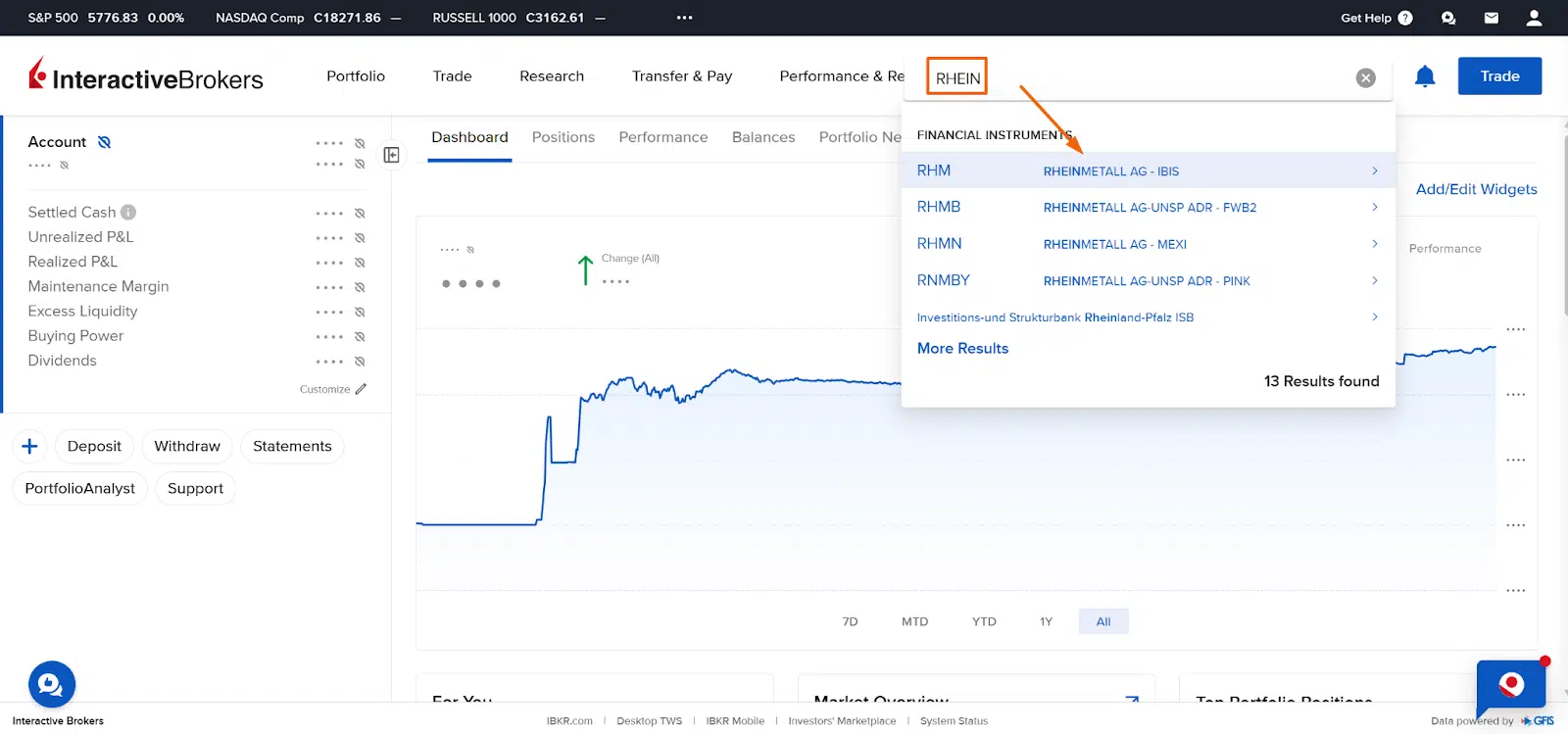
“IBIS” means that it is traded on Xetra, the main German stock exchange.
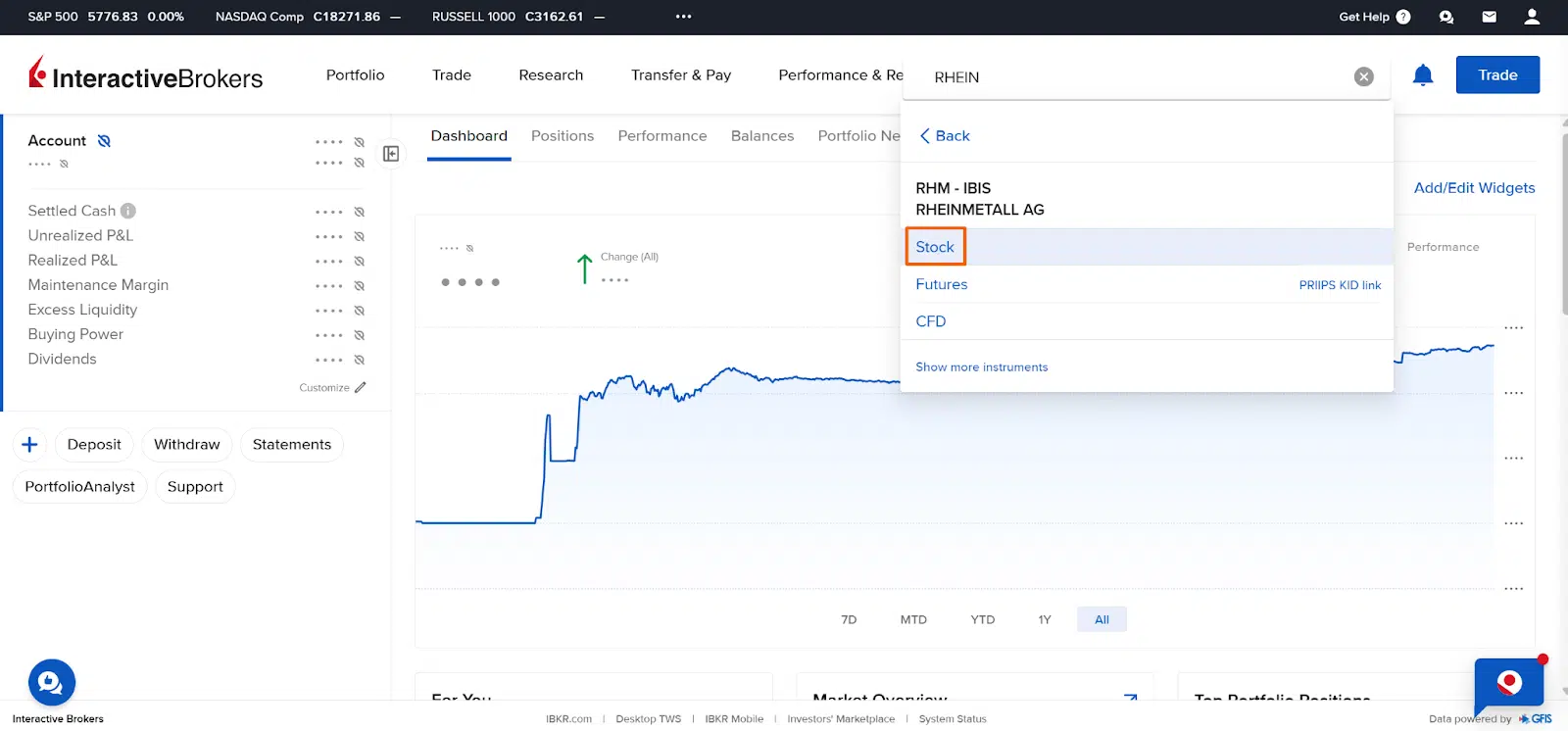
Then, select “Stock”:
Step 2: place a “Buy” order:
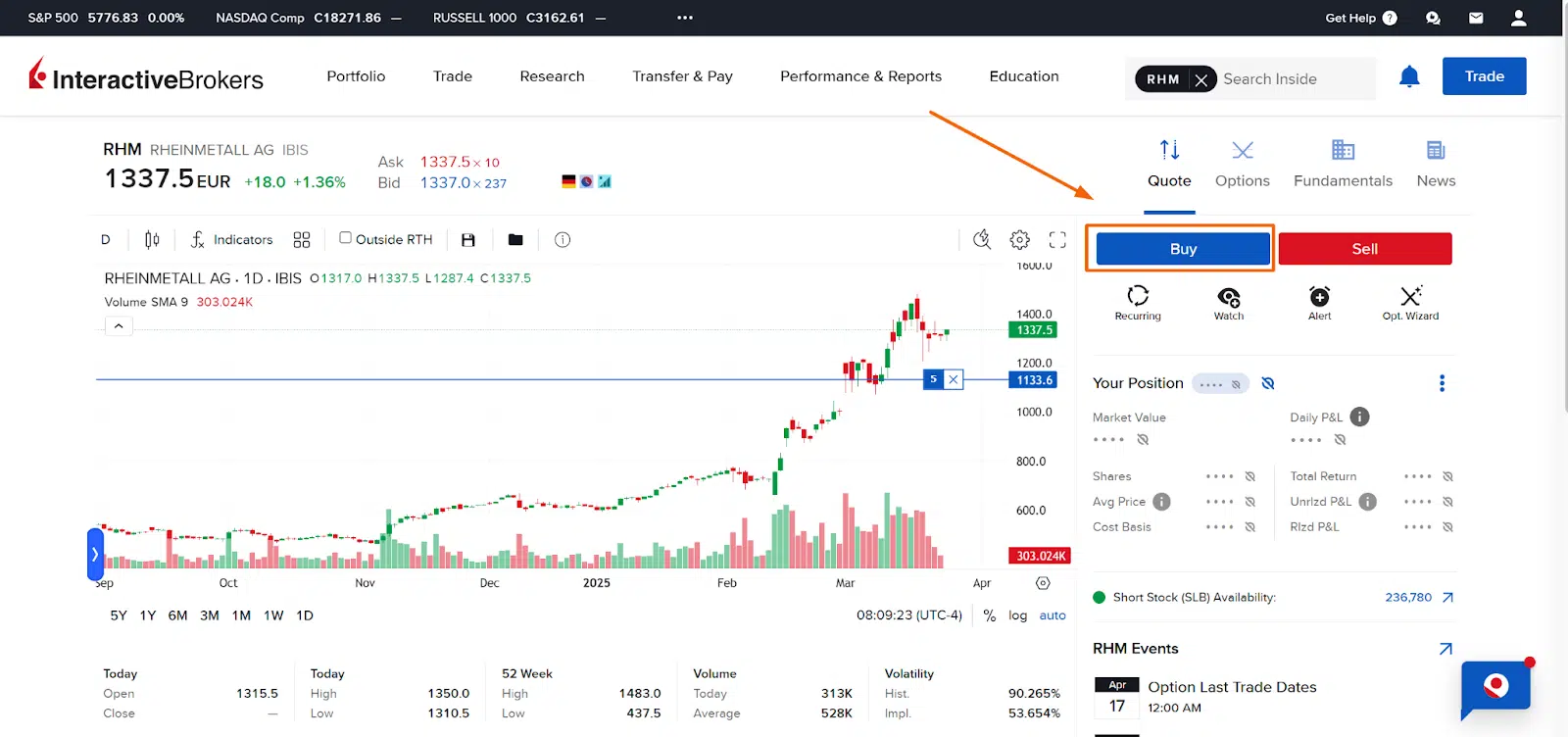
If you look at the image carefully, you will notice a hidden view of “Your Position”, which is my own investment in this stock (yes, I have skin in the game on this one).
Step 3: fill in the order details
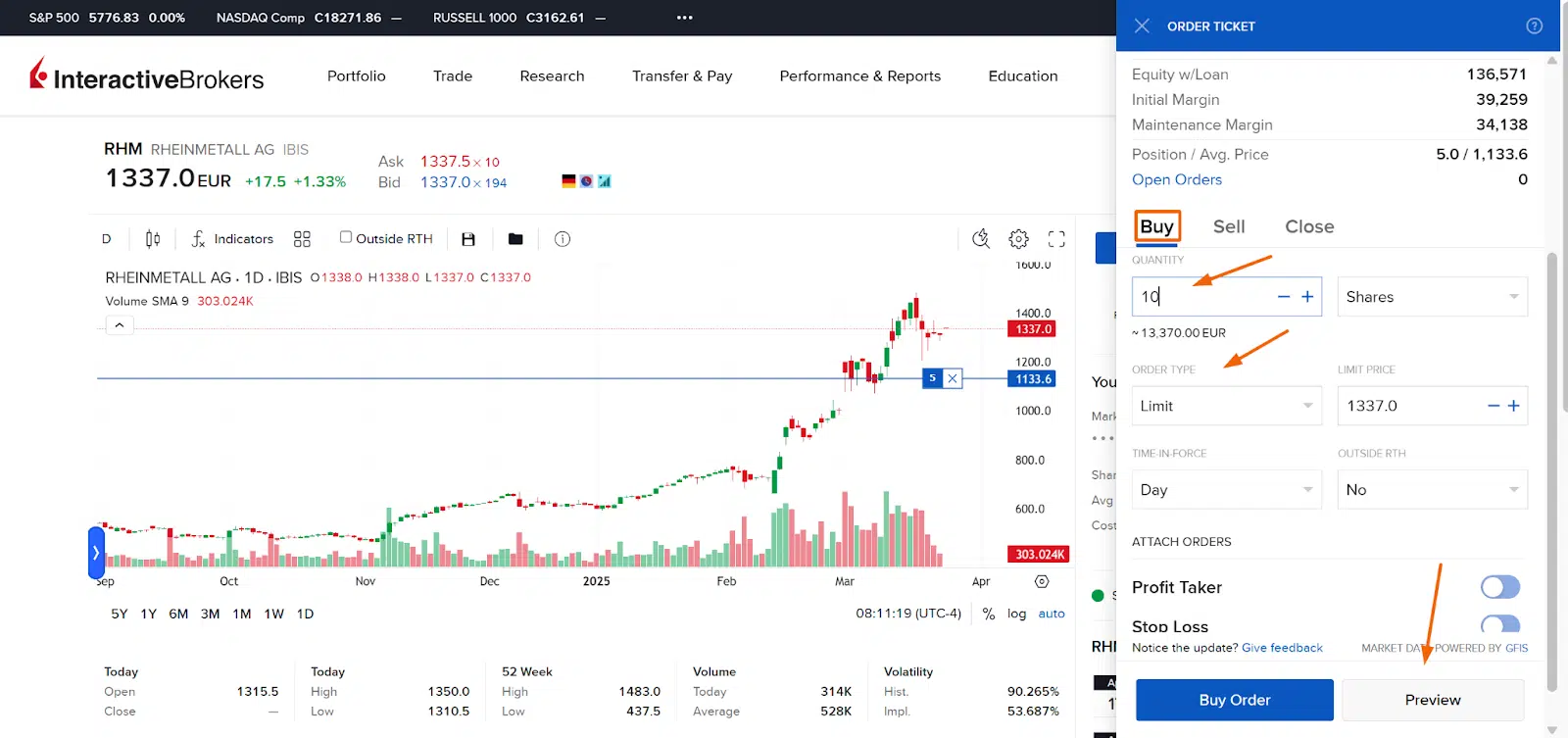
When the order ticket appears on the right side, scroll down and select your parameters. In our case, we chose to buy 10 shares with a “limit” order of €1,337, the maximum price per share we were willing to pay at the time of the screenshot. You could also place a “market” order, which buys the stock almost instantly at the best available price.
Step 4: click “Preview” and, finally, “Submit Buy Order”
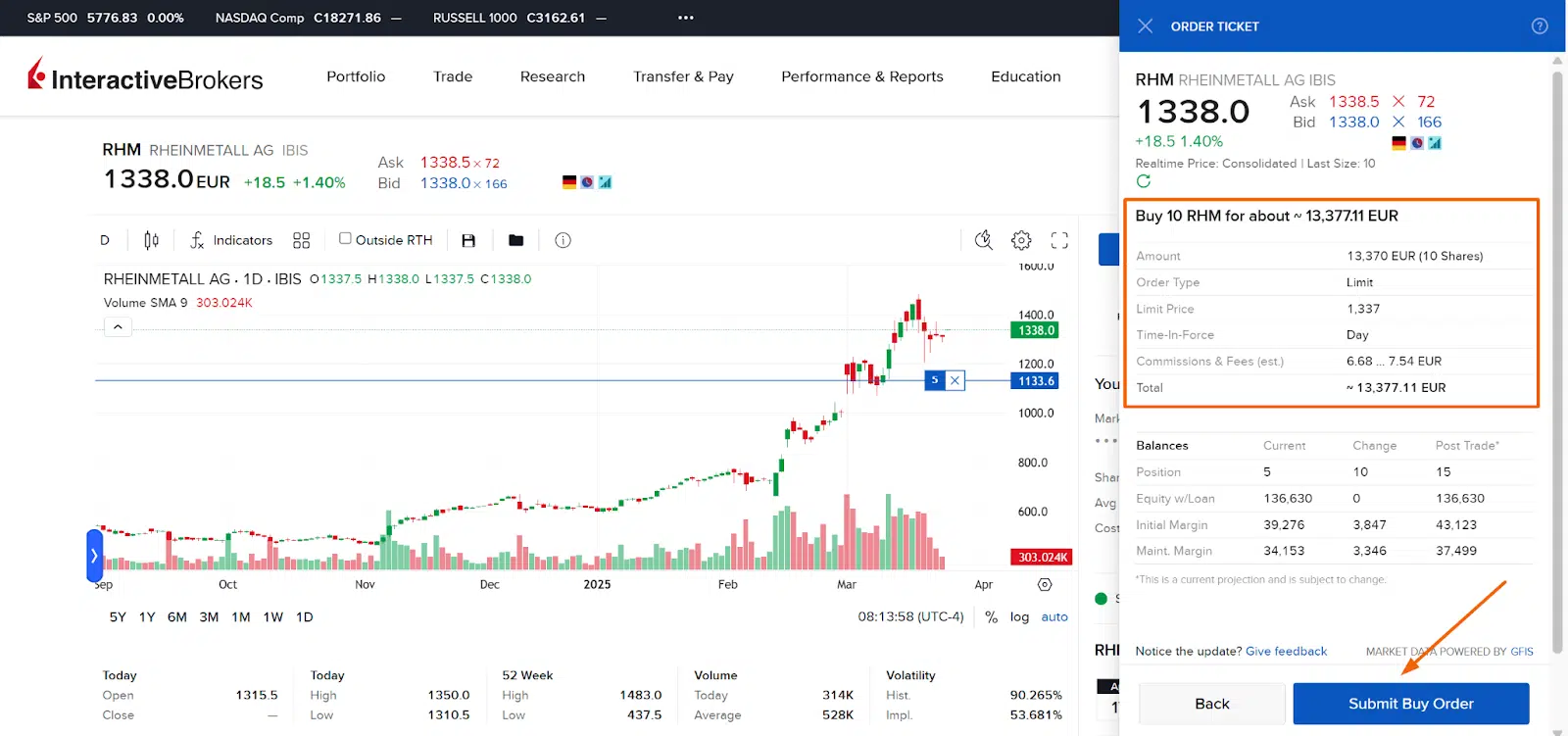
Here, you can give it a final check, including the commission you will pay for executing the order (up to €7.54 in our case).
Once you are ready, click “Submit Buy Order”, and that’s it.
Investment strategy tips
For European investors
- Use platforms like Interactive Brokers, DEGIRO or Freedom24 to access the WisdomTree ETF.
- Choose UCITS ETFs: under the EU’s PRIIPs rules (Packaged Retail and Insurance-based Investment Products), most US-listed ETFs cannot be sold to EU retail investors because they lack a Key Information Document.
- Consider a core-satellite approach, keeping a sector ETF or a few defence stocks as a small part of a diversified portfolio.
For American investors
- Use ADRs for direct stock exposure (for example, Airbus: EADSY, Leonardo: FINMY).
- Check your broker’s international access. Interactive Brokers gives US clients direct access to European exchanges, while Fidelity and Schwab offer international trading on some markets.
- Remember that most US defence ETFs hold US companies. For European exposure, look at a Europe-focused fund such as EUAD.
Risks to consider
- Valuation risk: even after the 2026 fall, most of the large European defence stocks trade at more than 20 times past earnings.
- Execution risk: order backlogs only turn into profits if companies can produce and deliver on time, as the German frigate cancellation showed.
- Political risk: budgets, procurement decisions and export permits depend on governments, and a ceasefire in Ukraine could change market sentiment quickly.
- Concentration: European defence ETFs are concentrated in a few large companies. The top 10 holdings of the WisdomTree fund make up about 64% of it.
- Sustainability exclusions: some ESG (environmental, social and governance) funds and pension schemes exclude defence companies, which can limit demand for their shares.
Frequently asked questions
Are European defence stocks still a good investment after the 2026 fall?
Defence spending in Europe is still set to grow for years, but the market is now judging companies on delivery, margins and valuation rather than on budget announcements. Whether the sector suits you depends on your time horizon and risk tolerance. This article does not give investment advice.
What is the largest European defence ETF?
Among Europe-focused UCITS ETFs, the WisdomTree Europe Defence UCITS ETF had about €4.19 billion in assets in October 2026. The VanEck Defense UCITS ETF is larger, but it invests globally.
Can US investors buy European defence stocks?
Yes. They can buy ADRs, buy the shares directly on European exchanges through a broker with international access, or use a US-listed Europe-focused ETF such as EUAD.
Final thoughts
The European defence sector is no longer in the shadow of its American counterpart. Rising geopolitical threats, NATO’s 5% target and uncertainty about US commitments have pushed Europe’s military spending to historic levels, and investors are paying attention.
However, 2026 has been a reminder that higher budgets do not automatically mean higher share prices. Whether you choose individual stocks like Rheinmetall, BAE Systems or Thales, or prefer the simplicity of an ETF like the WisdomTree Europe Defence UCITS ETF, the opportunities are there for both US and European investors.
Remember to weigh your risk tolerance, geopolitical views and long-term goals before investing. The defence sector can be volatile, and past performance does not guarantee future results.



