One of these two brokers started in the UK in 1974, before the internet existed. The other launched in 2010 and was built for the way people trade today. If you are choosing between IG and Pepperstone, you are looking at one of the closest matchups among FCA-regulated brokers.
To help you decide, we put together an unbiased comparison of IG and Pepperstone for UK traders and investors, covering safety, costs, products, platforms, account opening and what real users say. This article is the written, deeper version of our IG vs Pepperstone video, with every number side by side.
Here’s our quick take:
- Pepperstone: Our recommended choice for active traders. Raw spreads from 0.0 pips, no inactivity fee, no deposit or withdrawal fees on standard methods and your choice of MetaTrader 4, MetaTrader 5, cTrader, TradingView or Pepperstone’s own platform.
- IG: Best for long-term investors and for anyone who wants trading and investing under one roof. Real share and ETF ownership, a Stocks and Shares ISA, over 17,000 markets and a 50-year track record as a publicly listed company.
IG vs Pepperstone in a nutshell
| Area | IG | Pepperstone |
| Product offering | Spread betting and CFDs on 17,000+ markets, plus real shares, ETFs, ISA, SIPP, listed options and futures and direct crypto | Spread betting and CFDs on forex, indices, commodities, shares and ETFs (trading only, no share ownership) |
| Interest on cash | 3.75% AER variable on uninvested cash in investment accounts (September 2026) | Not applicable |
| Trading platforms | IG web platform and app, TradingView, MetaTrader 4, MetaTrader 5, ProRealTime, L2 Dealer | Pepperstone platform and app, TradingView, MetaTrader 4, MetaTrader 5, cTrader |
| Account types | Spread betting, CFD, share dealing, ISA, Junior ISA, SIPP, Smart Portfolio | Standard, Razor, spread betting, professional |
| Account currencies | GBP (with automatic conversion) or multi-currency | GBP, USD, EUR, AUD, CHF, SGD, HKD and others |
| Account opening, cash and portfolio transfers | Fully online, no minimum by bank transfer (card deposits from £250), free deposits and withdrawals | Fully online, no minimum by bank transfer (£10 by other methods), free deposits and withdrawals except international bank wires |
| Fees | EUR/USD spread from 0.6 pips, no commission on forex and indices, 0.8% currency conversion on trades | Razor: EUR/USD spread from 0.0 pips plus £2.25 per lot per side. Standard: from 1 pip, no commission |
| Education, research and demo account | It’s a tie – both have strong education and free demo accounts. | It’s a tie – both have strong education and free demo accounts. |
| Security | FCA-regulated, FSCS cover up to £85,000, listed on the London Stock Exchange | FCA-regulated, FSCS cover up to £85,000, private company with licences in several top-tier jurisdictions |
| Customer support | 24-hour phone, email, WhatsApp and live chat during the trading week. Trustpilot around 3.8/5 | 24-hour live chat, phone and email during the trading week. Trustpilot around 4.3/5 |
| Verdict | Best for long-term investing and one-stop trading and investing | Best for active traders (our winner for UK traders) |
Source: IG and Pepperstone UK websites, September 2026
1. Flash overview of IG and Pepperstone
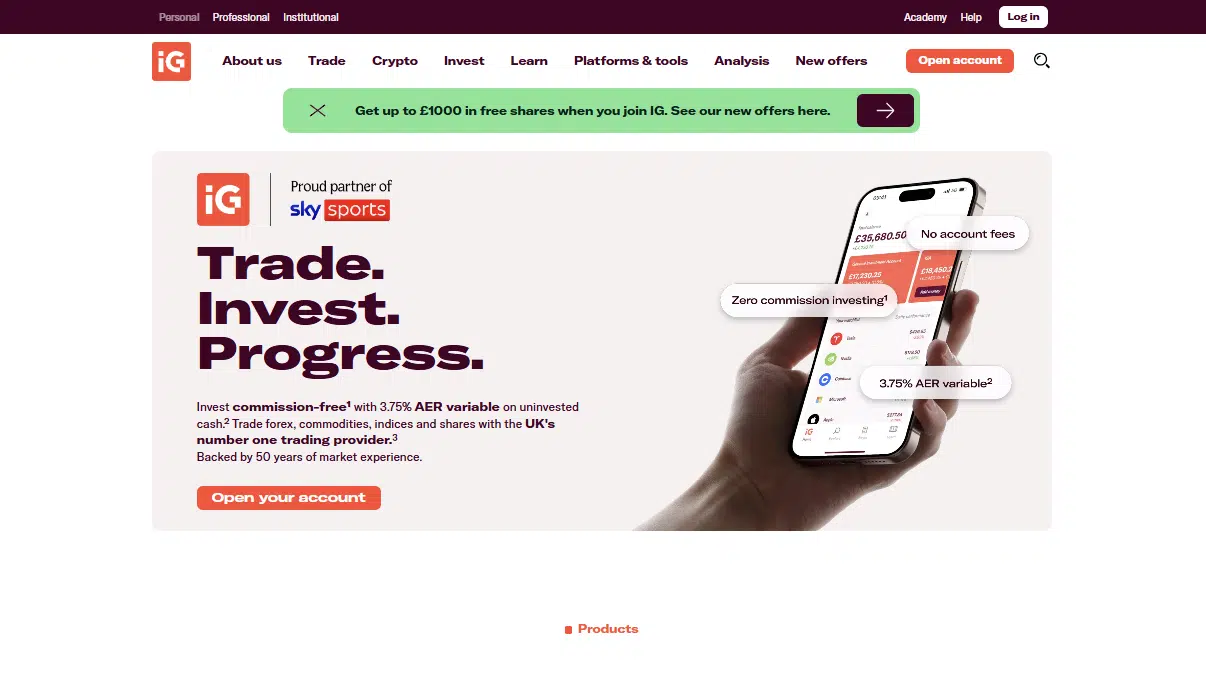
IG was founded in London in 1974 and invented financial spread betting. Today it is part of IG Group Holdings plc, a company listed on the London Stock Exchange under the ticker IGG, which means audited accounts, published financials and quarterly scrutiny from shareholders.
In the UK, IG operates through three FCA-authorised entities: IG Markets Ltd (CFDs, FCA reference 195355), IG Index Ltd (spread betting, reference 114059) and IG Trading and Investments Ltd (share dealing, ISAs and SIPPs, reference 944492).
IG gives access to over 17,000 markets and, unlike most CFD brokers, lets you own real shares and ETFs, hold them inside a Stocks and Shares ISA or a SIPP and even buy crypto directly.
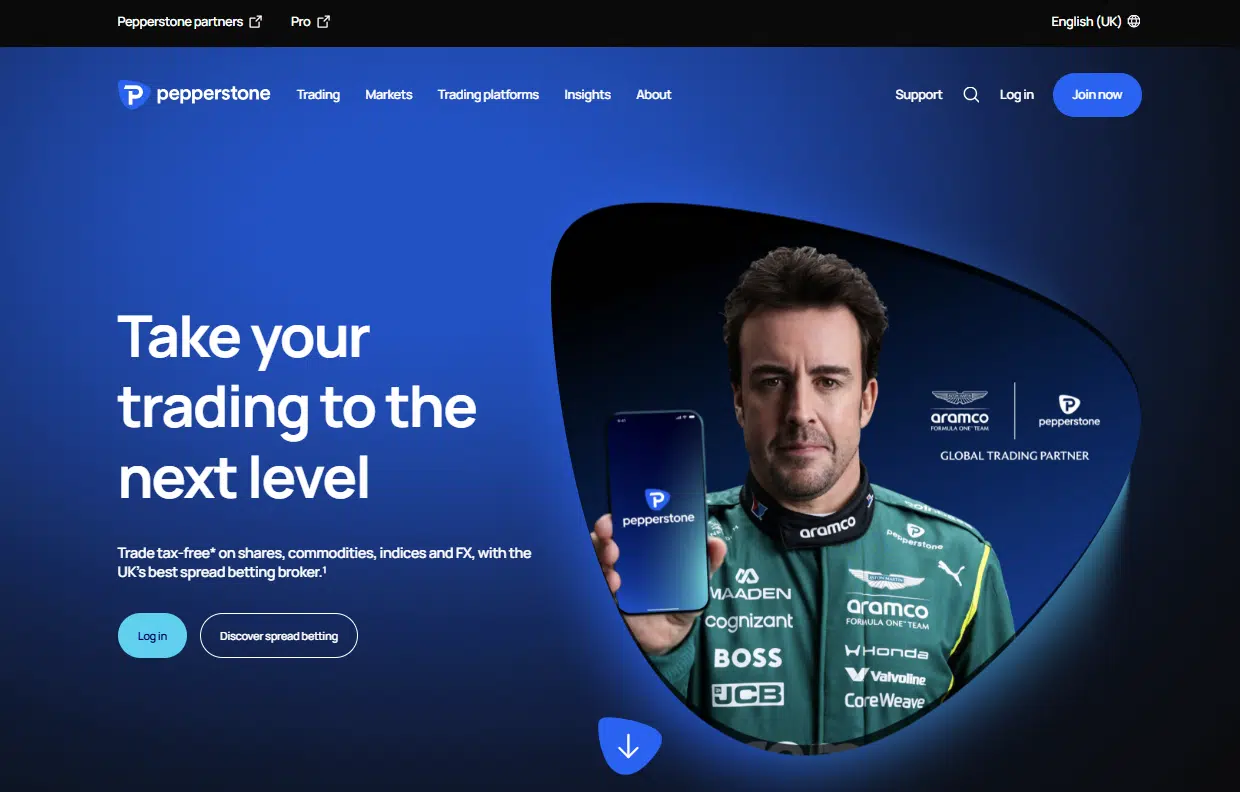
Pepperstone was founded in Melbourne in 2010 and has grown into one of the largest forex and CFD brokers in the world, with over 900,000 accounts across the group as of March 2026.
UK clients are served by Pepperstone Limited, authorised and regulated by the FCA under reference number 684312. The wider group also holds licences from ASIC in Australia, CySEC in Cyprus, BaFin in Germany and the DFSA in Dubai.
Pepperstone is a pure trading specialist: spread betting and CFDs on forex, indices, commodities, shares and ETFs, with raw spreads, fast execution and support for every major third-party platform. It does not offer share ownership or an ISA.
2. Product offering
The single most important difference between these two brokers is not price or platforms. It is what each one is built for. IG is an investor’s toolbox that also happens to offer leveraged trading. Pepperstone is a trading specialist and nothing else. The table below summarises the products available with each broker for UK clients.
| Asset class | IG | Pepperstone |
| Spread betting | ✔ | ✔ |
| Forex CFDs | ✔ | ✔ |
| Index and commodity CFDs | ✔ | ✔ |
| Share and ETF CFDs | ✔ | ✔ |
| Bond CFDs | ✔ | ✘ |
| Listed options and futures | ✔ | ✘ |
| Real shares and ETFs (ownership) | ✔ | ✘ |
| Stocks and Shares ISA / SIPP | ✔ | ✘ |
| Direct crypto (ownership) | ✔ | ✘ |
| Crypto CFDs | Professional clients only | Not available to UK retail clients |
Source: IG and Pepperstone UK websites, September 2026. Crypto CFDs are not available to retail clients in the UK under FCA rules.
Investing vs trading: which one is built for you?
With IG you can buy real shares and ETFs and actually own them, hold them inside a Stocks and Shares ISA to shelter gains and dividends from tax, and run a SIPP for your pension. Share dealing is commission-free on UK and US shares (a 0.7% currency conversion fee applies on non-GBP trades) and IG pays 3.75% AER variable interest on uninvested cash in investment accounts. If your goal is long-term wealth, owning good companies and funds for years, IG can do that and Pepperstone cannot.
Pepperstone only offers leveraged products. It is built purely for trading forex, indices, commodities and share CFDs, with raw spreads and fast execution. That focus is exactly why active traders like it, but it also means there is no way to build a buy-and-hold portfolio there.
Both brokers offer spread betting, where profits are currently free from capital gains tax and stamp duty for UK residents. Tax treatment depends on your individual circumstances and tax law may change, but for many British traders this remains a meaningful advantage over CFDs.
So ask yourself one question: do you want to own, or do you want to trade? Long-term ownership points to IG. Pure trading points to Pepperstone.
3. Trading platforms
One of the key value propositions of an online broker is the platform it provides. Here the two brokers follow different philosophies, although the gap is smaller than it used to be.
IG trading platforms
IG’s core product is its own web platform and mobile app, which handle spread betting, CFDs, share dealing and crypto in one place. It is polished, fast and packed with tools: integrated news, trading signals, alerts, a stock screener and IG Academy for education. For advanced charting, IG offers ProRealTime, and for direct market access on shares it offers L2 Dealer.
IG has also opened up to third-party platforms. UK clients can now trade through TradingView, MetaTrader 4 and, since 2026, MetaTrader 5, with free VPS hosting on qualifying accounts. The one platform still missing is cTrader.
Pepperstone trading platforms
Pepperstone does not lock you into a single platform. You can trade on MetaTrader 4, MetaTrader 5, cTrader, TradingView or the Pepperstone platform and mobile app, all connected to the same account and pricing. Whatever setup you already use, you can bring it with you. This is a big plus for algorithmic traders (Expert Advisors on MT4 and MT5, cBots on cTrader) and for anyone who charts on TradingView and wants to execute without leaving it.
The trade-off is that Pepperstone’s own platform is simpler than IG’s, and the overall experience depends on which third-party platform you pick.
If you want freedom of choice and cTrader, Pepperstone wins. If you want one app that does everything, including your ISA, IG wins.
4. Interest on cash
Given where interest rates are, many brokers now pay a return on uninvested cash. Quick summary for IG and Pepperstone:
| Currencies | IG | Pepperstone |
| GBP | 3.75% AER variable (investment accounts only) | Not applicable |
Source: IG and Pepperstone UK websites, September 2026
IG pays 3.75% AER variable, monthly, on uninvested cash up to £100,000 held in its share dealing, ISA and SIPP accounts. To earn interest in a given month you must hold an open position or have traded. The rate does not apply to spread betting or CFD accounts. Pepperstone does not pay interest on cash balances.
5. Account types
Both brokers offer leveraged (margin) accounts for spread betting and CFDs, where you deposit a fraction of the position value and both profits and losses are magnified. As FCA-regulated brokers, both cap retail leverage at 1:30 on major forex pairs, 1:20 on major indices and gold, 1:10 on other commodities and 1:5 on shares, and both provide negative balance protection, so a retail client can never lose more than the balance in the account.
IG offers spread betting, CFD and share dealing accounts, a Stocks and Shares ISA, a Junior ISA, a SIPP, a managed Smart Portfolio and a crypto account. A single login gives access to all of them.
Pepperstone offers two CFD account types that differ only in pricing (Standard and Razor), a spread betting account for UK residents and a professional account for clients who meet the FCA’s elective professional criteria. Accounts can be opened in GBP, USD, EUR and several other base currencies.
6. Account opening, cash and portfolio transfers
Account opening
Both brokers run a fully online application with ID and address verification and an appropriateness test for leveraged products. Most applications are approved within one business day at both.
IG has no minimum deposit for bank transfers, while card deposits carry a £250 minimum. Pepperstone has no minimum for bank transfers and a £10 minimum for other methods, so either broker lets you start small.
Cash transfers
IG accepts bank transfers, debit and credit cards and PayPal, all free of IG charges. Pepperstone accepts bank transfers, cards, PayPal and other e-wallets, also free. The one exception at Pepperstone is a £15 charge on withdrawals by bank wire to an international bank account. Both brokers pay withdrawals back to the original funding source under anti-money-laundering rules.
Portfolio transfers
This only applies to IG. Because IG offers real share and ETF ownership, you can transfer an existing portfolio, ISA or SIPP in or out for free (electronic holdings). Pepperstone has no custody service, so there is nothing to transfer.
7. Pricing – trading and non-trading fees
This is where the two brokers really separate. First, remember the two types of cost: trading fees (spreads and commissions) and non-trading fees (withdrawal, inactivity and conversion charges).
Trading fees
| Fees | IG | Pepperstone |
| EUR/USD spread (CFD) | From 0.6 pips, no commission | Razor: from 0.0 pips + £2.25 per lot per side. Standard: from 1 pip, no commission |
| EUR/USD spread (spread betting) | From 0.6 points | From 0.6 points |
| Index CFDs | FTSE 100 from 1 point, S&P 500 from 0.4 points | Spread only, no commission |
| UK share CFDs | 0.10% commission | 0.10% commission per side |
| US share CFDs | 2 cents per share | 2 cents per share per side |
| Real shares and ETFs | £0 commission on UK and US shares (0.7% FX fee on non-GBP trades) | Not applicable |
| Overnight funding (admin fee) | Interbank rate + 1.5% for forex and 3.4% for other asset classes (CFD) | Swap rates published in the platform |
| Currency conversion fee | 0.8% on trades in a currency other than the account base currency | Converted at spot rate when the account currency differs |
Source: IG charges page and Pepperstone costs and fees page (UK), September 2026. Pepperstone’s Razor commission is £2.25 per lot per side on MT4 and MT5 with a GBP account. On cTrader it is $6 round trip, on TradingView $7 round trip and on the Pepperstone platform $3.50 per side.
On headline spreads the two look close: IG from 0.6 pips on EUR/USD with everything priced into the spread, Pepperstone from 0.0 pips plus commission. For a UK trader on MT4 or MT5, one standard lot of EUR/USD on Razor costs £4.50 in round-trip commission plus a raw spread that in practice sits around 0.1 pips, an all-in cost of roughly 0.5 to 0.6 pips. That is at or below IG’s minimum spread before IG’s spread widens in normal conditions. For scalpers and high-volume traders the difference adds up quickly. For occasional traders, Pepperstone’s Standard account (from 1 pip) is slightly more expensive than IG on the headline number, so the choice matters less.
Non-trading fees
| Fees | IG | Pepperstone |
| Deposit fees | £0 | £0 |
| Withdrawal fees | £0 | £0 (£15 for international bank wires) |
| Inactivity fee | £0 | £0 |
| Custody or platform fee | £0 | Not applicable |
| Minimum deposit | £0 by bank transfer, £250 by card | £0 by bank transfer, £10 by other methods |
Source: IG charges page and Pepperstone costs and fees page (UK), September 2026. IG previously charged a £12 monthly inactivity fee after 24 months without trading. Its UK charges page now lists the inactivity fee as free on spread betting, CFD and investment accounts.
On non-trading fees the two are now almost level. IG scrapped its inactivity fee in 2026 and neither broker charges for deposits or standard withdrawals. Pepperstone still edges it for very small accounts thanks to the £10 minimum on card deposits, and for active traders the Razor pricing is the decisive factor. For anyone who trades regularly, Pepperstone wins on cost.
8. Investor security
A lot of comparisons treat regulation as the tiebreaker between brokers. Here it is not, because both IG and Pepperstone are authorised by the Financial Conduct Authority (FCA), one of the strictest regulators in the world. FCA authorisation gives every UK retail client the same four protections at both brokers:
- Segregated client money: your funds are held in separate accounts, apart from the broker’s own money.
- Negative balance protection: you can never lose more than the balance in your account.
- Leverage caps: retail leverage is limited to 1:30 on major forex pairs and lower on other assets.
- FSCS cover: if the firm itself fails and cannot return your money, the Financial Services Compensation Scheme protects eligible claims up to £85,000 per person. This applies to spread betting and CFD accounts at FCA-regulated brokers. It is not theoretical: when Alpari UK collapsed in January 2015, the FSCS stepped in and clients were compensated. What the FSCS does not cover is losses from your own trading.
So how do you judge safety beyond the licence? You look at the company itself.
IG regulation and protection
IG has been operating for over 50 years and is a public company listed on the London Stock Exchange. That means audited accounts, published capital ratios and constant scrutiny from investors and analysts. Beyond the UK, the IG Group holds licences from top-tier regulators including ASIC in Australia, the CFTC in the United States, the FMA in New Zealand and BaFin in Germany.
Pepperstone regulation and protection
Pepperstone is younger and privately owned, but it has grown into one of the largest forex brokers globally and holds licences in several tier-one jurisdictions: the FCA in the UK, ASIC in Australia, BaFin in Germany, CySEC in Cyprus and the DFSA in Dubai. UK clients deal exclusively with Pepperstone Limited, registered in England and Wales and authorised by the FCA, so they get the full FCA and FSCS protection described above.
Both brokers give you the same regulatory protection in the UK. This round is a tie, with IG’s listed status and longer history as the tiebreaker for anyone who values maximum transparency.
9. Customer support and what real users say
Both brokers offer support around the clock during the trading week. IG can be reached by phone, email, WhatsApp and live chat, and its help centre is extensive. Pepperstone offers 24-hour live chat, phone and email support and is known for quick responses.
Independent reviews tilt towards Pepperstone. On Trustpilot, Pepperstone scores around 4.3 out of 5 (rated Excellent) from roughly 3,400 reviews, with users frequently praising fast support and quick withdrawals. IG sits at around 3.8 out of 5 from over 9,700 reviews, with praise for the platform and recurring complaints about phone waiting times. Both scores were checked in September 2026 and may have moved since.
One more signal we always look at: Pepperstone is one of the brokers endorsed by the r/Forex subreddit, the largest forex community on the internet. IG is not on that list.
Disclaimer: Investments in securities and other financial instruments always involve the risk of loss of your capital. The forecast or past performance is no guarantee of future results. It is essential to do your own analysis before making any investment.
IG risk warning: Spread bets and CFDs are complex instruments and come with a high risk of losing money rapidly due to leverage. 69% of retail investor accounts lose money when trading spread bets and CFDs with this provider. You should consider whether you understand how spread bets and CFDs work, and whether you can afford to take the high risk of losing your money.
Pepperstone risk warning: Spread bets and CFDs are complex instruments and come with a high risk of losing money rapidly due to leverage. 72.9% of retail investor accounts lose money when trading spread bets and CFDs with this provider. You should consider whether you understand how spread bets and CFDs work, and whether you can afford to take the high risk of losing your money.
10. Pros and cons
What they share: both are FCA-regulated, with segregated client funds, negative balance protection, a 1:30 retail leverage cap and FSCS cover up to £85,000.
IG
Pros
-
50 years of history and listed on the London Stock Exchange
-
Real share and ETF ownership, Stocks and Shares ISA, Junior ISA and SIPP
-
Over 17,000 markets, listed options and futures, direct crypto
-
3.75% AER on uninvested cash in investment accounts
- Excellent education and research, strong in-house platform, now with MT4, MT5 and TradingView
Cons
-
Higher all-in trading costs for active forex traders than Pepperstone Razor
-
£250 minimum deposit by card
-
No cTrader
- Lower Trustpilot score
Pepperstone
Pros
-
Raw spreads from 0.0 pips and low overall costs on the Razor account
-
No inactivity fee, no deposit fees, no withdrawal fees on standard methods
-
£10 minimum deposit (none by bank transfer)
-
MT4, MT5, cTrader, TradingView and its own platform
- Higher Trustpilot score and endorsed by the r/Forex community
Cons
-
Trading products only: no share ownership, no ISA, no interest on cash
-
A far smaller market range than IG
- Privately owned, so less public financial disclosure than IG
IG vs Pepperstone – comparison verdict
To sum it up, here is our verdict:
- Pepperstone: Best for active traders and our winner for UK traders
- IG: Best for long-term investing and for combining trading and investing in one account
Both brokers are safe. Both are FCA-regulated with the same protections for UK retail clients, and that is rare enough for us to say you are not making a mistake with either. The decision comes down to what you want to do.
If you are building long-term wealth, want to own shares and ETFs and use your ISA allowance, and you like the idea of trading and investing from a single login, go with IG. If you are here to trade, Pepperstone wins: lower all-in costs on the Razor account, no account fees, a lower minimum deposit and your choice of platform, including cTrader, which IG does not offer.
For more information on Pepperstone, read our full review.
You can also read some of our other comparisons, such as the one between Pepperstone and IC Markets.