


How much money can you make copying other traders on social trading platforms? It’s a question a lot of people ask. You’ve probably seen people online bragging about the returns they make from copy trading, with numbers anywhere from 100% to 1,000% a year. But how likely is that in the real world? In this article, we look at what realistic copy trading returns look like, what reduces them and how to judge the traders you might copy.
Can you make a living from social trading?
It is possible, but it is rare. Making a living from copy trading requires both consistent returns and a large amount of capital, so if you don’t have much money to start with, it is very unlikely. It’s prudent to be realistic and not expect quick riches.
Trading can look easy over the short term. Anyone can get lucky and show fantastic returns over a few weeks or months, and if they extrapolate their returns over a year, it may come out at a few hundred per cent. And when they then show those returns to new traders on social trading platforms, many unsuspecting traders decide to get on the train and let this seemingly genius trader make trades on their behalf.
Over the long term, however, trading is far from easy. In fact, it’s tough to generate even low double-digit returns consistently over many years. Even professionals struggle: according to S&P Dow Jones Indices, 79% of actively managed US large-cap equity funds did worse than the S&P 500 in 2025.
Even the most famous investor in the world, Warren Buffett, generated 19.7% a year on average through Berkshire Hathaway between 1965 and 2025, against 10.5% a year for the S&P 500 with dividends reinvested, according to Berkshire’s 2025 annual report. That was enough to turn $100 into about $6.1 million and make him widely considered “the world’s greatest investor”. Buffett stepped down as chief executive at the end of 2025. Here is a table with Buffett’s returns through Berkshire Hathaway, broken down by decade:

What is the return on Social Trading?
Now, let’s look at a real trader as a case study. As you can see in the image below, his returns have varied quite a bit, from slightly positive in the first five months of the year to much more profitable in the second half of the year. Additionally, this trader also had one month of negative returns, which is not uncommon in trading.
And here are the exact corresponding returns for each month:

As you can see, if you add up all the monthly numbers, this trader’s total return for the year was about 31%. And among all the months, only August resulted in double-digit returns of more than 10%. For all the other months, returns mostly ranged between 0 and 5%.
This means that if you had copied this trader with €1,000, you would have made between €0 and €50 in most months. Over the entire year, you would have made about €310, before costs.
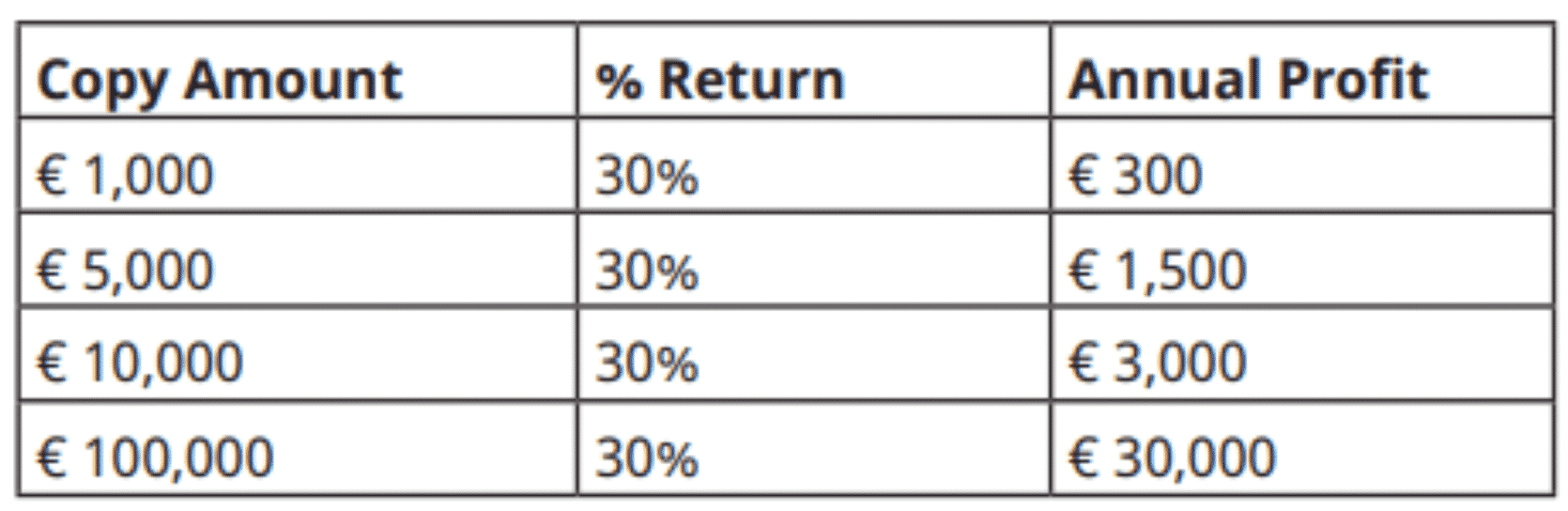
Could you live off of that? Well, probably not. But what you can do is to start small and let your trading account grow organically year after year. Maybe one day you will have an account large enough to make a living from. Below are a few more examples to help you get an idea of what different account sizes can mean in terms of your profit potential:
Past performance is not indicative of future results, and there are no guarantees in investing. The same applies to copy trading. The goal is to identify traders with a better chance of repeating their results and to manage the group of traders you copy carefully.
What reduces your copy trading returns
The return shown on a trader’s profile is not exactly what you will get. Several things reduce it:
- Trading costs: spreads, commissions and currency conversion fees apply to every trade copied, and active traders make many trades.
- Leverage and overnight fees: many copied traders use CFDs (contracts for difference) with leverage, which carry overnight financing costs and magnify losses. Most retail CFD accounts lose money.
- Timing: you usually start copying after a trader’s best period, when their returns attract attention, and your results will differ from theirs.
- Taxes: gains from copy trading are taxed in your country of residence like any other investment gains.
How to evaluate a trader before copying
In its supervisory briefing on copy trading, the European Securities and Markets Authority (ESMA) says that past performance should not be the most prominent element of marketing and should generally cover the previous five years, in complete 12-month periods. You can apply the same logic when choosing a trader:
| What to check | Why it matters |
| Track record of 3 to 5 years or more | A few good months can be luck. Several complete years, including a bad market, say much more. |
| Maximum drawdown | The largest fall from a peak shows how much you could lose along the way. |
| Risk score and use of leverage | High leverage can produce spectacular gains and equally fast losses. |
| Diversification | A portfolio concentrated in a few assets is more exposed to a single bad bet. |
| Consistency of monthly returns | Steady returns are usually more repeatable than one or two exceptional months. |
| Assets copied and number of copiers | Popularity is not proof of skill, but a long-standing base of copiers can signal trust. |
Checklist based on our experience and on ESMA’s supervisory briefing on copy trading (March 2023).
Bottom line
- Like any other investment, copy trading won’t make you rich overnight. It involves risks, including capital loss, even when following and/or copying or replicating top-performing traders.
- Annual returns above 60% to 70% are usually down to luck or very high risk. Set realistic expectations: very few copied traders sustain 20%+ a year for five years or more, and even Warren Buffett averaged 19.7%.
- In our view, 5% to 15% a year is a more realistic expectation for copy trading, and losses are possible. Even that requires a good understanding of the market and careful trader selection. For comparison, the S&P 500 returned 10.5% a year with dividends between 1965 and 2025.
- The returns depend on the capital you invest: 5% of €1,000 isn’t the same as 5% of €100,000. Only risk capital you don’t need, so that losses don’t put your financial stability at risk.
- Potential returns are higher than on term deposits or government bonds, but so are the risks. In the EU, ESMA’s 2023 supervisory briefing treats many copy trading services as portfolio management or investment advice under MiFID II, which brings stricter rules on how firms select traders and present past performance.
Copy trading does not amount to investment advice. The value of your investments may go up or down. Your capital is at risk. Past performance is not an indication of future results. CFDs are complex instruments and come with a high risk of losing money rapidly due to leverage. You should consider whether you understand how CFDs work and whether you can afford to take the high risk of losing your money.



