


FP Markets pitches itself as a well-regulated, low-cost CFD broker with more than 10,000 instruments. Founded in Sydney in 2005, it has picked up 80+ industry awards and sits among the better-known names for forex and CFDs.
The story has one critical twist: which FP Markets entity you sign up with changes almost everything. Australian clients get real shares via Iress and 30:1 leverage under ASIC. EU clients get CySEC and an investor compensation scheme of up to €20,000. International clients get up to 500:1 leverage under the Seychelles FSA and no compensation scheme at all. Same brand, very different products.
Here’s what you need to know before opening an account.
Risk warning: CFDs are complex instruments and come with a high risk of losing money rapidly due to leverage. 75.04% of retail investor accounts lose money when trading CFDs with this provider. You should consider whether you understand how CFDs work and whether you can afford to take the high risk of losing your money.
Video overview
Pros and cons
Pros
- $50 minimum deposit, no inactivity or deposit fees
- Raw spreads from 0.0 pips + $3/side commission
- Four platforms: MT4, MT5, cTrader, TradingView (+ Forex VPS)
- 10,000+ products for Australian clients via Iress (real shares, DMA)
- 24/7 multilingual customer support
- Regulated by multiple Tier-1 authorities (ASIC, CySEC, FSCA)
- Negative balance protection + segregated client funds across all entities
- Islamic swap-free accounts with grace periods of up to 5 nights
- Leverage up to 500:1 (offshore entities) or 30:1 (Tier-1 entities)
- Wide range of base currencies: USD, EUR, GBP, AUD, CHF, JPY, SGD, HKD and more
Cons
- International clients fall under the Seychelles FSA with no compensation scheme
- Non-Australian clients cannot hold real stocks, ETFs, or bonds - CFDs only
- Iress platform (Australians only) carries a 60 AUD/month platform fee + 25 AUD/month data fee
- Not available in the US, Japan, Belgium, Luxembourg, Hong Kong, Taiwan, New Zealand, or Qatar
- $10 fee on international bank wire withdrawals
- Web platform UI feels visibly dated
Who FP Markets is for (and who should skip it)
| Trader profile | Verdict |
| 🇦🇺 Australian trader wanting real shares + CFDs in one broker | 👍 Strong fit: Iress gives direct market access (DMA) to ASX, NYSE, NASDAQ, LSE, HKE and SGX |
| 🌍 Active CFD / forex trader outside the US and excluded countries | 👍 Solid fit: low raw spreads, four platforms, fast execution |
| 🧮 Scalper or day trader | 👍 Raw account + cTrader is a strong combo |
| ☪️ Muslim trader wanting swap-free accounts | 👍 Islamic accounts with grace periods available |
| 🇪🇺 EU trader wanting CFD access with Tier-1 regulation | 👍 CySEC entity offers €20k compensation scheme (leverage capped at 30:1) |
| 📈 Long-term investor (non-Australian) | 👎 No real shares, ETFs or bonds, so it’s the wrong broker |
| 🛡️ Non-EU, non-AU trader valuing statutory compensation | 👎 Offshore entities offer no compensation scheme |
| 🔰 Complete beginner | 👎 High leverage + CFDs = steep risk curve |
| 🚫 Residents of the US, Russia and sanctioned countries (such as Iran, Cuba and Syria) | 👎 Not available |
Fees
FP Markets has two main account structures that cover most traders. Typical spreads are published here.
| Fee type | Standard account | Raw account |
| Forex commission | Built into spread | $3 / €2.75 / £2.25 per side |
| Avg EUR/USD spread | 1.29 pips | 0.19 pips |
| Avg GBP/USD spread | 1.6 pips | 0.5 pips |
| Avg USD/JPY spread | 1.67 pips | 0.58 pips |
| Metals commission | Built into spread | $3 / €2.75 / £2.25 per side |
| Indices, commodities, crypto | Built into spread | Built into spread |
| Equity / ETF CFDs | $0.02/share (US) or 0.05% to 0.2% elsewhere | Same as Standard |
| Deposit fee | $0 | $0 |
| Minimum deposit | $50 / €50 | $50 / €50 |
| Iress platform fee (AU only) | 60 AUD/month + 25 AUD/month data | Same |
Source: FP Markets fees and charges and FP Markets spreads (typical spreads, October 2026). Withdrawal fees depend on the method and are shown in the client portal.
Which account fits you?
- Standard: better for swing traders holding positions for days. No commission, wider spreads.
- Raw: better for scalpers and day traders. Tight spreads, commission each side. Usually the cheaper option for frequent traders.
Swap fees apply to positions held overnight at 5pm New York time. Wednesdays (or Fridays on some instruments) are triple-swap days to cover the weekend.
Islamic accounts replace swaps with a flat admin fee that only kicks in after a grace period of up to 5 nights, depending on the instrument.
Equity and ETF CFD commissions
| Market | Commission per side | Minimum per side |
| Australia | 0.05% | AUD 5 |
| US (NYSE / NASDAQ) | $0.02 / share | $2 |
| UK | 0.1% | £2 |
| Europe | 0.1% | €2 |
| Hong Kong | 0.2% | $2 |
Source: FP Markets fees and charges, October 2026. ETF CFDs on NYSE and NASDAQ cost the same as share CFDs.
How does this stack up?
Raw spreads are competitive but not class-leading. IC Markets typically shows tighter Raw EUR/USD spreads in live testing, and Fusion Markets has an edge on Raw account commissions. FP Markets’ edge isn’t price. It’s the combination of all four major platforms, Tier-1 parent regulation, Iress for Australians, and stronger support infrastructure.
Products & markets: what you can and can’t trade
FP Markets is a CFD-only broker for most clients, with more than 10,000 instruments in total. Australian users are the exception, as they can get real shares via the Iress platform.
| Product | Global clients | Australian clients (Iress) |
| Forex CFDs | ✅ | ✅ |
| Share CFDs | ✅ | ✅ |
| Index CFDs | ✅ | ✅ |
| ETF CFDs | ✅ | ✅ |
| Commodity CFDs | ✅ | ✅ |
| Precious metal CFDs | ✅ | ✅ |
| Cryptocurrency CFDs | ✅ (majors) | ✅ |
| Futures CFDs | ✅ | ✅ |
| Real stocks (DMA) | ❌ | ✅ (ASX, NYSE, NASDAQ, LSE, HKE, SGX) |
| Real ETFs | ❌ | ✅ |
| Bonds | ❌ | ❌ |
| Mutual funds | ❌ | ❌ |
| Options (non-CFD) | ❌ | ❌ |
Max leverage by instrument and jurisdiction
Leverage is capped by your regulator, not by the platform. The same product can trade at 30:1 under CySEC and 500:1 under the Seychelles FSA.
| Instrument | Tier-1 entities (ASIC, CySEC) | Offshore entities (FSA, CMA, FSC) |
| Forex | 1:30 | 1:500 |
| Indices | 1:20 | 1:200 |
| Metals | 1:20 | 1:100 |
| Commodities | 1:20 | 1:100 |
| Cryptocurrencies | 1:2 | 1:50 |
| Shares | 1:5 | 1:20 |
High leverage cuts both ways. At 1:500 leverage, a 0.2% move against you wipes out the margin. This is the structural reason most retail CFD traders lose money: FP Markets’ EU site notes that national regulators found 74% to 89% of retail investors trading CFDs lose money.
Trading platforms
One genuine strength: FP Markets is one of the few brokers offering all four mainstream platforms (MT4, MT5, cTrader and TradingView), plus its own WebTrader and Iress for Australian clients. TradingView is available on the Raw account.
| Platform | Best for |
| MT4 | Forex traders, legacy EAs and indicators |
| MT5 | Multi-asset traders, modern charting, built-in economic calendar |
| cTrader | Scalpers, algo traders (C# automation), Level II Depth of Market |
| TradingView | Chart-first traders who already hold a TV subscription |
| Iress (AU only) | Equity day traders wanting DMA and full market depth |
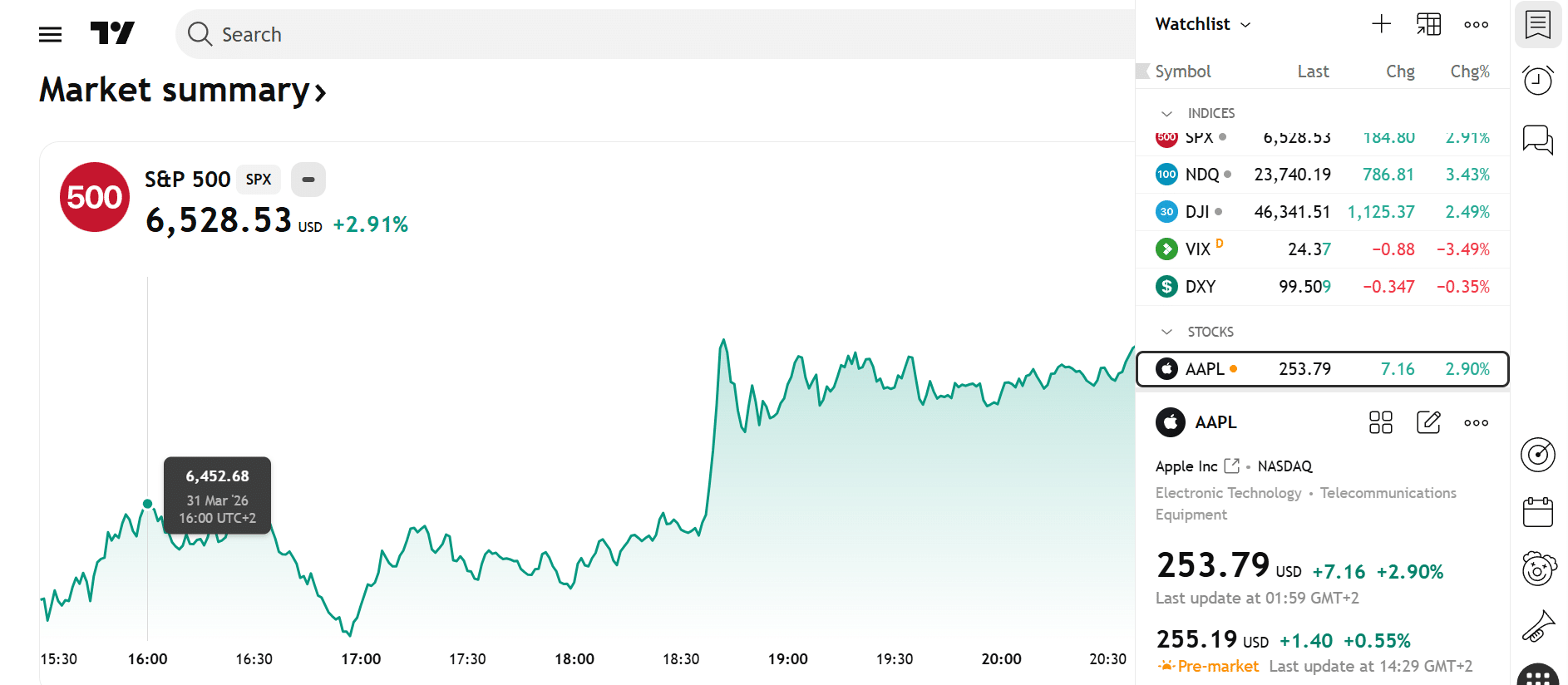
A Forex VPS is available, hosted in the same Equinix NY4 and LD5 data centers as the trading servers, a meaningful latency advantage if you run 24/5 algos.
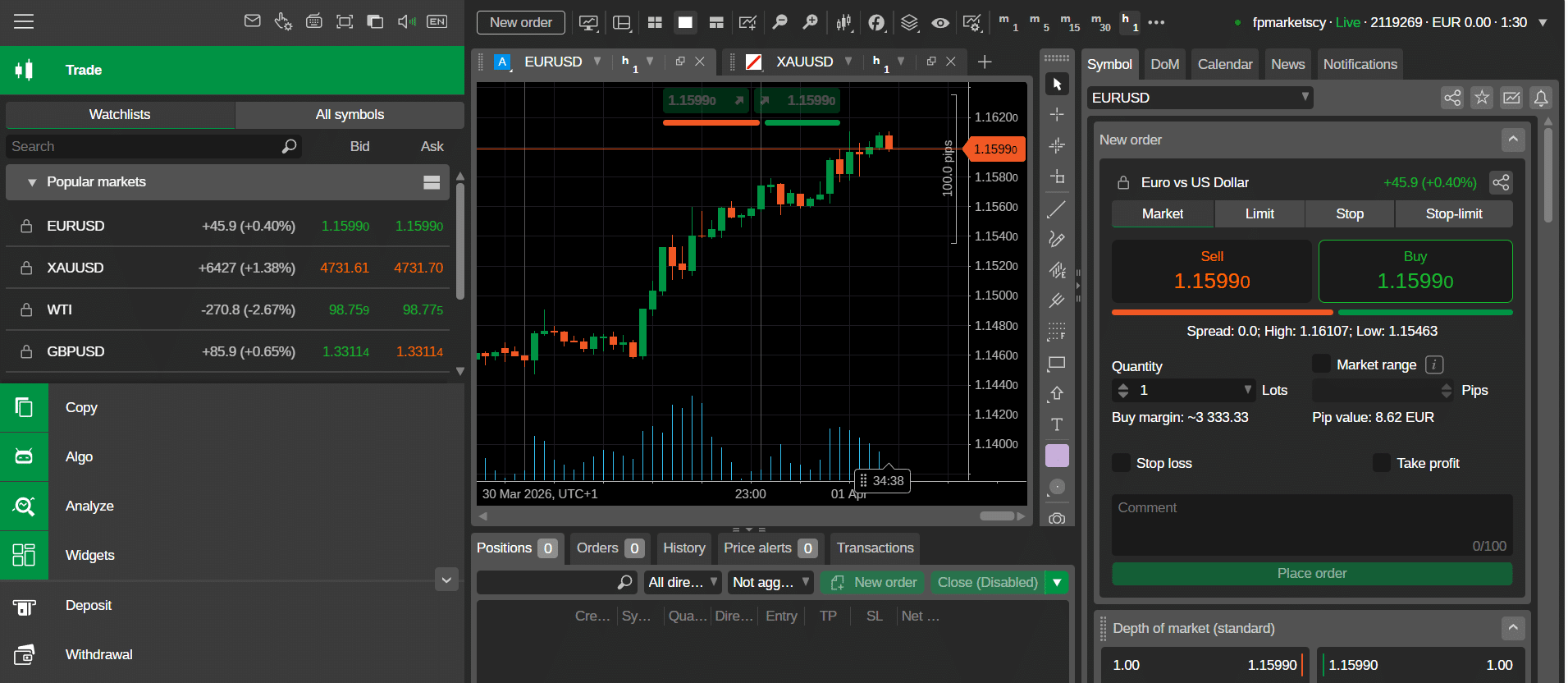
Iress (Australia only) gives direct market access to exchange order books, bypassing liquidity providers, with full Level 2 market depth. Trade-off: 60 AUD/month platform fee + 25 AUD/month ASX live data fee, potentially waivable for high-volume traders.
The proprietary web platform is functional but visibly dated. The mobile app looks modern but is feature-limited (account management, transfers, basic tools, biometric login). Serious trading happens on MT4/5, cTrader, TradingView or Iress, not in FP’s own apps.
Is FP Markets safe? The honest answer depends on your entity
This is where most broker reviews give you a generic “yes, regulated globally” answer. With FP Markets that’s misleading. Your protection depends entirely on which subsidiary onboards you.
Your safety snapshot by entity
| Your jurisdiction | Regulator | Tier | Compensation scheme | Max leverage | |
| 🇦🇺 Australia | ASIC (license 286354) | 🟢 Tier 1 | ❌ None (segregation only) | 1:30 | |
| 🇪🇺 EU / EEA | CySEC (license 371/18) | 🟢 Tier 1 | ✅ €20,000 (90% of assets) | 1:30 | |
| 🇿🇦 South Africa | FSCA (FSP 50926) | 🟡 Tier 2 | ❌ None | Varies | |
| 🇰🇪 Kenya | CMA | 🟡 Tier 2 | ❌ None | Up to 1:500 | |
| 🌍 International (rest of world) | FSA Seychelles (SD 130) | 🔴 Tier 3 | ❌ None | Up to 1:500 |
Cross-entity protections
| Protection | Applies to |
| ⚖️ Negative balance protection | ✅ All entities |
| 🔒 Segregated client funds | ✅ All entities |
| 🏦 Banking license | ❌ No (broker, not a bank) |
| 📉 Securities lending | N/A (CFD model, no real securities held) |
| 💸 Payment for order flow (PFOF) | N/A (CFD model, broker is counterparty) |
| 📊 Publicly listed parent | ❌ No (privately held group) |
What this means in plain terms
If FP Markets went bust tomorrow, what happens depends on your entity:
- EU clients fall back on CySEC’s Investor Compensation Fund, which covers 90% of assets up to €20,000.
- Australian, South African, Kenyan and International clients have no compensation scheme. You rely on segregation (your funds are held separately at third-party banks) and negative balance protection (you can’t lose more than you deposited). Segregation is not the same as a compensation guarantee.
Why different leverage caps? Tier-1 regulators (ASIC, CySEC) cap retail CFD leverage at 30:1 precisely because high leverage is where retail traders lose most money. Offshore entities allow up to 500:1 because their regulators don’t impose the same caps. More leverage is a trading feature, not a safety one.
Regulator tiers, explained quickly:
- Tier 1 (strongest): FCA (UK), ASIC (AU), CySEC (EU), BaFin (DE), FINRA (US)
- Tier 2: FSCA (South Africa), CMA (Kenya), FSC (Mauritius), DFSA (Dubai)
- Tier 3 (offshore): Seychelles FSA, Vanuatu VFSC, SVG FSA, Belize FSC
Some jurisdictions (for example St. Lucia) only offer company registration with no active regulation, meaning no compensation, no mandatory negative balance protection, and no segregation requirement. FP Markets does not use these jurisdictions for client onboarding, but it’s worth understanding the gradient.
Account types
FP Markets has two main account types, Standard and Raw, with Islamic versions and specialist options. Most traders end up on Standard or Raw:
| Account | Min deposit | Spreads | Commission | Best for |
| Standard | $50 / €50 | From 1.0 pips | $0 | Swing and position traders |
| Raw | $50 / €50 | From 0.0 pips | $3/side | Day traders, scalpers |
| Islamic | $50 / €50 | Same as base | Admin fee after grace period | Muslim traders |
| Iress (AU only) | Varies | DMA pricing | Per-trade + platform fee | Professional equity traders |
| PAMM / MAM | Varies | Varies | Varies | Money managers |
| Demo | None | Real market data | None | Testing (free) |
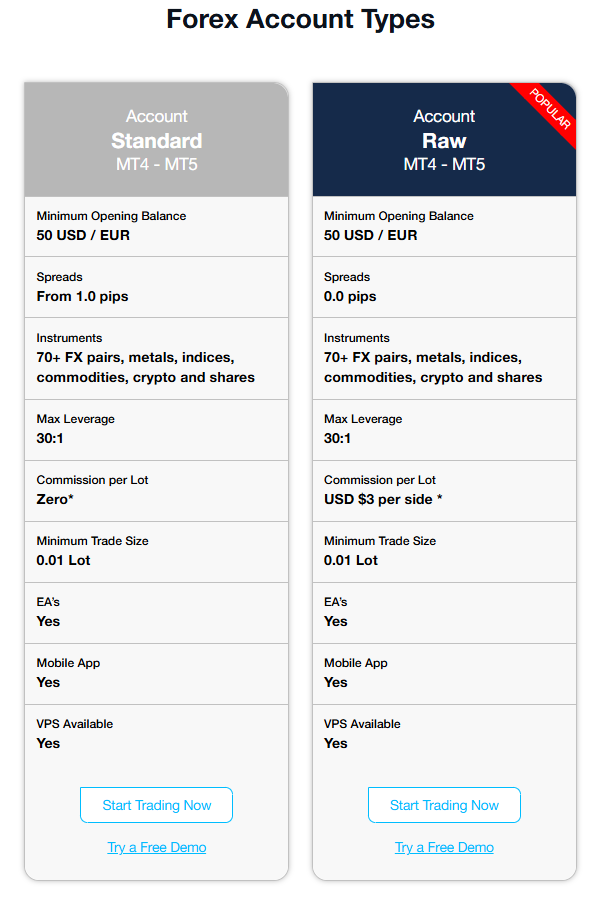
Islamic accounts charge a fixed admin fee instead of swaps, with a 5-night grace period on many major pairs. Close inside 5 days and you pay nothing. Contact customer support after opening the account to convert it.
Iress accounts (Australia only) provide direct market access, where orders go straight to the exchange order book, plus Level 2 depth of market. The 60 AUD/month + 25 AUD/month data fees can be waived at high trade volumes. Best suited for professional equity traders.
PAMM/MAM accounts are for experienced managers running capital for others. MAM allows different lot sizes per sub-account, while PAMM splits profit and loss by each investor’s share of the pool.
Account opening
What to expect:
| ⏱️ Time to activate | Same day to 1 business day |
| 🪪 ID required | Passport or national ID |
| 📄 Proof of address | Utility bill or bank statement |
| 💰 Minimum deposit | $50 / €50 (or local equivalent) |
| 💱 Base currencies | AUD, USD, EUR, GBP, SGD, CAD, CHF, JPY, HKD, PLN, MXN, BRL, ZAR |
| 🔍 Document check | More thorough than average, so expect follow-up questions |

After opening the main account, you can spin up additional sub-accounts on different platforms and fee structures in a few clicks. Demo accounts are free and use live market data, which is useful for testing the platforms before committing capital.
Funding options depend on your residency, and FP Markets charges no deposit fees. Withdrawal fees depend on the method.
User reviews and support
- Trustpilot: 4.8 / 5 across 10,300+ reviews (October 2026)
- TradingView: 4.1 / 5 across 2,000+ reviews
- Common praise: execution speed, customer support, low spreads
- Common complaints: withdrawal friction, account terminations, occasional platform glitches
Support runs 24/7 via live chat, email, and phone in multiple languages. In our testing, email response times were fast (under 2 hours during business hours) and answers were substantive rather than copy-paste.
Final verdict
FP Markets is a legitimate, well-established CFD broker with one of the strongest platform line-ups in the industry, genuinely competitive raw spreads, and a unique offering for Australian clients via Iress. For active forex and CFD traders, and for Australians wanting one broker covering both real shares and CFDs, it’s a real option worth shortlisting.
Go in with eyes open on three things:
- Your entity determines your protection: EU clients get a compensation scheme of up to €20,000. Australian clients get Tier-1 oversight but no compensation. International clients get high leverage but no compensation and no Tier-1 regulator. Check which subsidiary you’re signing up with.
- No real shares, ETFs or bonds, unless you’re Australian: Long-term buy-and-hold investors outside Australia are at the wrong broker.
- Raw spreads are competitive, not best-in-class: IC Markets and Fusion Markets can beat them on pure execution cost. FP Markets wins on the bundle (four platforms, a Tier-1 parent and Iress for Australians), not on any single number.
If any of those three matter more than the trade-off you’re getting, compare FP Markets against alternatives before opening an account. If the bundle fits your profile, it’s a solid pick.
Risk warning: CFDs are complex instruments and come with a high risk of losing money rapidly due to leverage. 75.04% of retail investor accounts lose money when trading CFDs with this provider. You should consider whether you understand how CFDs work and whether you can afford to take the high risk of losing your money.
