Prediction markets have become one of the fastest-growing segments in US financial trading. These platforms allow you to buy and sell event contracts based on the outcome of real-world events, from Federal Reserve decisions and inflation data to sports, politics, and pop culture. Instead of trading price movements on traditional assets, you’re trading probabilities.
We’ve tested and compared the best prediction market platforms available to US investors, evaluating them on regulation, fees, market coverage, user experience, and liquidity.
What you should know: Prediction markets are regulated by the Commodity Futures Trading Commission (CFTC) as event contracts – they are not classified as gambling. However, they involve risk, and you can lose your entire position. State-level restrictions still apply in some jurisdictions, particularly for sports-related contracts.
Best prediction markets platforms for US investors in 2026
- Plus500US: Best for regulated access to prediction markets via a broker – our top pick for traditional traders. It offers a new sign up bonus with the promo code IITW.
- Kalshi: Best overall prediction market exchange with the largest market range
- Robinhood: Best for all-in-one investing – stocks, crypto, and event contracts in one app
- Polymarket: Best for liquidity and crypto-native users (this platform is USDC-only)
- FanDuel Predicts: Best for sports prediction markets in non-betting states
- DraftKings Predictions: Best for fantasy sports players
- PredictIt: Best for political markets
Disclaimer: Trading event contracts involves risk. Each contract can settle at $1 or $0, meaning you can lose your entire investment on any given position. These platforms are not sportsbooks, and prediction markets should not be confused with gambling – but the risks are real.
Video summary
Prediction markets platforms comparison
| Platform | Trading fees* | Markets | Regulated in the US? | Min. deposit | Funding |
| Plus500US | $0.01/contract + exchange fees | Economics, politics, sports, crypto, climate | CFTC (via Kalshi) | $10 (futures) | Bank, debit card |
| Kalshi | Variable (price-based) | Sports, politics, economics, weather, crypto, culture | CFTC (DCM) | $0 | ACH, wire, debit, crypto |
| Robinhood | $0.01-$0.02/contract | Sports, politics, economics, crypto, culture, esports | CFTC (via Kalshi) | $0 | Bank, instant transfer, debit |
| Polymarket | $0 on limit orders; small fee on market orders in select categories | Politics, crypto, sports, global events | CFTC (US arm via QCEX) | $0 | USDC (crypto only) |
| FanDuel Predicts | 2% of potential payout | Sports, finance, economics, politics | CFTC (via CME Group) | $0 | In-app deposit |
| DraftKings | $0.01/contract (per side) | Sports, economics, politics | CFTC (via Railbird) | $5 | In-app deposit |
| PredictIt | 10% on profits + 5% on withdrawals | Politics, elections, policy only | CFTC (DCM/DCO) | $5 | Credit/debit card |
Note*: Fees shown reflect each platform’s standard commission structure. For platforms that access third-party exchanges (Plus500, Robinhood, DraftKings), additional exchange fees may apply. Actual trading costs also depend on order type and market liquidity.
Reviews
1# Plus500US

Plus500US launched its prediction markets offering in early February 2026, making it one of the newest entrants in the space, but it’s backed by serious infrastructure. The platform provides access to Kalshi’s CFTC-regulated event contracts, while Plus500 handles clearing through its membership with Kalshi Klear LLC.
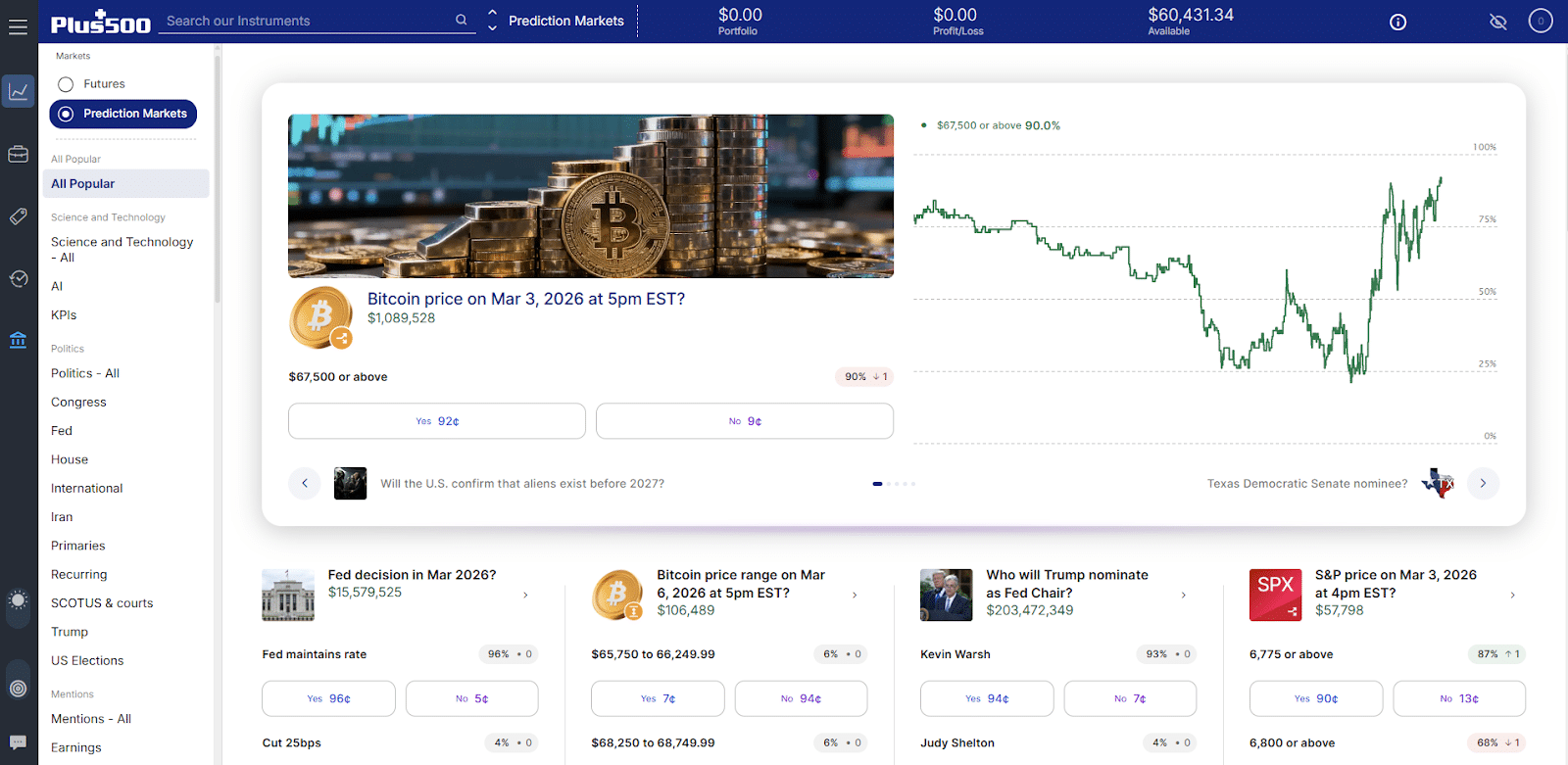
What makes Plus500 our top pick is its positioning as a proper broker for prediction markets. If you’re already comfortable with futures trading or traditional brokerage platforms, Plus500US will feel immediately familiar. You can trade event contracts on economic, financial, and geopolitical events, all within the same app where you’d trade E-mini S&P 500 futures or crude oil contracts.
The $0.01 per contract commission is competitive and transparent. There are no deposit fees on the broker side (though your bank may charge separately), and the demo account lets you explore the entire platform risk-free with virtual funds.
Plus500 is also the clearing partner for CME Group and FanDuel’s event-based contracts platform, which signals strong institutional credibility. As an FTSE 250 publicly listed company with over 33+ million registered customers with the Plus500 Group since inception, the corporate backing here is unmatched by most prediction market startups.
The main limitation is that Plus500 is essentially a front-end for Kalshi’s order book, so your liquidity and market selection depend on what Kalshi offers. But for US investors who want a clean, regulated, broker-style experience for prediction markets alongside traditional futures, Plus500 is the best option available today.
Pros
-
Familiar broker interface for traditional traders
-
Futures and prediction markets under one roof
-
Low $0.01/contract commission
-
Excellent demo mode for beginners
-
No deposit fees on the broker side
- Backed by an FTSE 250 publicly listed company
Cons
-
Exchange fees from Kalshi may apply on top of broker commission
-
Liquidity depends on Kalshi's order book
-
Newer entrant to prediction markets (launched Feb 2026)
- Does not support crypto deposits
For a deep dive, please read our Plus500US review.
2# Kalshi

Kalshi is the backbone of US prediction markets. As the first CFTC-designated contract market for event contracts, it provides the regulatory infrastructure that many other platforms (including Plus500 and Robinhood) rely on to offer their own prediction market products.
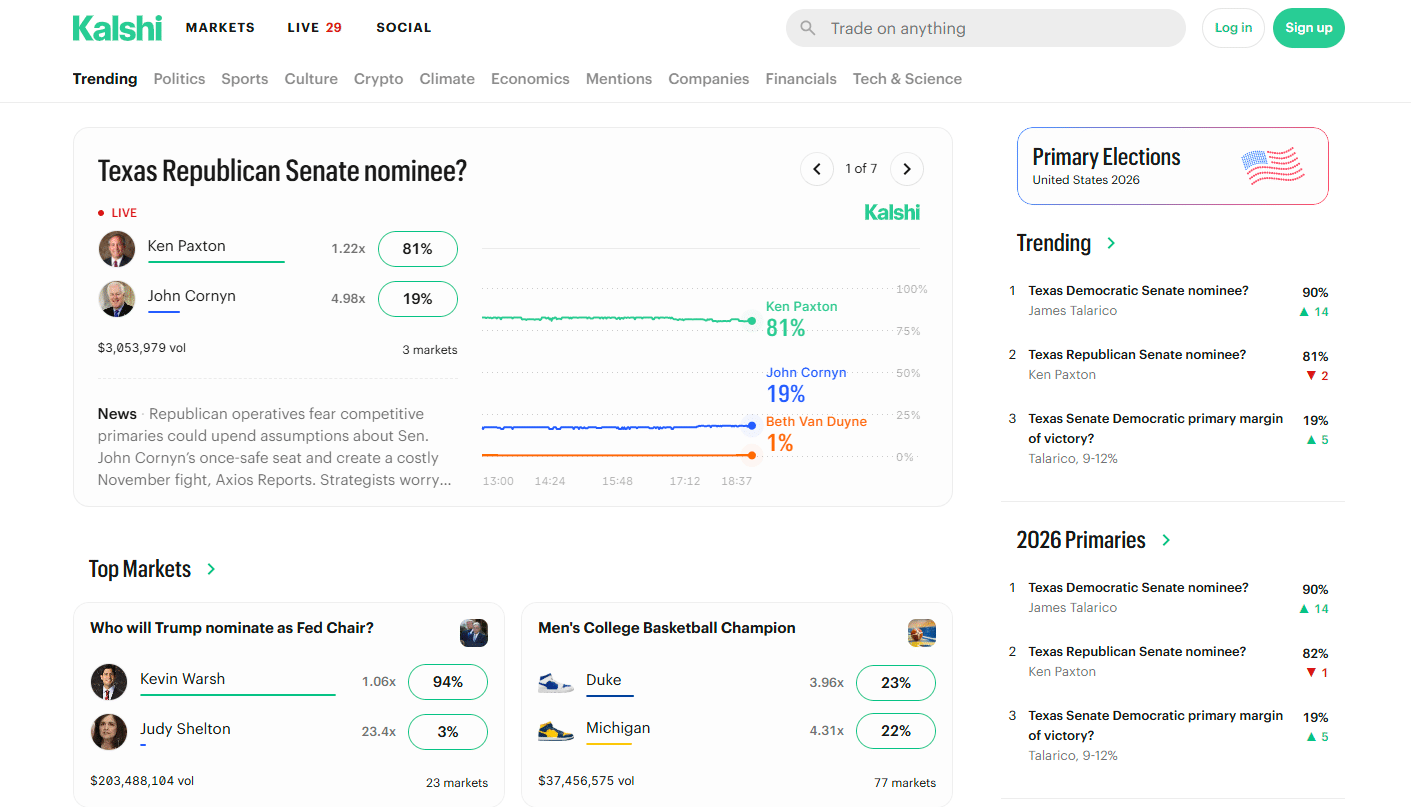
If you want direct access to the exchange with the broadest market selection, Kalshi is the natural choice. Its event contracts cover everything from Federal Reserve rate decisions and CPI data releases to Super Bowl outcomes, Oscar winners, and even hurricane forecasts. The platform generated $263.5 million in fee revenue in 2025 and was valued at $11 billion following its Series E round, making it one of the most well-capitalized fintech companies in the prediction space.
The fee structure is worth understanding: rather than a flat rate, Kalshi charges based on the contract price. Contracts priced around 50 cents carry the highest fees, while those near 1 cent or 99 cents are significantly cheaper. Free ACH deposits help keep costs down, though the 2% debit card fee is a drawback.
The reason Kalshi ranks second rather than first is that for most traditional investors, the broker-style experience of Plus500US will feel more natural. However, Kalshi remains the best option for traders who want direct exchange access, the widest market coverage, and full order book control.
Pros
-
Full CFTC regulation - the gold standard
-
Deepest market selection among regulated platforms
-
Earns interest on cash balances
-
Accepts crypto deposits (converted to USD)
- Available in 140+ countries
Cons
-
Fees apply on every trade (can add up for active traders)
-
2% fee on debit card deposits
-
Higher fees on mid-priced (50c) contracts
- No welcome bonus (Platinum program for VIPs only)
3# Robinhood

Robinhood entered prediction markets in October 2024 with presidential election contracts and has since expanded aggressively. Its prediction market hub now features over 1,600 active markets, and event contracts have become the platform’s fastest-growing new product, with 8.5 billion contracts traded in Q4 2025 alone.
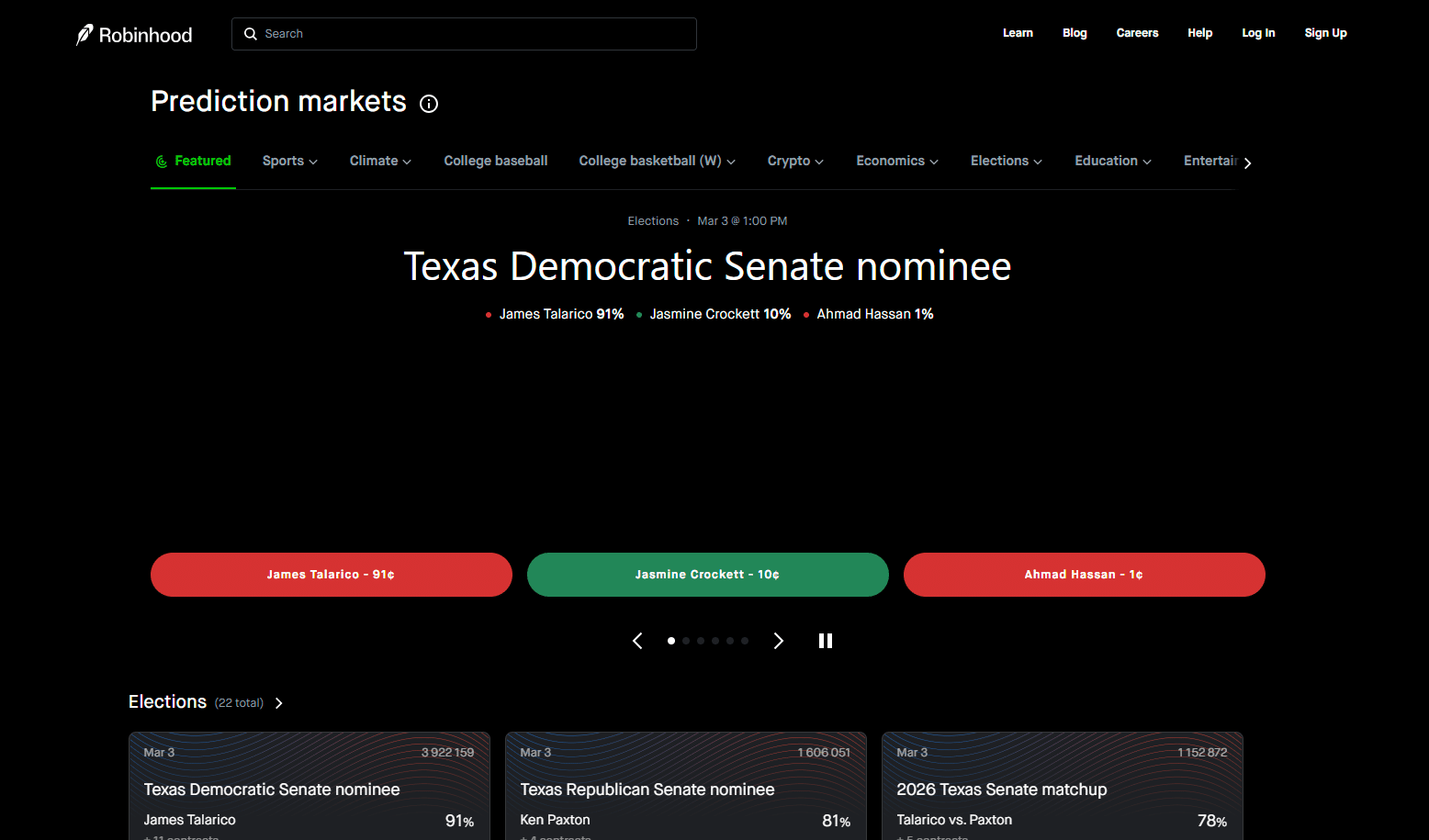
The biggest advantage of Robinhood is convenience. If you already trade stocks, ETFs, or crypto on the platform, prediction markets feel like a natural extension of your portfolio. You can fund trades from the same account, and the interface makes it easy to browse markets by category.
The custom combo feature is unique: you can package up to 10 individual event contracts into a single multi-leg position, similar to parlay bets but structured as regulated financial contracts. This is something neither Kalshi nor Plus500 currently offer.
The downside is cost. Robinhood adds its own commission layer on top of Kalshi’s exchange fees, which means you’ll pay more per trade than going directly through Kalshi or Plus500. For active traders, this cost difference adds up significantly.
Pros
-
All-in-one platform (stocks + crypto + predictions)
-
Familiar interface for existing Robinhood users
-
Free instant bank transfers
-
Combo contracts for multi-event trading
- Live scores and real-time updates for sports contracts
Cons
-
Adds its own fee layer on top of Kalshi's exchange
-
Sports contracts restricted in MD, NJ, and NV
-
No crypto deposit option
- No demo account for prediction markets
4# Polymarket

Polymarket is the undisputed global volume leader in prediction markets, processing billions in trading volume monthly. The platform’s liquidity is unmatched – even multi-million dollar trades experience minimal slippage on major markets.
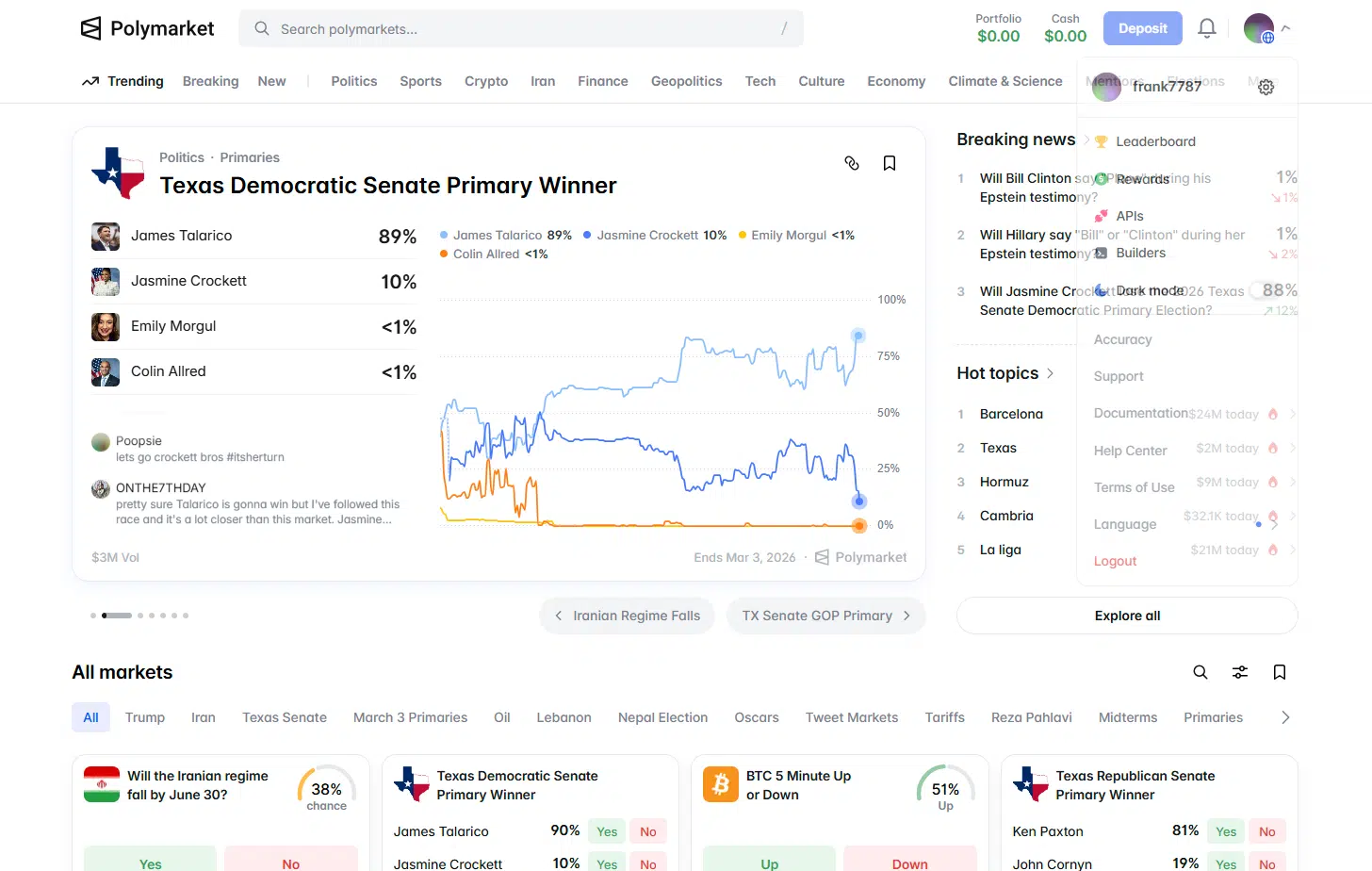
The zero-fee structure on most markets is a massive advantage for active traders. While some newer categories carry taker fees, the majority of Polymarket’s markets remain fee-free, making it the cheapest platform for high-volume trading.
The catch for US investors is access. Polymarket acquired QCEX (a CFTC-licensed exchange) in late 2025 and is gradually rolling out US access to waitlisted users, starting with sports markets. You’ll need a crypto wallet and USDC to participate, which adds friction for investors who prefer traditional banking.
For US investors who are comfortable with crypto and can access the platform, Polymarket offers the best combination of liquidity and low costs in the prediction market space.
Pros
-
Zero fees on the vast majority of markets
-
Highest liquidity and deepest order books globally
-
Widest range of markets across all categories
-
Customizable dashboard for market monitoring
- Decentralized and non-custodial
Cons
-
Requires USDC - barrier for non-crypto users
-
US access is still limited (waitlist-based)
-
Regulatory status in the US still evolving
- Some state-level restrictions may apply
5# FanDuel Predicts

FanDuel Predicts launched in December 2025 as a standalone app, backed by a partnership between Flutter Entertainment (FanDuel’s parent company) and CME Group, the world’s largest derivatives marketplace. Flutter plans to invest $200-$300 million into the prediction market product in 2026.
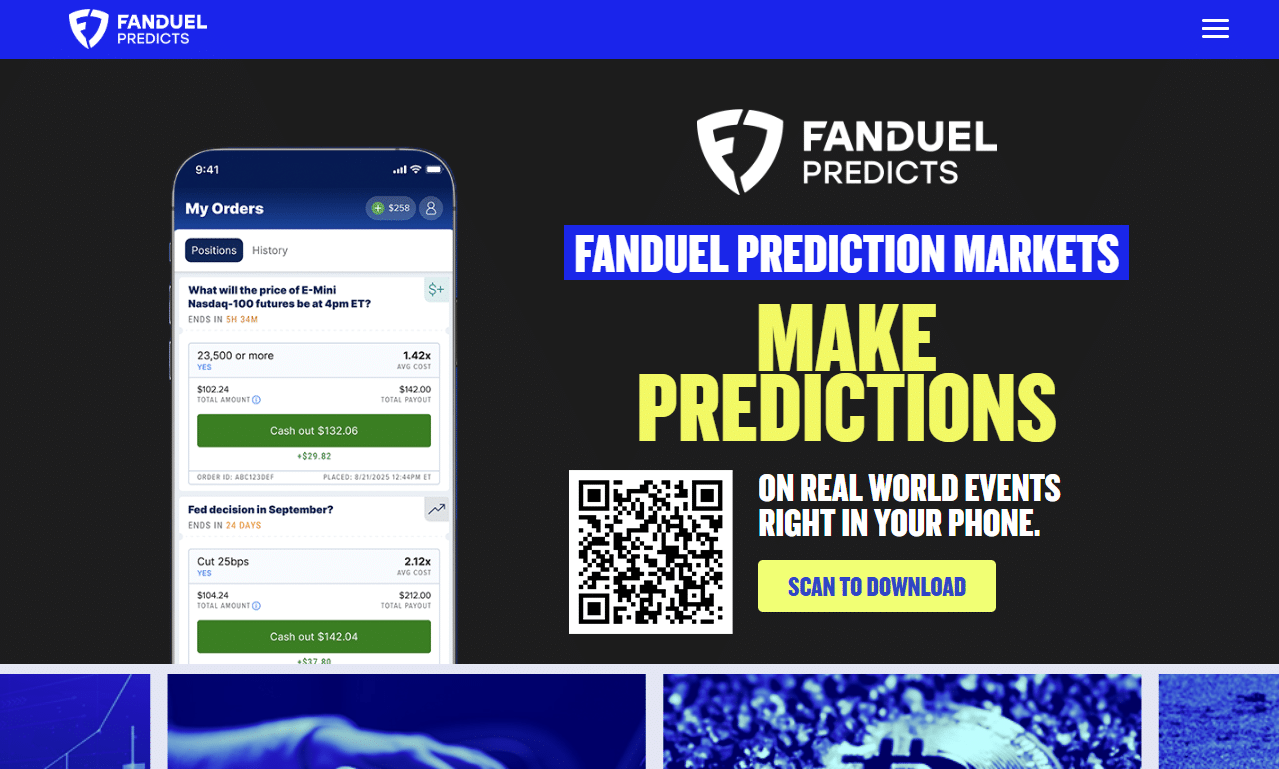
The platform is designed to give fans in non-betting states a legal way to engage with sports outcomes through regulated event contracts. Phase one covers sports, finance, economics, and politics, with phase two expected to add crypto, stocks, pop culture, and more.
For sports-focused traders, particularly those in states where traditional sports betting is illegal, FanDuel Predicts offers a compelling alternative. The clearing infrastructure is handled by Plus500, adding institutional credibility. However, the platform is still early in its rollout.
Pros
-
CME Group partnership adds institutional credibility
-
Nationwide availability for general prediction markets
-
Legal sports prediction markets in non-betting states
- Massive brand reach and user base
Cons
-
Still in phased rollout - limited market depth
-
Sports contracts only available in 18 states
-
Less diverse market selection than Kalshi or Polymarket
- New platform - track record still being established
6# DraftKings Predictions

DraftKings launched its Predictions product in December 2025 across 38 states. The platform is particularly interesting because DraftKings acquired Railbird, an event contract exchange, and plans to roll out its Railbird-powered proprietary exchange later in 2026.
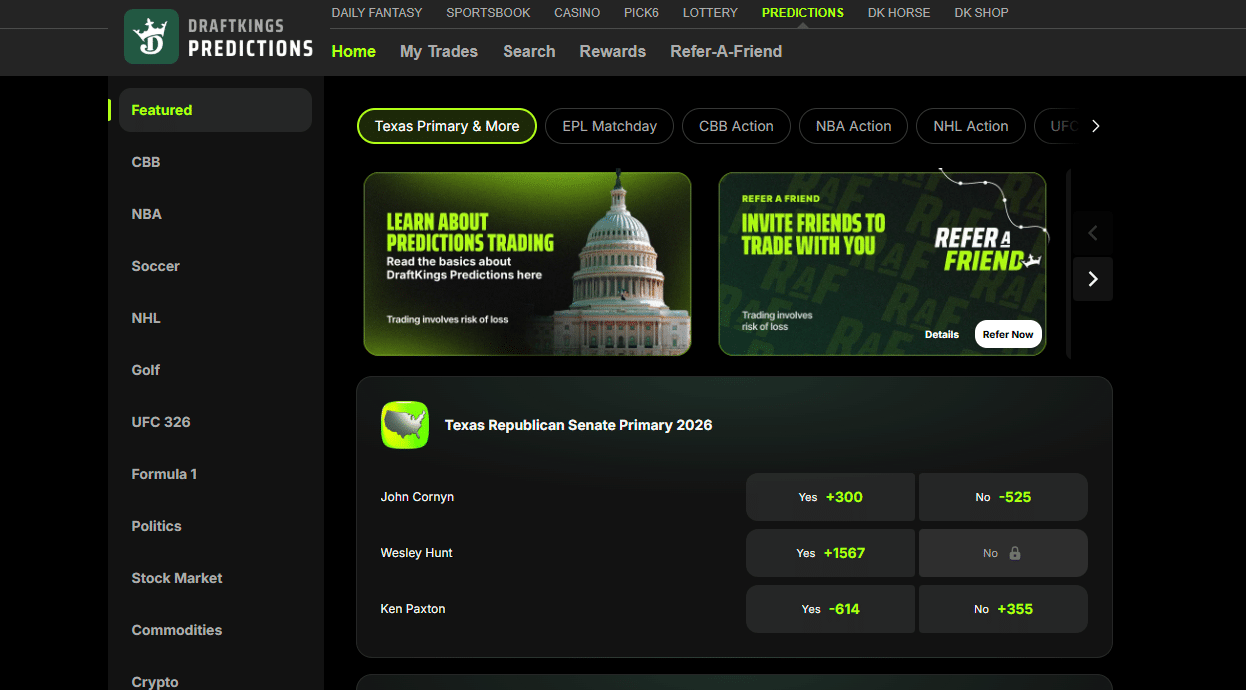
For now, DraftKings Predictions serves primarily as a complement to its daily fantasy sports platform. The market selection is narrower than Kalshi or Polymarket, and the company did not include prediction market revenue in its fiscal 2026 guidance, suggesting the product is still in an early growth phase.
Pros
-
Familiar brand for fantasy sports players
-
Building proprietary exchange infrastructure
-
Available in 38 states
- Strong potential for growth in 2026
Cons
-
Prediction markets revenue not yet included in guidance
-
Proprietary exchange not yet live
-
Narrower market selection currently
- Stock has declined 34% - investor uncertainty
7# PredictIt

PredictIt is the grandfather of US prediction markets. After years of legal battles with the CFTC, the platform won its lawsuit in July 2025 and received full regulatory approval in September 2025. For pure political forecasting, PredictIt offers unmatched depth – from presidential and congressional races to cabinet appointments and niche policy outcomes.
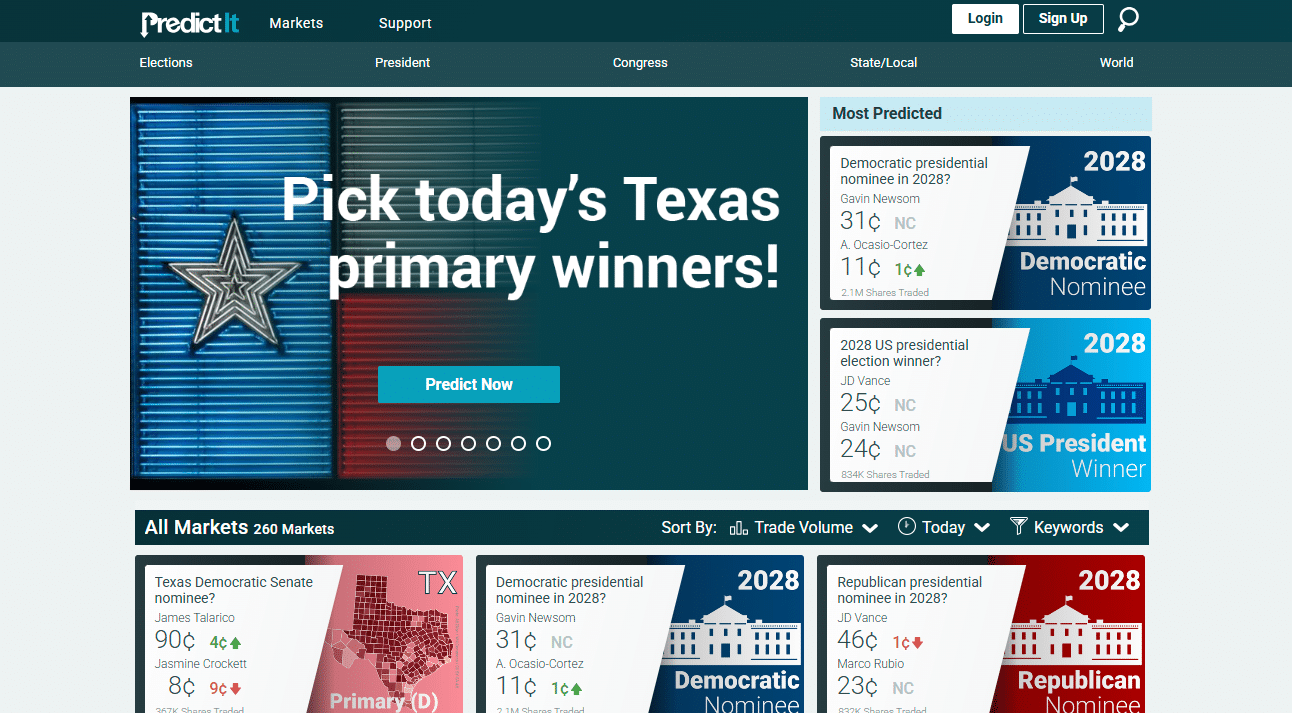
The main drawback is cost. The 10% profit fee plus 5% withdrawal fee means you need roughly 16% gross returns just to break even after cashing out, making it the most expensive prediction market in the US. The $3,500 position limit also restricts serious capital deployment.
PredictIt is best suited for political junkies and policy researchers who value depth in down-ballot political markets over breadth across other categories.
Pros
-
Unmatched depth in political and down-ballot races
-
Academic research heritage adds analytical credibility
-
Less whale influence due to position limits
- Full CFTC approval after years of legal battles
Cons
-
Steepest fees in the industry (10% profits + 5% withdrawals)
-
$3,500 position cap limits serious traders
-
No sports, crypto, or non-political markets
- Low liquidity compared to Kalshi and Polymarket
What are prediction markets?
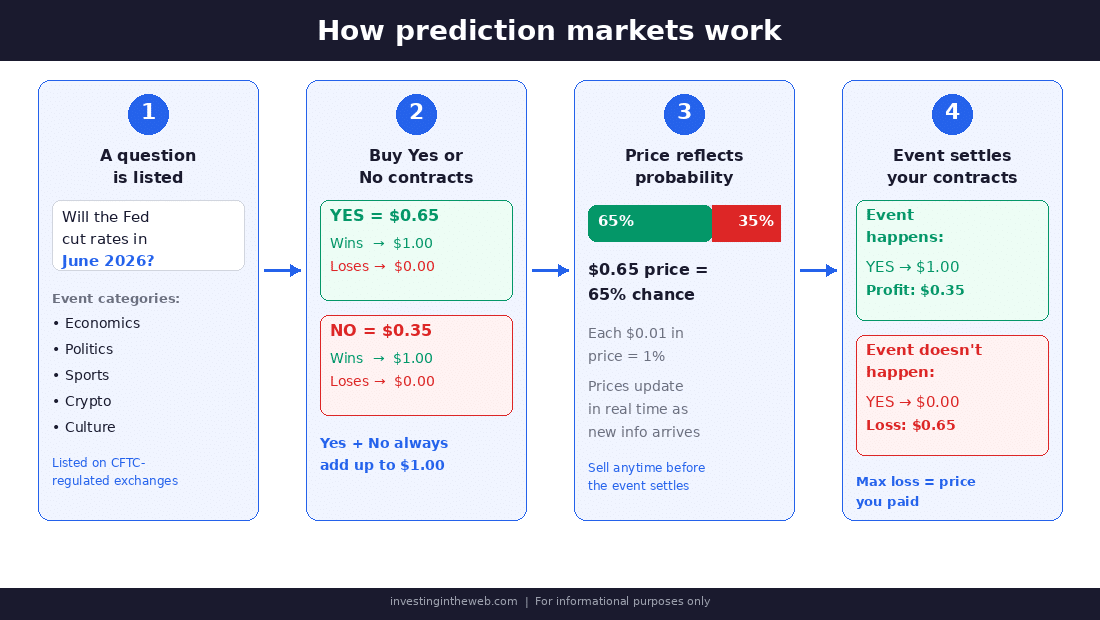
Prediction markets are financial platforms where you trade contracts based on the outcome of real-world events. Each contract is a binary question – “Will X happen?” – and its price reflects the market’s collective estimate of the probability.
Prices range from $0.01 to $0.99, with each cent roughly representing a 1% probability. If you buy a “Yes” contract at $0.35 and the event occurs, your contract settles at $1.00 – a profit of $0.65 per contract. If the event doesn’t occur, the contract settles at $0.00, and you lose your $0.35.
In the US, prediction markets are regulated by the CFTC as event contracts. This distinguishes them from gambling – they’re classified as financial derivatives, which is why they can legally operate in states where sports betting is prohibited. However, the regulatory landscape is still evolving, with some states challenging sports-related event contracts in court.
How to choose a prediction market platform
Choosing the right prediction market platform depends on what you’re looking for. Here are the key factors to consider:
- Regulation and safety: All platforms in our ranking are either Commodity Futures Trading Commission (CFTC)-regulated or provide access to CFTC-regulated contracts through partnerships. However, the nature of that regulation varies. Kalshi and PredictIt hold their own designated contract market licenses, while Plus500 and Robinhood operate as brokers accessing Kalshi’s exchange. Polymarket’s US arm was recently approved, but is still rolling out.
- Fees: Fee structures vary significantly. Polymarket charges zero fees on most markets, Plus500 charges a flat $0.01 per contract, Kalshi uses a variable model based on contract price, and PredictIt takes 10% of profits plus 5% of withdrawals. For high-volume traders, these differences compound dramatically over time.
- Market coverage: If you’re primarily interested in political markets, PredictIt offers the deepest coverage. For broad access across sports, economics, and culture, Kalshi leads among regulated US exchanges. Polymarket offers the widest global range but with limited US access.
- User experience: If you already use a brokerage account, Plus500US or Robinhood will feel most natural. If you’re crypto-native, Polymarket is the obvious choice. If you’re coming from sports betting, FanDuel Predicts or DraftKings will feel most familiar.
- Liquidity: Liquidity matters because thin markets mean wider spreads and difficulty exiting positions. Polymarket leads globally, Kalshi leads among US-regulated platforms, and newer entrants like FanDuel and DraftKings are still building depth.
The US regulatory landscape for prediction markets
The regulatory environment for prediction markets in the US has evolved rapidly. The CFTC oversees prediction markets as designated contract markets (DCMs), giving platforms like Kalshi legal standing as financial exchanges rather than gambling operations. This federal classification generally preempts state gaming laws, which is why prediction markets can operate in states where sports betting is illegal.
However, state-level challenges continue. Nevada issued a temporary restraining order against Polymarket in early 2026, and New York’s attorney general has warned that platforms promoting unlicensed sports contracts may face legal consequences. Several other states are reviewing sports prediction markets under their own gaming regulations.
There are also emerging concerns about insider trading. Legislation has been introduced (the Public Integrity in Financial Prediction Markets Act of 2026) to prohibit federal officials from trading on prediction markets using non-public information. Google began allowing US advertisements for federally regulated prediction markets in January 2026, further mainstreaming the industry.
From a tax perspective, a provision in the One Big Beautiful Bill Act caps gambling loss deductions at 90%, effective January 1, 2026. Whether prediction market trades fall under this cap or are treated as financial instruments with full loss deductions is still unclear — the IRS has not yet issued specific guidance.
Bottom line
To sum up, here are our key findings for investors looking for the best prediction markets platform:
Plus500 Futures
Best for regulated access to prediction markets via a broker - our top pick for traditional tradersKalshi
Best overall prediction market exchange with the largest market rangeRobinhood
Best for all-in-one investing - stocks, crypto, and event contracts in one appPolymarket
Best for liquidity and crypto-native users (this platform is USDC-only)FanDuel Predicts
Best for sports prediction markets in non-betting statesDraftKings Predictions
Best for fantasy sports playersPredictIt
Best for political markets
We hope you found this article enlightening and wish you the best of luck in your trading journey!
Disclaimer: This article is for informational purposes only and does not constitute financial advice. Prediction markets involve risk, including the potential loss of your entire investment. Past performance is not indicative of future results. Always do your own research before trading and consult with a qualified financial advisor if needed.
Frequently asked questions (FAQs)
Are prediction markets legal in the US?
Yes, but only on CFTC-regulated platforms offering approved event contracts. Kalshi, Polymarket US, and PredictIt all hold CFTC designations. Platforms like Plus500, Robinhood, and FanDuel access these regulated contracts through partnerships. State-level rules still vary, particularly for sports-related contracts.
Are prediction markets the same as gambling?
No. Prediction markets are classified as financial derivatives under CFTC regulation, not as gambling. However, the behavioral risks are similar – you can lose your entire position, and markets can trigger the same patterns as gambling. Always trade responsibly and never risk more than you can afford to lose.
Which prediction market platform has the lowest fees?
Polymarket charges zero fees on the majority of its markets, making it the cheapest option for active traders. Among regulated US-first platforms, Plus500US offers a competitive $0.01 per contract commission. Kalshi uses a variable fee structure that can be higher, especially for contracts priced around 50 cents.
Can I trade prediction markets in all 50 states?
General economic and political event contracts are available in all 50 states on most platforms. However, sports-related contracts are subject to restrictions in certain states. Robinhood restricts sports contracts in Maryland, New Jersey, and Nevada. FanDuel Predicts offers sports contracts in only 18 states. Always check the specific platform for availability in your state.
How are prediction market profits taxed?
Profits from prediction markets may be subject to US tax reporting. The tax treatment is currently uncertain – the IRS has not issued specific guidance on whether event contracts are treated like gambling wagers (subject to the 90% loss deduction cap under the 2025 One Big Beautiful Bill Act) or like financial derivatives (where 100% of losses offset gains). Consult a qualified tax advisor for your specific situation.
What is the difference between Kalshi and Plus500US for prediction markets?
Kalshi is the underlying exchange where event contracts are listed and settled. Plus500US is a broker that provides access to Kalshi’s contracts through its own platform interface. Trading through Plus500 gives you a broker-style experience with futures and prediction markets under one roof, while Kalshi gives you direct exchange access with more control over the order book. Plus500 charges $0.01 per contract, while Kalshi uses a variable fee model.
Is Polymarket available in the US?
Polymarket is gradually returning to the US market after acquiring QCEX, a CFTC-licensed exchange, in late 2025. Access is currently being rolled out to waitlisted users on a phased basis, starting with sports markets. The US-regulated product operates differently from Polymarket’s international platform. Full US availability is expected to expand throughout 2026.