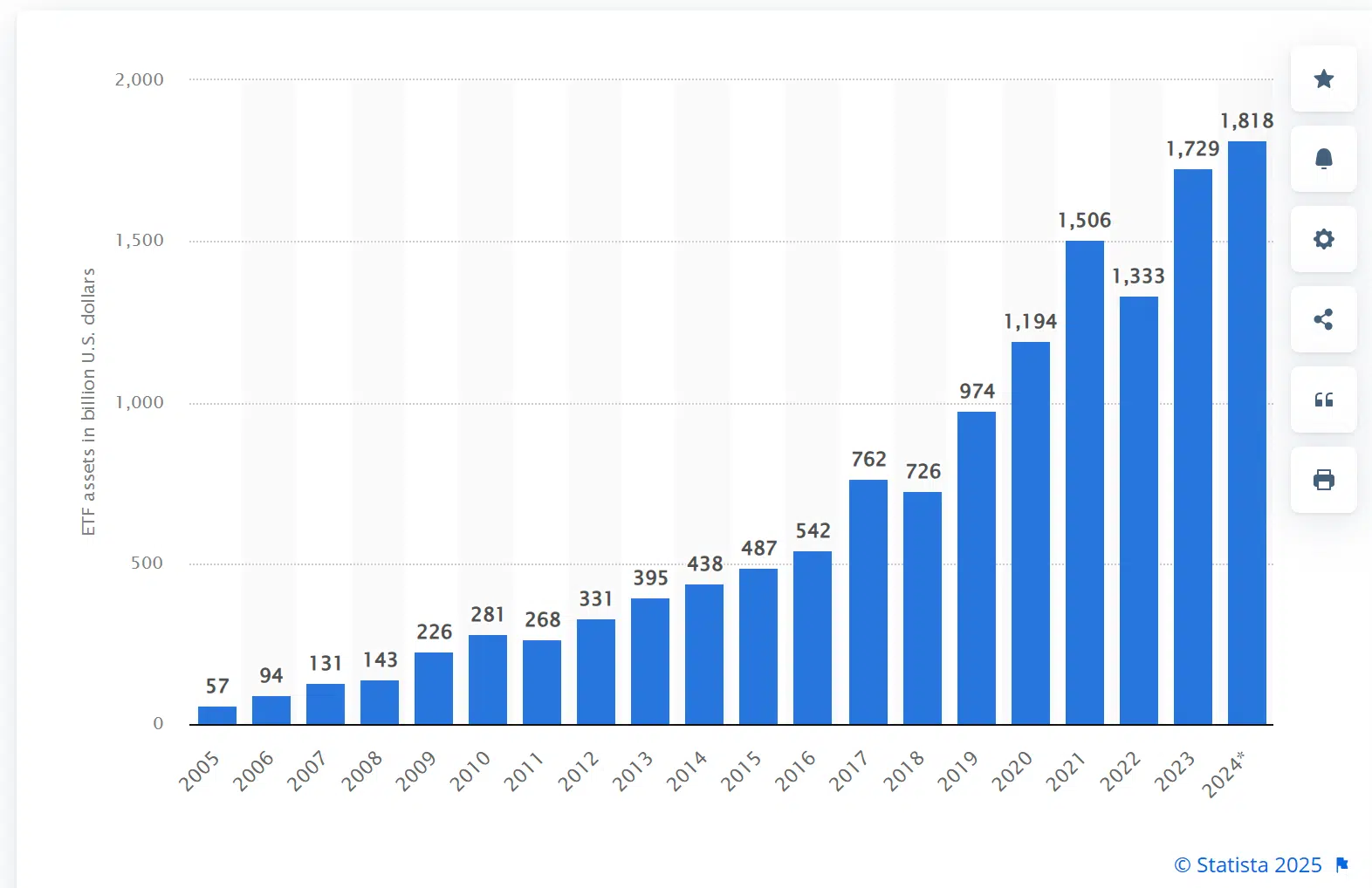
Exchange-traded funds (ETFs) have become an increasingly popular investment vehicle for many investors worldwide and, of course, in Europe:
Within Europe, one of the most prominent categories is the UCITS ETF. In this article, we will demystify UCITS ETFs, clarify how they are regulated, and discuss where you can buy them, drawing on guidance from the European Securities and Markets Authority (ESMA), in particular its “Guidelines on ETFs and other UCITS issues“.
What does UCITS mean?
UCITS stands for “Undertakings for Collective Investment in Transferable Securities”. This term originates from a series of EU directives establishing a harmonized regulatory framework for mutual funds within Europe. Key points include:
- Investor protection: UCITS funds must meet stringent requirements designed to protect retail investors. This includes diversification rules, restrictions on leverage, and requirements for transparent disclosure.
- Example: single issuer exposure limits. As a general rule, a UCITS fund cannot invest more than 10% of its net assets in securities or money market instruments issued by a single entity, and holdings above 5% cannot add up to more than 40% of the fund (the “5/10/40 rule”). Funds that replicate an index can go up to 20% per issuer, or 35% in exceptional market conditions.
- Passporting across the EU: Once a UCITS fund is authorized in one EU Member State, it can be marketed across the entire European Economic Area (EEA) through a simple notification to each country, without needing a separate authorization.
- Standardized regulation: The UCITS brand is widely recognised, providing investors with trust and clarity regarding operational and risk management standards.
What is a UCITS ETF?
A UCITS ETF is an ETF that complies with the UCITS directive. Like other ETFs, it is:
- Exchange-listed and tradable on a stock exchange throughout the trading day.
- Passively managed (in most cases) to track a specific index such as the S&P 500, STOXX Europe 600, or other market benchmarks. However, actively managed UCITS ETFs also exist, though they are less common.
- Regulated under UCITS rules, ensuring the product meets specific guidelines around portfolio diversification, transparency, and investor protection.
Because UCITS ETFs meet EU regulatory standards, they often attract not just European investors, but also international investors seeking an investment product that meets established European rules.
The regulatory framework of UCITS ETFs
ESMA’s guidelines outline several important regulatory aspects for UCITS ETFs:
- Transparency requirements: UCITS ETFs must clearly disclose their investment objectives, index-tracking methodology and risks in the prospectus and in the Key Information Document (KID).
- Diversification: UCITS-compliant funds have strict diversification rules. In most cases, no single issuer can make up more than 10% of the fund’s assets, although index-tracking funds can go up to 20%.
- Liquidity management: The ETF must ensure it can meet investor redemptions, typically requiring it to hold sufficiently liquid assets.
- Collateral requirements: In cases where the ETF engages in securities lending or uses derivatives, ESMA guidelines dictate the nature and quality of collateral it must hold to manage counterparty risk.
- Investor disclosure: Additional disclosures are required when a UCITS ETF departs from its usual index-based strategy or invests in financial derivative instruments (FDIs).
These regulatory demands aim to enhance investor protection, enforce transparency, and preserve market integrity.
The advantages and disadvantages of UCITS ETFs
Advantages
- High investor protection: UCITS ETFs are subject to stringent rules, providing reassurance to retail and institutional investors alike.
- Tax efficiency: Depending on your tax jurisdiction, UCITS ETFs can be more tax-efficient than non-UCITS funds (e.g., US-domiciled ETFs) due to international tax treaties and favourable withholding tax conditions (see the section on fund domicile below).
- Diversification and liquidity: UCITS ETFs offer exposure to a range of underlying assets, sectors, and geographic markets, while being easily tradable throughout the trading day.
- Regulatory transparency: Regular and standardized reporting ensures investors know exactly what is happening with the fund’s holdings, fees, and performance.
Disadvantages
- Limited choices for certain markets: Compared to some US-listed ETFs, the selection of UCITS ETFs can be narrower for specific niche sectors or thematic strategies.
- Trading costs: While ongoing charges (TER, or total expense ratio) are low, though often slightly higher than for comparable US-listed ETFs,, investors should consider brokerage fees, bid-ask spreads, and currency conversion costs.
- Risk of tracking error: As with any index fund, the ETF’s returns can deviate from its benchmark due to fees, transaction costs, and portfolio rebalancing.
How to identify a UCITS ETF?
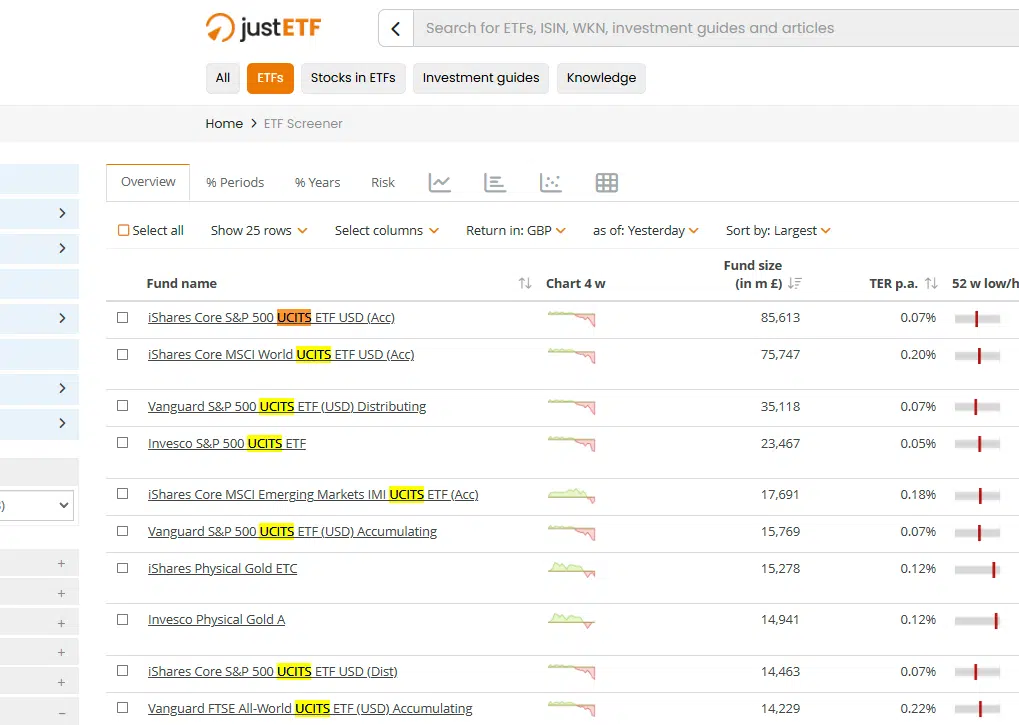
The best way is to look at the full name of the ETF you want to invest in. If you go to justETF, you will find thousands of ETFs. In all UCITS ETFs, you will notice the word “UCITS” in their names:
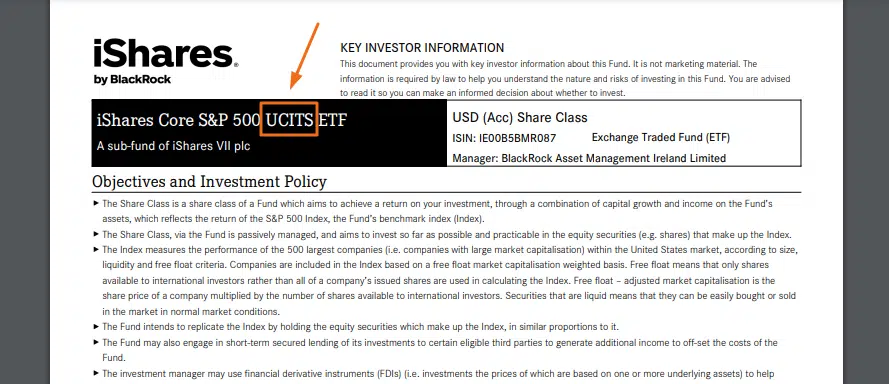
If you are still in doubt, check the fund documents. Since January 2023, UCITS funds sold to retail investors publish a Key Information Document (KID), which replaced the older Key Investor Information Document (KIID). Example for the iShares Core S&P 500 UCITS ETF:
Fund domicile and withholding tax
Most UCITS ETFs are domiciled in Ireland or Luxembourg, and the difference matters for anything that holds US stocks. Under the tax treaty between Ireland and the United States, US dividends paid to an Irish fund are taxed at 15% at source, while a Luxembourg fund generally suffers 30%. That gap is lost every year inside the fund and does not show up in the TER, which is why Irish-domiciled ETFs dominate US and global equity exposure.
Why European investors buy UCITS ETFs instead of US ETFs
Since 2018, the EU PRIIPs Regulation (Packaged Retail and Insurance-based Investment Products) requires a Key Information Document before a fund can be sold to retail investors. US-domiciled ETFs do not publish one, so most EU brokers will not let retail clients buy them. UCITS ETFs do, which makes them the default option for European retail investors.
Accumulating or distributing?
Many UCITS ETFs come in two versions. Accumulating (Acc) ETFs reinvest dividends inside the fund, while distributing (Dist) ETFs pay them out to you. Which one suits you depends mostly on how your country taxes dividends and fund gains, so check your local rules before choosing.
Here are three of the largest UCITS ETFs as an example:
| ETF | Xetra ticker | TER | Domicile | Dividends |
| iShares Core S&P 500 UCITS ETF USD (Acc) | SXR8 | 0.07% | Ireland | Accumulating |
| iShares Core MSCI World UCITS ETF USD (Acc) | EUNL | 0.20% | Ireland | Accumulating |
| Vanguard FTSE All-World UCITS ETF (USD) Accumulating | VWCE | 0.14% | Ireland | Accumulating |
Examples of large UCITS ETFs. Source: justETF, October 2026.
Where and how to trade in UCITS ETFs
Trading UCITS ETFs is broadly similar to trading stocks:
- Open a brokerage account: You will need an account with a broker that offers access to European exchanges (e.g., Euronext Amsterdam or Paris, Xetra, Borsa Italiana or the London Stock Exchange).
- Search for the ticker or ISIN: Each UCITS ETF has one ISIN (International Securities Identification Number) but can trade under different tickers on different exchanges. For instance, the iShares Core MSCI World trades as EUNL on Xetra and IWDA on Euronext Amsterdam.
- Place a buy order: You can place market or limit orders during the exchange’s trading hours.
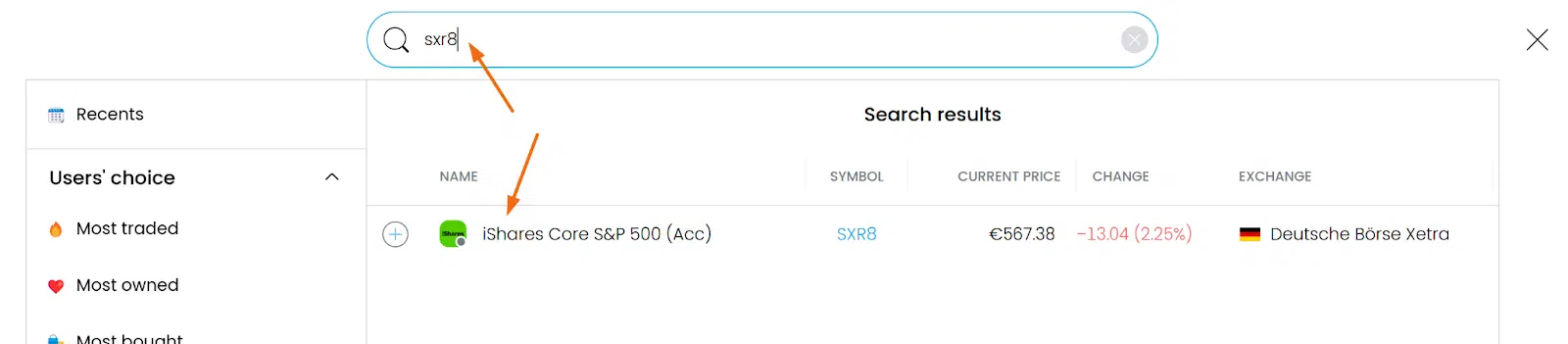
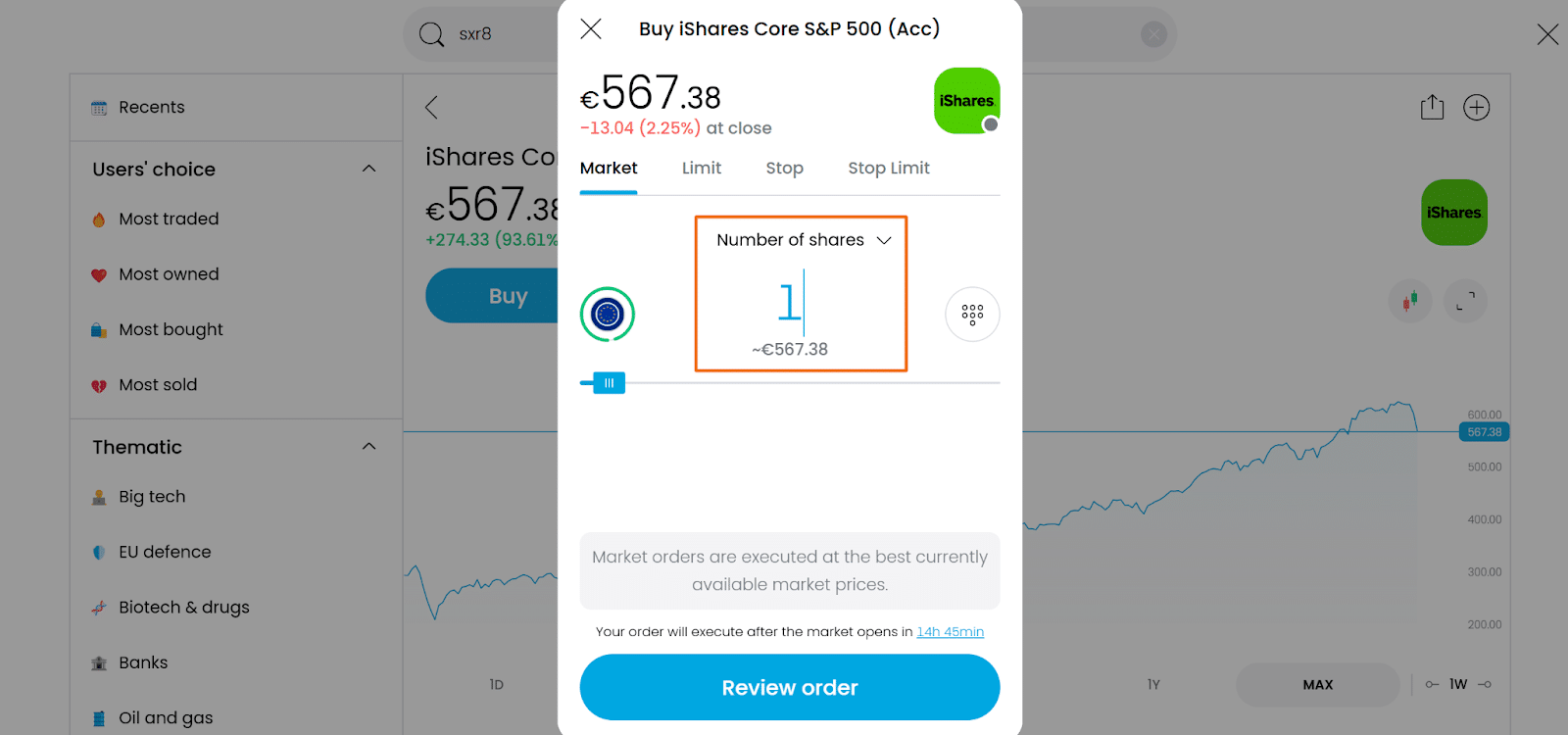
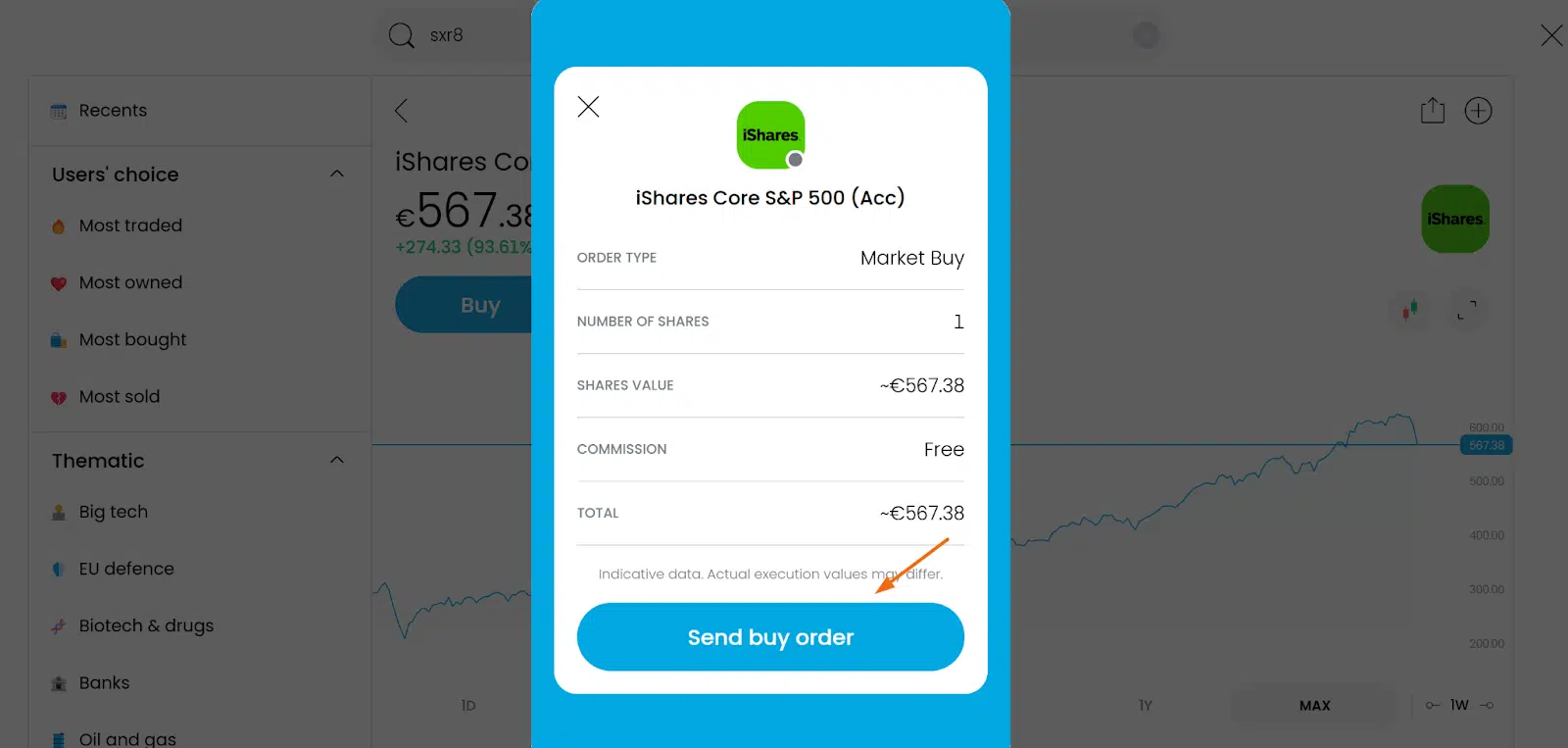
For our example, we will be buying the iShares Core S&P 500 UCITS ETF USD (ticker SXR8) while using Trading 212*, a broker that charges no commission on ETFs (other fees may apply, see terms and fees). A 0.15% FX fee applies when converting funds. Other fees may apply.
- First, search for SXR8:
- Second, select the ETF, click “Buy” and choose the number of shares (one, in our case):
- Third, click “Review” (there is no commission on this order) and finally “Send buy order”:
*When investing, your capital is at risk and you may get back less than invested. Past performance doesn’t guarantee future results.
Other investment platforms to consider
Apart from Trading 212, you can find others that allow you to buy UCITS ETFs. Ensure your broker or platform offers trading on European exchanges. Here are a few popular options:
- Interactive Brokers: A global brokerage with wide market access, suitable for advanced traders wanting international reach.
- Lightyear**: A newer platform focusing on low-cost investing, including European stocks and ETFs.
- Freedom24***: A CySEC-regulated broker with access to US, European and Asian exchanges and a broad stock and ETF offering.
When choosing a broker, consider trading fees, currency conversion charges, spread, and the regulatory framework in your home country.
**Capital at risk. The provider of investment services is Lightyear Financial Ltd for the UK and Lightyear Europe AS for the EU. Terms apply: lightyear.com/terms. Seek qualified advice if necessary.
***Investing involves risk of loss.
Frequently asked questions
Can investors outside the EU buy UCITS ETFs?
Yes. UCITS is an EU framework, but UCITS ETFs are bought by investors in the UK, Switzerland, the Middle East and Asia, among others, often for the more favourable withholding tax treatment of Irish-domiciled funds. Availability depends on your broker.
Can I buy US-listed ETFs in Europe?
Most EU retail investors cannot, because US ETFs do not publish the Key Information Document required by the PRIIPs Regulation. Investors classified as professional clients can sometimes access them.
What is the difference between a KID and a KIID?
Both are short documents that summarise a fund’s objective, risks and costs. Since 1 January 2023, UCITS funds sold to EU retail investors use the PRIIPs Key Information Document (KID), which replaced the older Key Investor Information Document (KIID).
Are UCITS ETFs safe?
UCITS rules cover diversification, leverage and how the fund’s assets are held, and the assets are kept by an independent depositary, separate from the fund manager. That protects you if the provider fails, but not from market losses: the value of the ETF still goes up and down with its index.
Bottom line
UCITS ETFs offer investors exposure to a diverse range of assets, strong regulatory oversight, and the convenience of intraday trading. They are a popular choice for those seeking a reliable, transparent, and potentially tax-efficient way to invest in global markets.
While they come with certain trading costs and may have a narrower range of niche offerings than some non-UCITS funds, their investor protections and ease of cross-border marketing in the EU make them a compelling choice for many portfolios.
If you are looking to invest in UCITS ETFs, remember to research thoroughly, choose a reputable broker, and evaluate how these funds align with your long-term investment goals and risk tolerance.
As with any investment decision, always consider seeking professional financial or tax advice tailored to your personal circumstances.