Saxo, the well-known European online broker, stopped onboarding new clients in a number of countries from 1 July 2024, as part of a strategic review announced at the same time.
That review has since concluded, and the outcome explains a great deal about why the exits happened. This article covers which countries were affected, what happened to existing clients, where the company ended up, and the alternatives available to those who lost access.
Key takeaways
- Saxo stopped accepting new clients from several countries on 1 July 2024.
- The move affected clients across Europe, the Americas, the Middle East, Africa and Asia-Pacific.
- The strategic review it formed part of ended in the sale of a majority stake to J. Safra Sarasin, completed in March 2026.
- Saxo services existing clients in more countries than it onboards new ones from, so being on the service list does not mean you can open an account.
- Investors can consider Interactive Brokers, eToro, XTB, Plus500, or Trading 212 as alternatives.
Restricted countries
From 1 July 2024, Saxo stopped accepting new clients from the following countries:
- Europe: Albania, Cyprus, Georgia, Guernsey, Isle of Man, Jersey, Serbia
- Americas: Argentina, Aruba, Bonaire, Sint Eustatius and Saba, Brazil, British Virgin Islands, Canada, Cayman Islands, Chile, French Guiana, Saint Barthelemy, Saint Martin, Sint Maarten, Uruguay
- Middle East and Africa: Bahrain, Egypt, Jordan, Kuwait, Mauritius, Mayotte, Oman, Réunion Island, Seychelles, South Africa
- Asia-Pacific: China, India, Indonesia, French Polynesia, New Caledonia, New Zealand, Taiwan, Turkey
Countries Saxo currently services
There is an important distinction here that catches people out, and Saxo makes it explicitly.
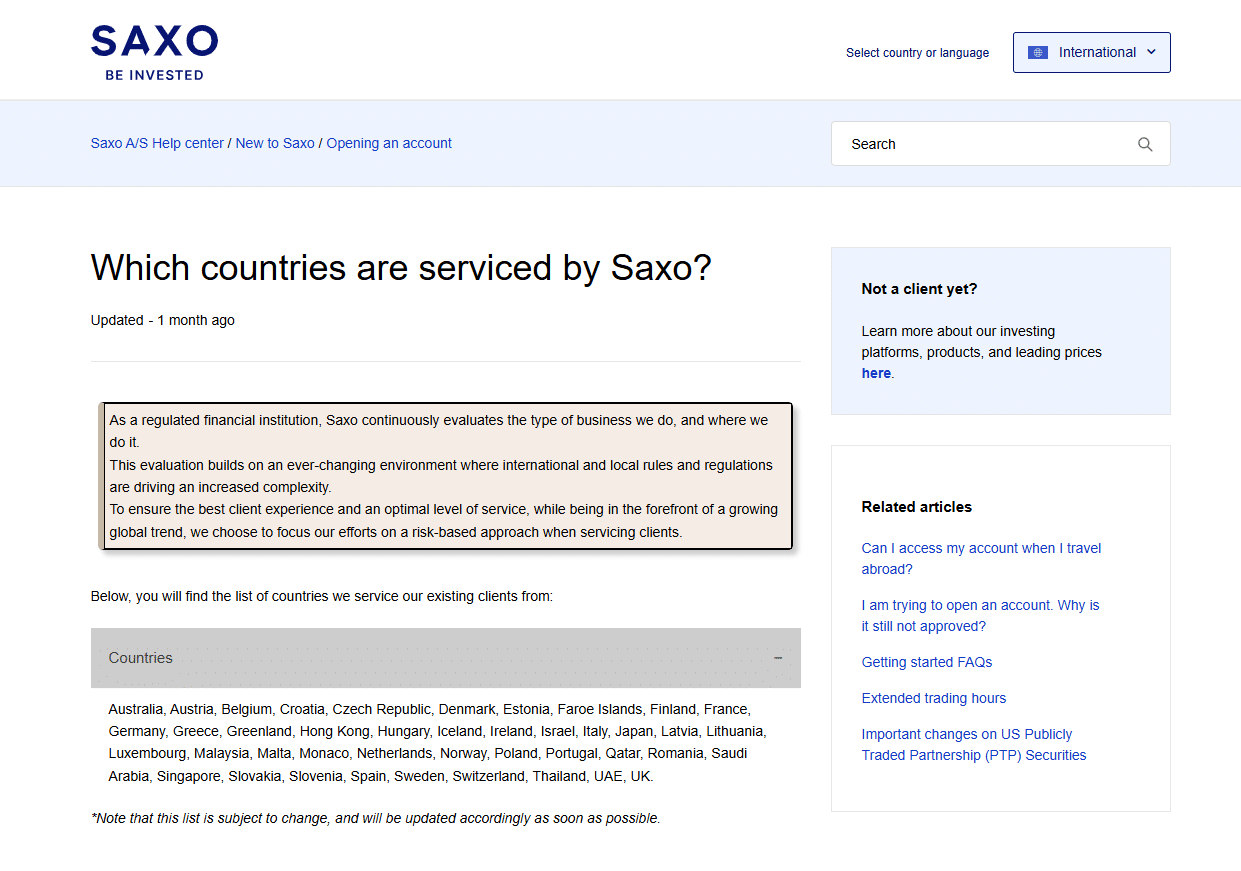
The list below is of countries where Saxo services existing clients. Saxo states that there may be differences between this list and the countries from which it onboards new clients, and that you can only open an account if your country appears on the account opening form itself.
In other words: finding your country below does not guarantee you can open an account. Check the account opening form, which is the definitive test.
Saxo currently services clients residing in:
- Europe: Austria, Belgium, Croatia, Czech Republic, Denmark, Estonia, Faroe Islands, Finland, France, Germany, Greece, Greenland, Hungary, Iceland, Ireland, Italy, Latvia, Lithuania, Luxembourg, Malta, Monaco, Netherlands, Norway, Poland, Portugal, Romania, Slovakia, Slovenia, Spain, Sweden, Switzerland, United Kingdom
- Middle East: Israel, Qatar, Saudi Arabia, United Arab Emirates
- Asia-Pacific: Hong Kong, Japan, Malaysia, Singapore, Thailand
- Oceania: Australia
Saxo notes that this list is subject to change and updated as required. To check whether you can actually open an account, go to Saxo’s account opening page and look for your country in the selector:
What happened to existing clients
Existing clients in the affected countries were not offboarded immediately. Saxo carried out the process through to the end of 2024, notifying each client directly about timelines.
If you held an account and never actioned the notification, contact Saxo directly to establish the current position on your holdings.
Where Saxo ended up: the J. Safra Sarasin acquisition
The July 2024 announcement was not simply a tidying-up exercise. It was framed as a review of strategic opportunities, and that review had a destination.
In March 2026, the Swiss private banking group J. Safra Sarasin completed its acquisition of a majority stake in Saxo, taking around 71%. Daniel Belfer became CEO, and founder Kim Fournais moved to Chairman of the Board. In July 2026 the group agreed to acquire Fournais’s remaining holding of roughly 29%, subject to regulatory approval.
Read alongside that outcome, the country exits look less like isolated compliance decisions and more like what they were: simplifying a business before a sale. Reducing the number of jurisdictions a broker operates in lowers regulatory overhead, narrows risk, and makes the company cleaner to value and to buy.
For clients in supported countries, the practical effect so far has been continuity rather than change. But ownership has shifted, and it is reasonable to keep an eye on whether the country list moves again under new control.
Saxo alternatives for affected clients
For investors in the affected countries, there are several reputable alternatives:
- Interactive Brokers: Best alternative overall. IBKR is the closest equivalent to Saxo in product breadth, with access to more than 170 exchanges in 40 countries, low commissions and the lowest currency conversion costs available.
- eToro: Best for commission-free ETF investing and social trading
- XTB: Best for forex and commission-free stocks and ETFs
- Plus500*: Best for demo account and CFDs
- Trading 212: Best for beginners and auto-invest
Availability varies considerably by country, and a broker that serves one restricted market may not serve another. Check each one against your own residency before assuming access, exactly as you would with Saxo.
*81% of retail CFD accounts lose money.

Why did Saxo leave so many countries?
Saxo did not publish a country-by-country explanation, but the pattern and the timing point to three things.
Regulatory cost per market. Maintaining compliance across dozens of jurisdictions, each with its own rules and reporting, is expensive and consumes staff. Concentrating on fewer markets reduces that overhead substantially, and Saxo has said its approach is risk-based, focusing effort where it can deliver the level of service it wants.
Scale per market. Operating in a country only pays above a certain client base. Markets with fewer clients tend to be the first to go when a broker reorganises, which is consistent with the mix of small and distant markets on the restricted list.
Preparing for a transaction. The exits were announced in the same breath as a review of strategic opportunities, and that review ended in a majority sale. A simpler business with fewer regulatory exposures is easier to value and to sell, and it is reasonable to read the two together rather than separately.
Conclusion
Saxo’s withdrawal from a long list of markets in 2024 affected many clients, and the offboarding of existing accounts in those countries was completed by the end of that year.
With hindsight, those exits look like the first step in a process that ended with J. Safra Sarasin acquiring control in March 2026. For clients in supported markets, the service has continued largely unchanged.
If you were affected, the alternatives above cover most of what Saxo offered, and Interactive Brokers is the closest match on breadth of product. Check availability for your own country before opening anything, and if you are in a country on Saxo’s service list but cannot open an account, that is the distinction explained earlier rather than an error on your part.
Risk disclaimer: When investing, your capital is at risk and you may get back less than invested. Past performance doesn’t guarantee future results.