


Hello, fellow investor! Today, we’ll explore Pepperstone, a globally renowned CFD and forex broker. We aim to determine whether this broker aligns with your trading goals and needs in 2026.
Pepperstone’s low trading costs and wide range of instruments, including forex, indices, commodities, shares, ETFs and cryptocurrencies (all traded as CFDs), appeal to active traders. UK clients can also use spread betting, which is currently free of capital gains tax for UK residents.
However, Pepperstone is not available everywhere, and residents of the United States cannot open an account. Traders in restricted countries may want to consider alternative brokers, such as Interactive Brokers, which offer broader geographic availability.
Pepperstone only offers CFDs (and spread betting in the UK), so you trade derivatives rather than owning real stocks or ETFs, an important distinction for long-term investors. CFDs are complex instruments and come with a high risk of losing money rapidly due to leverage. 74.1% of retail investor accounts lose money when trading CFDs with Pepperstone EU Limited and Pepperstone Limited (UK), and 75.2% with Pepperstone GmbH. You should consider whether you understand how CFDs work and whether you can afford to take the high risk of losing your money.
So, let’s dive deeper into what our research has uncovered about Pepperstone.
Video summary
Overview
Pepperstone, founded in 2010 and headquartered in Melbourne (Australia), has become one of the largest forex and CFD brokers in the world, with more than 900,000 accounts held globally (March 2026). The broker has earned multiple industry awards for its services, notably receiving the “Best MT4 and MT5 Broker” award for 2026 by Investing in the Web.
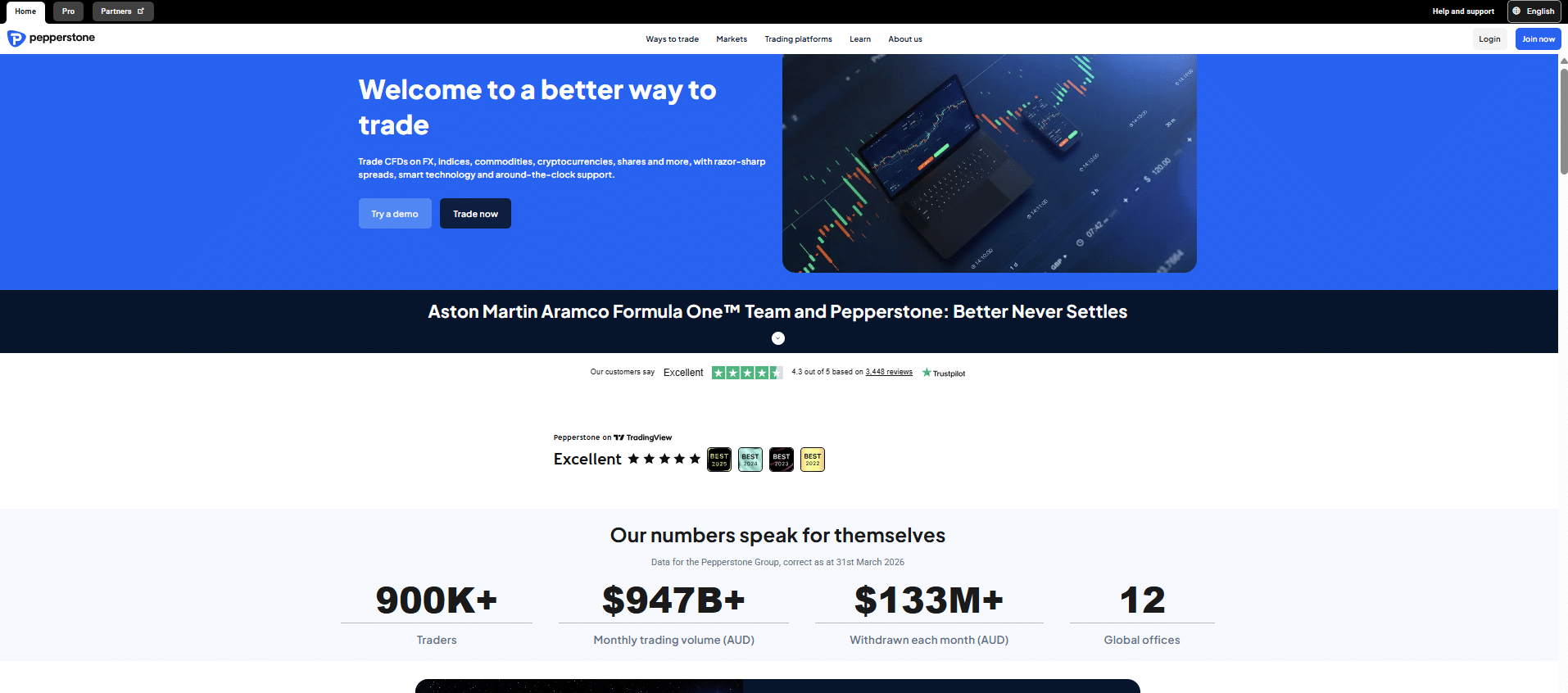
Pepperstone has nine licensed entities, regulated by authorities including the FCA (UK), ASIC (Australia), CySEC (Cyprus), BaFin (Germany), the DFSA (Dubai), the CMA (Kenya) and the SCB (Bahamas).
The broker offers multiple trading platforms, including MetaTrader 4 (MT4), MetaTrader 5 (MT5), cTrader, and TradingView, with features such as advanced charting, custom indicators, and automated trading via Expert Advisors (EAs), though platform availability may vary by region.
Pepperstone reports a 99.32% fill rate with no dealer intervention (all trades from 1 January to 31 March 2026). Its product range covers more than 1,350 instruments across different asset classes, all available as CFDs (and as spread betting for UK clients). For traders on the go, Pepperstone offers mobile apps for iOS and Android plus web-based platforms accessible from any browser.
Account types cater to different trader profiles:
- Razor account: favoured by scalpers, algorithmic traders, and Expert Advisor users. Offers raw spreads starting from 0.0 pips with a commission of $3.50 per lot per side on MT4 and MT5 ($3 on cTrader).
- Standard account: commission-free, with all trading costs built into a slightly wider spread, suitable for traders who prefer a simpler, no-commission approach.
When trading with Pepperstone, it’s important to understand that you’re engaging in Contracts for Difference (CFDs). This means you’re not owning the underlying assets but rather speculating on price changes, with leverage that magnifies both gains and losses. Retail clients in the UK, EU and Australia get negative balance protection, so they cannot lose more than their account balance. For a more comprehensive explanation of the distinction between CFDs and shares, please refer to our dedicated article on the topic.
Highlights
| 🗺️ Supported countries | Most countries, not the US |
| 💰 Forex CFDs spreads | From 0.0 pips on Razor account ($3.50 per lot per side commission) |
| 💰 Stock CFDs fees | From $0.02 per share (UK and US markets) |
| 💰 Perpetual CFDs fees | 0.015% per side (0.03% on gold and MSTR) |
| 💰 Inactivity fee | $0 |
| 💰 Withdrawal fee | $0 (USD 20 on international bank wires in the EU, £15 in the UK) |
| 💵 Minimum deposit | $10/€10/£10 (no minimum for bank transfers) |
| 📍 Products offered | CFDs on forex, shares, ETFs, commodities, indices, currency indices, cryptocurrencies and perpetuals (depending on region), spread betting (UK only) |
| 🛡️ Negative balance protection | Yes, for retail clients in the UK, EU and Australia |
| 🎮 Demo account | Yes (unlimited duration) |
| 📜 Regulatory entities | FCA (UK), CySEC (Cyprus), ASIC (Australia), BaFin (Germany), DFSA (Dubai), CMA (Kenya), SCB (Bahamas) |
Data as of September 2026. Fees and features vary by region and entity, so check Pepperstone’s pricing page before opening an account.
Pros and cons
Pros
- Quick customer support response times
- No fees for deposits, withdrawals, or account inactivity
- Competitive spreads in the Razor account with active trader rebates
- Higher leverage options are available depending on region and client categorization
Cons
- Limited to CFD trading; no direct asset ownership
- Higher Forex spreads in the standard account
- Crypto CFDs offerings are limited compared to competitors
- Limited educational resources
Account opening
Opening an account with Pepperstone is a clear and straightforward procedure, executed entirely online and and usually takes about 15 minutes.
Steps to open an account:
- Start the registration: Navigate to Pepperstone’s website and click on “Join Now” to begin the process.
- Sign up using preferred method: You have the option to sign up using your Apple, Google, Facebook, or email account.
- Select your country and provide basic information: You’ll be required to select your country of residence, which determines your eligibility to open an account with Pepperstone. You must also fill in basic information such as your name, date of birth, and phone number.
- Decide on your account’s purpose: At this step, you can choose to either start trading with a demo account to practice or proceed to set up a live trading account.
- Set up your trading account: If you opt for a live account, you will choose the account type (Standard or Razor), your preferred leverage, and the base currency you wish to use.
- Complete a trading expertise survey: Pepperstone requires additional information about your employment and income status. You’ll answer questions regarding your annual income, savings, and investment values. They also inquire about your trading objectives and the risk level of your trading style. Additionally, this survey will include questions about your experience with CFDs or Forex and your understanding of the risks involved with trading derivatives.
- Document verification: Pepperstone requires you to upload your identification documents to comply with regulatory standards.

Once you’ve submitted all the required information and documents, your account will undergo a verification process. This can take up to three business days, although in our experience it is often done within a day.
Account types
Pepperstone offers two primary account types:
- Razor Account: This account type is designed for more advanced traders who prefer trading at tighter spreads and are comfortable paying a commission per trade. For example, the minimum spread for major pairs is as low as 0 pips.
- Standard Account: Ideal for traders who prefer an all-inclusive spread without separate commission charges. The minimum spread on the same major currency pairs is 1 pip (1.1 pips on average for EURUSD in August 2026).
Several common features are available across both account types, such as a minimum trade size of 0.01 lots, leverage that depends on your region and client category (up to 1:30 on major forex pairs for retail clients in the UK, EU and Australia, up to 1:500 for professional clients) and a choice of ten base currencies: USD, EUR, GBP, CHF, AUD, JPY, NZD, SGD, HKD and CAD. Below is a detailed comparison:
| Account type | Razor Account | Standard Account |
| Trading Platforms | MT4, MT5, cTrader, TradingView | MT4, MT5, cTrader |
| Commission (Forex Only) | USD 3 to 3.50 per lot per side | No commission |
| Spreads | Raw (from 0) | Variable |
| Instruments Offered | 1,350+ | 1,350+ |
| Stop Out Level | Retail: 50% | Retail: 50% |

Active Trader and Professional accounts
Beyond the standard Razor and Standard accounts, Pepperstone offers two specialised account programmes for serious traders:
Active Trader programme
Designed for high-volume traders, the Active Trader programme gives rebates on spreads and commissions based on how much you trade each month. On Pepperstone’s Australian site, for example, the tiers are:
- Tier 1 (10% rebate): 200 to 499 forex lots, 400 to 999 commodity lots or 2,000 to 4,999 index lots a month.
- Tier 2 (20% rebate): 500 to 1,499 forex lots, 1,000 to 2,999 commodity lots or 5,000 to 14,999 index lots.
- Tier 3 (30% rebate): more than 1,500 forex lots, 3,000 commodity lots or 15,000 index lots.
The exact terms vary by entity. For scalpers and algorithmic traders, these rebates can meaningfully reduce trading costs.
Professional client classification
Under EU and UK rules (MiFID II), retail clients can ask to be treated as professional clients if they meet at least two of these criteria:
- A portfolio of cash and financial instruments above €500,000.
- An average of 10 significant trades per quarter over the previous four quarters.
- At least one year of professional experience in the financial sector that requires knowledge of these products.
Professional clients on Pepperstone benefit from:
- Higher leverage: up to 1:500 on major forex pairs, major indices, gold, bitcoin and ether (1:20 on shares and ETFs).
- No 50% retail close-out rule.
- Access to products not offered to retail clients in some regions, such as crypto CFDs in the UK.
Important: opting up to Professional status means waiving several retail-client protections, including negative balance protection and, in some jurisdictions, access to the Financial Ombudsman Service. Professional classification should only be pursued by traders who fully understand the increased risks and have the experience to manage them.
Deposits and withdrawals
You have access to a secure client portal that allows for straightforward financial transactions, including deposits and withdrawals, and Pepperstone does not charge for deposits or most withdrawals (international bank wires cost USD 20 in the EU and £15 in the UK). Here’s a summary of the available funding and withdrawal methods:
| Payment method | Deposits | Withdrawals |
| Apple Pay / Google Pay | Immediate, from €10 | Up to 1 business day |
| Debit/credit cards | Immediate, from €10 | Up to 1 business day |
| Domestic bank transfer | Up to 2 business days, no minimum | Free |
| International bank transfer | No minimum | USD 20 (EU), £15 (UK) |
| PayPal | Immediate (not in the UK) | Free |
Payment methods for EU clients, September 2026. Methods vary by region: Australian clients can also use Skrill, Neteller, BPAY and PayID. Withdrawals go back to the original deposit method where possible. EU clients cannot fund or withdraw with crypto.
Trading platforms
Pepperstone provides multiple trading platforms designed to suit traders on any device. Whether you prefer trading from desktop, mobile, or tablet, Pepperstone offers flexible solutions across Windows, macOS, iOS, and Android. There is also a browser-based WebTrader for traders who prefer not to install any software. Here is an overview of the available platforms and their key features:
MetaTrader 4 (MT4)
MetaTrader 4 remains the world’s most popular forex and CFD trading platform, favoured for its extensive features and customisation options. Pepperstone’s MT4 implementation is available on desktop (Windows and macOS), web, iOS, and Android, supporting algorithmic trading and strategy customisation through MQL4 for building and running Expert Advisors (EAs). Pepperstone adds Smart Trader Tools, a free suite of more than 60 trading applications for MT4 and MT5, including an alarm manager, a mini terminal and a trade simulator.

MetaTrader 5 (MT5)
MetaTrader 5 is the successor to MT4, offering broader functionality, faster processing speeds, and additional asset class support. It’s designed for traders who require more advanced capabilities and access to a wider product universe. Available on desktop, web, iOS, and Android, MT5 supports coding in MQL5 (a more powerful object-oriented language than MQL4), providing enhanced strategy development and back-testing. The platform includes more built-in indicators than MT4, an integrated economic calendar, depth-of-market (DOM) functionality, and more flexible customisation for various trading styles.

cTrader
cTrader on Pepperstone focuses on replicating an institutional-grade trading environment, making it well-suited to experienced and active traders. The platform features an intuitive modern interface alongside advanced trading functionalities such as level II pricing (DOM), granular control over slippage and price tolerance, and precise order routing. cTrader supports coding in C# for fully customised algorithmic strategies through cTrader Automate. It is popular with scalpers and algorithmic traders, and it is where Razor commissions are lowest (USD 3 per lot per side).

TradingView
Pepperstone offers full integration with TradingView, known for its charting tools and large trading community. It is available with Razor accounts. This platform is ideal for traders who rely heavily on technical analysis and benefit from community-driven insights. Pepperstone allows users to directly link their trading accounts to TradingView, accessing industry-leading charts, 100+ pre-built indicators, custom Pine Script studies, an integrated economic calendar, and news feeds, all from a single browser-based interface.
Free TradingView subscription
Pepperstone offers eligible clients a free TradingView Essential, Plus or Premium subscription. Pepperstone does not publish the qualifying criteria on its site, so ask your account manager what applies to you. For reference, TradingView Premium lists at $59.95 a month when billed annually. For traders who already pay for TradingView, this can be a meaningful saving.
Additionally, Pepperstone offers complementary tools to enhance the trading experience (availability varies by region and jurisdiction):
- CopyTrading by Pepperstone: lets you copy the trades of more than 9,000 vetted traders.
- cTrader Copy and MetaTrader Signals: copy strategies from providers on those platforms.
Mobile trading app
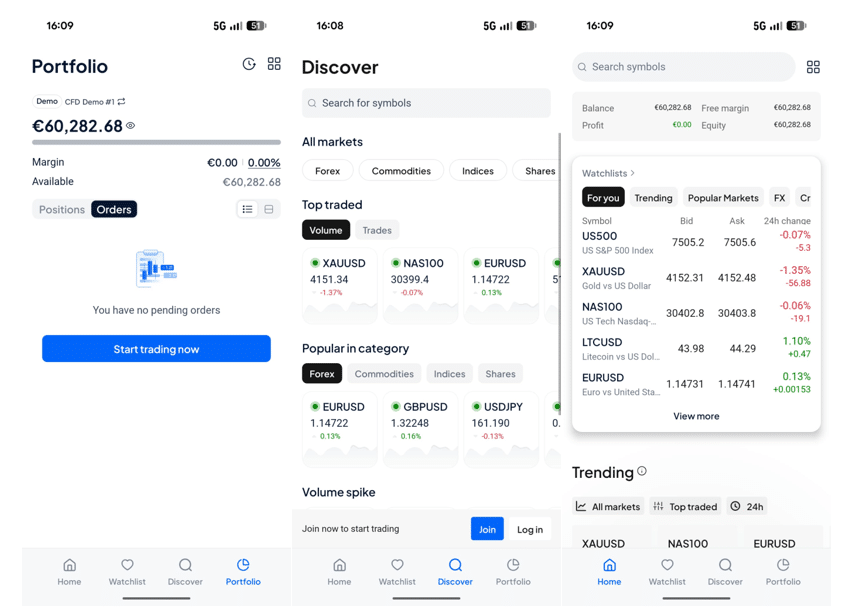
Beyond the mobile versions of MT4, MT5, and cTrader, Pepperstone offers its own proprietary Pepperstone mobile app available on iOS and Android, designed for traders who want a clean, broker-native experience without needing to install third-party platforms.
Key features of the Pepperstone app:
- Account management: deposits, withdrawals and document uploads.
- Live charts with technical indicators and drawing tools.
- Order placement across forex, indices, commodities, shares and other CFDs.
- Market news and analysis from Pepperstone’s research team.
- Push notifications for price alerts, margin calls and order fills.
- Biometric login (Face ID, Touch ID, fingerprint).
- Multi-device synchronisation with desktop and web platforms.
User feedback is generally positive: in September 2026, the app had a 4.4/5 rating on Google Play (1,430+ reviews) and 4.0/5 on the UK App Store (80 ratings).
For active traders who require advanced charting, multi-screen workflows, or algorithmic strategies via Expert Advisors, the dedicated MT4, MT5, or cTrader mobile apps remain the better option. The Pepperstone app is best suited for monitoring positions, simple trades and account admin on the go.
Products & markets
Pepperstone offers a diverse range of trading instruments on multiple exchanges worldwide. With more than 1,350 instruments (all traded as CFDs, plus spread betting for UK clients), you can trade several asset classes. Leverage below refers to retail clients in the UK and EU:
- Forex: 90+ currency pairs (major, minor and exotic), with leverage up to 1:30 on majors and 1:20 on minors. Spreads start from 0.0 pips on Razor.
- Commodities: CFDs on gold, silver, crude oil, natural gas and more, with leverage up to 1:20 on gold and 1:10 on other commodities.
- Indices: more than 20 cash stock indices, such as the US500 (S&P 500), UK100 (FTSE 100) and GER40 (DAX), with no commission and leverage up to 1:20 on major indices and 1:10 on minor ones.
- Currency indices: three currency basket indices, USDX, EURX, and JPYX, which measure the value of one currency against a basket of others.
- Cryptocurrencies: CFDs on bitcoin, ether and around 20 other coins, plus crypto indices, with leverage up to 1:2. The FCA bans crypto CFDs for UK retail clients, so in the UK they are only available to professional clients.
- Perpetual CFDs: CFDs with no fixed expiry, borrowing the perpetual contract model popular in crypto. Pepperstone launched the first one on SpaceX in June 2026, ahead of its expected IPO (it gives no rights to SpaceX shares), and in July 2026 extended perpetuals to gold, the Nasdaq 100, the S&P 500, WTI and Brent crude and a list of individual stocks. Commission is 0.015% per side (0.03% on gold and MSTR). Availability depends on your region.
- Shares: CFDs on more than 1,100 stocks from markets including the US, UK, Germany, Australia, Hong Kong and much of Europe, with leverage up to 1:5 for retail clients and 1:20 for professional clients.
- ETFs: CFDs on 90+ ETFs tracking sectors, themes and indices.
- Spread betting (UK only): leveraged trading on forex, indices, commodities and shares, with profits currently free of capital gains tax for UK residents.

Leverage limits, product availability, and crypto/spread betting offerings vary by jurisdiction and client classification (retail vs professional). Please refer to Pepperstone’s local entity for region-specific terms.
Fees
Broker fees are typically categorised into two main types:
- Trading fees: costs of executing trades, such as spreads (the difference between the buying and selling price), commissions and swap rates (overnight financing on positions held past the daily rollover).
- Non-trading fees: costs not linked to trading, such as deposit, withdrawal, inactivity and currency conversion fees.
Now let’s explore the specific trading and non-trading fees Pepperstone charges so you can understand what to expect.
Spreads
Spreads vary by account type and instrument. These are the minimum and average spreads Pepperstone published for major forex pairs:
| Symbol | Razor min | Razor avg | Standard min | Standard avg |
| EURUSD | 0.0 | 0.1 | 1.0 | 1.1 |
| GBPUSD | 0.0 | 0.2 | 1.0 | 1.2 |
| USDJPY | 0.0 | 0.2 | 1.0 | 1.2 |
| AUDUSD | 0.0 | 0.1 | 1.0 | 1.1 |
| USDCAD | 0.0 | 0.2 | 1.0 | 1.2 |
| USDCHF | 0.0 | 0.2 | 1.0 | 1.2 |
Spreads in pips, based on data from 1 to 31 August 2026. Source: Pepperstone EU pricing. Spreads can widen in volatile or illiquid markets. Razor accounts also pay a commission.
Commissions
Pepperstone charges forex commissions only on Razor accounts. Standard accounts are commission-free, with costs built into the spread. This is the Razor commission on MT4 and MT5:
| Account currency | Per 1 lot, per side | Per 1 lot, round trip |
| USD | USD 3.50 | USD 7.00 |
| EUR | EUR 2.60 | EUR 5.20 |
| GBP | GBP 2.25 | GBP 4.50 |
Razor forex commission per standard lot (100,000 units of the base currency), MT4 and MT5. Source: Pepperstone, September 2026.
Commission by platform on the Razor account:
- cTrader: USD 6 round trip per lot (USD 3 to open, USD 3 to close).
- TradingView: USD 7 round trip per lot.
- MT4 and MT5: USD 7 round trip per lot.
For CFDs on shares and ETFs, commissions apply on both Razor and Standard accounts:
| Asset class | Commission per side |
| Australian share CFDs | 0.07% |
| German share CFDs | 0.10% |
| Hong Kong share CFDs | 0.15% |
| UK and other European share CFDs | 0.10% |
| US share and ETF CFDs | USD 0.02 per share |
Minimum charges are very low: 0.01 in the local currency on Australian, German and UK shares, USD 0.02 on US shares and none on Hong Kong shares. Source: Pepperstone, September 2026.
Swap rates
Swap rates, often referred to as rollover interest rates, are charged or credited to your trading account for positions held past the daily rollover time (typically 5:00 PM New York time). They reflect the cost (or yield) of maintaining a leveraged position overnight and vary based on trade direction, the instrument involved, and prevailing market conditions. Here’s a summary of how Pepperstone calculates its swap rates:
- Forex: calculated based on trade size and the overnight interest rate differential between the two currencies in the pair. Rates change daily.
- Indices and shares: calculated from the closing price, trade size and the relevant interbank reference rate, plus or minus an annual charge of 2.5%. Long positions usually pay, while short positions may pay or receive.
- Commodities: based on the price difference between the current and next-month futures contracts, plus an annual charge of 2.5%.
Note that swap rates can quickly erode profits on positions held for extended periods, particularly on commodities and indices where the financing cost is structural. For longer-term directional views, consider whether owning the underlying (via a stockbroker like Interactive Brokers) might be more cost-effective than holding leveraged CFDs.
Non-trading fees
Pepperstone’s non-trading fees are low:
- Deposit fees: none, although your bank or card issuer may charge its own fees.
- Withdrawal fees: none, except international bank wires (USD 20 in the EU, £15 in the UK).
- Inactivity fees: none.
- Account opening fees: none.
- Currency conversion: applies when you trade an instrument in a currency other than your account’s. With ten base currencies available, you can hold accounts in the currencies you trade most.
Education and research tools
While Pepperstone’s educational library isn’t as deep as IBKR Campus or eToro Academy, the broker does offer a meaningful range of resources for traders of all levels:
Pepperstone Academy
The flagship educational platform includes structured courses on forex trading, technical analysis, risk management, trading psychology, and platform tutorials. Content is organised by experience level (beginner, intermediate, advanced) and includes video lessons, quizzes, and downloadable PDFs.
Webinars and live events
Pepperstone regularly hosts live webinars covering market analysis, platform deep-dives, and trading strategies, presented by in-house analysts and external guest speakers. Recorded sessions are available on demand for clients in different time zones.
Market analysis and research
- Daily and weekly market commentary from Pepperstone’s research team (led by Head of Research Chris Weston).
- Economic calendar highlighting high-impact events.
- Trading calendar with key earnings, central bank meetings and economic releases.
- Market news feed in the platforms.
Smart Trader Tools (MT4 and MT5)
A free suite of 60+ trading applications for MT4 and MT5, including:
- Mini Terminal: one-click order entry with risk-defined parameters.
- Trade Terminal: advanced order management.
- Alarm Manager: customisable price and indicator alerts.
- Correlation Matrix and Sentiment Indicators.
Honest comparison
Pepperstone’s educational offering is solid for active forex and CFD traders who want practical, technically-focused content. However, it falls short for investors looking for fundamental analysis, long-term investing principles, or asset allocation guidance, areas where Interactive Brokers (IBKR Campus) and eToro (eToro Academy) typically offer more comprehensive resources.
Regulation
Pepperstone has nine licensed entities around the world. Client money is held in segregated accounts, and each entity follows its local rules on leverage, client protection and complaints.
Here is an overview of the main entities and the differences between them:
| Country | Regulator | Max. leverage (retail) | Investor compensation |
| Australia | ASIC | 1:30 | None |
| Bahamas | SCB | 1:200 | None |
| Cyprus (EU) | CySEC | 1:30 | Up to €20,000 (Investor Compensation Fund) |
| Dubai | DFSA | 1:30 | None |
| Germany | BaFin | 1:30 | Statutory scheme (EdW) |
| Kenya | CMA | 1:400 | None |
| UK | FCA | 1:30 | Up to £85,000 (FSCS) |
Leverage on major forex pairs for retail clients. The Bahamas entity (Pepperstone Markets Limited) also serves UAE retail clients. The Cypriot fund pays the lower of 90% of covered claims or €20,000.
Accepted Countries
Pepperstone offers its trading services to a wide global audience but has restrictions in certain countries. Pepperstone does not publish a full list of restricted countries: the sign-up form tells you whether your country is accepted.

Here is an overview:
- Covered by a local entity: the UK, the European Economic Area, Australia, Dubai and Kenya. Clients in many other countries, including the UAE, are served by the Bahamas entity.
- Not available: the United States, and any country where CFDs are not allowed under local law.
User reviews
Pepperstone receives mostly positive feedback on Trustpilot, where it was rated 4.2 out of 5 (“Great”) from more than 3,600 reviews in September 2026.
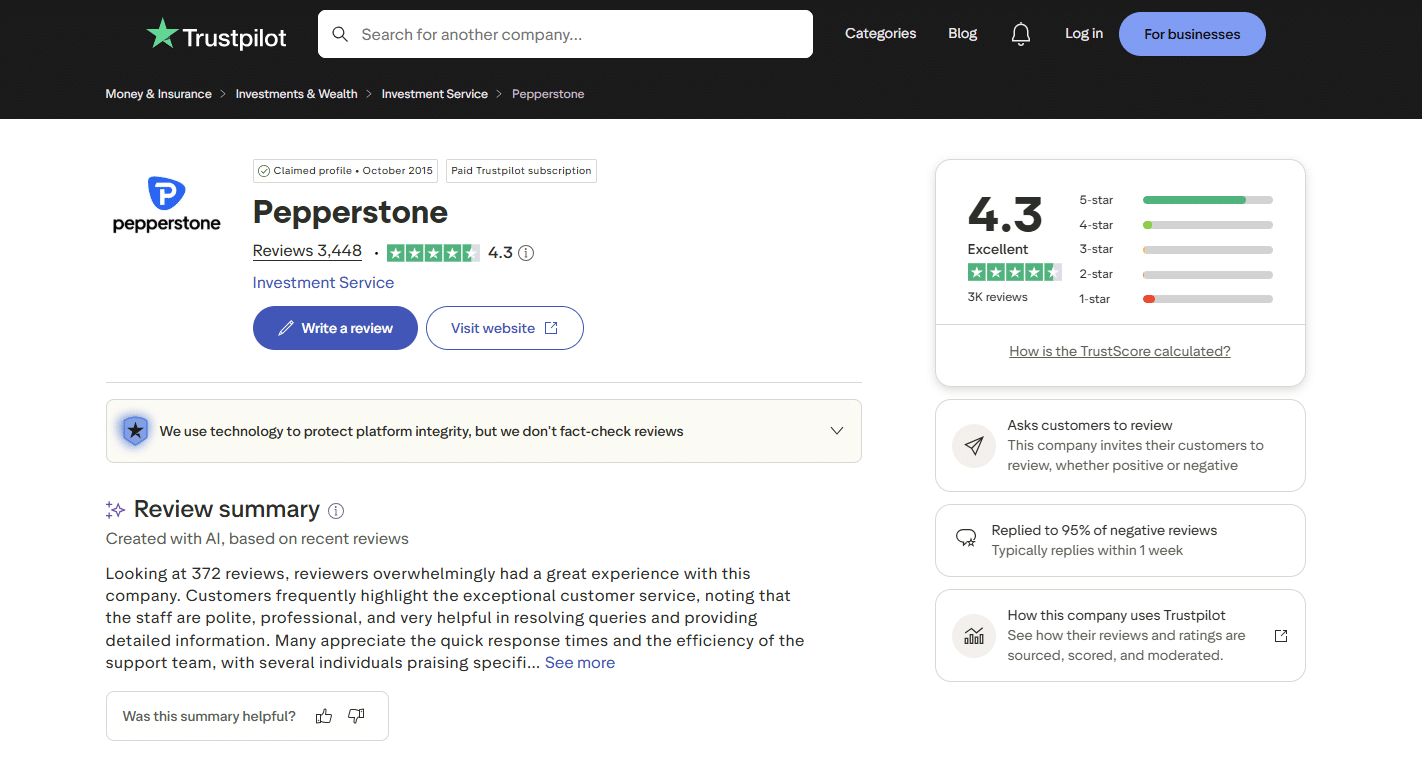
About 79% of reviewers give it 5 stars, often praising its customer service and execution. However, about 10% of reviews are 1-star, mentioning issues such as withdrawal delays and account verification. Pepperstone replies to many negative reviews.
As for their customer support, our experience with their live chat feature was outstanding. Our inquiry was resolved promptly, with a response time of less than 20 minutes.
Bottom line
Pepperstone is a strong choice for active forex and CFD traders who value low costs and platform choice. Its offering of MetaTrader 4, MetaTrader 5, cTrader and TradingView suits different trading styles, with advanced charting, automated trading and copy trading.
It is regulated by authorities including the FCA, ASIC, CySEC, BaFin, the DFSA and the CMA, with negative balance protection for retail clients in the UK, EU and Australia. However, it does not serve US residents.
However, prospective clients should weigh several limitations:
- CFDs only (plus UK spread betting): no real stock or ETF ownership and no tax-efficient wrappers such as ISAs or SIPPs.
- High risk: 74.1% of retail CFD accounts lose money at Pepperstone’s UK and EU entities, and 76.1% at Pepperstone GmbH.
- No interest on uninvested cash.
- Fewer educational resources than IBKR Campus or eToro Academy.
Overall, Pepperstone suits experienced active traders looking for low forex and CFD costs and a choice of professional platforms. For long-term, buy-and-hold investors, a broker that offers real shares and ETFs, such as Interactive Brokers, is usually a better fit. New users should consider starting with the unlimited demo account to assess the platforms and execution quality before committing real capital.
