


Hey! This article gives you our honest review of BUX, a Dutch mobile-first investment app and subsidiary of ABN AMRO, one of the largest banks in the Netherlands.
BUX is a low-commission stock, ETF, and ETC trading app with over 700,000 active clients across Europe. It is currently available to investors from 8 European countries: the Netherlands, Belgium, Germany, France, Spain, Italy, Austria, and Ireland.
That’s BUX in a nutshell. If you want to find out what our research team has to say after carefully analyzing BUX, keep on reading our BUX Review.
Overview
BUX was founded in 2013 in Amsterdam by Nick Bortot, a former BinckBank executive, with a mission to democratise investing for a new generation of European retail investors. The platform launched BUX Zero in 2019 as a commission-light stock and ETF investing app, growing rapidly to become one of Europe’s most prominent neobrokers.
In December 2023, ABN AMRO announced the acquisition of BUX, with the deal formally completed in July 2024 following regulatory approval. Since then, BUX has operated as an independent subsidiary within the ABN AMRO group, leveraging the bank’s financial backing and infrastructure while maintaining its product agility and user-friendly identity. The “BUX Zero” branding was retired – the app is now simply known as BUX.
BUX remains mobile-only: account opening, funding, trading, and portfolio management all take place through the iOS or Android app. There is no desktop or web trading platform, though you can register for an account from a desktop browser. This focus on simplicity is intentional, targeting beginner and intermediate investors who want a clean, low-cost path to long-term investing rather than active trading tools.
If you already know where you want to allocate your capital – particularly through periodic ETF investing – the app can be a competitive option in the Dutch and broader European retail investment market, especially given ABN AMRO’s institutional backing.

BUX provides “the investment service of reception and transmission of client orders” – meaning it acts as an intermediary between you and the execution venue for the financial instruments you buy or sell (stocks, ETFs, and ETCs). It does not run a complex in-house execution engine, which keeps operating costs low and contributes to its competitive fee structure. Despite offering a contact support team, BUX does not provide investment or tax advice.
One critical point that many investors miss in BUX’s Client Agreement: by default, you give consent for BUX to lend out the financial instruments held in your account (e.g., for short-selling by other market participants). While securities lending allows BUX to generate revenue and keep platform fees low, it does carry a small additional counterparty risk for investors. To mitigate this, BUX requires collateral to be held at at least the value of the lent securities, and you can opt out of the lending programme in the app settings if preferred.
Client assets are held through ABN AMRO Clearing Bank N.V. (for cash) and Stichting BUX Custody (for securities), keeping client funds segregated from BUX’s operational accounts. Cash balances are protected up to €100,000 under the Dutch Deposit Guarantee Scheme (DGS), and securities are held separately through the bankruptcy-remote Stichting BUX Custody structure.
Highlights
| 🗺️ Supported countries | 8 European countries: Netherlands, Belgium, Germany, France, Spain, Italy, Austria, Ireland |
| 💰 EU stock and ETF fees | €1.99 per market or limit order; €0 on Zero Orders (max 3/month on Plus and Prime tiers, executed at end of trading day) |
| 💰 US stock fees | €0.99 + 0.25% FX per market order |
| 💰 Currency conversion fee | 0.25% |
| 💰 Monthly service fee | €0 (Basic) / €2.99 (Plus) / €7.99 (Prime) |
| 💰 Cash interest | ~2.75% on uninvested cash (Plus and Prime tiers only, linked to ECB policy) |
| 💵 Minimum investment | €5 (via fractional shares) |
| 📍 Products offered | 3,000+ stocks (EU and US), ETFs, ETCs, crypto ETPs (no direct crypto since March 2024) |
| 🎮 Demo account | No |
| 🛡️ Investor protection | €100,000 under Dutch Deposit Guarantee Scheme (DGS) for cash; securities held separately via Stichting BUX Custody |
| 📜 Regulatory entity | BUX B.V., regulated by the Dutch Authority for the Financial Markets (Autoriteit Financiële Markten – AFM) |
| 🏢 Parent company | ABN AMRO (acquired BUX in July 2024) |
Data as of June 2026. Fees, plans, and product offerings may change – please verify on BUX’s official website before opening an account.
Account types and tiers
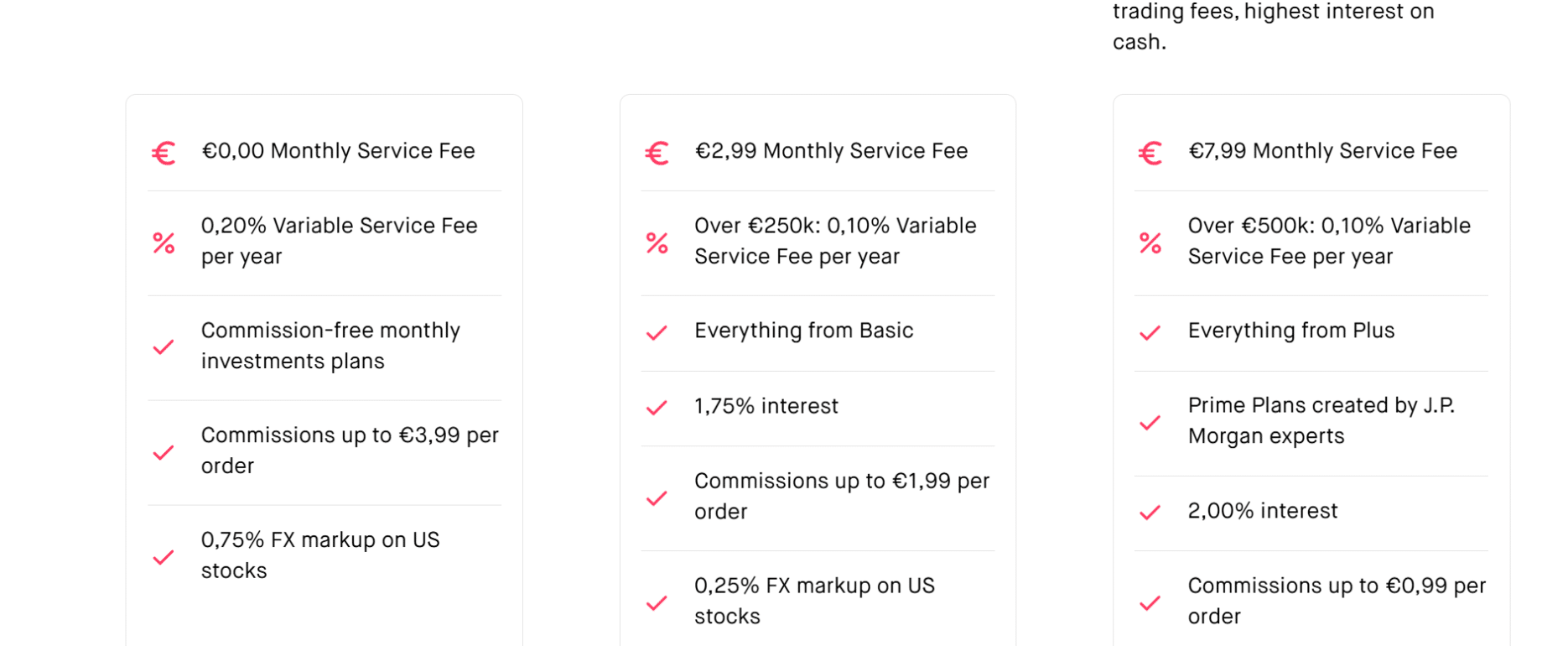
Since August 2025, BUX has operated a three-tier subscription model introduced after the ABN AMRO acquisition. Choosing the right tier is one of the most important decisions when opening a BUX account, as the monthly fee and included features vary significantly:
| Feature | BUX Basic | BUX Plus | BUX Prime |
| Monthly fee | €0 | €2.99 | €7.99 |
| Zero Orders (commission-free) | Not included | 3 per month | 3 per month |
| EU stock/ETF market orders | €1.99 per order | €1.99 per order | €1.99 per order |
| US stock market orders | €0.99 + 0.25% FX | €0.99 + 0.25% FX | €0.99 + reduced FX |
| Cash interest (on uninvested EUR) | None | ~2.75% AER | ~2.75% AER (higher tier) |
| Customer support | Standard | Standard | Priority |
| Best for | Occasional investors and complete beginners | Regular monthly investors using investment plans + Zero Orders | Active investors with larger uninvested cash balances and US-stock focus |
How to choose:
- Basic is the most cost-effective if you trade fewer than 2-3 times per month and have minimal uninvested cash;
- Plus pays for itself if you use at least 2 Zero Orders per month (saving €3.98 vs market orders) or hold meaningful uninvested cash balances earning 2.75%;
- Prime mainly benefits investors with larger portfolios where reduced FX markup and higher cash interest exceed the €5 monthly premium over Plus.
Account opening
Opening a BUX account is fully digital and typically takes around 10 minutes from start to finish. The process is mobile-first – you can begin registration on a desktop browser, but you’ll complete identity verification and start trading via the BUX app on iOS or Android.
What you’ll need:
- Valid identification: passport, national ID card, or driver’s licence (varies by country);
- Proof of residence: matching your country of registration (one of the 8 supported European countries);
- BSN (Burgerservicenummer): required for Dutch residents;
- Linked bank account in your name: BUX requires the funding bank account to match the account holder’s name (anti-money laundering requirement);
- Smartphone: iOS or Android device for the BUX app.
Step-by-step process:
- Download the BUX app or sign up via getbux.com;
- Select your country of residence and choose your subscription tier (Basic, Plus, or Prime);
- Complete personal information: name, date of birth, contact details, BSN/tax ID;
- Identity verification: upload ID document and complete a selfie/video verification;
- Investment suitability questionnaire: BUX is legally required (under MiFID II) to assess your investment knowledge, experience, financial situation, and objectives – this protects you from being mismatched with unsuitable products;
- Link your bank account: most clients link via SEPA or Tikkie (instant for Dutch clients);
- Make your first deposit: minimum €5 to start investing.
Express signup for ABN AMRO clients: existing ABN AMRO bank customers can opt to share their KYC details with BUX directly, accelerating account opening to just a few minutes. The BUX account is created instantly and linked to your ABN AMRO bank account.
Approval is typically instant for most applicants. In some cases (e.g., additional verification required), it can take up to 1-2 business days. You can practise navigating the app before depositing – though note that BUX does not offer a demo account with virtual money for paper trading.
Pros and cons
Pros
- Low commissions on stock, ETF and ETC trading
- Offers one free share of up to 100€ upon deposit
- Fractional investing
- Modern and user-friendly mobile app
- No inactivity, custody, deposit or withdrawal fee
- No minimum required deposit
Cons
- Zero order execution delay
- No demo account
- Limited financial products
- Only available in eight countries
Products and markets
BUX has significantly expanded its product offering since the original launch of BUX Zero. As of 2026, the app provides access to 3,000+ instruments, including:
- EU stocks: from major European exchanges including Dutch (Euronext Amsterdam), German (Xetra/Frankfurt), Belgian, French, Italian, Spanish, and Austrian markets;
- US stocks: NASDAQ and NYSE-listed companies (executed via ABN AMRO Clearing);
- ETFs: a curated selection of UCITS-compliant ETFs from leading providers including iShares, Vanguard, and Amundi – covering broad market indices, sectors, themes, and bonds;
- ETCs: Exchange-Traded Commodities for gold, silver, and other commodities;
- Crypto ETPs: indirect crypto exposure via exchange-listed products (Bitcoin and Ethereum) – direct cryptocurrency trading was discontinued in March 2024 and migrated to Coinmerce.
Notable gaps in the product range: no bonds, no options, no futures, no forex, and no CFDs. BUX is intentionally positioned as a long-term investing platform rather than an active trading venue. Check the official BUX website for the latest product list.
For investors with smaller capital, BUX offers fractional investing from as little as €5 per transaction. Rather than needing to buy a full share of expensive stocks like Tesla ($340+) or Amazon ($200+), you can specify a euro amount and receive a proportional fraction of the share. This makes it practical to build a diversified portfolio with modest monthly contributions.
BUX also offers investment plans (Spaarplannen in Dutch): automated recurring investments in stocks and ETFs of your choice. You can set up monthly contributions to a customised portfolio, with no transaction fee on these scheduled purchases. If you skip a month, no charges apply.

Fees
BUX takes a relatively transparent approach to fees, with the most important caveat being the monthly service fee structure introduced after the ABN AMRO acquisition. Since August 2025, BUX has operated three subscription tiers:
- BUX Basic (€0/month): standard trading with market and limit orders at standard fees; no Zero Orders included; no cash interest;
- BUX Plus (€2.99/month): includes 3 free Zero Orders per month; cash interest on uninvested balances (~2.75% AER as of June 2026);
- BUX Prime (€7.99/month): includes 3 free Zero Orders per month, higher cash interest, lower FX markup, and priority customer service.
Trading fees across all tiers:
- EU stocks and ETFs: €1.99 per market or limit order; €0 via Zero Orders (Plus and Prime only, max 3/month);
- US stocks: €0.99 per market order + 0.25% FX conversion (Basic and Plus); reduced FX on Prime;
- Investment plan orders: typically commission-free across all tiers;
- Crypto ETPs: standard trading fees apply (no separate crypto fee structure since the migration away from direct crypto).
How Zero Orders work
A common question: “How does a Zero Order actually work?” In simple terms, BUX collects all client Zero Order requests during the day and submits them as a batched order to the exchange at the end of the trading day (between 16:00 and 17:00 CET). The benefit is no transaction commission; the trade-off is no control over the exact execution price.
To protect investors from significant price slippage, BUX has built in price-protection thresholds:
- Buy orders: automatically cancelled if the end-of-day execution price is more than 4% above the price at the time you placed the order;
- Sell orders: automatically cancelled if the end-of-day execution price is more than 5% below the price at the time you placed the order.
Zero Orders are best suited for long-term investors who don’t need precise entry/exit pricing and prefer to save the per-trade commission. They are not appropriate for active traders, news-driven entries, or volatile periods where execution price matters more than fees.
Currency conversion costs
BUX earns additional revenue through a 0.25% FX markup applied when you trade US stocks (which are denominated in USD). Since your account base currency is EUR, the platform must convert your euros to dollars at purchase and back to euros at sale – and the markup applies on both sides.
Example: if the EUR/USD spot rate is 1.10, BUX will give you an effective rate of approximately 1.09725 (€1 = $1.09725 instead of $1.10). The same markup applies in reverse when you sell. For UK stocks (GBP) and other non-EUR instruments, similar FX markups apply.
For investors trading frequently in US stocks, this 0.25% on each conversion can add up – particularly on smaller trades where the FX cost becomes a meaningful proportion of overall transaction costs. BUX Prime tier offers reduced FX markup, which can offset the higher monthly fee for active US-stock investors.
Spreads
Like any broker, BUX faces market spreads (the difference between bid and ask prices) on the instruments traded. These spreads are charged by market makers – third-party entities that provide liquidity – not by BUX itself. BUX has no control over spreads and does not earn revenue from them.
Spreads vary based on three main factors:
- Liquidity of the instrument: highly liquid stocks like Apple have very narrow spreads, while less-traded names can have wider spreads;
- Time of day: spreads tend to be tightest during peak trading hours when major markets overlap (e.g., when both New York and London markets are open);
- Market volatility: in periods of high volatility (earnings season, central bank announcements, geopolitical events), market makers widen spreads to compensate for the increased risk of holding inventory.
Based on historical averages, BUX estimates the typical spread cost on its supported instruments at approximately 0.08% for EU stocks and 0.0574% for US stocks. These figures are estimates only and actual costs may vary by instrument and market conditions.
Safety and regulation
In terms of safety, BUX B.V. is authorised and regulated by the Dutch Authority for the Financial Markets (Autoriteit Financiële Markten – AFM) and registered with the Dutch Chamber of Commerce (KvK: 58403949). Following the July 2024 acquisition by ABN AMRO, BUX operates as a subsidiary within the ABN AMRO group, benefiting from the institutional backing of one of the Netherlands’ largest banks.
Client protections work on two layers:
- Cash protection: client cash balances are held with ABN AMRO Clearing Bank N.V. and protected up to €100,000 per person under the Dutch Deposit Guarantee Scheme (DGS) in the event of bank insolvency;
- Securities protection: client assets (stocks, ETFs, ETCs) are held in a separate legal entity called Stichting BUX Custody – a Dutch foundation (Stichting) whose sole purpose is to hold financial instruments and money for BUX clients. The Stichting structure means client assets are bankruptcy-remote: if BUX B.V. were to fail, your securities would remain legally protected and recoverable.
Additionally, the Dutch Investor Compensation Scheme (ICS) provides supplementary cover of up to €20,000 if BUX B.V. were to become unable to return client investments (this is a regulatory backstop – in practice, the Stichting Custody structure means client securities should not be at risk from BUX insolvency).
To summarise:
- Cash on your BUX balance → held with ABN AMRO Clearing Bank (DGS protection up to €100,000);
- Stocks, ETFs, and ETCs → held in Stichting BUX Custody (bankruptcy-remote structure);
- Backup protection → ICS up to €20,000 if both layers fail (highly unlikely in practice).
Want to learn more? Check out our dedicated article on investment protection for EU investors.
User reviews and reputation
BUX has built a substantial user base across its 8 supported European countries, with feedback that reflects both its strengths and limitations. Here’s a summary of how the platform performs across major review channels:
| Platform | Rating | Volume |
| Apple App Store | ~4.5/5 | 10,000+ reviews |
| Google Play | ~4.3/5 | 15,000+ reviews |
| Trustpilot | ~3.8/5 | 1,500+ reviews |
Common positive feedback:
- Clean, intuitive mobile interface that makes investing accessible for first-time users;
- Fractional investing from €5 lowers the barrier to entry significantly;
- Tikkie deposits (Dutch market) are praised for being instant and frictionless;
- Zero Orders are appreciated by long-term, cost-conscious investors;
- ABN AMRO backing provides reassurance about platform stability and safety.
Common negative feedback:
- Monthly service fee on Plus and Prime tiers is unpopular among less active users;
- Limited customer service hours and occasional slow response times;
- Occasional app glitches and bugs reported after major updates;
- Removal of direct crypto trading in March 2024 frustrated users with existing crypto holdings;
- Limited product range (no bonds, options) frustrates more advanced users.
BUX is generally responsive to negative reviews, with the support team actively engaging on Trustpilot and App Store comments. The overall sentiment positions BUX as a strong choice for beginners and long-term passive investors, but less suitable for active traders or those seeking diverse asset classes.
Countries accepted
BUX is available in 8 European countries and offers only EUR-denominated accounts. Their services are currently available in: Austria, Belgium, France, Germany, Ireland, Italy, the Netherlands, and Spain.
Looking for an online broker that accepts clients in other countries? We’ve reviewed leading platforms with broader geographic coverage, including eToro, DEGIRO, XTB, Trading 212, and Interactive Brokers.
Is BUX worth a try?
If you’re a beginner or intermediate investor in one of the eight supported European countries and you’re looking for a sleek, mobile-first platform to start a long-term investing journey, BUX is worth considering. Its key strengths:
- Low transaction fees (especially Zero Orders on Plus/Prime tiers);
- Fractional investing from €5 per transaction;
- Investment plans for automated monthly contributions;
- Cash interest on uninvested balances (Plus/Prime tiers);
- Strong institutional backing from ABN AMRO Clearing Bank;
- Robust safety framework: AFM regulation + €100K DGS + Stichting Custody;
- Clean, intuitive mobile app well-suited to beginners.
However, BUX may not be the best fit for advanced investors or those who require:
- A wide range of products (no bonds, options, futures, forex, or CFDs);
- Direct cryptocurrency trading (only crypto ETPs available since March 2024);
- A desktop or web trading platform (BUX is mobile-only for trading);
- Deep research, analyst reports, or advanced charting tools;
- Global market access beyond the European and US markets currently supported.
Additional considerations before opening an account:
- The monthly service fee (€2.99 Plus / €7.99 Prime) is worth weighing against your trading frequency – infrequent investors may find BUX Basic the most cost-effective tier;
- Securities lending is enabled by default – you can opt out in app settings if you prefer not to lend out your shares;
- EUR-only accounts: trading US stocks involves 0.25% FX markup at deposit and withdrawal, which compounds for active US-stock traders.
Ultimately, BUX stands out as a solid, low-cost entry point into European retail investing – particularly for those who value simplicity, want to build long-term portfolios systematically, and appreciate the security of being backed by a major Dutch bank. For more advanced needs or broader global access, brokers like Interactive Brokers or DEGIRO may suit you better. As always, make sure your broker choice aligns with your investment goals, risk tolerance, and long-term strategy.
