


After analysing the key factors, we do not recommend opening an account with Pocket Option. Our due diligence found several serious red flags, including warnings from regulators in the UK, the US, Spain, Italy and Belgium, which we explain in this review.
We have also reviewed Quotex, another binary options platform with similar warning signs.
Looking for supervised and regulated brokers instead? Check our list of recommended brokers.
Video summary
Watch a short recap of our review in the video below:
What is Pocket Option?
Pocket Option is an unregulated online platform that mainly offers binary options, a product where your payoff is “all or nothing” within a time frame you choose.
Let’s say Apple is trading at $100, and you believe it will be above that in 5 minutes. If the price ends above $100, you get your stake back plus a fixed payout. If it ends below $100, you lose your whole stake. That’s it.
Binary options are so risky that regulators have banned them for retail investors in major markets. The UK’s Financial Conduct Authority (FCA) has banned their sale to retail consumers since April 2019, and the European Securities and Markets Authority (ESMA) prohibited them for retail clients in 2018, a measure that EU national regulators then made permanent. A platform that offers them to retail clients in these regions is, by definition, operating outside the rules.
Is Pocket Option regulated?
No. Pocket Option has no authorisation from any top-tier regulator. Our first check in any broker review is whether reputable authorities, such as the US Securities and Exchange Commission (SEC) or the UK’s FCA, regulate the platform. Pocket Option failed this test.
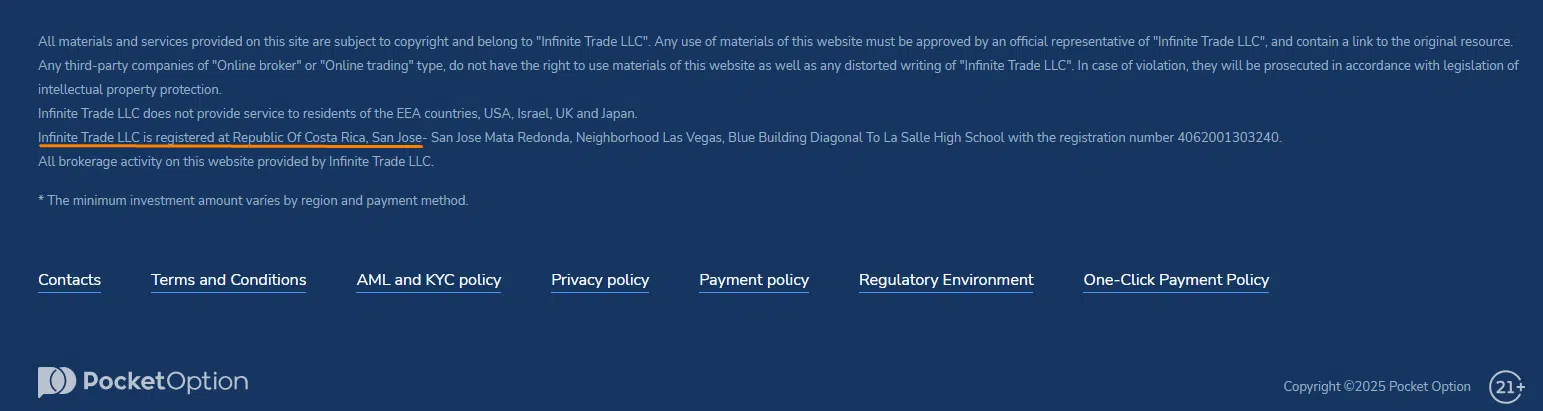
The website names Infinite Trade LLC, registered in San José, Costa Rica, as its operator. The FCA’s warning, last updated in February 2026, lists Pocket Option at an address in Castries, Saint Lucia, another offshore jurisdiction, and a related company, PO Trade Ltd, is registered there. The brand has also been linked to “Gembell Limited”, a company registered in the Marshall Islands. This pattern of changing names and offshore locations is common among high-risk platforms.
Because it isn’t supervised by top-tier regulators, there is no guarantee that clients would be compensated if the platform failed or refused to return their money. Investor compensation schemes in the US, EU and UK don’t apply to firms registered in offshore jurisdictions.
Warnings from regulators
Pocket Option and its related brands have received warnings from several regulators:
- UK FCA: its warning (first published in September 2021 and last updated in February 2026) states that the firm is not authorised to provide financial services or products in the UK. It lists several domains, including pocketoption.com, potrade.com, trader-pockethub.com and m.pocketoption.com.
- US CFTC: Pocket Option is on the RED List (Registration Deficient List) of foreign entities that appear to solicit US residents without being registered.
- Spain’s CNMV: warned against PO Trade in April 2024.
- Italy’s CONSOB: listed PO Trade Ltd among unauthorised firms in April 2025.
- Belgium’s FSMA: added Pocket Option to its list of fraudulent platforms in June 2023.
Being flagged by so many regulators, including two top-tier ones (FCA and CFTC), is a serious red flag. Before dealing with any platform, search its name on the FCA Warning List and on your own regulator’s website.
Finally, we found very little information about the company behind the platform: no LinkedIn company page and no information about its management or employees.
Trustpilot reviews: are they fake?
If you search for “Pocket Option” on Trustpilot, you may find several profiles for other domains instead of the real one, pocketoption.com.
When we first wrote this review, the company’s profile had over 3,000 reviews, but Trustpilot had already flagged it (see image below). After reading dozens of reviews, we found that most positive feedback looked unreliable: broad statements, no specific details and language that is not typical of genuine customers.

The negative reviews showed a clear pattern of complaints: difficulties withdrawing money, price discrepancies and suspected chart manipulation.
Aggressive sales approach
Platforms that want your money as quickly as possible often try to create a fear of missing out (FOMO). On Pocket Option’s homepage, two elements stood out:
- Continuous pop-ups in the bottom left corner with messages like “David earned $250 in 32 seconds”.
- A registration form that is impossible to hide.
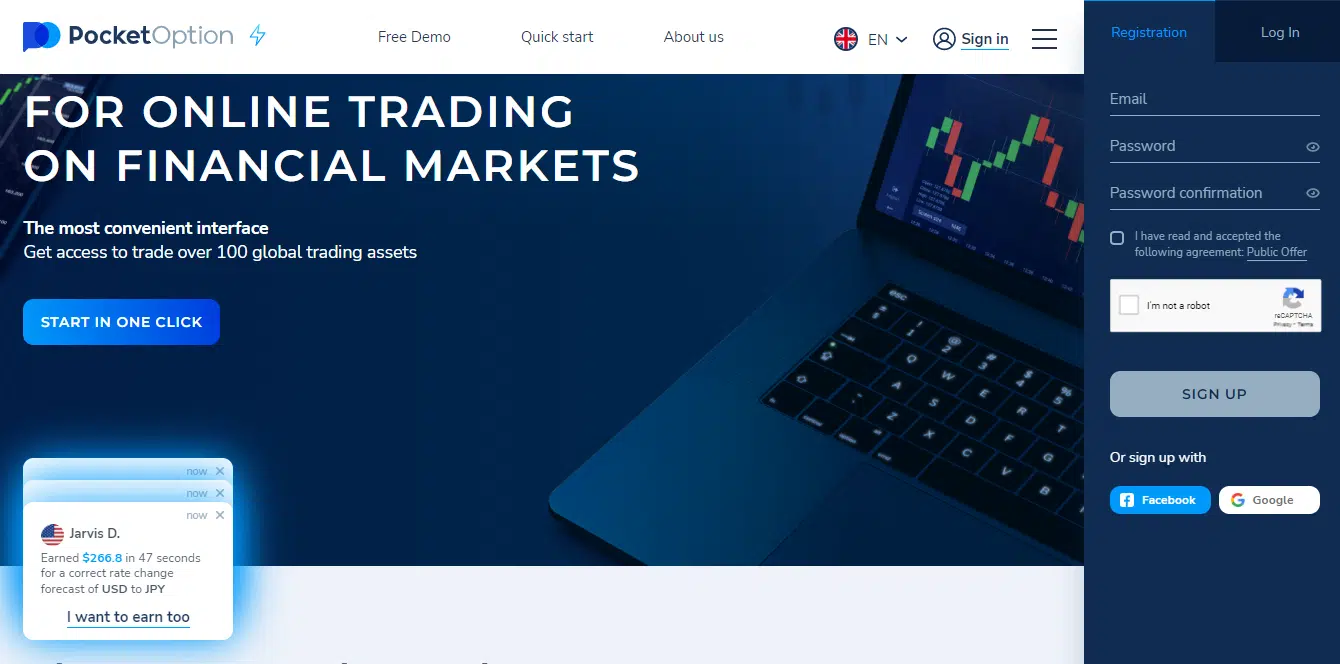
Regulated brokers rarely, if ever, use these practices.
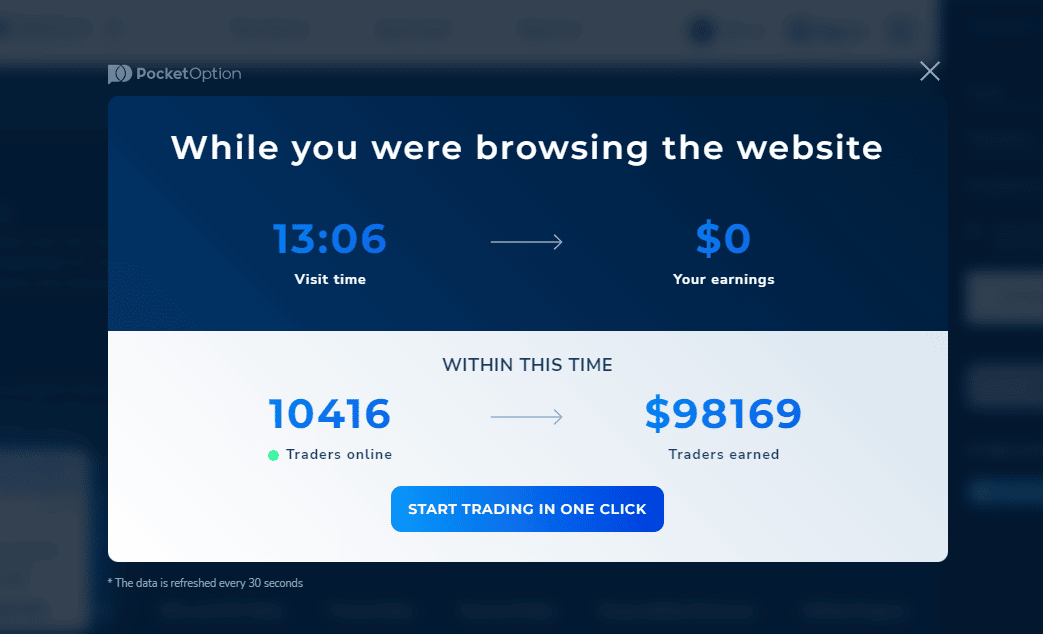
Pocket Option also showed a pop-up after we had been browsing its website for a while (it shows 13:06 minutes, as we had the page open while checking other websites). It is an aggressive sales tactic that suggests you are wasting time by researching the platform before signing up.
Did you know that it accepts deposits from restricted countries?
The website footer states that Infinite Trade LLC does not provide services to residents of the EEA countries, the USA, Israel, the UK and Japan. However, when we checked, it accepted deposits without first asking where you live.
When you want to withdraw your money, Pocket Option will ask you to verify your account, so it will find out that you deposited from a restricted country. As a result, your withdrawal is likely to be refused.
So, is Pocket Option a scam?
We have not seen proof that would allow us to call Pocket Option a scam. However, it is unregulated, it has been flagged by several regulators, it offers a product banned for retail investors in the UK and the EU, and it uses aggressive sales tactics. In our view, your money is not safe with this company.
We strongly recommend avoiding platforms with so many red flags, no matter how appealing their offer looks (low minimum deposit, demo account or promo codes).
Regulated and supervised online brokers (our recommendations)
- Interactive Brokers: Best overall online broker
- eToro: Best for ETF investing and social trading
- Webull: Best low-cost US broker
- Public: Best US broker for fee transparency


52% of retail CFD accounts lose money.


Bottom line
Before opening an account with any broker, check the following:
- Is the platform regulated by a top-tier authority, such as the SEC, the FCA or a regulator in the EU?
- Is it on a regulator’s warning list, such as the FCA Warning List or the CFTC RED List?
- Does it offer products that are banned for retail investors where you live, such as binary options in the UK and the EU?
- Does it use pushy sales tactics? If so, dig deeper.
- Are the online reviews credible? Check several sources, and be wary if you can’t find any negative points.
Pocket Option fails most of these checks, so we recommend choosing a regulated broker instead.
FAQs
What are binary options?
Binary options are complex financial products with only two outcomes: you win a fixed amount or lose your stake. They have an expiry time, a strike price and a fixed payout. For example, it is Monday morning and you believe stock X will be above $85 at 2:30 p.m. With a binary option, you bet that the stock will finish above $85. If it does, you win the payout. If not, you lose the amount you bet. This makes them closer to gambling than investing, which is why they are also called “all-or-nothing options” or “fixed-return options”.
Binary options differ from conventional options, which you can trade before expiry to manage your position.
Are binary options legal?
Binary options are banned for retail investors in the UK (by the FCA since 2019) and restricted across the EU, following ESMA’s 2018 product intervention. In the US, they can only be offered legally on regulated exchanges. Platforms that offer them to retail clients in these regions without authorisation are operating illegally.
How does Pocket Option make money?
Platforms like Pocket Option typically act as the counterparty to your trades, and the payout on a winning trade is lower than the amount you risk. For example, you bet $50 that a stock will rise in the next minute. If you win, you might receive your $50 back plus $40. If you lose, you lose the full $50. Over many trades, this gap gives the platform an edge, and because it is on the other side of your trade, your losses are its gains. This creates a conflict of interest.
Can I get my money back from Pocket Option?
If you have trouble withdrawing, keep records of all your deposits and communications, contact your bank or card provider about a possible chargeback as soon as possible, and report the platform to your national regulator. Be careful with “recovery” services that promise to get your money back for a fee, as many of them are scams too.
