Kenya has quietly built one of the most developed retail forex markets in Africa. It is one of the few countries on the continent with a formal local licensing regime, run by the Capital Markets Authority (CMA), and a payments culture built around M-Pesa that most international brokers have had to adapt to rather than the other way round.
That combination changes how you should choose a broker. The right question is not just who has the tightest spreads, but who holds a CMA licence, who moves money through M-Pesa without friction, and who lets you hold your account without paying for currency conversion twice on every deposit.
Below we compare the best forex brokers available to Kenyan residents. Every broker on this list is licensed by the Capital Markets Authority. Offshore brokers without a local licence are deliberately excluded, and the section on regulation explains why that filter matters.
Best forex brokers in Kenya
- Pepperstone: Best overall, raw pricing with the widest platform choice
- FXPesa: Best for shilling accounts and local support
- HFM: Best low cost entry point and free VPS hosting
- Scope Markets: Best for a dedicated account manager
Disclaimer: Investing involves risk of loss.

72-95% of retail CFD accounts lose money.

80% of retail investor accounts lose money when trading Online Forex/CFDs with this provider.

70% of retail investor accounts lose money when trading CFDs with HF Markets (Europe) Ltd.

73.68% of retail investor accounts lose money when trading CFDs with this provider.
Comparison of CMA licensed forex brokers in Kenya




Data checked September 2026. Always confirm the licence of the specific entity opening your account on the CMA public register before depositing.
What CMA regulation gives you, and what it does not
Online forex trading in Kenya is regulated by the Capital Markets Authority under the Capital Markets (Online Foreign Exchange Trading) Regulations, 2017 (Legal Notice 226 of 2017). Only brokers licensed by the CMA can legally serve Kenyan residents directly.
The regulations create three licence types: non-dealing brokers, which pass your orders to the market and earn a commission or spread mark-up, dealing brokers, which act as market makers, and money managers. All four brokers in this guide are non-dealing brokers.
A CMA licence comes with real obligations:
- Capital: minimum paid-up capital of KES 30 million for a non-dealing broker (KES 50 million for a dealing broker), plus liquid capital of at least KES 30 million or 8% of total liabilities at all times;
- Client money: held strictly apart from the broker’s own funds, in a segregated client account with a bank licensed under Kenya’s Banking Act, and reconciled daily;
- Local presence: the broker must be a company incorporated in Kenya, with local office space, equipment and staff;
- Risk controls: procedures for stop losses, margin calls and close-outs, and to avoid negative account balances.
One thing a licence does not give you: the Investor Compensation Fund under the Capital Markets Act is designed for failures of licensed stockbrokers and dealers, and we found no provision extending it to online forex clients.
An offshore broker offers none of the protections above. If something goes wrong with an unlicensed firm, there is no Kenyan authority you can complain to and no local court that can easily reach the entity holding your money. The CMA publishes cautions against unlicensed operators, most recently a public caution on 11 September 2026 naming around 15 entities, and it is why this guide only includes licensed firms.
Kenyan rules allow leverage of up to 1:400, far higher than European or British regulators permit. Higher leverage means faster wins but also faster losses, and a licence does not protect you from the product. Whatever a broker offers, the leverage you actually use is a choice, and keeping it low is the single most effective risk control available to you.
All CMA-licensed forex brokers
As of September 2026, the CMA register lists 16 licensed online forex brokers. The four in this guide are the ones we rank highest for Kenyan traders, but the full list is useful if you want to check a broker you have seen advertised:
| Broker | Licence no. | Type |
| FXPesa (EGM Securities) | 107 | Non-dealing |
| Scope Markets (SCFM) | 123 | Non-dealing |
| Pepperstone Markets Kenya | 128 | Non-dealing |
| FXTM (Exinity Capital East Africa) | 135 | Non-dealing |
| HFM (HFM Investments) | 155 | Non-dealing |
| Windsor Markets Kenya | 156 | Non-dealing |
| Exness KE | 162 | Non-dealing |
| Ingot Ke | 173 | Non-dealing |
| Admirals KE | 178 | Non-dealing |
| FP Markets | 193 | Non-dealing |
| IC Markets (KE) | 199 | Non-dealing |
| Anzo Capital | 219 | Non-dealing |
| TPXMGLOBAL Kenya | 233 | Non-dealing |
| AvaTrade Kenya | 262 | Non-dealing |
| Empire FX Trade | 203 | Dealing |
| Capital.com (CC Kenya Securities) | 244 | Dealing |
Source: CMA licensee register (non-dealing and dealing online forex brokers), checked September 2026. The register also lists three licensed money managers.
Broker reviews
Pepperstone at a glance
72-95% of retail CFD accounts lose money.
Founded in Melbourne in 2010, Pepperstone has grown into one of the largest independent forex brokers in the world, with more than 830,000 traders according to its website and regulated in seven jurisdictions, including by the FCA in the United Kingdom and ASIC in Australia.
Kenyan clients are served locally by Pepperstone Markets Kenya Limited, licensed by the Capital Markets Authority since 2020 (licence no. 128), which means your counterparty sits inside the Kenyan regulatory perimeter rather than offshore.
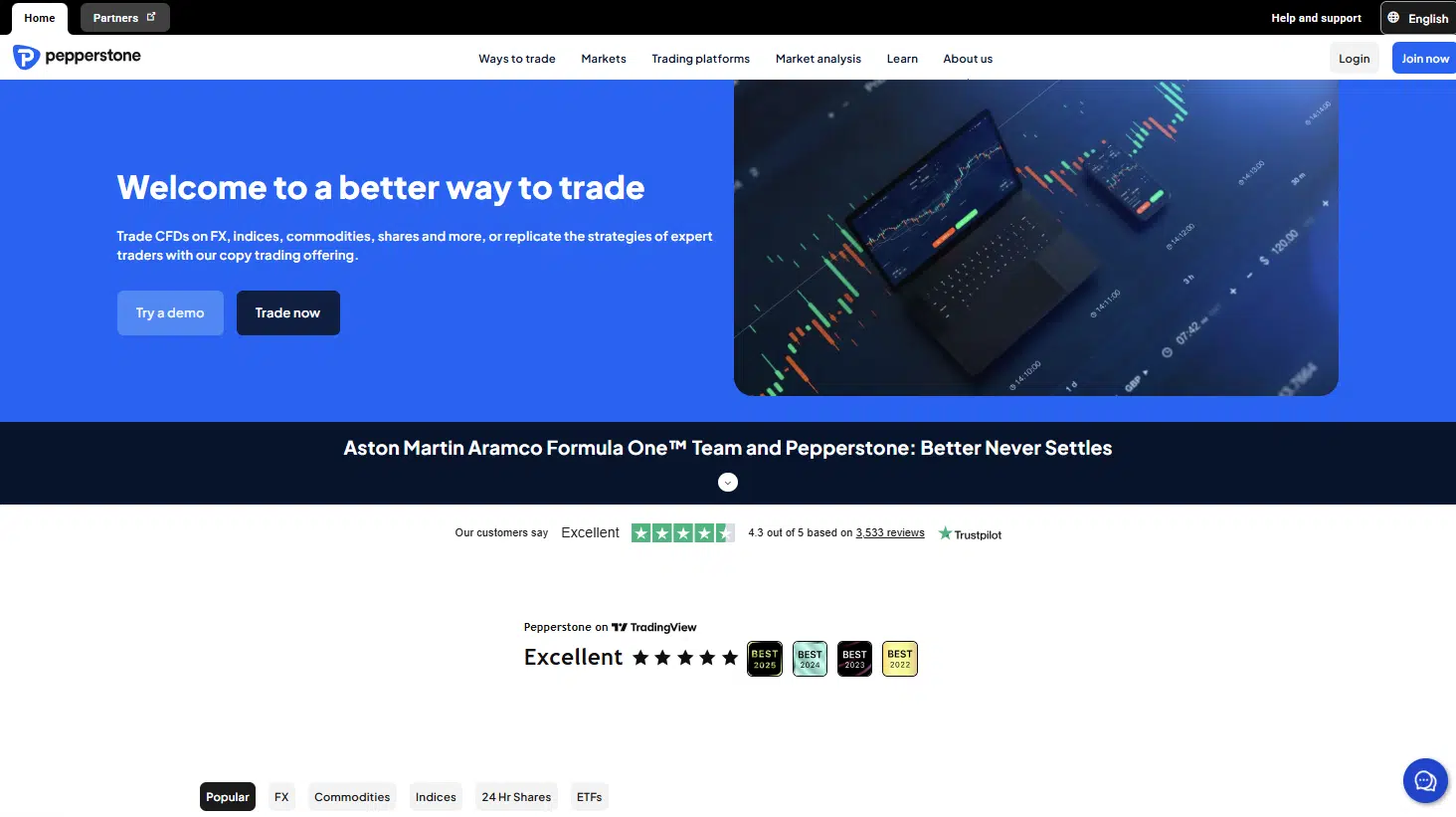
Forex is the core of the offering, with more than 90 currency pairs covering majors, minors and a reasonable selection of exotics. Liquidity is aggregated from Tier 1 banks and non bank market makers with no dealing desk, which is what allows the raw pricing model to work: on the Razor account, EUR/USD is priced from 0.0 pips with a fixed commission from $3.50 per lot per side on MetaTrader and TradingView, or $3.00 per side on cTrader. The Standard account rolls the cost into the spread instead, from 1 pip on major pairs with no separate commission. For anyone trading more than occasionally, Razor is usually the cheaper configuration, and high volume traders can apply for rebates through the Active Trader Program.
Where Pepperstone stands out among the four brokers here is platform choice. Alongside its own web platform and app, it supports MetaTrader 4, MetaTrader 5, cTrader and native TradingView execution, which few CMA licensees offer together. If you run an Expert Advisor or a cBot, or your analysis already lives in TradingView charts, it accommodates that workflow without compromise. Scalping, hedging and fully automated strategies are all explicitly permitted.
Leverage for Kenyan clients runs up to the 1:400 CMA maximum on major pairs, with lower caps on other instruments. That deserves respect: at 1:400, a quarter of one percent move against you wipes out the margin on the position. Negative balance protection applies to retail clients: if your account goes negative, Pepperstone returns it to zero. There is no minimum to open an account (top-ups start at $10), M-Pesa deposits and withdrawals carry no Pepperstone fee, and support runs 24 hours on weekdays plus 18 hours at weekends, with a Kenyan phone line.
Pros
- Quick customer support response times
- No fees for deposits, withdrawals, or account inactivity
- Competitive spreads in the Razor account with active trader rebates
- Higher leverage options are available depending on region and client categorization
Cons
- Limited to CFD trading; no direct asset ownership
- Higher Forex spreads in the standard account
- Crypto CFDs offerings are limited compared to competitors
- Limited educational resources
Want to know more? Check our Pepperstone review and visit Pepperstone’s website.
CFDs are complex instruments and come with a high risk of losing money rapidly due to leverage. 88% of retail investor accounts lose money when trading on margin with this provider. You should consider whether you understand how CFDs work and whether you can afford to take the high risk of losing your money.
FXPesa at a glance
80% of retail investor accounts lose money when trading Online Forex/CFDs with this provider.
FXPesa is operated by EGM Securities Limited, part of the Equiti Group, which in 2018 became the first online forex broker licensed by the CMA (licence no. 107). It remains the most Kenyan broker on this list: the entire operation is built around the way Kenyan traders move money, with free, instant M-Pesa and Airtel Money deposits and withdrawals and no minimum deposit on the Standard account.
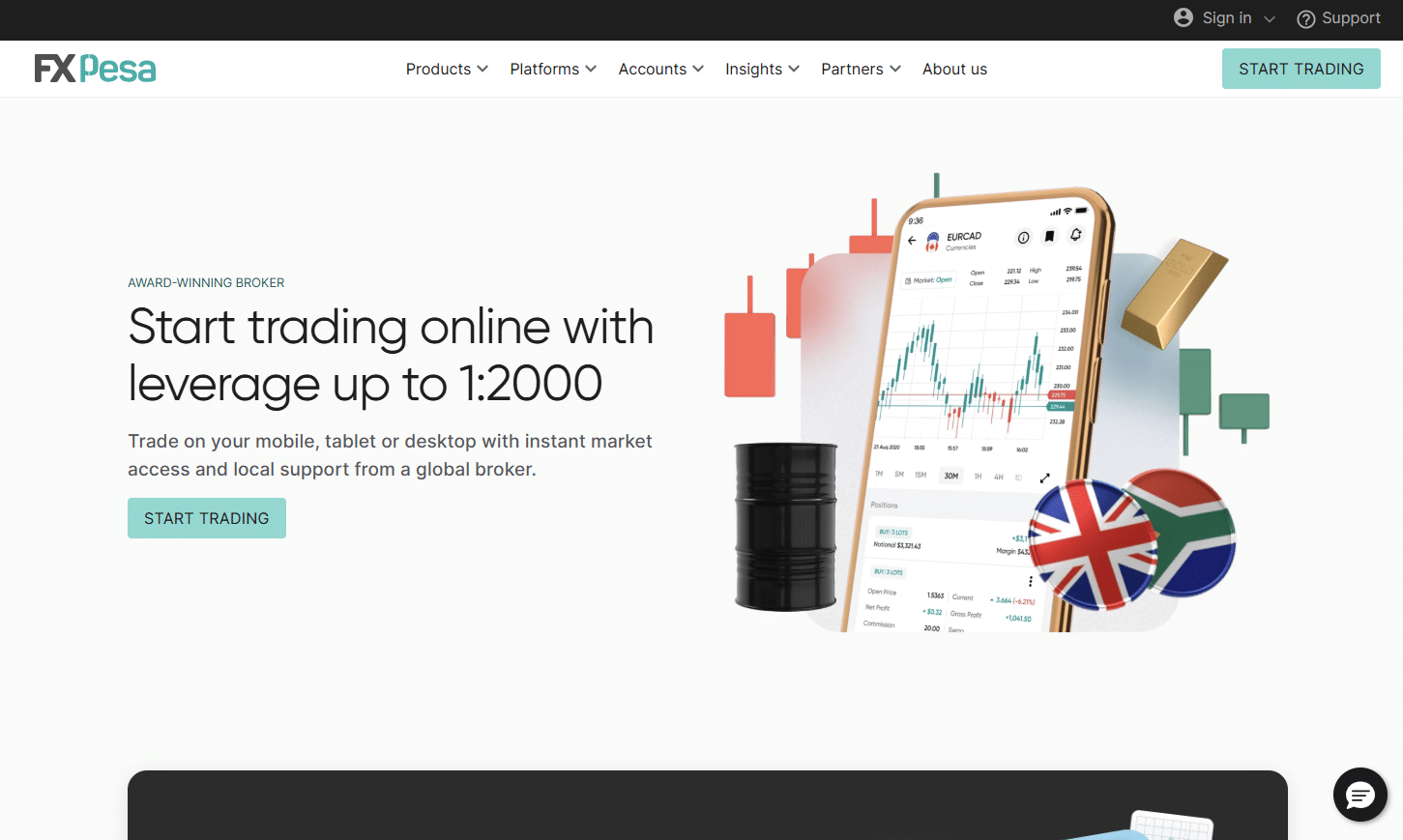
The feature that matters most in practice is the Kenyan shilling denominated account. Every USD account in this guide converts your shillings on the way in and back again on the way out, and for someone funding frequently in small amounts, those conversion costs quietly exceed what a slightly tighter spread saves. A KES base currency removes that friction entirely and makes performance tracking straightforward.
Trading runs on MetaTrader 4, MetaTrader 5, a web trader and the Equiti Trader app, with two account types, both available in USD or KES. The Standard account prices through the spread, averaging 1.4 pips with no commission, while the Premier account, from $100, offers spreads from 0.0 pips with a commission of $3.50 per lot per side. Leverage runs up to the CMA maximum on major pairs.
Where FXPesa clearly leads is education and support. Its FXPesa Academy runs free training and financial literacy workshops, support is staffed locally, and there is a real office in Westlands, Nairobi, plus a satellite office in Nakuru, that you can walk into if something goes wrong. The trade off is reach: instrument coverage and platform choice are narrower than the international names on this list.
Pros
- M-Pesa, Airtel Money and MTN deposits and withdrawals, free and instant
- No minimum deposit and zero commission on the Standard account
- Premier account: spreads from 0.0 pips, $3.50 per lot per side, from $100
- Accounts in USD or KES, avoiding conversion costs for local traders
- MT4, MT5, WebTrader, Equiti Trader app and copy trading
- All deposits free, plus free domestic bank withdrawals
- Local offices, toll-free line, WhatsApp and 24/6 support
- Free education via FXPesa Academy and a no-strings demo account
Cons
- Single non tier 1 licence, with no compensation scheme comparable to FSCS or ICF
- 100% welcome bonus is non-withdrawable, cannot cover losses and is voided on withdrawal
- CFDs only, so no real ownership, no direct dividends and overnight financing costs
- Execution only, with no advice or portfolio management
- Account type and currency cannot be changed once set
- 1% withdrawal fee (up to $30) on Skrill and Neteller, $15 on international wires
Want to know more? Check our FXPesa review and visit FXPesa’s website.
Online Forex/CFDs are complex instruments and come with a high risk of losing money rapidly due to leverage. 80% of retail investor accounts lose money when trading Online Forex/CFDs with this provider. You should consider whether you understand how CFDs work and whether you can afford to take the high risk of losing your money.
HFM at a glance
70% of retail investor accounts lose money when trading CFDs with HF Markets (Europe) Ltd.
HFM, formerly HotForex, serves Kenyan clients through HFM Investments Limited, licensed by the CMA since 2021 (licence no. 155). Its proposition in the Kenyan market is accessibility: M-Pesa funding is supported, and the cent account tier lets a new trader run live positions measured in cents rather than dollars while learning the mechanics without meaningful capital at risk.
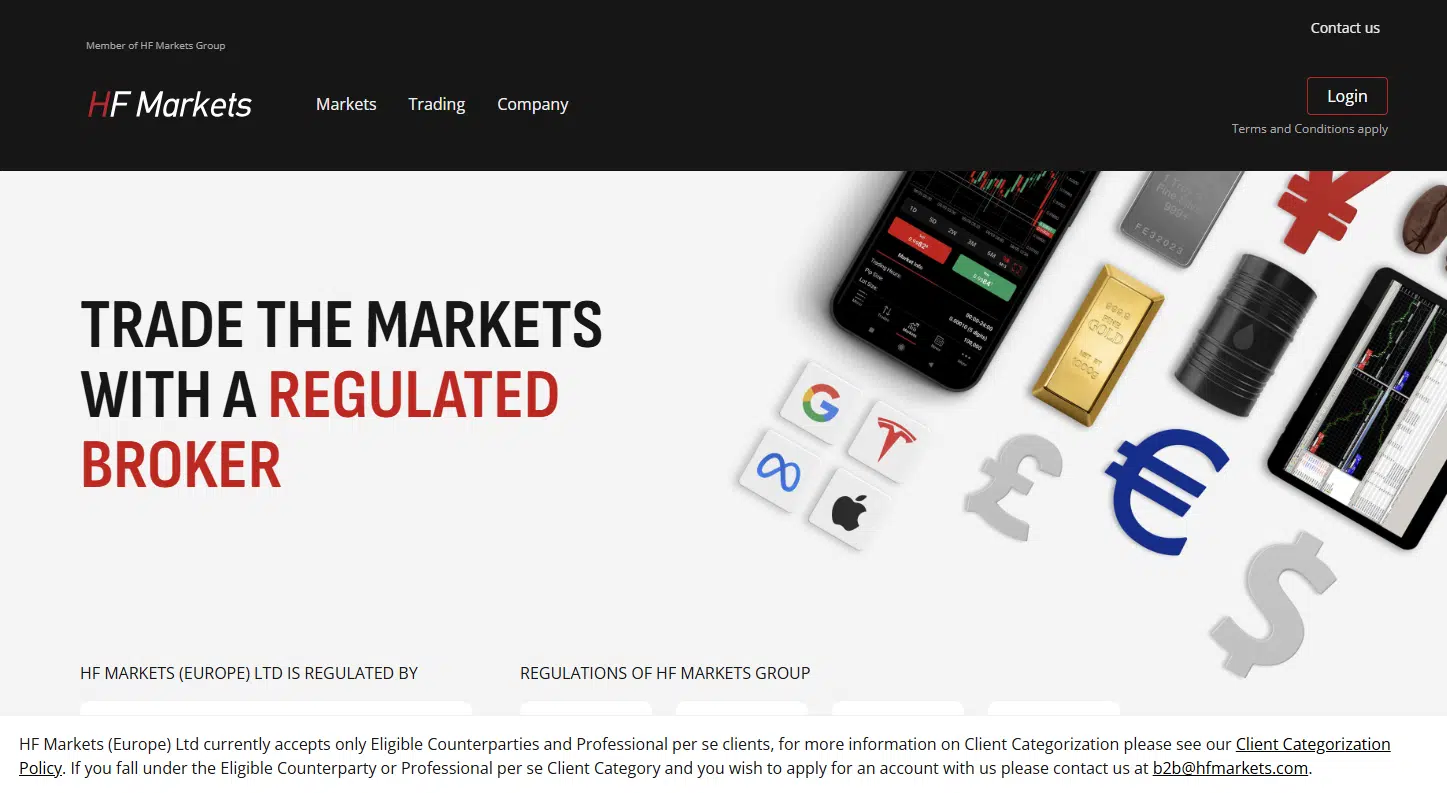
On pricing, the Premium account charges no commission with spreads from around 1.2 pips on EUR/USD, and the Zero account offers raw spreads from 0.0 pips with a commission from $3 per lot per side, which is competitive with the raw offerings elsewhere on this list. Leverage runs up to the CMA cap on major pairs.
Two features matter for specific audiences. Free VPS hosting is available for qualifying clients, which is genuinely useful if you run Expert Advisors around the clock and do not want your strategy dependent on home internet. And HFM’s copy trading service, covered by a Kenyan copy trading agreement, lets newer traders follow more experienced ones, which none of the other three brokers here offers.
Platforms are MetaTrader 4 and 5 plus the HFM app. There is no cTrader or TradingView execution, and spreads on the entry level accounts are wider than the raw pricing available at Pepperstone or on HFM’s own Zero tier, which is the price of the low entry point.
Pros
Cons
Online Forex/CFDs are complex instruments and come with a high risk of losing money rapidly due to leverage. The majority of retail investor accounts lose money when trading Online Forex/CFDs. You should consider whether you understand how CFDs work and whether you can afford to take the high risk of losing your money.
Scope Markets at a glance
73.68% of retail investor accounts lose money when trading CFDs with this provider.
Scope Markets, operated by SCFM Limited, was the second online forex broker licensed by the CMA (non-dealing licence no. 123, plus a derivatives broker licence) and runs a local operation from Nairobi. Like FXPesa, it offers a Kenyan shilling denominated account alongside a USD one, with M-Pesa and Airtel Money funding.
Scope has built its position on service rather than on being the cheapest. Every account comes with a dedicated account manager, which suits traders who want more contact than an international broker provides. There are two leveraged accounts, both from $100 and with leverage up to 1:400:
- Silver (USD): spreads from 1.1 pips with no commission;
- Gold (KES): spreads from 0.2 pips plus a commission of $3.50 on forex.
Trading on these accounts runs on MetaTrader 5 only, with no MetaTrader 4, cTrader or TradingView, so systematic traders will find wider platform choice above. For a trader who values a local relationship and a shilling account, the proposition is coherent.
Pros
- Access to NSE derivatives, which most CFD brokers in Kenya cannot offer
- Gold account priced in KES, avoiding conversion costs for local traders
- Gold spreads average 0.2 pips with $3.50 per lot per side on FX and metals
- Scope Invest account for fractional stocks from $50, with zero commission and no swaps
- Micro lot trading at 0.01 on both Silver and Gold
- Swap free option available on the Silver account
- Dedicated account manager included on all account types
- Local office in Westlands, Nairobi, with two Kenyan phone lines
Cons
- $100 minimum on both Silver and Gold, high for the Kenyan retail market where rivals start at $0
- MT5 only, with no proprietary app or web platform of its own
- No crypto, ETFs or bonds in the instrument list
- Rigid account currencies: Silver is USD only, Gold is KES only, with no choice
- Share commissions are steep and opaque, ranging from 4% to 35% depending on the market
Want to know more? Check our Scope Markets review and visit Scope Markets’ website.
Online Forex/CFDs are complex instruments and come with a high risk of losing money rapidly due to leverage. 58.74% of retail investor accounts lose money when trading Online Forex/CFDs. You should consider whether you understand how CFDs work and whether you can afford to take the high risk of losing your money.
M-Pesa, taxes and practicalities
Every broker in this guide supports M-Pesa, but the details differ. FXPesa processes M-Pesa deposits and withdrawals instantly and free of charge, while Pepperstone charges no fee and says most withdrawals are processed within one business day. Withdrawal speed is the metric worth testing with a small amount before you commit serious money.
On currency, a USD account means every shilling deposit is converted on the way in and back on the way out. If you fund frequently in small amounts, a KES denominated account at FXPesa or Scope Markets can save more than a tighter spread earns you.
On tax, since 1 January 2023 the Income Tax Act includes gains from financial derivatives in chargeable income, excluding derivatives traded on the Nairobi Securities Exchange. Gains from derivatives such as CFDs are therefore generally treated as income, taxed at resident rates from 10% to 35%, rather than under the 15% capital gains tax. Brokers do not withhold tax for you, so keep your statements and speak to a local accountant about how to declare.
If you would rather own shares than trade leveraged CFDs, see our guide on how to buy stocks in Kenya.
How we chose the best forex brokers in Kenya
Our team has professional experience in finance and portfolio analysis, and we have reviewed well over 100 brokers and trading platforms since we started publishing comparisons. This ranking follows the same methodology we apply across the site.
First, regulation: we only considered brokers holding a Capital Markets Authority licence for their Kenyan entity, verified on the CMA public register. Offshore entities accepting Kenyan clients without a local licence were excluded.
Second, total cost of trading: spreads, commissions, overnight financing and non trading fees (deposits, withdrawals, inactivity and currency conversion), measured on standard trade sizes using each broker’s published pricing rather than headline claims. Currency conversion carries extra weight here, because a USD account converts every shilling twice.
Third, platform quality and range of markets: charting, order types, execution speed, mobile experience and the breadth of instruments available. We gave extra weight to what matters specifically to Kenyan traders, namely M-Pesa deposit and withdrawal speed, KES base currency support, and whether there is a local office and support desk you can actually reach.
Which forex broker should you choose in Kenya?
If you are an active or systematic trader who wants raw pricing and the freedom to use MetaTrader, cTrader or TradingView, Pepperstone is the strongest option in this guide, and the only one of the four that supports all four platforms.
FXPesa and Scope Markets are the right homes for traders who want shilling accounts and someone local to talk to. HFM’s cent account makes it an easy entry point for someone starting with a few thousand shillings, and its free VPS makes it a credible second choice for automated traders.
Whichever you choose, verify the entity on the CMA register before depositing, start with the lowest leverage you can tolerate, and test the withdrawal process before the deposit gets large. The licence protects you from the firm. Position sizing is what protects you from the market.
Other resources
- Check our Youtube channel! You will find step-by-step guides of how to invest in the S&P 500 on different apps, as well as other educational videos about investing and investment platforms.
- Explore our tools: Check our comparison tool, reviews, broker bonuses, broker interest rates, BrokerMatch, and others.
This article is for informational and educational purposes only and does not constitute investment advice. Forex and CFDs are leveraged products and come with a high risk of losing money rapidly. The large majority of retail investor accounts lose money when trading these products. Fees, spreads and conditions are variable and were accurate at the time of writing. Always confirm current terms with the provider and verify licences on the CMA public register. Tax treatment depends on individual circumstances and tax law may change.