


What is the difference between VUSA and VOO? These are two ETFs that, despite having different tickers, track the same index, the S&P 500. Their difference lies in their structure (domicile, currencies, expense ratios, taxes) and their target investors: VUSA is built for European and UK investors, VOO primarily for US investors.
VUSA can be traded in EUR, GBP, CHF and USD depending on the exchange, while VOO trades only in US dollars on NYSE Arca. The same provider, Vanguard, offers both.
One point before you compare them: most European retail investors cannot buy VOO. Under EU PRIIPs rules a fund must publish a Key Information Document, and US-domiciled ETFs do not, so EU brokers cannot offer them to retail clients. For most readers in the EU the practical choice is VUSA or another UCITS S&P 500 tracker, not VOO. We cover this in detail below.
Throughout this article, we will address all the relevant topics so you can make an informed investment decision.
VUSA vs VOO compared in a nutshell
Our team has compiled all the information discussed throughout the article into a table, so that it can be easier for you to observe the differences and make a decision.
| ETF | VUSA | VOO |
| Index Tracked | S&P 500 | S&P 500 |
| Fund Manager | Vanguard | Vanguard |
| Domicile | Ireland (UCITS) | United States |
| Inception | 22 May 2012 | 7 September 2010 |
| Assets | $86,036 M (fund); $51,854 M (this share class) | $978,960 M (ETF) |
| Number of holdings | 504 | 506 |
| Exchanges* | LSE, SIX Swiss, Euronext Amsterdam, Deutsche Börse, Borsa Italiana and others | NYSE Arca |
| Fund Currency** | USD | USD |
| Dividend Distribution | Distributing (quarterly) | Distributing (quarterly) |
| Expense Ratio | 0.07% | 0.03% |
| Available to EU retail investors? | Yes | Generally no (PRIIPs) |
VUSA data as at 31 July 2026; VOO data as at 30 June 2026.
*On some exchanges the ticker differs, for example VUSA on the London Stock Exchange is listed as VUSD when traded in US dollars.
**Fund currency is the reporting currency. You can still trade VUSA in other currencies such as EUR, GBP and CHF.
Can you even choose? PRIIPs and availability
For many readers this question settles itself before any of the comparisons below matter.
EU regulation requires that a packaged retail investment product be sold with a Key Information Document. US-domiciled ETFs, including VOO, do not produce one, because US rules do not require it. The result is that EU brokers generally cannot offer VOO to retail clients. This is why UCITS versions of popular US ETFs exist at all: they are the compliant route to the same underlying index.
There are exceptions. Investors classified as professional or elective professional can sometimes access US-listed ETFs, and rules differ outside the EU. UK investors have their own regime, and investors elsewhere may face no restriction at all.
So the honest framing is this. If you are an EU retail investor, VUSA is very likely your only realistic option of the two, and the comparison below is useful mainly for understanding what you are getting. If you are a US investor, VOO is the cheaper and more liquid choice and there is no reason to look at VUSA. The genuinely open choice belongs to a narrower group than the volume of “VUSA vs VOO” searches suggests.
Index tracked and holdings
Both VUSA and VOO track the S&P 500 index, which follows 500 large-cap companies in the United States. Both use physical replication, meaning the fund manager actually buys the underlying shares rather than using derivatives to mimic the return.
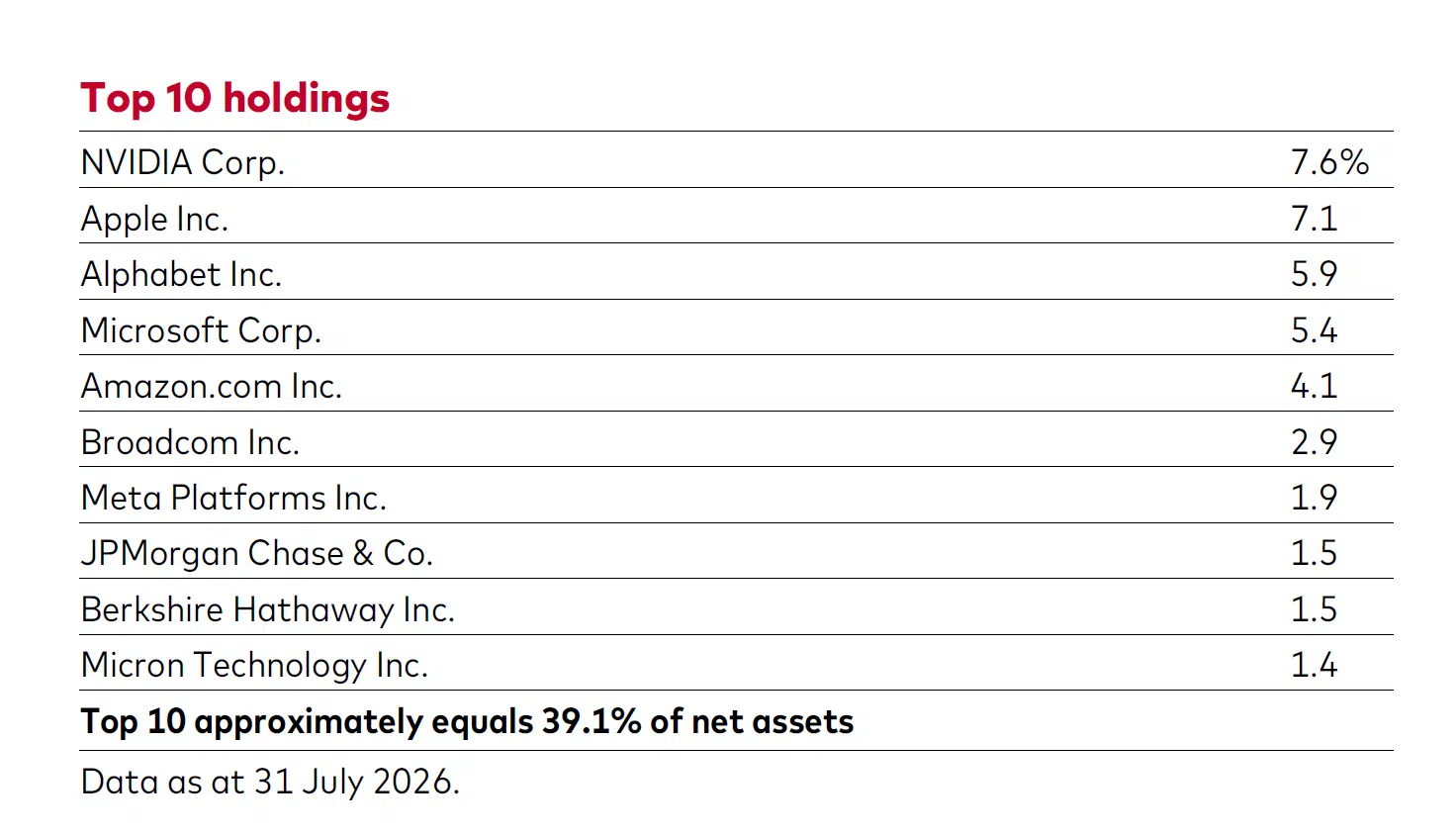
Their portfolios are very close but not identical. VUSA held 504 stocks and VOO 506 at their respective reporting dates, and the top ten differ slightly in both composition and weight:
| VUSA top 10 | Weight | VOO top 10 | Weight |
| NVIDIA | 7.6% | NVIDIA | 7.5% |
| Apple | 7.1% | Apple | 6.6% |
| Alphabet | 5.9% | Alphabet | 5.8% |
| Microsoft | 5.4% | Microsoft | 4.3% |
| Amazon.com | 4.1% | Amazon.com | 3.6% |
| Broadcom | 2.9% | Broadcom | 2.8% |
| Meta Platforms | 1.9% | Micron Technology | 2.0% |
| JPMorgan Chase | 1.5% | Meta Platforms | 1.9% |
| Berkshire Hathaway | 1.5% | Tesla | 1.8% |
| Micron Technology | 1.4% | Eli Lilly | 1.5% |
| Top ten total | 39.1% | Top ten total | 37.9% |
Sources: Vanguard S&P 500 UCITS ETF factsheet (31 July 2026) and Vanguard S&P 500 ETF factsheet (30 June 2026). The one-month gap between reporting dates accounts for part of the difference.
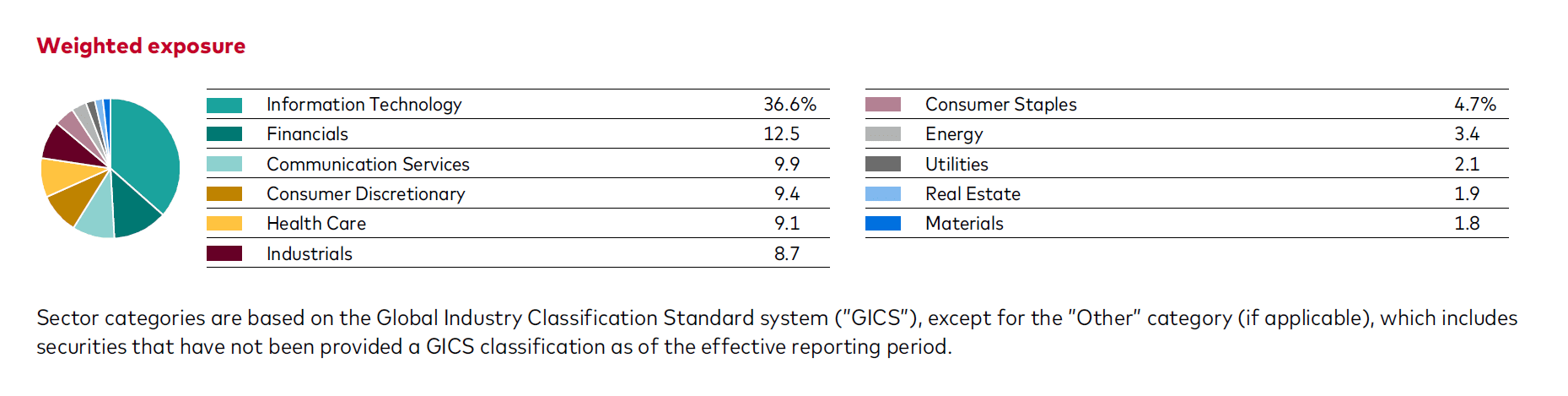
The differences are mostly a matter of timing rather than strategy. Both funds are tracking the same index with the same method, so over time you should expect their holdings to converge on the same list. Sector weights confirm this: information technology was 36.6% of VUSA and 38.0% of VOO, with financials at 12.5% and 11.8% respectively.
Neither fund tracks perfectly. VUSA’s factsheet notes index tracking risk explicitly, and small deviations from the index are normal and expected for any physically replicating fund.
The fund manager
Both ETFs are offered by the same fund manager, Vanguard. VOO launched on 7 September 2010, while VUSA followed on 22 May 2012.
The legal structures differ. VUSA sits inside Vanguard Funds plc, an Irish UCITS authorised by the Central Bank of Ireland and managed by Vanguard Group (Ireland) Limited. VOO is a US fund. This is the root of most of the differences that follow.

AUM
VOO is far larger than VUSA, helped by a two-year head start and by serving the vast US market directly.
| ETF | VUSA | VOO |
| Assets (millions, USD) | $86,036 (fund total) | $978,960 (ETF) |
| Reporting date | 31 July 2026 | 30 June 2026 |
VOO is approaching a trillion dollars in ETF assets, and over $1.6 trillion including the fund’s other share classes. VUSA’s $86 billion looks small beside it, but in European terms it is one of the largest ETFs available.
Does size matter to you as an investor? Mainly through liquidity and spreads. Both funds are large enough that this is a non-issue for ordinary retail trade sizes. Where it can matter is at the exchange level: VUSA is listed on several European venues and trading volume is not evenly spread across them, so the spread you pay may vary depending on where your broker routes the order.
Exchanges
VOO is listed on NYSE Arca. VUSA, as a European ETF, is listed on several exchanges, so our team has compiled the tickers and currencies from Vanguard’s factsheet:
| Listing | Trade Currency | Ticker |
| London Stock Exchange | GBP | VUSA |
| London Stock Exchange | USD | VUSD |
| SIX Swiss Exchange | CHF | VUSA |
| Euronext Amsterdam | EUR | VUSA |
| Deutsche Börse | EUR | VUSA |
| Borsa Italiana | EUR | VUSA |
Source: Vanguard factsheet, 31 July 2026. VUSA is also available on other European venues such as gettex and Stuttgart; check what your broker offers.
Choosing the right listing matters more than it first appears. If your account is in euros and you buy the USD line, you pay a currency conversion on every purchase. Buying the EUR listing avoids that. Note this does not remove currency risk, which is a separate thing explained below.
Currency
Both VUSA and VOO have the US dollar as their base currency. The listings can be traded in different currencies depending on the exchange, but that is a trading convenience rather than a change in what you own.
Both are unhedged, so you are exposed to the dollar regardless of which listing you buy. Buying VUSA in euros on Deutsche Börse does not make it a euro investment: the underlying holdings are US companies priced in dollars, and if the dollar weakens against the euro your return in euro terms falls, whichever line you bought. The listing currency affects your conversion costs at purchase, not your currency exposure afterwards. This distinction trips up a lot of first-time ETF investors.
Distribution
Both VOO and VUSA are distributing funds, paying dividends quarterly. This appeals to investors who want a regular income stream. The underlying equity yield of the portfolio was around 1.1% as at 31 July 2026.
If you are accumulating rather than drawing an income, note that Vanguard also offers an accumulating share class of the same UCITS fund, VUAA, which reinvests dividends automatically. In several European countries that is more tax-efficient, since distributions are taxed as they arrive. Whether it helps depends entirely on your country’s rules, and in some, such as Austria and Germany, accumulating funds are taxed annually anyway.
Fund domicile and tax
VUSA is domiciled in Ireland, VOO in the US. For a non-US investor this is the most consequential difference between the two funds, and it works on two separate levels.
| ETF | VUSA | VOO |
| Domicile | Ireland | United States |
| US dividend withholding | 15% at fund level | Up to 30% for non-residents |
| US estate tax exposure | None | US-situs asset |
Dividend withholding. Non-resident investors in a US-domiciled ETF such as VOO face up to 30% US withholding on dividends, reduced to 15% in many cases if your country has a tax treaty with the US and you file a W-8BEN. Ireland’s treaty gives VUSA a 15% rate at fund level on the US dividends it receives, and Ireland applies no further withholding when the fund distributes to you. On a portfolio yielding roughly 1.1%, the difference between a 15% and 30% rate is worth around 0.17% a year, which is several times the 0.04% gap in expense ratios.
US estate tax. This gets far less attention and can matter far more. VOO is a US-situs asset, so a non-resident alien holding it is potentially exposed to US estate tax on death, with an exemption of only $60,000 against roughly $14 million for a US citizen, and rates running up to 40% above that. VUSA, being Irish-domiciled, carries no such exposure. If you are a non-US investor building a position of any size, this alone is a strong argument for the UCITS version.
None of this is tax advice, and your own country’s treatment of the fund and its distributions matters too. One practical note from the factsheet: VUSA has tax reporting status in Austria, Germany, Switzerland and the UK, which simplifies matters considerably for investors in those countries. Confirm your position with a qualified adviser.
Total expense ratio
Besides the fees you pay your broker when trading, there is another cost called the total expense ratio, or ongoing charges figure. It is charged by the fund manager to cover the cost of running the ETF. VUSA charges 0.07%, VOO charges 0.03%.
| ETF | VUSA | VOO |
| TER / OCF | 0.07% | 0.03% |
| Cost per year on €10,000 | €7 | €3 |
The TER is expressed as a percentage of the fund’s assets and charged daily against net asset value rather than billed to you separately. On a €10,000 holding the difference between the two funds is about €4 a year.
Worth keeping in perspective in two directions. Against each other, the gap is small and smaller than the withholding tax difference discussed above. Against the wider market, both are extremely cheap: Vanguard’s own factsheet puts the average S&P 500 index fund at 0.41%, which on the same €10,000 would cost €41 a year.
Performance
Here are the annualised returns each fund reports, net of fees:
| Period | VUSA | VOO |
| 1 year | 19.28% | 22.28% |
| 3 years | 19.01% | 20.58% |
| 5 years | 12.55% | 13.36% |
| 10 years | 14.72% | 15.47% |
| Since inception | 14.71% | 15.03% |
VUSA as at 31 July 2026, VOO as at 30 June 2026 (NAV return). Past performance is not a reliable indicator of future results.
Do not read too much into this table. The two funds are not measured on the same basis, and the difference is not what it appears.
Vanguard benchmarks VUSA against the S&P 500 Net Total Return index, which assumes dividends are reinvested after deducting 30% withholding tax. VOO is measured against the standard total return index, which does not make that deduction. The reporting dates also differ by a month, over which markets moved.
Against their own respective benchmarks, both funds did what they are supposed to do. VUSA returned 19.28% against 19.14% for its benchmark over one year. VOO returned 22.28% against 22.32%. Both track the index closely, which is the only thing you should expect a passive fund to do.
Diversification
As an investor, it is worth noting that both VUSA and VOO track the S&P 500 and therefore focus entirely on the US stock market. Geographic allocation is 100% United States, so both offer no direct exposure to companies outside the US.
However, most of these companies sell their products internationally, so your economic exposure is broader than the domicile suggests. You can explore this in our article “Stocks: What is Your Real Country/Currency Exposure?“.
Both funds spread holdings across every major sector, but the balance is less even than that phrasing suggests. Information technology alone was 36.6% of VUSA and 38.0% of VOO, with the next largest sector, financials, around 12%. The top ten holdings account for roughly 38 to 39% of each fund, and NVIDIA and Apple together are about 14%. That is a genuine concentration risk, and it has grown over recent years as the largest technology companies have risen. Anyone treating an S&P 500 tracker as a fully diversified portfolio should be aware of it.
Cheapest brokers to invest in VUSA and VOO
Now that we have gone through the differences between the two ETFs, it is time to look at where to buy them. We have analysed the most important features of different ETF brokers and put together a list of four.
Here are the four brokers and what each is good for:
- eToro: Best for social trading
- Interactive Brokers: Best for the largest ETF offering
- Public.com: Best for commission-free investing and access to an investor community
- InvestEngine: Best for expert-managed portfolios
| Broker | ETF fees | Minimum Deposit | Number of ETFs | Regulators | Country |
| eToro | $0 (other fees apply) | $50 (varies between countries) | 300+ | FCA, CySEC, ASIC | Available worldwide (exceptions apply). |
| Interactive Brokers | Free for US investors; up to USD 0.0035 per share (min. USD 0.35) for international investors | €/$/£0 | 13,000+ | FINRA, SIPC, SEC, CFTC, CIRO, FCA, CBI, AFSL, SFC, SEBI, MAS, MNB | Available worldwide (exceptions apply). |
| Public.com | $0 for US-listed stocks and ETFs during regular market hours; $2.99 per trade during extended hours for non-premium members | $0 | 200+ | SEC, FINRA | Available in the UK and the USA. |
| InvestEngine | 0%-0.25% | £100 | 500+ | FCA | Available in the UK. |
| Broker | VUSA | VOO |
| eToro | ✘ | ✔ |
| Interactive Brokers | ✔ | ✔ |
| Public.com | ✘ | ✔ |
| InvestEngine | ✔ | ✔ |
Availability varies by your country of residence and investor classification. A tick above does not mean VOO is available to you as an EU retail investor, since PRIIPs rules generally prevent that regardless of what the broker lists. Check within your own account before assuming access.
Conclusion
VUSA and VOO track the same index, with nearly the same holdings, run by the same manager. What separates them is structure, and structure is decided mostly by where you live.
If you are a US investor, VOO is the obvious choice. It is cheaper at 0.03%, enormous, highly liquid, and carries none of the complications that domicile creates for foreign holders.
If you are a European or UK investor, VUSA is almost certainly the right answer, and often the only available one. PRIIPs rules generally prevent EU retail investors from buying VOO at all. Even where access exists, the Irish domicile means 15% rather than up to 30% withholding on US dividends, and no exposure to US estate tax above the $60,000 non-resident threshold. Both of those outweigh the 0.04% difference in expense ratios many times over.
The fee comparison, which usually dominates these discussions, is the least important part. On €10,000 you are arguing about €4 a year. The withholding difference is worth roughly four times that, and the estate tax question could matter far more than either.
Ultimately, the choice between VOO and VUSA is decided less by the funds themselves than by your tax residency and what your broker can legally sell you. Confirm both before deciding.



