Machine learning (ML) and artificial intelligence (AI) have moved from “promising emerging technologies” to genuinely transformative forces over the past few years. They’re already heavily deployed across industries, and the potential continues to expand at a pace few other technologies have matched.
In 2025, the global AI market was estimated at around $757 billion, and is projected to reach over $4 trillion by 2035 at a compound annual growth rate (CAGR) of roughly 18% to 19%.
One of the most influential players in the field is OpenAI. While the company had developed multiple research products before then, the November 2022 launch of ChatGPT catapulted it into the mainstream and made OpenAI a household name. In terms of active users, ChatGPT has reached scale faster than virtually any consumer product in history.
For more detailed numbers on ChatGPT itself, please visit our ChatGPT Statistics (2026) article.
OpenAI statistics (2026) in a nutshell
- OpenAI was founded in 2015 by Sam Altman, Elon Musk and others as a non-profit research lab.
- It created a capped for-profit arm in 2019 and, in October 2025, completed a recapitalisation into OpenAI Group PBC, a public benefit corporation controlled by the non-profit OpenAI Foundation.
- Its flagship product ChatGPT reached 100 million monthly users within two months of its November 2022 launch, then the fastest growth of any consumer app.
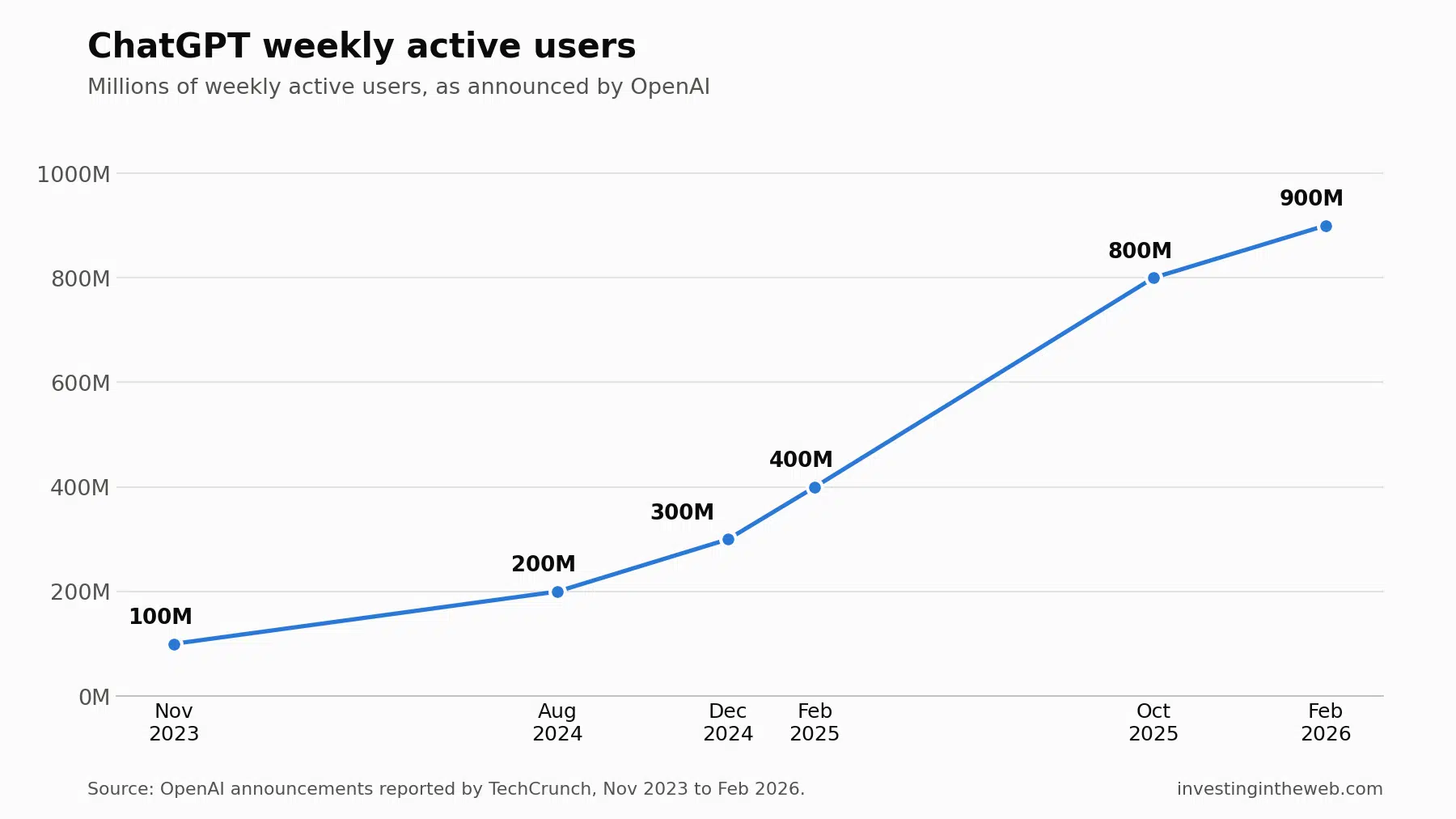
- ChatGPT had 900 million weekly active users and 50 million paying subscribers in February 2026, and was reported to be close to 1 billion weekly users in July 2026. OpenAI says more than 2 million businesses use its products.
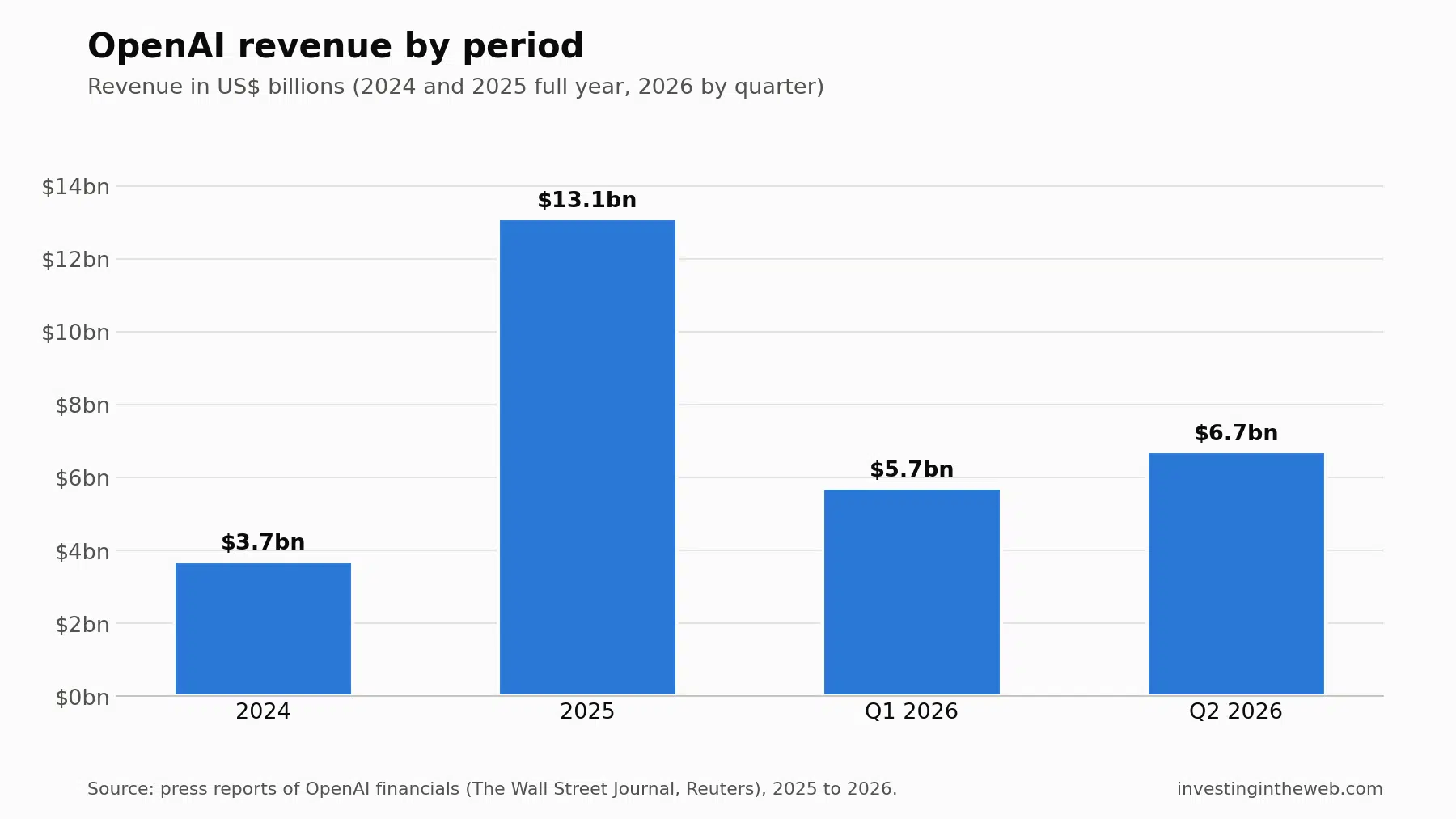
- OpenAI’s revenue grew from about $3.7 billion in 2024 to $13.1 billion in 2025. In 2026, it reportedly booked $5.7 billion in Q1 and $6.7 billion in Q2, and Axios reported in late September 2026 that its annualised revenue was nearing $70 billion. OpenAI is still loss-making.
- Microsoft has invested about $13.8 billion in OpenAI and holds a stake of roughly 27% in OpenAI Group PBC since the 2025 recapitalisation.
- In March 2026, OpenAI closed a record $122 billion funding round co-led by SoftBank, at a post-money valuation of $852 billion.
- In June 2026, OpenAI confidentially filed for an IPO in the US, without setting a date.
- Other notable OpenAI products include image generation in ChatGPT, the Sora video model, the Codex coding agent and the Whisper speech recognition model.
General Facts
1. OpenAI was founded as a non-profit in 2015 by Sam Altman, Elon Musk and other partners
OpenAI is an artificial intelligence (AI) research laboratory founded as a non-profit on 11 December 2015 and headquartered in San Francisco, California.
Its founders include Sam Altman (current CEO), Elon Musk, Ilya Sutskever, Greg Brockman, Trevor Blackwell, Vicki Cheung, Andrej Karpathy, Durk Kingma, Jessica Livingston, John Schulman, Pamela Vagata, and Wojciech Zaremba.
Elon Musk is reported to have been the biggest early donor. Apart from individuals, companies such as Amazon Web Services (AWS), Infosys and YC Research also backed the launch.
2. Elon Musk allegedly came up with the company name and invested $50 million in it, only to leave the company in 2018
According to Business Insider, Elon Musk said he came up with the company’s name and invested $50 million in its founding.
However, Musk left the board in 2018, citing “a potential future conflict [of interest]” with his work at Tesla. In 2019 he admitted that he quit because he was not in favour of aspects of what the OpenAI team wanted to accomplish. Musk has since become one of OpenAI’s most vocal critics and has challenged its move to a for-profit structure in court.
3. OpenAI created a capped for-profit arm in 2019, partnered with Microsoft and became a public benefit corporation in 2025
In 2019, OpenAI split into a non-profit and a capped for-profit OpenAI LP, with the profit capped at 100 times any investment.
This has enabled the company to attract investment from venture capital funds and offer employees stakes (stock options).
Following this announcement, the company partnered with Microsoft, whose Azure cloud has powered OpenAI’s systems since then.
In October 2025, OpenAI completed a recapitalisation: its for-profit business became OpenAI Group PBC, a public benefit corporation controlled by the non-profit OpenAI Foundation, and Microsoft received a stake of about 27%.
4. OpenAI’s mission is to ensure that artificial general intelligence (AGI) benefits all of humanity
The company’s mission is to research and create AI systems that are smarter than human beings to help humanity. Most notably, they strive to develop Artificial General Intelligence (AGI) safely and beneficially, as explained in their charter.
Some potential benefits of AGI they listed are a prolonged lifespan, driving the world economy, aiding with cognitive activities, and challenging the limits of possibilities and imagination.
However, many experts and non-experts have expressed concerns about this technology in safety, reinforcing biases in the training data, and in general, the “profound risk to society and humanity”. In March 2023, over 1,000 experts have called for a halt to advanced AI development, but no such pause was adopted.
5. The biggest breakthrough for the company was the introduction of ChatGPT in 2022
In late 2022, OpenAI received widespread media coverage after launching ChatGPT, an AI chatbot based on the language model called GPT-3.5.
Since then, ChatGPT has taken the world by storm and quickly found many applications in IT, publishing, marketing, finance, and other industries. Its popularity and performance were boosted by new models: GPT-4 in March 2023, GPT-4o in May 2024 and GPT-5 in August 2025.
Growth and Products
6. ChatGPT broke records as the fastest-growing platform (5 days to 1 million users and two months to 100 million users)
Starting from its launch on 30 November 2022, ChatGPT has become the fastest platform to reach 1 million users (in only five days). To put this into perspective, the previous record holder was Instagram, with 75 days to reach its first 1 million users.

But the platform didn’t stop there. After its first month, it already had around 57 million users, and it took another month to reach its first 100 million users.
By doing so, it broke the record for the fastest-growing platform in history at the time.
Growth continued well beyond that. ChatGPT reached 100 million weekly active users in November 2023, 400 million in February 2025, 800 million in October 2025 and 900 million in February 2026, along with 50 million paying subscribers.
7. Beyond ChatGPT, OpenAI’s notable products include image and video generation (Sora), Codex and Whisper
ChatGPT is the company’s flagship product, but other essential OpenAI products include its image generation models, the Sora video model, the Codex coding agent and Whisper.
Other than chatbots, image-generating AI products have seen the most hype and application in the early days of the technology. OpenAI started with the DALL-E models, and image generation is now built directly into ChatGPT. Its Sora models extend this to video, and Codex has become one of its main products for software development.
Another important OpenAI product is a neural network called Whisper, which can transcribe speech into text and translate many languages. At launch, it was trained on 98 languages.
8. More than 2 million businesses use OpenAI products, including Microsoft, Duolingo, Stripe and Khan Academy
APIs, which enable external apps to be connected to OpenAI’s products, have enabled an explosion of applications. By July 2026, OpenAI said more than 2 million businesses were using its products.
Some of the most notable industries and companies that are using OpenAI’s products are education (Duolingo, Khan Academy), finance (Deloitte, Stripe), IT (Microsoft, Wix), and many others.
Financials
9. OpenAI’s revenue grew from $3.7 billion in 2024 to $13.1 billion in 2025, and kept accelerating in 2026
In December 2022, Reuters reported that OpenAI projected $200 million in revenue for 2023 and $1 billion for 2024. Reality beat those projections by far: OpenAI’s revenue reached about $3.7 billion in 2024 and $13.1 billion in 2025. In 2026, it reportedly booked $5.7 billion in the first quarter and $6.7 billion in the second, and Axios reported in late September that its annualised revenue was nearing $70 billion.
However, OpenAI is still loss-making, with very high costs for computing power and talent. In the first quarter of 2026 alone, it reportedly burned $3.7 billion in cash.
10. Engineers at OpenAI reportedly earned around $925,000 a year in 2023, mostly in equity
According to levels.fyi, engineers at OpenAI received total compensation of around $925,000 a year in 2023. Most of that ($625,000) came from equity, and $300,000 from salary.
This is a common practice in start-up companies, as it aligns the interests of the employees and the founders and gives cash-short startups an opportunity to offer competitive compensation.
11. Microsoft has invested about $13.8 billion in OpenAI and holds a stake of roughly 27%
OpenAI spends far more than it brings in, so outside investment has been essential, most notably from Microsoft.
The tech giant invested $1 billion in 2019, $2 billion in 2021, and finally $10 billion in 2023.
Under the original deal, reported by Fortune, Microsoft was entitled to 75% of profits until it recouped its investment, and 49% after that. The October 2025 recapitalisation replaced this with a stake of about 27% in OpenAI Group PBC, then worth roughly $135 billion, for a total investment of about $13.8 billion.
Microsoft has integrated OpenAI’s models across Bing, Edge, Windows and Microsoft 365 through its Copilot assistant.
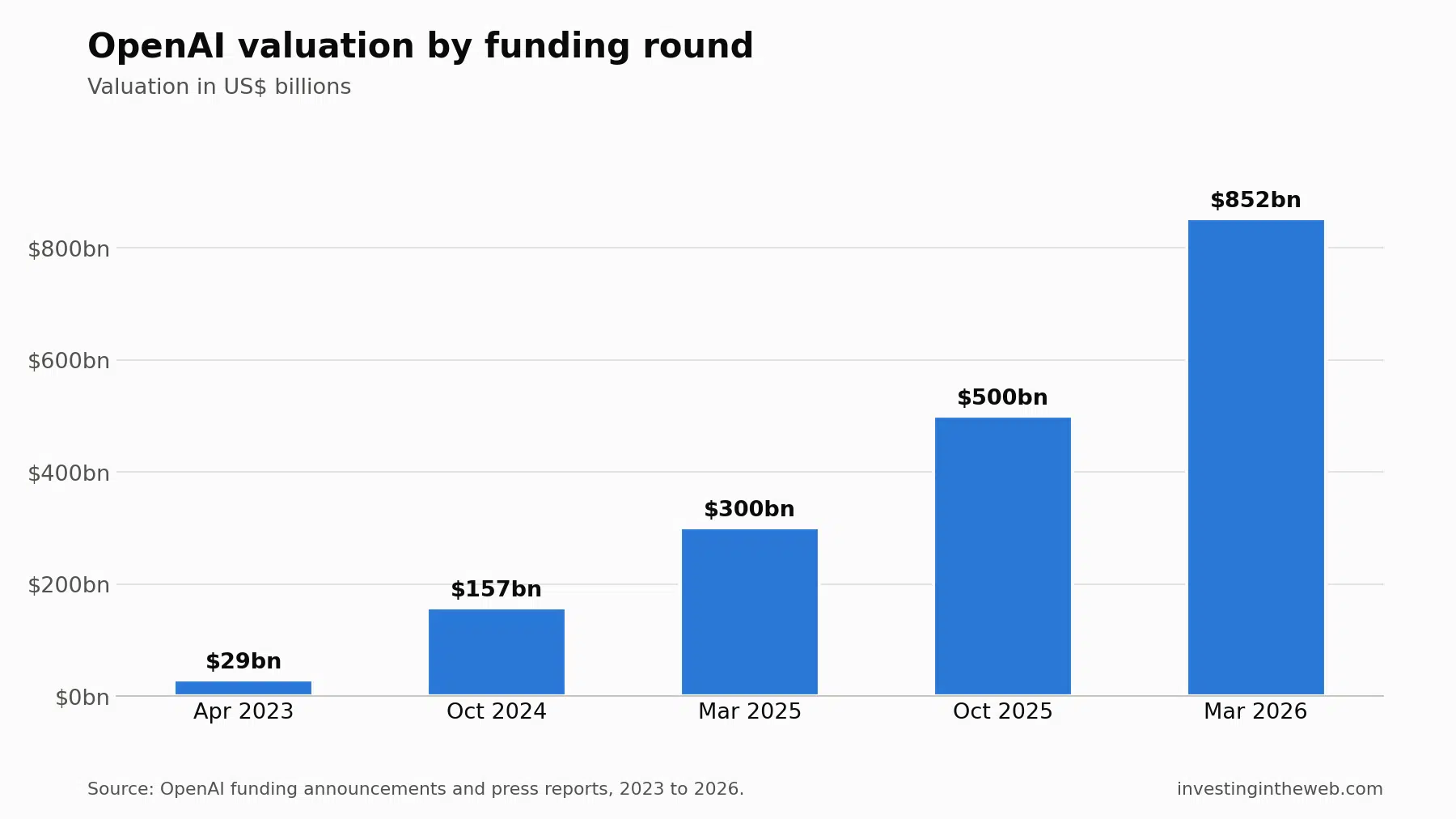
12. OpenAI was valued at $852 billion in March 2026 and has filed confidentially for an IPO
OpenAI’s valuation has multiplied in just three years: about $29 billion in 2023, $157 billion in October 2024, $300 billion in March 2025 and $500 billion at the October 2025 recapitalisation. In March 2026, it closed a $122 billion funding round co-led by SoftBank at a post-money valuation of $852 billion.
In June 2026, OpenAI confidentially filed for an initial public offering (IPO) in the US. It has not set a date, and reports have speculated about a valuation of up to $1 trillion.
Website traffic and users (2023 snapshot)
13. The openai.com website had around 1.7 billion monthly visits, or over 56 million per day (June 2023)
The statistics in this section are a snapshot from mid-2023, when ChatGPT still ran on the openai.com domain. ChatGPT moved to chatgpt.com in 2024, so openai.com traffic no longer captures most of its usage. For current usage, see the weekly active user figures above.
According to SimilarWeb, openai.com recorded over 56 million visits per day in June 2023 or around 1.7 billion monthly visits. The growth was particularly stellar in its first months, almost doubling every month during the first four months.
However, the meteoric growth has slowly tapered off and even reversed, with the platform recording around 200 million fewer visits in June than in May 2023.

14. This made openai.com the 20th most visited website in the world (June 2023)
To put these numbers into perspective, openai.com was then the 20th most visited website in the world. This was remarkable for such a young product, as ChatGPT generated most of the site’s traffic.
15. Interest in OpenAI (Google Web Search) grew immensely in late 2022 and peaked in March 2023
Two of the biggest peaks in interest around OpenAI coincide with the release of their most important product, ChatGPT, in late 2022 and the new version powered by GPT-4 in March 2023. Since then, the interest in the company (measured by Google Web Search) has slowly tapered off.

16. Most of the traffic to the site was direct (over 88%, 2023)
It is clear that most website visitors come there directly (over 88%). Around 10% of visitors come from organic search, and all other traffic sources combined make up less than 2%.

17. OpenAI products are unavailable in some countries, such as China and Russia
Although available in most countries, OpenAI products (most notably ChatGPT) are unavailable in some countries for various reasons.
Some reasons include ongoing wars, security and privacy concerns, regulation, and politics.
18. Despite the previous point, OpenAI drew the greatest search interest in China, followed by many African and Asian countries (2022 to 2023)
If we look at the Google Web Search data from Google Trends, OpenAI has caused the greatest interest by country in China from July 2022 to July 2023. The next countries on the list have received significantly less interest, with most of the frontrunners being developing African and Asian countries.

19. The biggest traffic-generating country for openai.com was the U.S., followed by other large economies (2023)
It is expected to see the U.S. as the biggest traffic-generating country for the openai.com website. Apart from the countries where their products are banned, other big (mostly developing) economies are in the top 5 in this category.

20. Nearly two-thirds of openai.com visitors were younger than 35 (2023)
Unsurprisingly, the younger generations are leading the way in adopting new technologies that OpenAI has to offer. The leading demographic of visitors to openai.com is the 25-34 age group, followed closely by the 18-24 age group. These two together make up almost two-thirds of the visitors.

We can only speculate that many minors under 18 are using the platform as well but are not included in this statistic. This would skew the age distribution even further towards the younger generations.
21. Most visitors to openai.com were male (60%, 2023)
Another expected statistic is that men make up the majority of visitors to the OpenAI website. However, that number is significantly more balanced than, for example, the ratio of women employees in the tech industry.

While 40% of openai.com visitors are female, it is estimated that only between 25-30% of tech industry employees are estimated to be women. OpenAI products could make an impact in levelling the playing field in the job market between the genders.
Conclusion
OpenAI has become one of the most valuable companies in the world in less than a decade. ChatGPT is close to 1 billion weekly users, revenue grew from $3.7 billion in 2024 to $13.1 billion in 2025 and kept accelerating in 2026, and the company was valued at $852 billion in March 2026 before filing confidentially for an IPO.
However, it is still loss-making and spends heavily on computing power. Competition is intense, with Google’s Gemini, Anthropic’s Claude and cheaper Chinese models closing the gap, and the risks of increasingly capable AI remain a central debate. An IPO would bring much more transparency to these numbers, so expect this picture to change quickly.