What is the difference between SPX and SPY? These are two widely recognised financial assets associated with the S&P 500 index. Despite having distinct tickers, these assets are frequently compared due to their significant similarities and differences.
SPX refers to the S&P 500 index itself, which tracks the performance of the 500 largest publicly traded companies in the United States. In contrast, SPY is an ETF (the SPDR S&P 500 ETF Trust) designed to track the performance of the S&P 500 index. While SPX serves as a benchmark index, SPY is a tradable security that aims to mirror the index’s movements closely while incurring small tracking differences.
Another key difference is how dividends are handled. SPX is a price-return index and does not distribute dividends, while SPY, as an ETF, distributes dividends to its shareholders quarterly (typically in March, June, September, and December).
Throughout this article, we’ll address all the relevant topics so you can make an informed investment decision.
What is SPX?
The SPX ticker represents the S&P 500 index, one of the most widely tracked benchmarks in global finance. The S&P 500 consists of approximately 500 of the largest publicly traded companies in the United States (the count fluctuates slightly as a result of corporate actions, but typically sits around 503-505 constituents due to companies with multiple share classes such as Alphabet and Fox). The index spans all 11 GICS sectors and serves as the primary benchmark for US large-cap equity performance.
It’s important to note that the SPX itself cannot be directly bought or sold like individual stocks or ETFs. Instead, it serves as a reference point for various financial instruments including futures, options, ETFs, mutual funds, and other derivatives. Investors who want exposure to the S&P 500 typically invest via tracking ETFs (such as SPY, IVV, VOO, or SPLG) or futures contracts (such as ES on the CME).
The composition of the S&P 500 is reviewed quarterly by the S&P U.S. Index Committee, which evaluates eligibility criteria including market capitalisation, liquidity, profitability, and US domicile. The index is float-adjusted and market-capitalisation weighted, meaning each company’s weighting is based on the market value of its freely tradable shares. As of mid-2026, the largest constituents include Apple, Microsoft, NVIDIA, Amazon, Alphabet, and Meta, with the top 10 holdings representing approximately 35% of the index’s total weight – a level of concentration that has drawn investor and regulatory attention in recent years.
What is SPY?
SPY is the ticker symbol for the SPDR S&P 500 ETF Trust, an exchange-traded fund (ETF) issued by State Street Global Advisors. Launched in January 1993, SPY was the first US-listed ETF ever created and remains one of the largest and most heavily traded ETFs in the world:
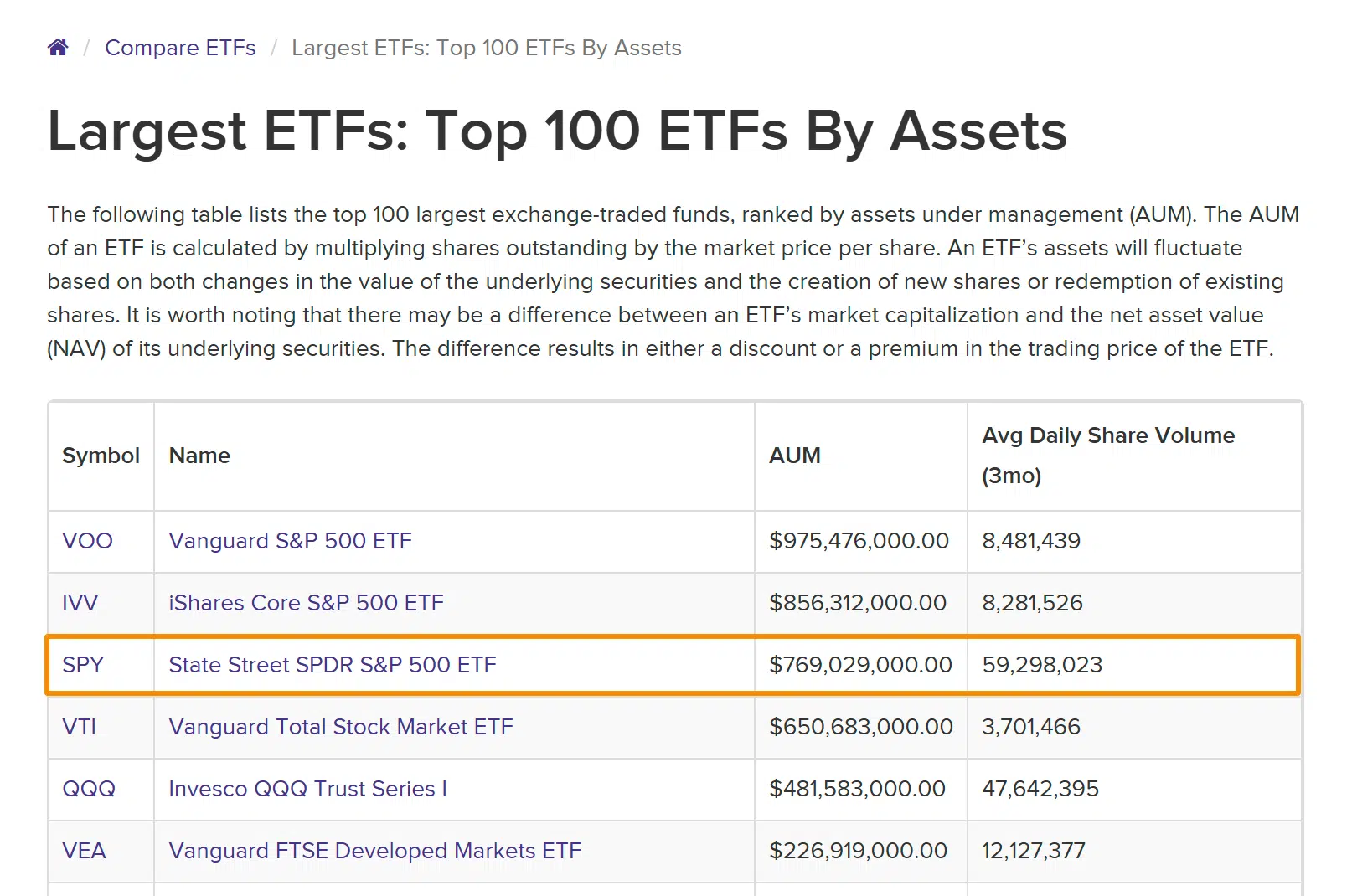
Unlike SPX, SPY trades directly on US stock exchanges (primarily NYSE Arca) just like an individual stock, with no need for derivative instruments. By purchasing shares of SPY, you gain proportional exposure to all 500+ companies in the S&P 500 index in a single transaction. The fund’s performance is designed to closely track the movements of the underlying index, with small tracking differences arising from the fund’s expense ratio, dividend reinvestment timing, and cash management.
SPY also offers exceptional liquidity, with average daily trading volumes among the highest of any security globally and an extensive options market – making it a popular choice for both long-term investors and active traders. From this point, we’ll conduct a more detailed analysis of SPY, covering various aspects that may be important for you as an investor to make an informed decision.
SPY – Index tracked
SPY replicates the S&P 500 index, which tracks the performance of approximately 500 large-cap companies listed in the United States. According to State Street Global Advisors (SSGA), SPY holds the same stocks in approximately the same proportions as the S&P 500 index.
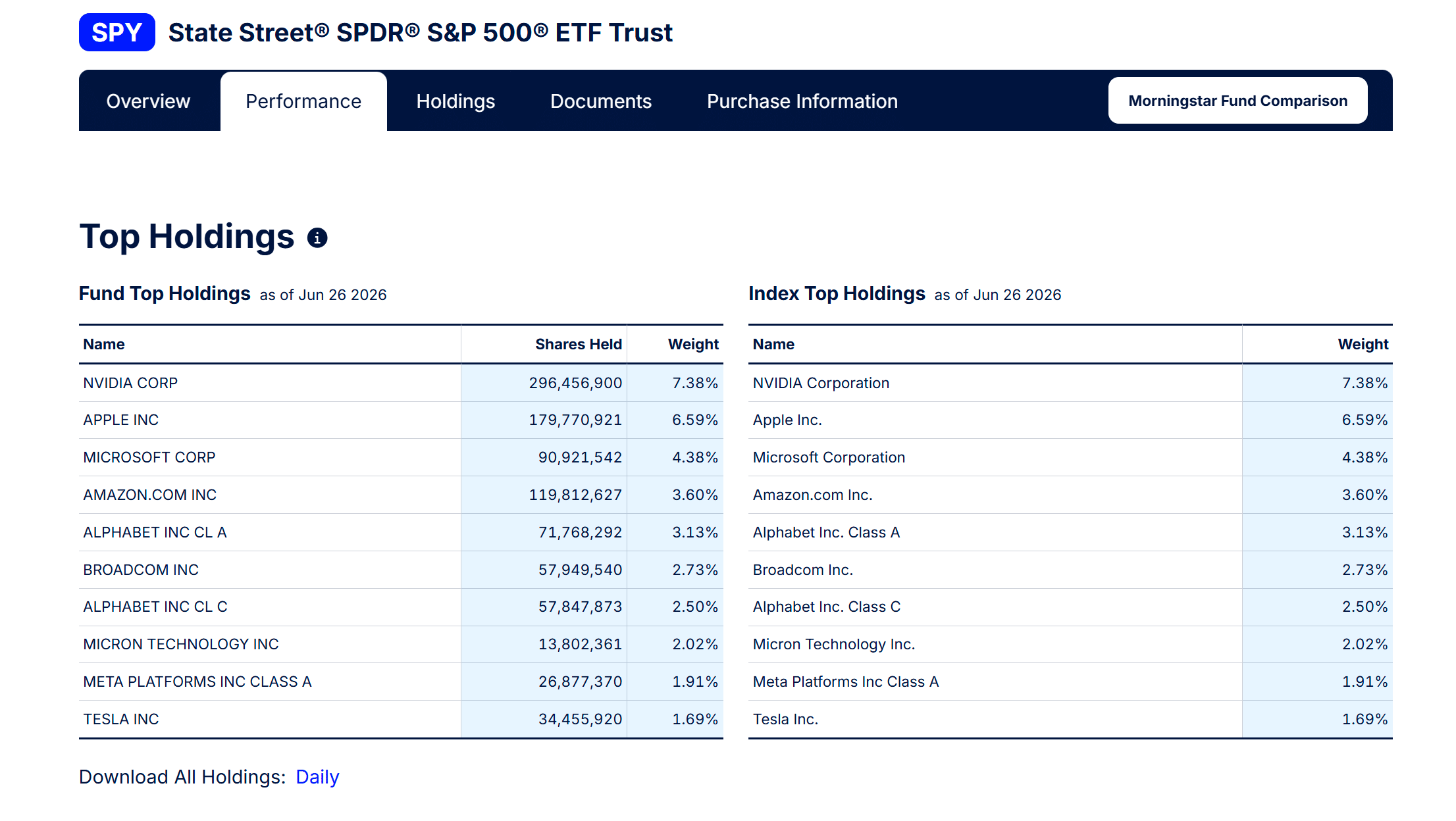
SPY uses a methodology called full replication to track the performance of the S&P 500 index. This means the ETF holds all of the index’s constituent stocks in the same proportions as they are weighted in the index itself, which helps minimise tracking error.
SPY vs SPX – performance
To illustrate the historical performance of SPY, our team conducted a simulation in which $10,000 was hypothetically invested ten years ago. This simulation provides insights into how the SPY ETF has performed relative to the SPX index over multiple time horizons.
SPY’s performance has historically tracked the S&P 500 very closely, with a small gap accounted for by the fund’s expense ratio (currently 0.0945%) and minor tracking differences. As of May 31, 2026:
| Time horizon | SPY (annualised %) | SPX (annualised %) |
| 1 Year | 29.72% | 29.78% |
| 3 Year | 23.42% | 23.61% |
| 5 Year | 14.00% | 14.15% |
| 10 Year | 15.50% | 15.65% |
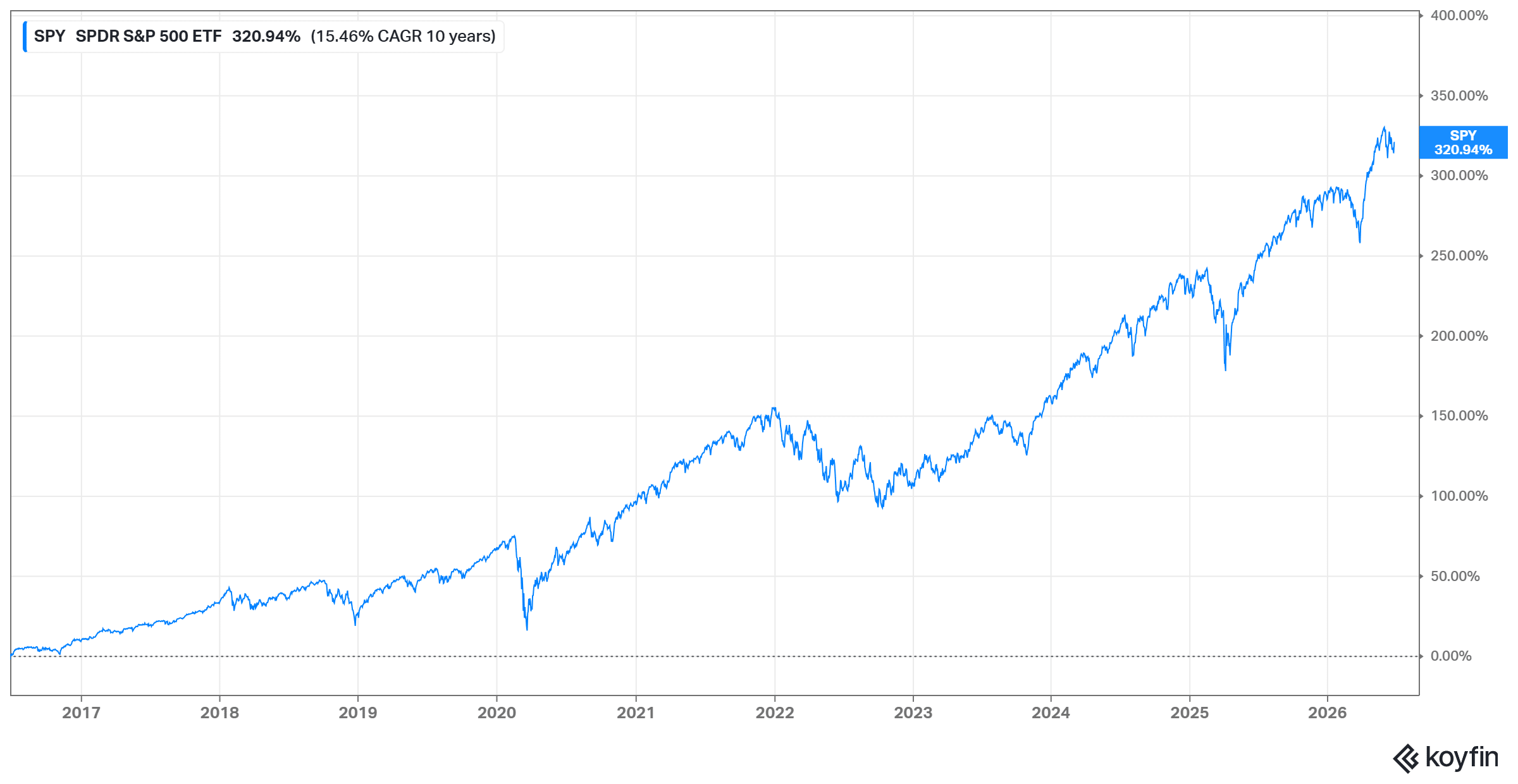
If you had invested $10,000 in SPY ten years ago, it would have grown to approximately $42,200 today, based on the 15.50% 10-year annualised return as of May 31, 2026. This simulation assumes reinvestment of all dividends and does not account for income taxes, which would reduce the net result depending on your jurisdiction and account type.
SPY – Fund Manager
SPY is managed by State Street Global Advisors (SSGA), an experienced asset management firm. The SPY was listed on the American Stock Exchange (AMEX) in January 1993, being the first ETF in the world.

SPY – Exchange and currency
SPY is listed and traded on the NYSE Arca exchange. As an investor, you can buy and sell SPY shares during regular US market trading hours (9:30 AM to 4:00 PM ET), as well as during pre-market and after-hours sessions, subject to your broker’s rules.
It’s important to note that SPY is denominated in US dollars (USD). This means the underlying assets and transactions of the ETF occur in USD, so non-US investors holding SPY will be exposed to USD currency risk relative to their home currency.
| Exchange | Listing date | Trading currency | Ticker | CUSIP | ISIN |
| NYSE Arca | Jan. 22, 1993 | USD | SPY | 78462F103 | US78462F1030 |
SPY – Distribution
SPY is a distributing ETF with a quarterly dividend schedule – typically March, June, September, and December. Distributions are derived from the dividends paid by the S&P 500 constituent companies, less the fund’s expense ratio. As a distributing ETF, SPY dividends are taxable in the year you receive them, with treatment varying by jurisdiction and account type (e.g., US qualified dividend tax rates, withholding for non-US investors).
SPY – Total expense ratio
Besides the fees you pay to your broker when trading ETF shares, there is another cost called the total expense ratio (TER). This is the fee charged by the fund manager to cover the operating expenses of running the ETF. SPY charges a TER of 0.0945% – one of the lowest among S&P 500 ETFs available globally (though competitors like VOO at 0.03% and SPLG at 0.02% are even cheaper for buy-and-hold investors).
| ETF | SPY |
| TER (%) | 0.0945 |
The TER is expressed as an annual percentage of your invested capital and is accrued daily based on the fund’s Net Asset Value (NAV). For example, if the TER were 0.50% and you had $10,000 invested, you would pay approximately $50 per year in fund expenses – deducted automatically through small daily NAV adjustments (for simplicity, this assumes the ETF’s value remained constant during the period).
SPY – Diversification
As an investor, it’s important to note that SPY tracks the S&P 500 index, which primarily focuses on the US stock market and its constituent companies. This means SPY’s direct geographic exposure is concentrated in the United States, with limited direct exposure to international markets or companies headquartered outside the US. That said, most large US-listed companies generate substantial revenue internationally, so investors do gain indirect global exposure through their multinational operations. You can explore this topic in our article “Stocks: What is your real country/currency exposure?“.
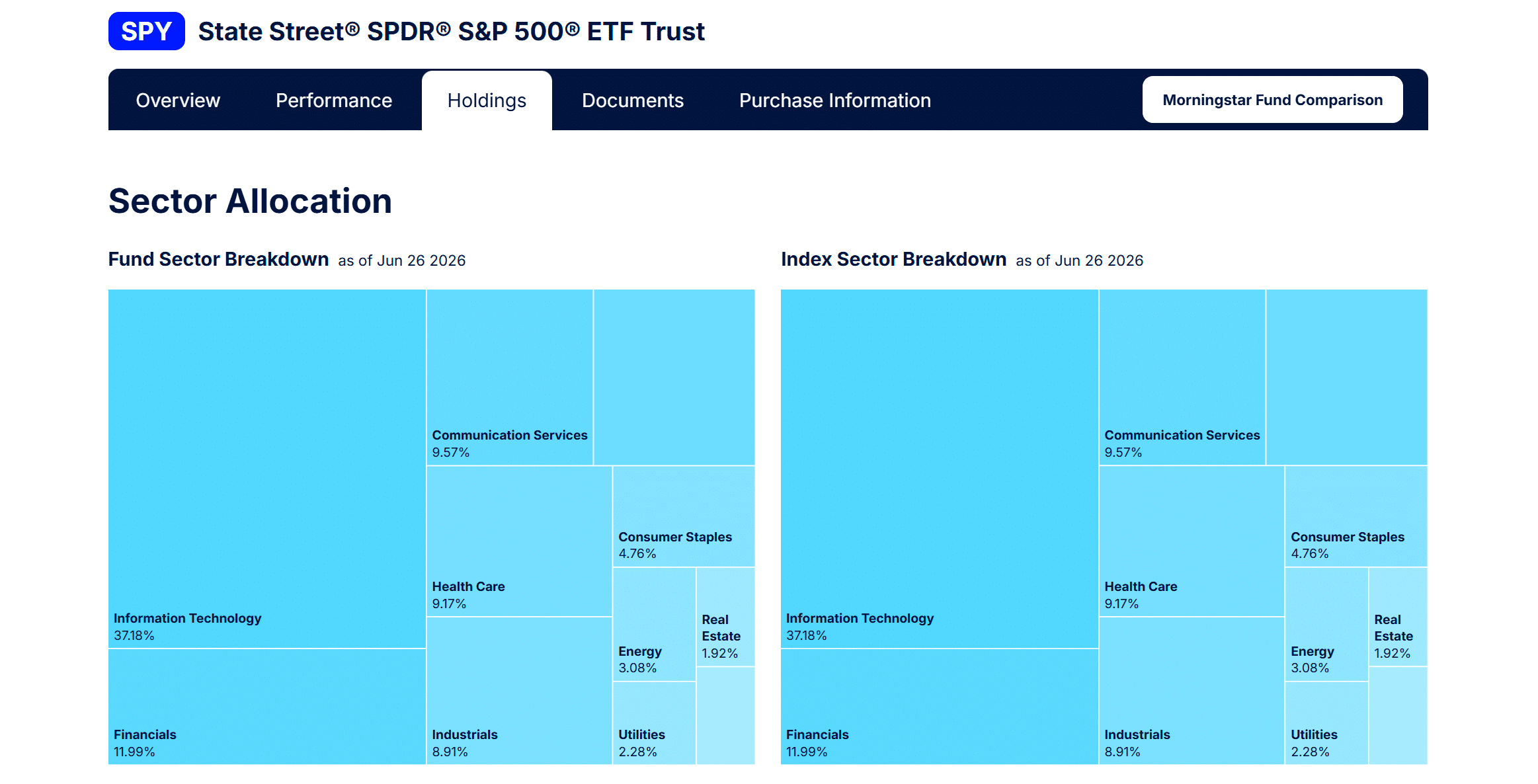
SPY does offer broad diversification across sectors of the US economy, including technology, healthcare, financials, consumer discretionary, communication services, industrials, energy, consumer staples, utilities, real estate, and materials. This sector breadth helps reduce exposure to sector-specific risks and promotes a balanced investment approach, although the index is currently heavily weighted toward technology and growth-oriented mega-cap names.
Cheapest brokers to invest in ETFs
Now that you know you can only invest in SPY (and not directly in SPX), it’s time to choose the right broker to execute your investment. We have evaluated the most important features across multiple ETF brokers and compiled a shortlist of four strong options available in the US, Canada, and other countries.
Without further delay, here are four ETF brokers worth considering:
- Interactive Brokers: best for the broadest ETF offering and global market access;
- eToro: best for social trading and commission-free real stock and ETF investing;
- Public.com: best for low-cost ETF trading with a focus on transparent fees;
- Questrade: best for Canadian residents.
Disclaimer: eToro is a multi-asset investment platform. The value of your investments may go up or down. Your capital is at risk. Other fees apply. For more information, visit etoro.com/trading/fees.
| Broker | ETF fees | Minimum Deposit | Number of ETFs | Regulators | Available Countries |
| Interactive Brokers | Varies by exchange with tiered Pricing:0.05% of Trade Value (min: €1.25, max: €29.00) | €/$/£0 | 13,000+ | FINRA, SIPC, SEC, CFTC, IIROC, FCA, CBI, AFSL, SFC, SEBI, MAS, MNB | US, Canada and other countries worldwide |
| eToro | $0 | $50 (varies between countries) | 300+ | SEC, FINRA, FCA, CySEC, ASIC | US and other countries, except Canada |
| Public.com | $0 | $0 | 45+ | FINRA and SIPC | US |
| Questrade | *$0 ($0.01 selling costs) | $1,000 | 1,800 | CIRO and CIPF | Canada |
*At Questrade, you can choose from 2 base currencies: USD (United States Dollar) and CAD (Canadian Dollar), which share the same symbol ($).
Conclusion
In summary, SPX represents the S&P 500 index and cannot be directly traded, while SPY is an ETF that tracks the S&P 500 and is tradable on the NYSE Arca exchange.
SPY offers direct tradability, quarterly dividend distributions, and exceptional liquidity, making it one of the most efficient ways to gain exposure to large-cap US equities. Both SPX and SPY are focused on the US stock market, with limited direct international exposure – though substantial indirect global exposure through multinational constituent companies.