SPY (SPDR S&P 500 ETF Trust) and VOO (Vanguard S&P 500 ETF) are two of the most popular ETFs tracking the S&P 500 Index. Their performance is nearly identical day-to-day, so the main differences come down to fees (TER), AUM, liquidity, and structure – which can make one or the other better suited to different investment strategies.
VOO has significantly lower fees (0.03% vs 0.09% for SPY) and is now the world’s largest ETF, with over $1 trillion in assets under management. In a landmark moment for the ETF industry, VOO became the first ETF ever to cross the $1 trillion AUM threshold on June 2, 2026, with peers SPY (~$785B AUM) and iShares Core S&P 500 ETF IVV (~$860B AUM) close behind. VOO had already overtaken SPY as the largest ETF roughly 18 months earlier, but the $1T milestone marks a historic moment for passive investing.
Even so, SPY remains the most heavily-traded ETF globally, with the deepest options market and tightest bid-ask spreads – making it the natural choice for active traders and options strategies.
In this article, we’ll cover the key differences and characteristics of these two ETFs so you can choose the one that best fits your goals in 2026.
SPY vs VOO compared in a nutshell
We have assembled all the information discussed throughout the article in this table so that you can make an informed decision.
| ETF | SPY | VOO |
| Full name | SPDR S&P 500 ETF Trust | Vanguard S&P 500 ETF |
| Index tracked | S&P 500 | S&P 500 |
| Fund manager | State Street Global Advisors (SPDR) | Vanguard |
| Inception date | January 1993 | September 2010 |
| AUM (June 2026) | ~$785 billion | ~$1 trillion+ (first ETF ever) |
| Fund currency | USD | USD |
| Dividend distribution | Distributing (quarterly) | Distributing (quarterly) |
| Dividend yield (approx, 2026) | ~1.06% | ~1.12% |
| Expense ratio (TER) | 0.0945% | 0.03% |
| Average daily volume | ~80 million shares (highest in world) | ~9 million shares |
| Fund structure | Unit Investment Trust (UIT) | Open-end fund |
| Best for | Active traders, options strategies, institutional flows | Long-term buy-and-hold investors prioritising low cost |
Performance
Overall, SPY and VOO deliver very similar returns since they track the same underlying S&P 500 Index. The slightly higher returns at VOO come almost entirely from its lower expense ratio (0.03% vs 0.09%) and its open-end structure (which allows faster dividend reinvestment and securities lending). VOO tracks the index marginally closer than SPY, with cumulative outperformance compounding meaningfully over multi-decade holding periods.
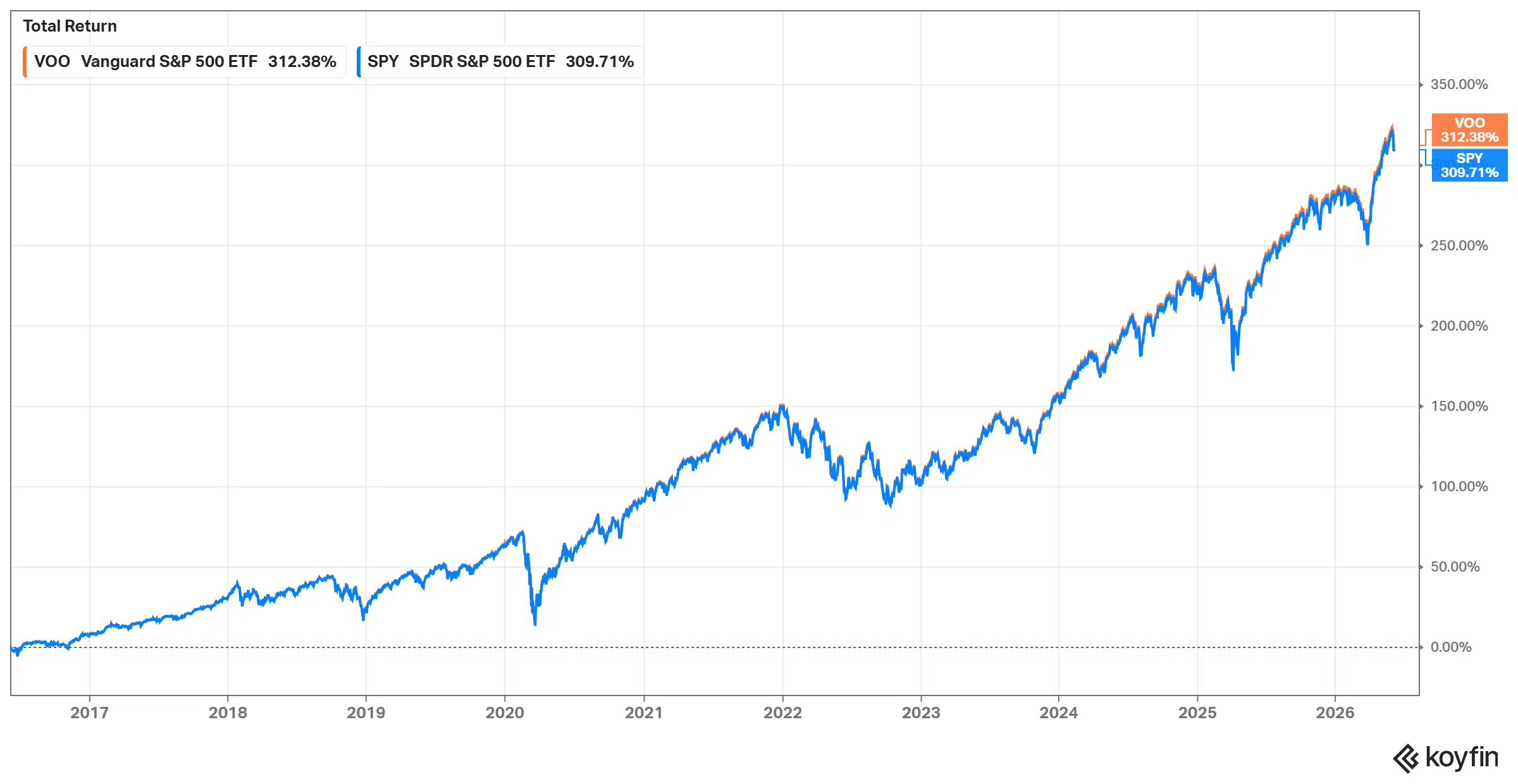
In the table below, you can see SPY and VOO’s annualised returns against the S&P 500 Index across various time horizons, accurate as of mid-2026. Returns shown are net of expenses and assume dividend reinvestment.
| ETF | 1-year return | 3-year return | 5-year return | 10-year return |
| SPY | ~25.18% | ~17.6% | ~14.0% | ~15.24% |
| VOO | ~25.29% | ~17.7% | ~14.1% | ~15.30% |
| S&P 500 Index | ~25.30% | ~17.7% | ~14.1% | ~15.35% |
Sources: SSGA SPY page and Vanguard VOO page. Data approximate as of mid-2026 – always verify on the official fund pages before investing. Past performance is not a reliable indicator of future returns.
The data confirms what the structural differences suggest: VOO marginally outperforms SPY across all time horizons, with the gap compounding over longer holding periods – precisely the 0.06% fee advantage plus minor tracking improvements from VOO’s open-end structure. For long-term investors, even this small annualised advantage translates to thousands of dollars in additional returns on substantial portfolios held for decades.
Overview
SPY: SPDR S&P 500 ETF Trust
Launched in January 1993 by State Street Global Advisors, SPY is the oldest ETF in the world – the original “exchange-traded fund” that pioneered the entire ETF industry. Its goal is to provide investment results that generally correspond to the price and yield performance of the S&P 500 Index. Despite no longer being the largest ETF by AUM (overtaken by VOO in early 2025), SPY remains the most heavily-traded ETF globally, with around 80 million shares changing hands daily – more than any other ETF. This depth of liquidity, combined with the world’s deepest ETF options market, makes SPY the default choice for active traders, options strategies, and institutional investors who need to move large positions quickly.
VOO: Vanguard S&P 500 ETF
Vanguard launched VOO in September 2010, making it considerably younger than SPY. Despite its relative newcomer status, VOO has grown rapidly thanks to its industry-low 0.03% expense ratio (three times cheaper than SPY) and Vanguard’s strong reputation for low-cost, investor-aligned products. In June 2026, VOO became the first ETF in history to cross $1 trillion in AUM – a landmark moment for the passive investing era. The structural choice of an open-end fund (rather than SPY’s Unit Investment Trust structure) also gives VOO slight operational advantages, including the ability to reinvest dividends faster and use securities lending to offset costs.
Index tracked
Both SPY and VOO aim to match the performance of the S&P 500 Index. If you’re looking to invest in the US stock market, both ETFs give you exposure to the 500 largest US-listed companies – which is precisely why they’re among the most popular ETFs in the world. Despite tracking the same underlying index, there can be tiny differences in the composition, weighting, and tracking accuracy between the two funds, driven mainly by fund structure (UIT vs open-end), cash management practices, and timing of dividend reinvestment – as you can see below.
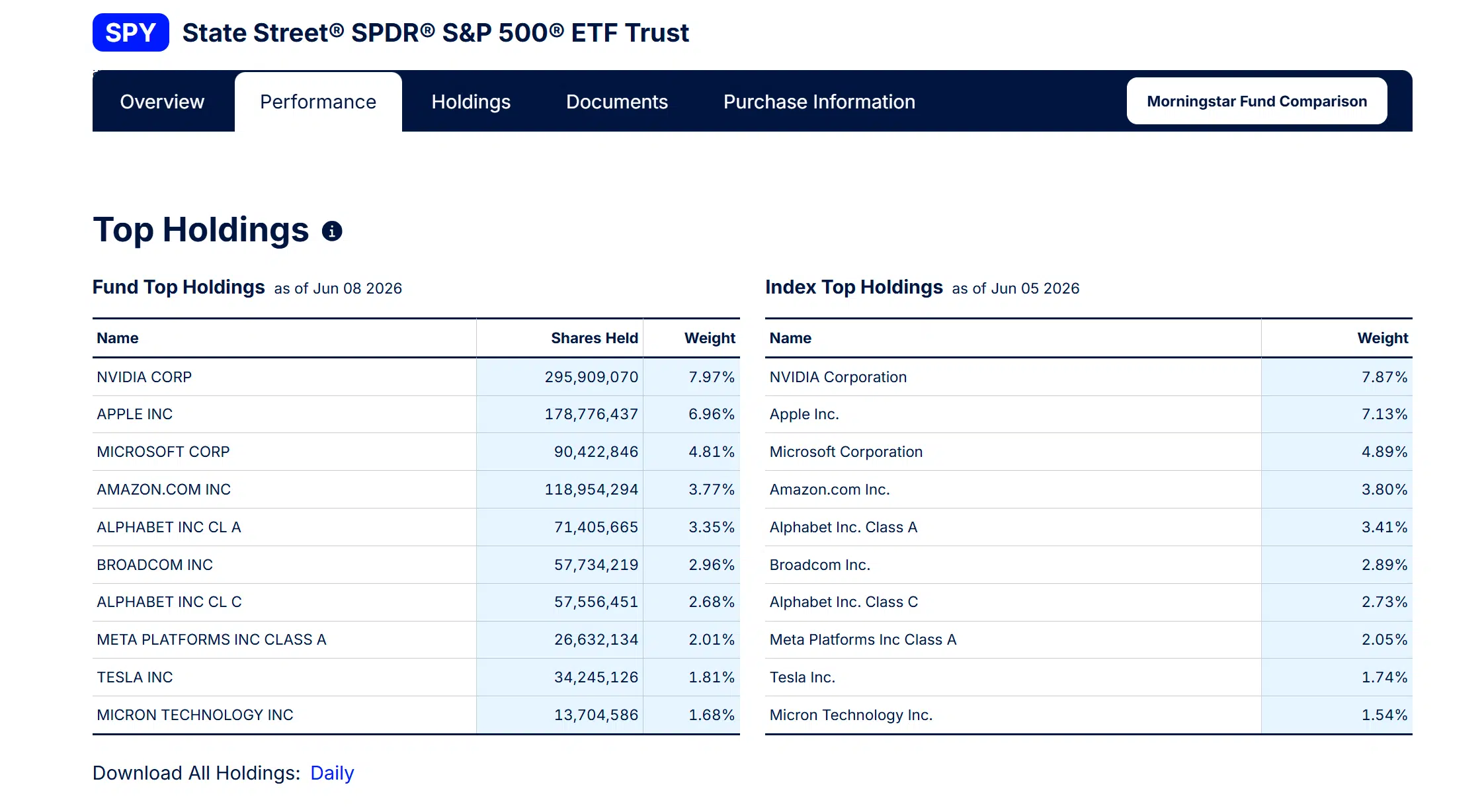
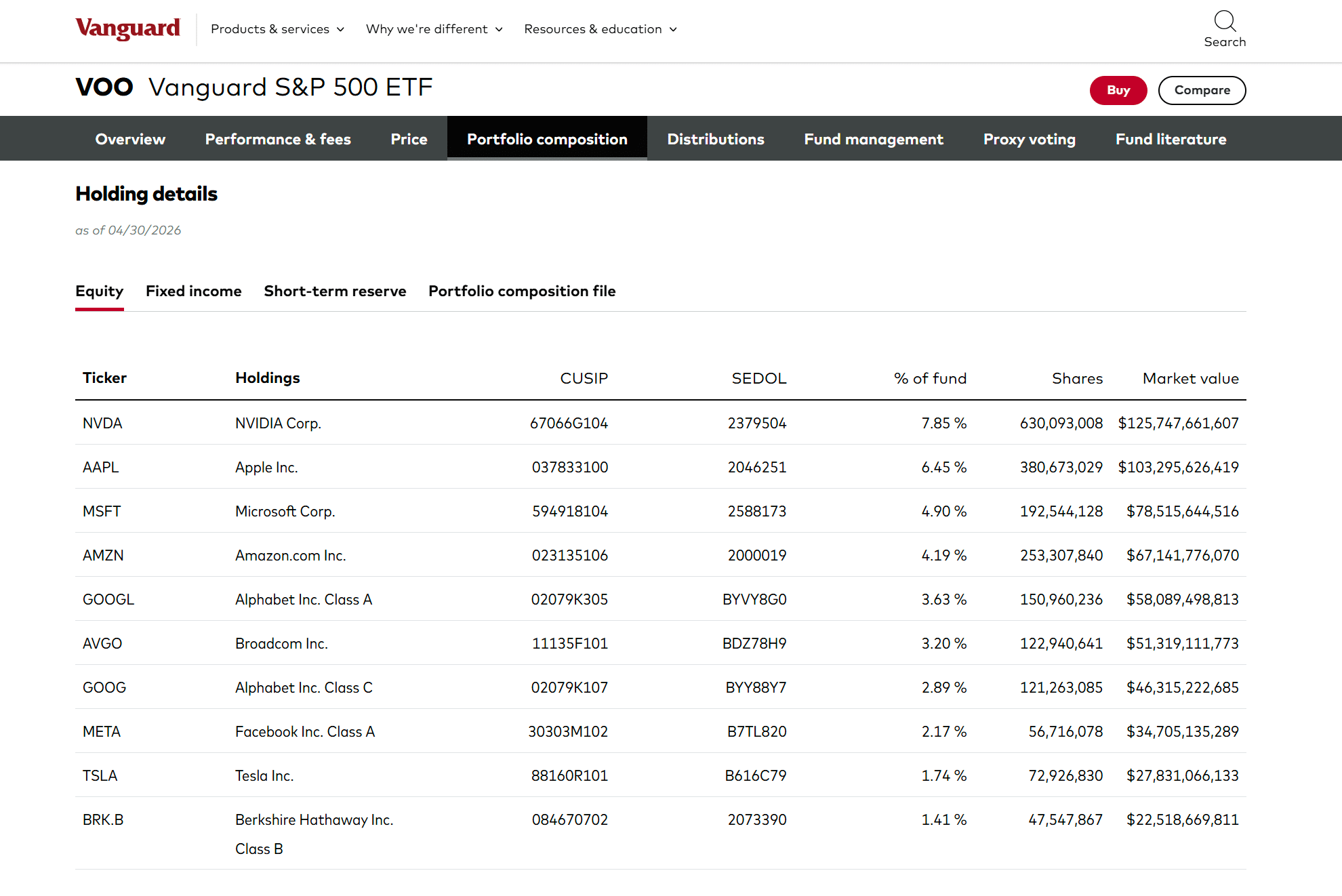
Both SPY and VOO are physically replicated ETFs – they hold the actual underlying stocks of the S&P 500 at the same market-capitalisation weights as the index, rather than using derivatives (such as total return swaps) to mirror index performance synthetically. This contrasts with synthetic ETFs like SPXP (Invesco S&P 500 UCITS ETF), which use swaps to replicate the index. For long-term US equity investors, physical replication is generally preferable because it removes counterparty risk and gives you genuine ownership exposure to the underlying companies.
Fund manager
SPY was launched in January 1993 by State Street Global Advisors (SSGA), the world’s fourth-largest asset manager with over $5 trillion in AUM. SPY is part of SSGA’s SPDR (“Spider”) ETF brand, which collectively manages over $1.4 trillion across more than 140 ETFs. As the first ETF ever created, SPY effectively launched the entire ETF industry – a 33-year-old fund that still trades more daily volume than any other ETF in the world.
VOO was launched in September 2010 by Vanguard, the world’s second-largest asset manager with over $10 trillion in AUM globally. Founded in 1975 by John C. Bogle, Vanguard pioneered the low-cost index fund and remains widely associated with the passive investing approach. Vanguard’s mutual structure (owned by its funds, which are in turn owned by their investors) gives it strong alignment with shareholder interests – one of the structural reasons Vanguard products like VOO are able to maintain such low expense ratios.
Distribution
Both SPY and VOO are distributing ETFs, meaning they pay dividends on a quarterly basis. This distribution policy can provide a modest, steady income stream from your investment. However, the dividend yield on both ETFs is relatively low (around ~1.1% annually as of 2026), since the S&P 500 is dominated by growth-oriented companies (technology, communications) that typically reinvest earnings rather than paying out high dividends. There is one small structural difference worth noting: VOO can reinvest dividends inside the fund faster thanks to its open-end structure, while SPY (as a Unit Investment Trust) is required to hold dividend cash before distributing it – creating a small “cash drag” that very marginally hurts SPY’s tracking during bull markets.
If you’re not a US resident, dividends paid by US-listed ETFs are subject to a 15% US dividend withholding tax under most tax treaties (or 30% if your country doesn’t have a tax treaty with the US), which further reduces the effective yield. UK and EU investors should also note that SPY and VOO are US-listed ETFs not available for retail purchase under PRIIPs regulation – so European retail investors typically need to use UCITS equivalents (e.g., SPYL, CSP1, VUSA, VUAG for S&P 500 exposure) instead.
Total Expense Ratio (TER)
The Total Expense Ratio (TER) reflects the annual cost an ETF charges for portfolio management, administration, marketing, distribution, and other operational expenses. This is one of the most important metrics for any long-term investor, since it directly reduces your net return – the higher the TER, the lower the compounded return for the investor over time.
| ETF | SPY | VOO |
| TER | 0.0945% | 0.03% |
VOO’s 0.03% expense ratio is among the industry’s lowest. SPY’s 0.0945% expense ratio is roughly three times higher than VOO’s. Although this difference may seem trivial in absolute terms, it compounds significantly over long holding periods. On a $100,000 position held for 30 years, the 0.06% fee difference compounds to several thousand dollars of foregone returns before any market movement is considered. For long-term buy-and-hold investors, this is the single most important factor in choosing between SPY and VOO – which is why VOO has been gaining AUM share consistently in recent years.
Liquidity
When choosing an ETF to invest in, liquidity matters because it determines how easily you can buy or sell at the price you want (i.e., with low spreads) and how quickly your order is filled. To measure ETF liquidity properly, you need to consider several factors. Here are the key indicators for SPY and VOO:
| Metric | SPY | VOO |
| Assets under management (AUM) | ~$785 billion | ~$1 trillion+ |
| Average daily volume (shares) | ~80 million | ~9 million |
| Average daily volume (dollar) | ~$50 billion+ | ~$6 billion+ |
| Average bid-ask spread | ~$0.01 (tightest in the industry) | ~$0.03 |
| Options market depth | Deepest of any ETF (millions of contracts daily) | Significantly smaller than SPY’s |
Source: ETF.com
These differences carry meaningful practical implications:
- For options trading and short-term strategies: SPY is clearly the better choice. Its ~80 million daily shares traded – the highest of any ETF in the world – combined with the deepest options market and tightest bid-ask spreads, makes it the default vehicle for covered calls, spreads, weekly options, and any strategy where execution quality matters. The 0.06% TER premium over VOO is well worth the liquidity advantage.
- For long-term buy-and-hold investing: VOO is the better choice. Its 0.03% expense ratio compounds significantly over decades, and the ~$0.02 wider average spread is irrelevant when you’re holding for years – you only pay the spread on the way in and on the way out.
- For institutional investors and active traders: SPY remains the go-to vehicle thanks to its unmatched trading volume and tighter spreads, which enable large positions to be moved with minimal market impact.
Higher trading volume generally translates to tighter bid-ask spreads and faster execution on large-volume orders without significantly impacting the price – which is precisely why active traders and options strategies continue to favour SPY even as VOO has overtaken it in AUM.
Sector diversification
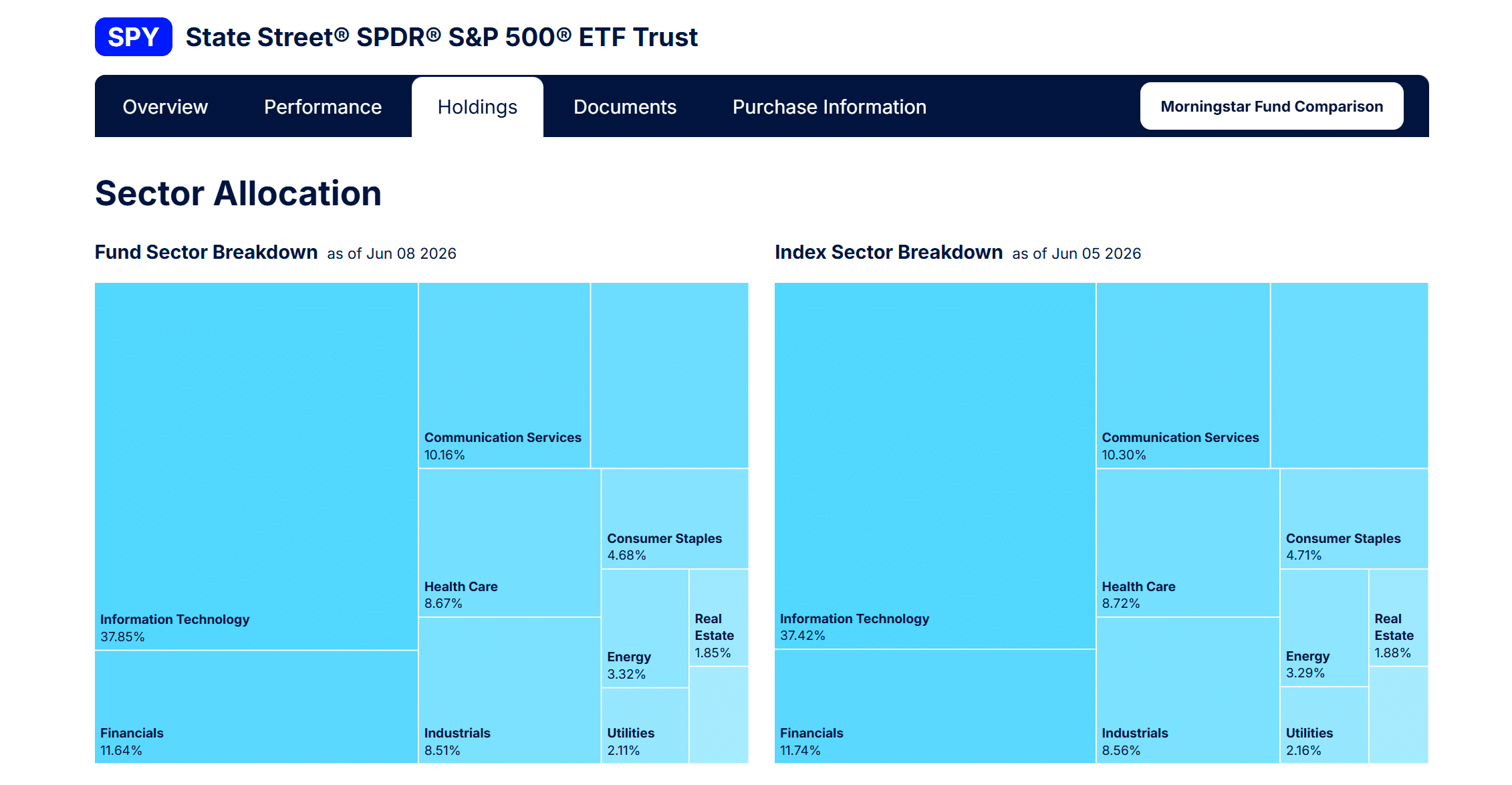
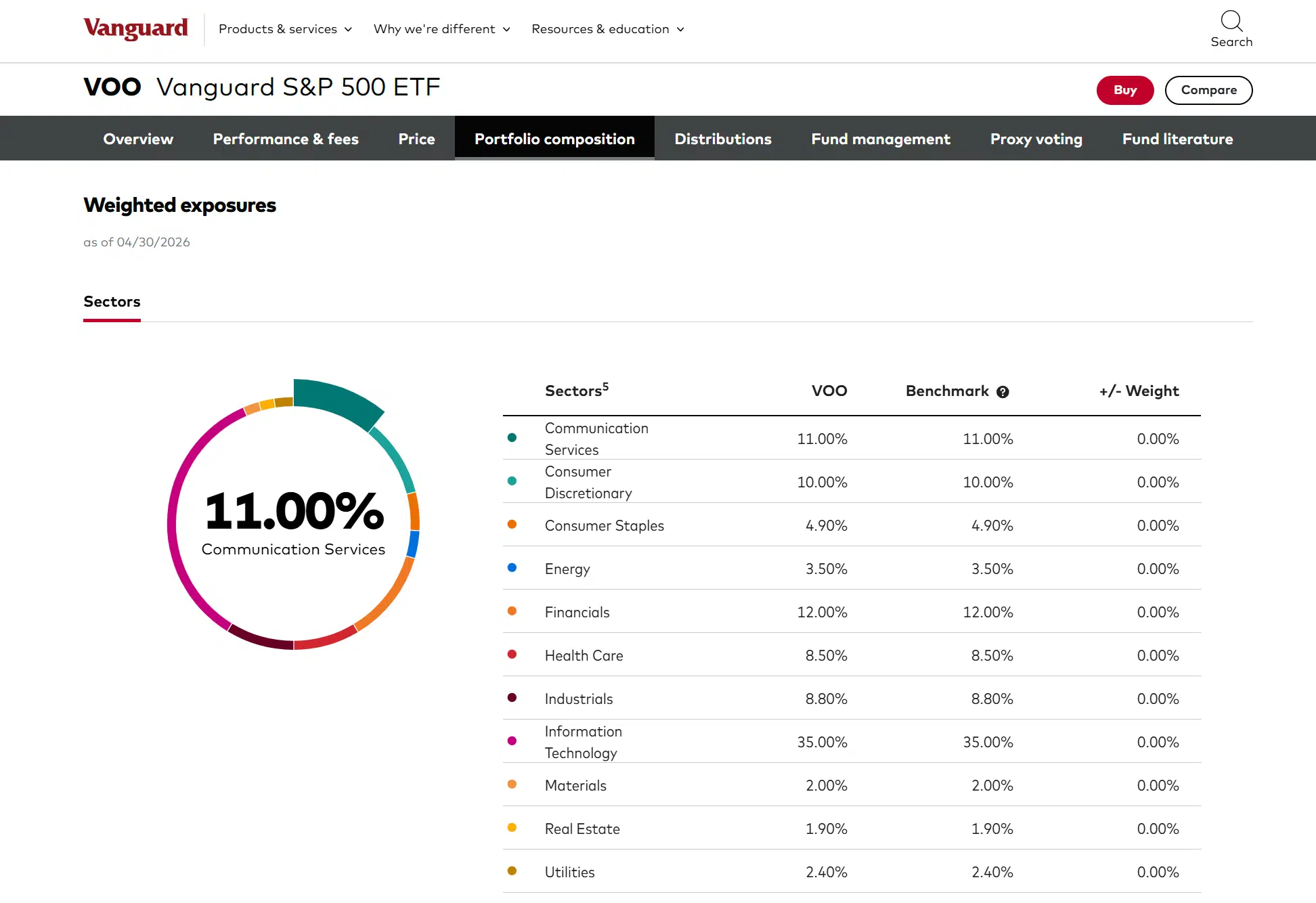
The S&P 500 Index is a diversified index that holds companies across all eleven GICS sectors, and therefore both ETFs try to replicate their weighting in the S&P 500 index, as you can see below:
Cheapest brokers to invest in SPY and VOO
Now that we’ve covered the differences between SPY and VOO, let’s look at where to actually invest in them. We’ve reviewed the most relevant ETF brokers offering access to SPY and VOO, focusing on cost, platform quality, and product range. The four standout options:
- eToro: best for social trading and commission-free real ETF investing.
- Interactive Brokers: best for the largest global ETF offering, lowest FX fees, and access to 150+ markets.
- Public.com: best for US-resident investors wanting commission-free trading and access to an investor community.
- Webull: best for low-commission ETF trading with strong mobile and desktop platforms.
Disclaimer: eToro is a multi-asset investment platform. The value of your investments may go up or down. Your capital is at risk. Other fees apply. For more information, visit etoro.com/trading/fees.
| Broker | ETF fees | Minimum deposit | Regulators |
| eToro | $0 (other fees apply) | $50 (varies between countries) | SEC, FINRA, FCA, CySEC, ASIC |
| Interactive Brokers | Free for US investors; Up to USD 0.0035 per stock (min: USD 0.35) for international investors | €/$/£0 | FINRA, SIPC, SEC, CFTC, IIROC, FCA, CBI, AFSL, SFC, SEBI, MAS, MNB |
| Public.com | $0 for US-listed stocks and ETFs during regular market hours; $2.99 per trade during extended hours for non-premium members | $0 | SEC, FINRA |
| Webull | $0 | $100 | SEC, FINRA, SIPC |
The bottom line
Both SPY and VOO offer a low-cost, efficient way to invest in a diversified portfolio of US large-cap equities – and given their near-perfect correlation, the practical difference between them is smaller than the comparison structure suggests. SPY has clear advantages in liquidity (the world’s most-traded ETF, ~80M daily shares, deepest options market, tightest bid-ask spreads), while VOO offers significantly lower fees (0.03% vs 0.09%), marginally better tracking thanks to its open-end structure, and a slightly higher dividend yield.
A quick framing to help narrow things down:
- Choose SPY if: you actively trade, run options strategies (covered calls, spreads, weeklies), need to move large positions quickly with minimal market impact, or value tight bid-ask spreads above lower fees.
- Choose VOO if: you’re a long-term buy-and-hold investor prioritising the lowest possible cost, you don’t trade frequently, or you want the marginal performance edge that compounds over decades.
- Either works well if: you’re building a long-term core US equity allocation – both ETFs are excellent S&P 500 vehicles.
The market has been steadily voting with its dollars: VOO became the first ETF in history to cross $1 trillion in AUM in June 2026, while SPY remains the dominant trading vehicle for the active and institutional investor community. Both are excellent in their respective lanes – the right answer depends on which lane you’re actually in.
Ultimately, the choice between SPY and VOO comes down to your specific investment style, time horizon, and how you actually intend to use the ETF. Consider factors like trading frequency, holding period, and broader portfolio strategy before making a decision.
This article is for informational purposes only and does not constitute investment advice. Past performance is not a reliable indicator of future returns – markets can go down as well as up. ETF availability, fees, and tax treatment vary by jurisdiction; UK and EU retail investors generally cannot purchase SPY or VOO directly under PRIIPs regulation and should consider UCITS equivalents. Always do your own research and consider consulting a qualified financial advisor about your specific situation.