


The S&P 500 is one of the world’s most widely tracked stock market indices, representing 500 of the largest publicly traded companies in the United States, including Apple, Microsoft, NVIDIA, Amazon, Alphabet, Meta and Tesla. Over the long term, it has delivered annualised returns of around 10% in US dollars (including dividends), which makes it a common core holding for investors who want exposure to US companies.
If you live in India, you can invest in the S&P 500, but the rules, costs and taxes are different from investing in the Indian market. You need to follow the Liberalised Remittance Scheme (LRS) of the Reserve Bank of India (RBI) and the Foreign Exchange Management Act (FEMA), account for Tax Collected at Source (TCS) and choose between several ways of investing.
In this guide, we explain step by step how to invest in the S&P 500 from India in 2026. We cover:
- The three main routes: buying S&P 500 ETFs listed in the US or Europe through an international broker under the LRS, investing through Indian mutual funds and ETFs (many of which are closed to new money because of overseas investment limits), and investing through platforms and funds in GIFT City, regulated by the International Financial Services Centres Authority (IFSCA).
- How to choose an S&P 500 ETF, comparing costs, size and how dividends are handled.
- How to choose a broker, including Interactive Brokers and Indian platforms that now offer US stocks.
- Rules and taxes: the LRS limit of US$250,000 per financial year, TCS on remittances, capital gains tax, US withholding tax on dividends, US estate tax and the Schedule FA disclosure in your tax return.
Whether you want to diversify beyond Indian stocks or gain direct exposure to large US companies, this guide will help you understand the trade-offs and pick the route that suits you.
How to invest in the S&P 500 from India (step-by-step guide)
1. Pick a fund or ETF tracking the S&P 500
Buying 500 stocks one by one would be costly and impractical. An exchange-traded fund (ETF) or index fund gives you the whole index in a single investment.
Indian funds: a few Indian funds give you exposure to the S&P 500 in rupees. However, Securities and Exchange Board of India (SEBI) rules cap how much Indian mutual funds can invest abroad (US$1 billion per fund house and US$7 billion for the whole industry), and these limits are close to fully used. As a result, many international funds have stopped or limited new investments. For example, the Motilal Oswal S&P 500 Index Fund has suspended lump-sum investments since 2022 and new SIPs since December 2024.
The table below shows the main funds that track the S&P 500 for Indian residents:
| Name | Type | Annual fee (TER) | Replication method | Fund size |
| Motilal Oswal S&P 500 Index Fund (Direct) | Mutual fund (closed to new investments) | 0.54% | Physical | ₹4,500+ Cr |
| Mirae Asset S&P 500 Top 50 ETF | ETF on NSE and BSE (tracks the 50 largest S&P 500 companies only) | 0.65% (June 2024) | Physical | ₹1,000+ Cr |
| Parag Parikh IFSC S&P 500 Fund of Fund | GIFT City fund in US dollars (invests in S&P 500 UCITS ETFs) | 0.30% (Direct) | Physical (through ETFs) | New fund (launched in 2026) |
Sources: Motilal Oswal and Value Research (October 2026), Mirae Asset factsheet (June 2024) and NSE data (October 2026), Parag Parikh (PPFAS) GIFT City. Check whether a fund is accepting new investments before you invest.
If you invest internationally under the LRS, you can buy the largest S&P 500 ETFs directly. Here are the biggest ones listed in the US:
| Name | ISIN | Ticker | Annual fee (TER) | Replication method | Use of income | Fund size (in $B) |
| Vanguard S&P 500 ETF | US9229083632 | VOO | 0.03% | Physical | Distributing | 1,000+ (all share classes) |
| iShares Core S&P 500 ETF | US4642872000 | IVV | 0.03% | Physical | Distributing | 890+ |
| SPDR S&P 500 ETF Trust | US78462F1030 | SPY | 0.0945% | Physical (UIT structure) | Distributing | 820+ |
| State Street SPDR Portfolio S&P 500 ETF | US78464A8541 | SPYM (formerly SPLG) | 0.02% | Physical | Distributing | 180+ |
Fund sizes from the issuers’ websites in October 2026 (Vanguard figure covers all share classes of the fund). Tickers are for the primary US listing.
US-listed or Irish UCITS ETFs? Indian investors can also buy S&P 500 ETFs domiciled in Ireland (UCITS ETFs), such as the iShares Core S&P 500 UCITS ETF (CSPX, ISIN IE00B5BMR087) or the Vanguard S&P 500 UCITS ETF in its accumulating version (VUAA, ISIN IE00BFMXXD54), through brokers like Interactive Brokers. They cost a little more each year, but they have two advantages for Indian residents:
- Lower withholding tax: US dividends paid to an Irish fund are taxed at 15%, while US ETFs held directly by an Indian resident suffer 25% US withholding tax under the India-US tax treaty.
- No US estate tax: if you are not a US resident and hold more than US$60,000 of US-situated assets, such as shares of US-listed ETFs, a US estate tax return may be required when you die, and the tax can be significant. Irish-domiciled ETFs are not US-situated assets.
Don’t worry if you are unfamiliar with “replication method” and “use of income“. We explain them later in this guide.
2. Choose a good broker and send money abroad
Once you have decided between Indian funds and international ETFs, you need a broker that gives you access to them. The table below compares a few options:
| Broker | Local Funds | International Funds | ETF Transaction Fees | Min. deposit | Number of ETFs |
| Interactive Brokers | ✔ | ✔ | US ETFs: $0.005 per share ($1 minimum, Fixed plan) | $0 | Thousands of ETFs worldwide |
| Zerodha | ✔ | ✘ | ₹0 on equity delivery | None | All ETFs listed on NSE and BSE |
| Upstox | ✔ | ✔ (US stocks through GIFT City) | ₹20 per executed delivery order | None | All ETFs listed on NSE and BSE |
Fees from the brokers’ websites, checked in October 2026.
Interactive Brokers serves Indian residents through Interactive Brokers (India) Pvt Ltd, regulated by SEBI. Indian residents can buy stocks, bonds and ETFs on foreign markets through it, but not futures, options or margin products.
Several Indian platforms, such as INDmoney, Vested and Upstox, now offer US stocks through brokers set up in GIFT City’s International Financial Services Centre (IFSC). This route still counts towards your LRS limit, and the same TCS rules apply.
Sending money abroad: to fund an international account, you remit money through your bank under the LRS, which allows up to US$250,000 per financial year. Your bank collects TCS of 20% on investment remittances above ₹10 lakh in a financial year (nothing up to ₹10 lakh). TCS is not an extra tax: you can claim it back against your income tax, but it ties up your money until then.
3. Place a buy order
Once your account is funded, you are ready to buy the S&P 500 ETF. In this example, we use Interactive Brokers, but the steps are similar with any broker:
a) Search for the S&P 500 ETF you have chosen
Use the search function and the ticker symbol to find the right ETF (in our example, we searched for SPY):
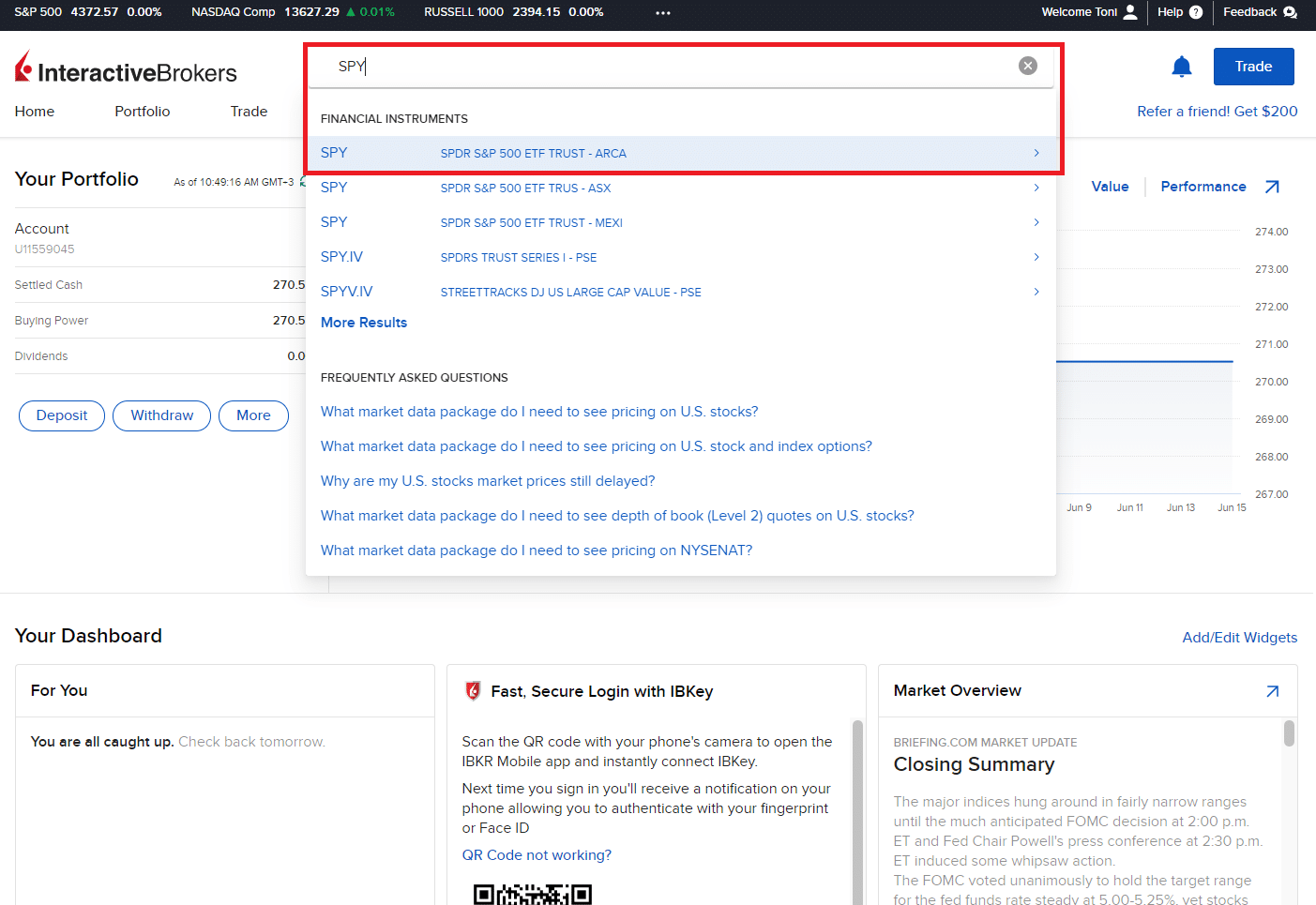
Your broker may offer the same ETF on several exchanges and in different currencies, such as USD or EUR. Choosing the version in your account currency helps you avoid currency conversion fees.
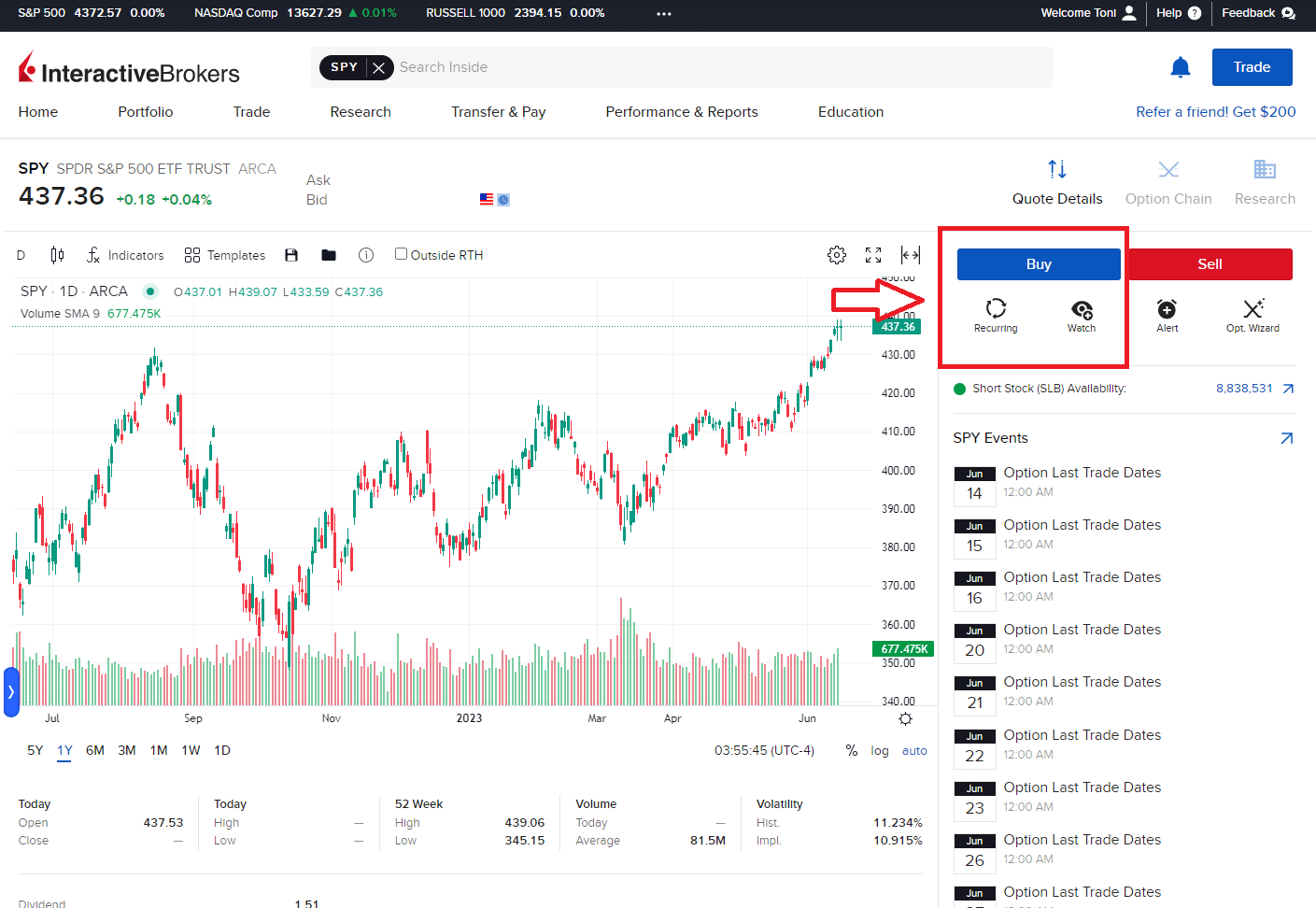
b) Click on “Buy”
You will usually find this button on the ETF page, next to the chart and the key information about the ETF.
c) Choose the order details
Now choose the order type and the amount:
- Limit order: the default on IBKR. You set the maximum price you are willing to pay, and the order only executes at that price or lower.
- Market order: buys immediately at the current market price.
- Amount or units: the amount of money or the number of shares you want to buy.

d) Place the order
Finally, click “Submit Buy Order”. The broker will then execute the trade according to your instructions.
What to look for in any ETF?
Not all ETFs are the same. Here are the factors to consider:
1. Fees (TER)
Fund managers charge an annual fee that is deducted from the fund’s assets. It is usually called the total expense ratio (TER) or ongoing charge (OCF). The lower it is, the more of the index return you keep. For Indian investors, also count the costs around the fund: broker commissions and currency conversion when you send rupees abroad.
2. Replication method
ETFs can use two replication methods:
- Physical replication: the fund buys the stocks in the index.
- Synthetic replication: the fund uses derivatives (swaps) to deliver the index return.
Given how liquid the S&P 500 companies are, most S&P 500 ETFs use physical replication.
3. Use of income
ETFs handle the dividends paid by the companies in the index in one of two ways:
- Accumulating ETFs reinvest dividends inside the fund, so you don’t receive cash payments. This mainly applies to UCITS ETFs listed in Europe, such as CSPX or VUAA. US-listed S&P 500 ETFs (VOO, IVV, SPY, SPYM) are distributing, because US tax rules require US funds to pay out most of their income.
- Distributing ETFs pay dividends, usually every quarter, into your brokerage account. In India, these dividends are taxable as foreign income.
For Indian investors, the choice largely depends on the route you take:
- If you buy US-listed ETFs under the LRS, you will hold distributing ETFs and receive dividends after US withholding tax.
- If you invest through Indian mutual funds or GIFT City funds, dividends are handled inside the fund.
- If you want accumulating ETFs, you need access to UCITS ETFs, which Interactive Brokers offers to Indian residents.
Tax treatment in India (2026)
Foreign stocks and ETFs are taxed differently from Indian equity ETFs. From 1 April 2026, the Income-tax Act 2025 replaced the Income-tax Act 1961, but the main rates for foreign shares were not changed by the 2026 Budget:
- Holding period: US-listed stocks and ETFs are treated like unlisted securities, so you need to hold them for more than 24 months (not 12 months, as for Indian listed shares) for long-term treatment.
- Long-term capital gains (LTCG): gains on holdings sold after 24 months are taxed at 12.5%, without indexation.
- Short-term capital gains (STCG): gains on holdings sold within 24 months are added to your income and taxed at your slab rate.
- Dividends: US dividends are subject to 25% US withholding tax under the India-US tax treaty (instead of 30%). They are then taxed in India at your slab rate, and you can claim a foreign tax credit (FTC) for the US tax already paid, so you don’t pay tax twice. From 1 April 2026, the FTC is claimed with Form 44, which replaced Form 67.
- Reporting: if you hold foreign assets, you must file ITR-2 or ITR-3 and disclose your foreign holdings in Schedule FA (based on the calendar year, January to December), foreign income in Schedule FSI and foreign tax credits in Schedule TR.
- TCS: nothing up to ₹10 lakh of investment remittances per financial year, then 20% on the amount above that. TCS can be claimed back against your tax liability.
Given the number of forms involved (W-8BEN to claim treaty benefits, Schedule FA, foreign tax credit claims) and the heavy penalties for not disclosing foreign assets under the Black Money (Undisclosed Foreign Income and Assets) and Imposition of Tax Act, 2015, it’s worth consulting a Chartered Accountant (CA) with experience in foreign investments.
4. Size
Larger funds generally carry a lower risk of being closed. If a fund is liquidated, it sells its holdings and returns the money to investors, which can trigger taxes and costs at a time you didn’t choose.
5. Hedging
Some ETFs use derivatives to hedge currency movements. This costs extra but reduces the effect of exchange rate changes. All the ETFs in the tables above are unhedged, so your returns in rupees depend on both the S&P 500 and the USD/INR exchange rate.
Bottom line
Investing in the S&P 500 from India is possible, but it takes more planning than buying Indian stocks. Here is a summary of the steps:
- Pick a fund or ETF tracking the S&P 500: choose between Indian funds (check whether they accept new investments), GIFT City funds and international ETFs such as VOO, IVV or the UCITS ETFs CSPX and VUAA.
- Find a suitable broker: compare commissions, currency conversion costs and the funds each one offers.
- Open an account and send money under the LRS: keep track of the US$250,000 annual limit and the TCS above ₹10 lakh.
- Place a buy order for the ETF you picked: search by ticker, choose the order type and submit.
Remember to report your foreign investments in your tax return every year. When investing, your capital is at risk.
FAQs
What is the S&P 500?
The S&P 500 is a stock market index that tracks the performance of 500 of the largest US companies.
Why would someone in India want to invest in the S&P 500?
Investing in the S&P 500 gives Indian investors exposure to large US companies and to the US dollar, diversifying a portfolio that is otherwise concentrated in Indian stocks and rupees.
Can I still invest in S&P 500 index funds in India?
Options are limited. Indian mutual funds face industry-wide limits on overseas investments, so many international funds, including the Motilal Oswal S&P 500 Index Fund, have stopped accepting new money. You can still buy the Mirae Asset S&P 500 Top 50 ETF on NSE and BSE, invest through GIFT City funds such as the Parag Parikh IFSC S&P 500 Fund of Fund, or buy S&P 500 ETFs directly through an international broker under the LRS.
Which brokers in India offer access to S&P 500 ETFs?
You can buy US-listed and UCITS S&P 500 ETFs through Interactive Brokers. Indian platforms such as INDmoney, Vested and Upstox offer US stocks and ETFs through GIFT City, while brokers like Zerodha give access to Indian ETFs listed on NSE and BSE.
Do I have to pay US estate tax on US ETFs?
It can apply. If you are not a US resident and hold more than US$60,000 of US-situated assets, including shares of US-listed ETFs, your heirs may need to file a US estate tax return. Irish-domiciled UCITS ETFs are not US-situated assets, which is one reason many Indian investors prefer them.
What is an Exchange Traded Fund (ETF)?
An exchange-traded fund (ETF) is an investment fund traded on a stock exchange like a share. It usually tracks an index, commodity, sector or asset class. With an S&P 500 ETF, you gain exposure to 500 companies in a single investment.
Can I trade Forex in India?
Yes, but with restrictions. Indian residents can only trade the currency derivatives allowed by the RBI (mainly rupee pairs and a few major cross pairs) on recognised Indian exchanges, and dealing with unauthorised brokers can lead to penalties. Read our article on the best forex brokers in India for more details.



