Bonds have regained their appeal as an income-generating asset. At the start of 2022, a six-month US Treasury bill yielded 0.22%. On 29 September 2026, according to the US Treasury, the six-month bill yielded 4.36% and the 10-year Treasury 5.26%, a big shift from the low-rate decade that preceded it.
While US residents can buy Treasuries directly through TreasuryDirect, the route is less straightforward for European and UK investors. The good news is that it remains entirely possible to invest in US Treasury bonds from Europe and the UK, through the secondary market or through ETFs.
In this article we provide a step-by-step guide on how European and UK investors can invest in US Treasury bonds, including T-bills and T-notes. We also cover the currency risk and tax considerations that apply, which matter more than most guides acknowledge.
Video summary
What are US Treasury bonds?
US Treasury bonds are debt securities issued by the United States Department of the Treasury to finance government operations and public spending. Backed by the full faith and credit of the US government, they are widely regarded as having very low credit risk. However, the US no longer has a top credit rating from any of the three main agencies: Moody’s downgraded it to Aa1 in May 2025, and S&P and Fitch rate it AA+.
Treasuries (except T-bills and inflation-linked TIPS) carry a fixed interest rate and maturities ranging from a few weeks to thirty years. They are sold at auction and can be bought by individuals, corporations, and foreign governments. Interest earned is exempt from US state and local taxes, though this exemption is of limited relevance to European and UK investors, who are taxed under their own country’s rules rather than US state law.
Treasury bonds vs Treasury notes vs Treasury bills
All three are issued by the US Treasury and differ principally in maturity:
- Treasury bills (T-bills) have the shortest maturities, typically one year or less, and are sold at a discount to face value rather than paying periodic interest. Your return is the difference between the purchase price and the face value at maturity.
- Treasury notes (T-notes) mature in 2 to 10 years and pay interest every six months.
- Treasury bonds (T-bonds) have the longest maturities, from 20 to 30 years, and also pay interest every six months.
One point worth understanding before choosing: longer maturities carry greater interest rate risk. If rates rise after you buy, the market value of a 30-year bond falls far more than that of a 6-month bill. Investors who held long-dated Treasuries through the 2022 rate-hiking cycle experienced double-digit losses despite holding what is often described as a risk-free asset. You avoid that loss only if you hold the bond to maturity.
How to buy US Treasury bonds from Europe and the UK
US citizens can invest directly through TreasuryDirect.gov. European and UK residents are not eligible to open an account there, so the practical options are buying on the secondary market or investing through bond exchange-traded funds.
Before covering the mechanics, two considerations specific to non-US investors:
- Currency risk: Treasuries are denominated in US dollars. If you are based in the eurozone or the UK, your actual return combines the bond yield with the EUR/USD or GBP/USD movement over your holding period. A 5% yield can easily be wiped out by a 5% move in the exchange rate, so consider whether you want that exposure or would prefer a currency-hedged ETF.
- Tax treatment: interest from Treasuries is generally not subject to US withholding tax for non-resident investors under the portfolio interest exemption, provided a valid W-8BEN is on file (see IRS Publication 515). However, the income remains taxable in your country of residence. UCITS bond ETFs may be treated differently again depending on where you live, so check your local rules.
Note that some brokers do not support these products. Below we focus on Interactive Brokers, eToro, and Freedom24.
Option 1: buy US Treasury bonds on the secondary market
Interactive Brokers allows you to invest in T-bills and Treasury bonds on the secondary market. Treasury markets are highly liquid with tight spreads, and IBKR charges a commission of 0.002% of face value on the first $1 million (minimum $5) on its fixed pricing plan.
Interactive Brokers offers access to over 1 million bonds, covering US government securities, corporate bonds, municipals, and more. The Bond Scanner tool lets you filter by maturity, yield, and coupon, and compare pricing against other venues.
Since bonds are classified as complex instruments, you will need to request bond trading permission in your IBKR account settings before placing a trade. It is a simple request in the account settings, but you need to make it in advance.
Here is an example of a US Treasury listing on IBKR’s web platform:


Option 2: Buy US Treasury bond ETFs
When choosing a US government bond ETF, look at two numbers. Yield to maturity is the expected annual return if the bonds are held until they mature. Duration measures how sensitive the ETF is to interest rates: with a duration of 7, a 1 percentage point rise in rates would cut the ETF’s value by about 7%.
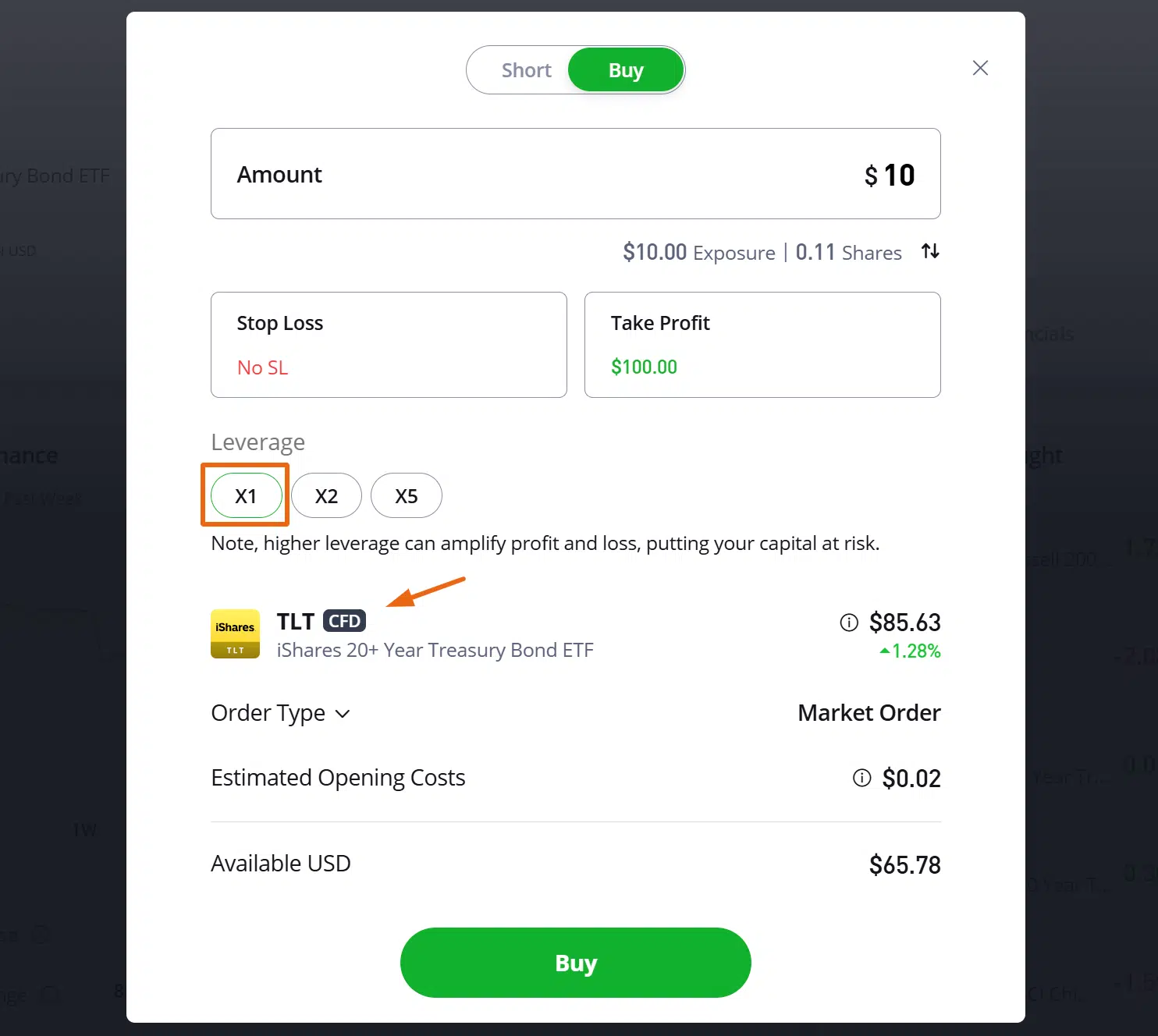
As an eToro user in the EU or UK, you can get exposure to some of the biggest US Treasury ETFs, but only through CFDs, because EU rules restrict direct investment in US-domiciled ETFs. Here is an example for T-bills, T-notes and T-bonds:
1. SPDR Bloomberg 1-3 Month T-Bill ETF (BIL):

2. iShares 1-3 Year Treasury Bond ETF (SHY):

3. iShares 20+ Year Treasury Bond ETF (TLT):

With these three ETFs on eToro, you trade CFDs and do not own the ETF. According to eToro, non-leveraged buy positions do not incur overnight fees, so an unleveraged CFD should track the ETF closely. eToro also lists UCITS Treasury ETFs such as IB01 and IBTA. CFDs are complex instruments and come with a high risk of losing money rapidly due to leverage. 51% of retail investor accounts lose money when trading CFDs with this provider.
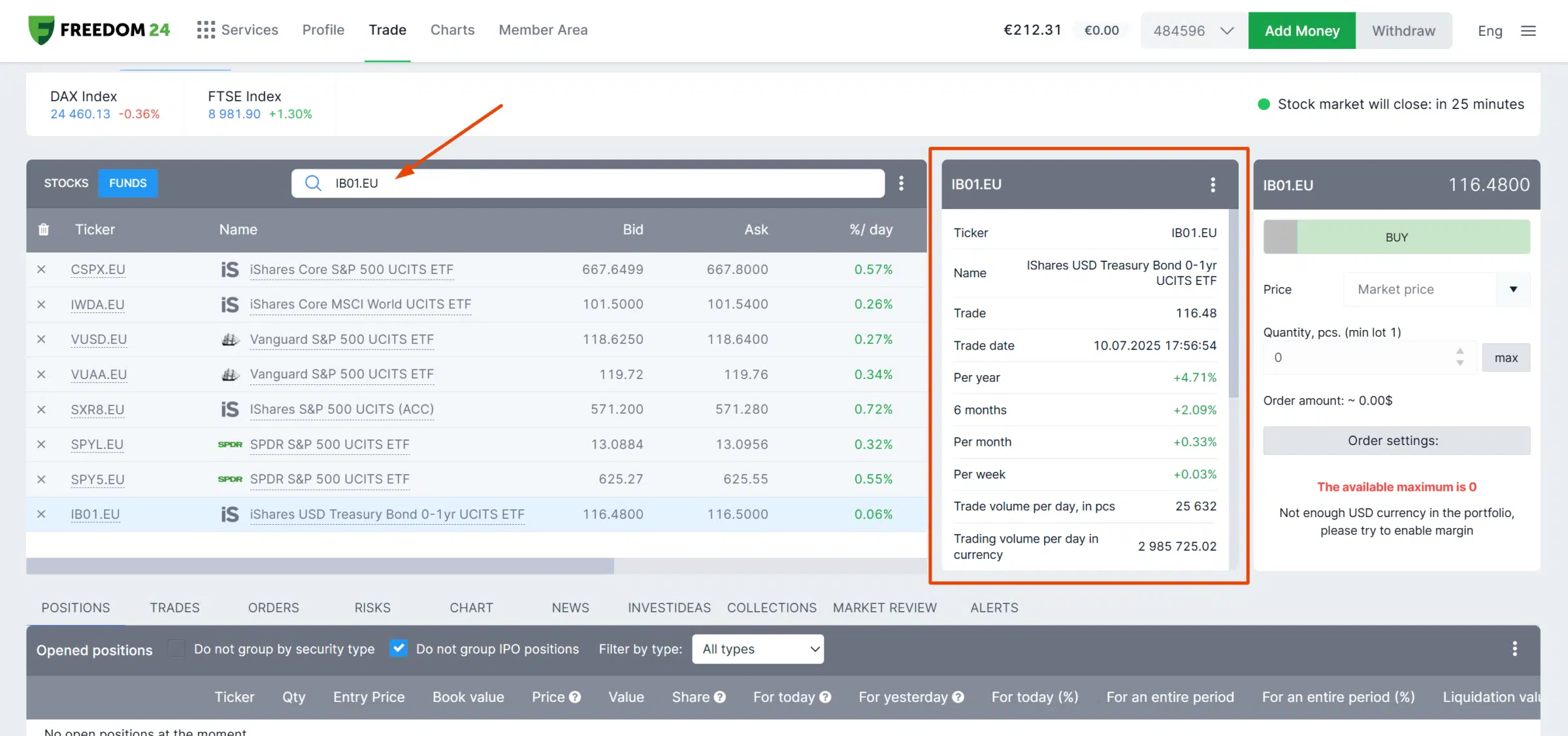
If you are a Freedom24 user, you have the option to purchase a variety of bond ETFs, such as the iShares USD Treasury Bond 0-1yr UCITS ETF (Acc), IE00BGSF1X88, which invests in US Treasuries maturing within a year. It is one of the largest Treasury UCITS ETFs, with a 0.07% TER and more than $28 billion in the fund (September 2026):
Freedom24 also offers a Bond Showcase for European clients, a curated list of bonds rated B+ and above, with denominations from $1,000. Until 31 October 2026, new clients can also get up to 20 gift shares worth $3 to $800 each, depending on their deposit (terms apply).
To reduce currency risk, you can also buy currency-hedged US Treasury ETFs. Some examples from iShares:
| ETF | Ticker | Hedged to | TER |
| iShares $ Treasury Bond 1-3yr EUR Hedged (Acc) | IBTE (2B7S on Xetra) | EUR | 0.10% |
| iShares $ Treasury Bond 1-3yr GBP Hedged (Dist) | IBTG | GBP | 0.10% |
| iShares $ Treasury Bond 3-7yr GBP Hedged (Dist) | CBUG | GBP | 0.10% |
| iShares $ Treasury Bond 7-10yr GBP Hedged (Dist) | IGTM | GBP | 0.10% |
| iShares $ TIPS 0-5 GBP Hedged (Dist) | TI5G | GBP | 0.12% |
Source: iShares, September 2026. TI5G holds inflation-linked Treasuries (TIPS). Hedging has a cost, which depends on the interest rate gap between the two currencies.
You can also invest in unhedged ETFs if you accept the currency risk. If your account is in EUR and you invest in USD, you will have to convert your money, and the broker will charge a currency conversion fee.
Several UCITS ETFs that hold US bonds trade in USD, GBP and EUR. However, if you have an IBKR or Freedom24 account, which lets you convert currencies at a low cost, there is little difference between these listings, since the currency exposure is the same.
Pros and cons of investing in US Treasury Bonds from Europe & the UK
Pros
-
High credit quality: US Treasuries are backed by the US government, rated Aa1/AA+, and the risk of default is very low.
-
Liquidity: the Treasury market is one of the largest and most liquid in the world.
- Lower volatility: short-dated Treasuries have historically fluctuated much less in price than stocks.
Cons
-
Interest rate risk: As interest rates rise, the price of your bonds will fall.
-
Inflation risk: the interest may not compensate for inflation.
-
Currency risk: unless you use a hedged ETF, changes in the exchange rate between the USD and the EUR or GBP can add to or reduce your return.
- Historically lower returns: In the long run, bonds tend to perform worse than other riskier asset classes.
Bottom line
Investing in US Treasuries from Europe and the UK is straightforward, and with yields around 4% to 5% in September 2026, they again offer a meaningful income. Using a platform like Interactive Brokers, investors can access the US Treasury market and purchase Treasury Bonds and T-Bills on the secondary market. Alternatively, a Treasury ETF gives you exposure to many bonds of a chosen maturity range in a single trade.
Consider the risks, especially currency risk and interest rate risk. The yield to maturity and duration of an ETF will help you judge its expected return and how much its price can move.
Overall, US Treasuries can diversify a portfolio and provide steady income, but their value in your currency can still fall. When investing, your capital is at risk.