Are you confused about whether to choose Trading 212 vs Trade Republic as a broker for your investing needs?
In this side-by-side comparison, we analyse Trading 212 vs Trade Republic to help you understand how these apps compare on some of the most common features and make a better-informed decision about the best broker for you.
Below, you’ll find the pros and cons of each broker, as well as a comparison table that features the different fees charged, the financial instruments supported, the regulation, and more. Keep reading!
Trading 212 vs Trade Republic
- Trading 212 is best for commission-free stock, ETF and crypto trading (Other fees may apply. See terms and conditions);
- Trade Republic is best for beginners and creating savings plans with stocks/ETFs
Both platforms are quite similar: they offer high interest on your cash balances, as well as a debit card. They are both user-friendly and nice brokers for investors. We believe that Trading 212 has a slight edge.
Trading 212 offers a free fractional share* (with our promo code IITW) while Trade Republic has a banking license, which means more protection for your cash balances.
Continue reading to know more (and read our review on Trading 212 as well)!
*Sponsored Link. To get free fractional shares worth up to 100 EUR/GBP, you can open an account with Trading 212 through our link.
Side-by-side comparison
| Category | Trading 212 | Trade Republic |
| Demo account | Yes | No |
| Account minimum | €/£10 | €0 |
| Interest on uninvested cash (annually) | EUR: 2.20%; USD: 3.30%; GBP: 3.80% | EUR: 3.00% |
| US stocks fees | €/£0 | €/$/£0+ €1 settlement fee per trade |
| EU stock fees | €/£0 | €/$/£0+ €1 settlement fee per trade |
| ETFs | €/£0 | €/$/£0+ €1 settlement fee per trade |
| Currency conversion fee | 0.15% (0.50% in CFDs) | 0% |
| Regulators | FCA, CySEC, BaFin, ASIC | BaFin |
Which is cheaper: Trading 212 or Trade Republic?
For most retail investors, Trading 212 is cheaper for one-off trades, while Trade Republic is cheaper for automated savings plans.
Trading 212 charges €0 in commissions on stocks and ETFs, with no per-trade settlement fee. Trade Republic also advertises “€0 commissions”, but applies a €1 external fee on every single trade (except savings plans), which means a buy-and-sell round trip costs at least €2.
However, Trade Republic flips the equation when it comes to recurring investments. Its savings plans are completely free on more than 2,500 ETFs and thousands of stocks, with no €1 external fee applied. Trading 212 has its own equivalent feature (Pies & AutoInvest), which is also commission-free, but does not offer the same depth of fractional ETF coverage for traditional DCA strategies.
On currency conversion, Trading 212 charges 0.15% FX when buying assets in a currency other than your base account currency (0.50% on CFDs). Trade Republic does not charge an explicit FX fee, but only operates in EUR (and PLN for Polish residents), which means you have no choice when buying US stocks – the conversion is built into the spread.
Practical example: for an investor making 5 buy-and-sell trades per month of €500 each in US stocks, Trading 212 charges roughly €0 in commissions plus ~€1.50 in FX fees (€3.75/year per €500), while Trade Republic charges ~€10 in external fees (€1 × 10 trades). For the same investor doing automated monthly investments of €500 in a global ETF via savings plan, Trade Republic charges €0 while Trading 212 also charges €0 via AutoInvest, making them equivalent.
Verdict: if you trade actively, Trading 212 wins on cost. If you invest passively via savings plans, both are essentially free.
Which is safer: Trading 212 or Trade Republic?
Both brokers are safe and regulated by reputable European authorities, but they differ in one important way: Trade Republic has a full banking license, while Trading 212 is regulated as an investment firm.
Trade Republic Bank GmbH holds a German banking license supervised by BaFin (the German Federal Financial Supervisory Authority) and the Deutsche Bundesbank. This means cash deposits held with Trade Republic are protected by the German Deposit Guarantee Scheme up to €100,000 per client – the same protection you would get with a traditional bank. Investments (stocks, ETFs, bonds) are held in a separate custody account and protected by the German Investor Compensation Scheme up to €20,000.
Trading 212 operates through several entities depending on your country: Trading 212 UK Ltd (regulated by the FCA), Trading 212 Markets Ltd (regulated by CySEC in Cyprus), and Trading 212 GmbH (regulated by BaFin in Germany). Each entity falls under its respective investor compensation scheme: up to £85,000 under the UK FSCS, up to €20,000 under the Cypriot ICF, and up to €20,000 under the German ESF. Cash balances at Trading 212 are typically held in segregated client accounts at top-tier banks and, in some cases, invested in Qualifying Money Market Funds (QMMFs) – which is how the broker pays interest on uninvested cash.
The practical difference: if you keep large cash balances at the broker (over €20,000), Trade Republic offers stronger protection thanks to the German Deposit Guarantee Scheme. For investments themselves, both brokers offer equivalent protection up to roughly €20,000-€85,000 depending on the entity.
Verdict: both are safe for typical retail investors. Trade Republic has the edge for clients holding significant cash balances at the broker, while Trading 212 is regulated by more authorities across more jurisdictions, which some investors view as a stronger sign of operational maturity.
Which is better for ETF investing?
For passive ETF investors following a Bogleheads or buy-and-hold strategy, both brokers are excellent choices, but they suit slightly different styles.
Trade Republic is purpose-built for ETF savings plans. It offers more than 2,500 ETFs available via free, automated savings plans with fractional shares from as little as €1 per execution. You can set up monthly (or weekly, biweekly, quarterly) automatic purchases of major ETFs like VWCE, IWDA, EUNL, SXR8, and most other popular UCITS ETFs, with no commission and no €1 external fee. This makes it arguably the most cost-effective platform in Europe for traditional dollar-cost averaging into broad-market ETFs.
Trading 212 approaches ETF investing differently through its Pies & AutoInvest feature. A “Pie” is a customizable basket of stocks and ETFs where you define the target allocation (for example, 60% VWCE, 30% bonds ETF, 10% gold ETC), and the platform automatically rebalances new contributions to maintain the allocation. This gives you more flexibility for building thematic or multi-asset portfolios, but requires slightly more setup. Trading 212 also offers commission-free one-off ETF purchases without external fees, which Trade Republic does not.
Where each broker shines:
- Choose Trade Republic if you want to “set and forget” a single ETF or a small handful of ETFs with monthly contributions, and you value the simplicity of a savings plan that runs automatically with zero fees
- Choose Trading 212 if you want to build customized multi-ETF portfolios with automatic rebalancing, or if you also want access to a demo account to practice before investing real money
Cost comparison for €500/month into VWCE:
- Trade Republic via savings plan: €0 commission, €0 external fee, no FX fee = €0 total cost per month
- Trading 212 via AutoInvest: €0 commission, no FX fee (VWCE is EUR-denominated) = €0 total cost per month
For most Bogleheads-style investors, the two brokers are essentially equivalent on cost. The decision comes down to which interface and feature set you prefer.
About Trading 212
Trading 212 is a fintech based in London that aims to democratize the entire investment process through a simple web and mobile application.
The company aims to do this by allowing its more than 5 million users to invest in over 10,000 stocks and ETFs, Forex, commodities, CFDs, and cryptocurrencies.
You will find commission-free stocks and ETFs trading, fractional shares, and even an automatic investment system. New users get one free fractional share worth up to €100 (promo code IITW). On the downside, it shows limitations regarding available products.

Disclaimer: Pies & Autoinvest is an execution-only service. Not investment advice or portfolio management. Automatic investing refers to executing scheduled deposits. You are responsible for all investment and rebalancing decisions.
Trading 212 pros and cons
Pros
- Commission-free real stock, ETFs and crypto trading (other fees may apply. See terms and fees)
- AutoInvest & Pies feature (execution-only service, not financial advice)
- Fast and easy account opening process
- Demo account
- Top Tier Regulators
- Free fractional shares worth up to €100
- High interest on uninvested cash
Cons
- Limited product portfolio (no Options, Bonds, Mutual Funds or Futures)
- No relevant Fundamental tools
- 0.15% of Foreign exchange fees
About Trade Republic
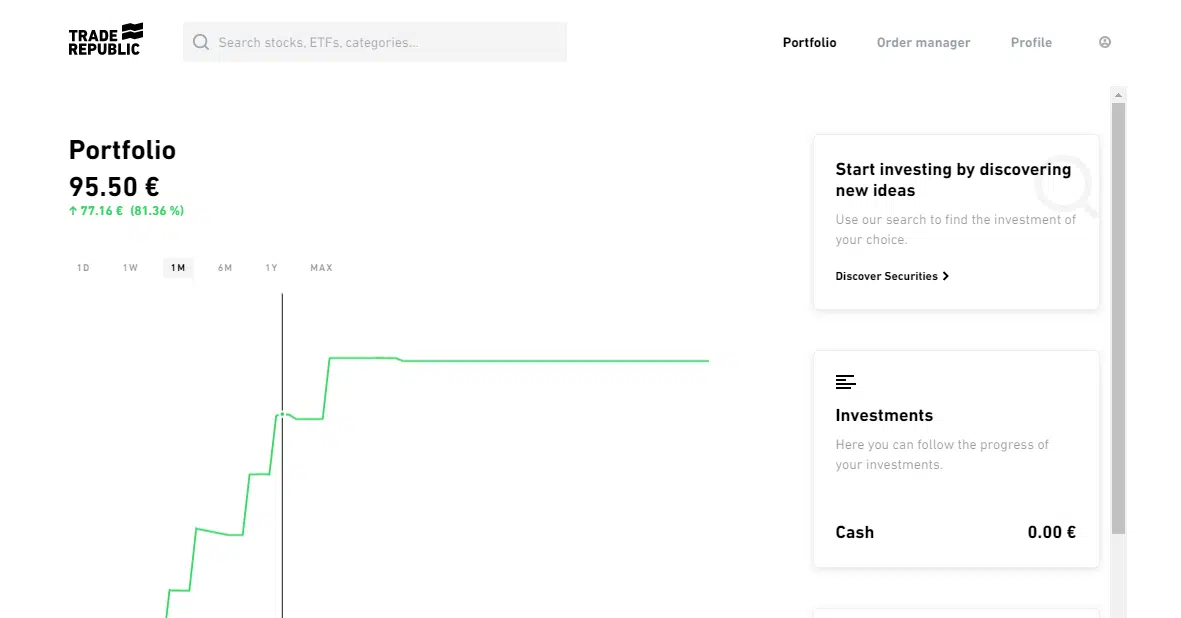
Trade Republic is a discount broker based in Berlin, Germany. It focuses on four types of financial assets: stocks, ETFs, cryptocurrencies, and derivatives.
It uses the motto “From the people, for the people” to express its commitment to its customer by selling itself as a “no order fee” platform.
Nonetheless, a €1 external fee is applied in every single trade (Except saving plans), meaning that in practice, you will charge at least €2 (€1 for buying and another €1 for selling).
Trade Republic pros and cons
Pros
- Automatic saving plans
- Interest paid in idle cash balances
- Invest from only €1
- No minimum deposit
- Direct debit in the share-saving plans
- Supervised and regulated by a top-tier regulator
- Has a banking license - deposits are protected by deposit guarantee scheme
Cons
- €1 flat external fee in every single trade (Except saving plans)
- No demo account
- Only one base currency (EUR), except in Poland where it accepts Zloty.
- No direct access to US Stock Exchanges - you might not be able to buy some popular US-listed companies, such as Reddit
- Currency conversion fees apply
- Engages in PFOF - Payment for Order Flow
How to invest in the S&P 500 on Trading 212 and Trade Republic (videos)
If you’re still unsure about which platform to choose, check our videos where we explain step-by-step how to invest in the S&P 500 on Trading 212 and on Trade Republic:
Trade Republic vs Trading 212: our veredict
Trading 212
Best for commission-free stock and ETF tradingTrade Republic
Best for beginners and creating savings plans with stocks/ETFs
Choosing between these two online brokers isn’t always an obvious decision. The differences between Trading 212 vs Trade Republic come from the trading platforms, products, fees, and security. Do you prefer a primary trading platform? Do you want to invest in ETFs only? Do you value security more?
Ultimately, the best online broker for you will depend on your profile, personal preferences, and objectives. Explore the websites above and decide for yourself!
Want to know more about Trading 212 vs Trade Republic? Explore our in-depth broker reviews, comparison table, and BrokerMatch tool. For example, you can find comparisons between Trading 212 and DeGiro or, alternatively, compare it with Revolut’s trading platform
Frequently asked questions
Can I have both a Trading 212 and a Trade Republic account?
Yes, there is no restriction on holding accounts at both brokers simultaneously. Many investors actually do this to diversify counterparty risk and to take advantage of each broker’s strengths – for example, using Trade Republic for automated ETF savings plans and Trading 212 for one-off trades or its demo account.
Do Trading 212 and Trade Republic offer fractional shares?
Yes, both brokers offer fractional shares. Trading 212 allows you to buy fractions of shares from as little as €1 across most stocks and ETFs in its catalog. Trade Republic offers fractional shares specifically through its savings plans feature, where you can invest as little as €1 per execution into ETFs and individual stocks.
Can I transfer my portfolio from Trading 212 to Trade Republic (or vice versa)?
In-kind portfolio transfers between brokers are technically possible in the EEA, but in practice both Trading 212 and Trade Republic have historically had limited support for incoming or outgoing transfers. The most common path is to sell your positions on one broker, transfer the cash, and rebuy on the other – bearing in mind the potential tax implications of realizing gains.
Does Trading 212 or Trade Republic offer a debit card?
Yes, both brokers offer debit cards. Trade Republic’s card includes a 1% saveback feature, where 1% of your card spending is automatically invested into a savings plan of your choice (capped at a monthly amount). Trading 212 offers a debit card with cashback rewards on certain spending categories. Both cards are linked to your investment account’s cash balance.
Which broker has higher interest on uninvested cash?
Interest rates change frequently and depend on the underlying central bank rates. As of April 2026, Trading 212 typically offers slightly higher rates on EUR cash than Trade Republic, but Trade Republic passes through the full ECB Deposit Facility Rate without a spread on cash held above certain thresholds. Always check both brokers’ current rates directly before choosing based on interest alone.
Is Trade Republic available in the UK?
No. Trade Republic does not currently serve UK residents, and there is no public timeline for a UK launch. UK residents looking for a similar mobile-first broker can consider Trading 212, Lightyear, Freetrade, or Interactive Brokers UK.
Does Trading 212 charge withdrawal fees?
No. Trading 212 does not charge withdrawal fees regardless of the method used (bank transfer, card, Apple Pay, Google Pay).
Can I trade options on Trading 212 or Trade Republic?
No. Neither broker offers traditional exchange-listed options. Trade Republic offers leveraged derivatives like warrants and knockout certificates, which serve a similar purpose for retail traders but are structurally different from listed options. Trading 212 does not offer derivatives beyond CFDs.
Which broker is regulated by more authorities?
Trading 212 is regulated by more authorities (FCA in the UK, CySEC in Cyprus, BaFin in Germany, ASIC in Australia) than Trade Republic, which is regulated solely by BaFin and the Deutsche Bundesbank under its German banking license. However, more regulators is not necessarily better – a single tier-1 regulator like BaFin provides comprehensive oversight on its own.
Are deposits insured at Trading 212 and Trade Republic?
Yes, but through different schemes. Trade Republic cash deposits are protected up to €100,000 by the German Deposit Guarantee Scheme thanks to its banking license. Trading 212 cash is held in segregated accounts at partner banks and protected up to €20,000 (CySEC), €20,000 (BaFin), or £85,000 (FCA) depending on the entity, plus additional protection on cash invested in QMMFs.