


Not sure whether to choose XTB or Trade Republic for your investments?
In this side-by-side comparison, we look at fees, products, interest on cash and regulation, as well as the pros and cons of each broker.
XTB vs Trade Republic
- XTB is best for commission-free stocks and ETFs and for active traders
- Trade Republic is best for beginners, earning interest and building savings plans with stocks and ETFs
Side-by-side comparison
| Category | XTB | Trade Republic |
| Demo account | Yes | No |
| Account minimum | €/$/£0 | €0 |
| Interest on uninvested cash (annually) | EUR: 2.30%, USD: 3.45%, GBP: 4.00%Rates for UK clients (GIA accounts) as shown on XTB’s UK website, last set on 13 January 2026. Rates vary by entity and can change weekly. | EUR: 2.50%ECB deposit facility rate since 16 September 2026. New clients in several countries (not Germany) get a promotional 3.00% on up to €50,000. |
| US stock fees | €/$/£0Up to €100,000 of monthly volume. A 0.2% fee (minimum €10) applies above that amount. | €0Plus a €1 external fee per order (free in savings plans). |
| EU stock fees | €/$/£0Up to €100,000 of monthly volume. A 0.2% fee (minimum €10) applies above that amount. | €0Plus a €1 external fee per order (free in savings plans). |
| ETFs | €/$/£0Up to €100,000 of monthly volume. A 0.2% fee (minimum €10) applies above that amount. | €0Plus a €1 external fee per order (free in savings plans). |
| Fractional shares | Yes | Yes (savings plans from €1) |
| Savings plans | Yes (ETF investment plans) | Yes (stocks, ETFs and crypto, free executions) |
| Currency conversion fee | 0.5% (0.8% at weekends and on holidays) | No conversion (trades in EUR) |
| Regulators | KNF, FCA, CySEC, DFSA, FSCA and FSC | BaFin and Bundesbank (full banking licence) |
Fees and rates from the brokers’ websites as of 8 October 2026. Hover over the values for details.
About XTB
XTB is a well-known online broker founded in 2004, listed on the Warsaw Stock Exchange, with more than 2.9 million clients. It offers its xStation platform on web, desktop and mobile, more than 11,700 instruments depending on the country, and good customer service.
Besides real stocks and ETFs with no commission up to €100,000 a month, XTB offers fractional shares, ETF investment plans, interest on uninvested cash and contracts for difference (CFDs) on forex, indices, commodities and crypto. xStation is one of the best apps for charts and technical analysis, with dozens of indicators and simple order placing.
On the downside, XTB charges a 0.5% currency conversion fee (0.8% at weekends and on holidays) when you buy assets in a different currency, and an inactivity fee of up to €10 a month after 365 days without trading and no deposit in the last 90 days.
If you want to dig deeper into this platform, read our full XTB review.

XTB pros and cons
Pros
- Free stocks trading (only applicable to some countries)
- Customizable trading platform (charts and workspace)
- Low Forex Spreads
- Demo account
- No minimum account deposit
- Valuable education materials
- Top-tier Regulators
Cons
- Complex trading platform for a beginner
- High Stock CFD spreads
- Limited product portfolio
- Withdrawal fees for transfers below $100
- Inactivity fee (€10/monthly after 1+ year with no activity plus no deposit in the last 90 days)
About Trade Republic
Trade Republic is a Berlin-based broker and bank, founded in 2015, with more than 10 million customers in 18 European countries. It offers stocks, ETFs, bonds, crypto, derivatives and savings plans, as well as a current account and a card with 1% Saveback invested into your savings plans.
It has no order commissions, but a €1 external fee applies to every one-off order (savings plans are free). In practice, a buy and a later sale cost at least €2 in total.
Cash earns the European Central Bank (ECB) deposit facility rate, 2.50% since 16 September 2026, and new clients in several countries (not Germany) get a promotional 3.00% on up to €50,000.
Trade Republic has a full German banking licence and is supervised by BaFin and the Bundesbank. Cash is protected up to €100,000 by the German deposit guarantee scheme.
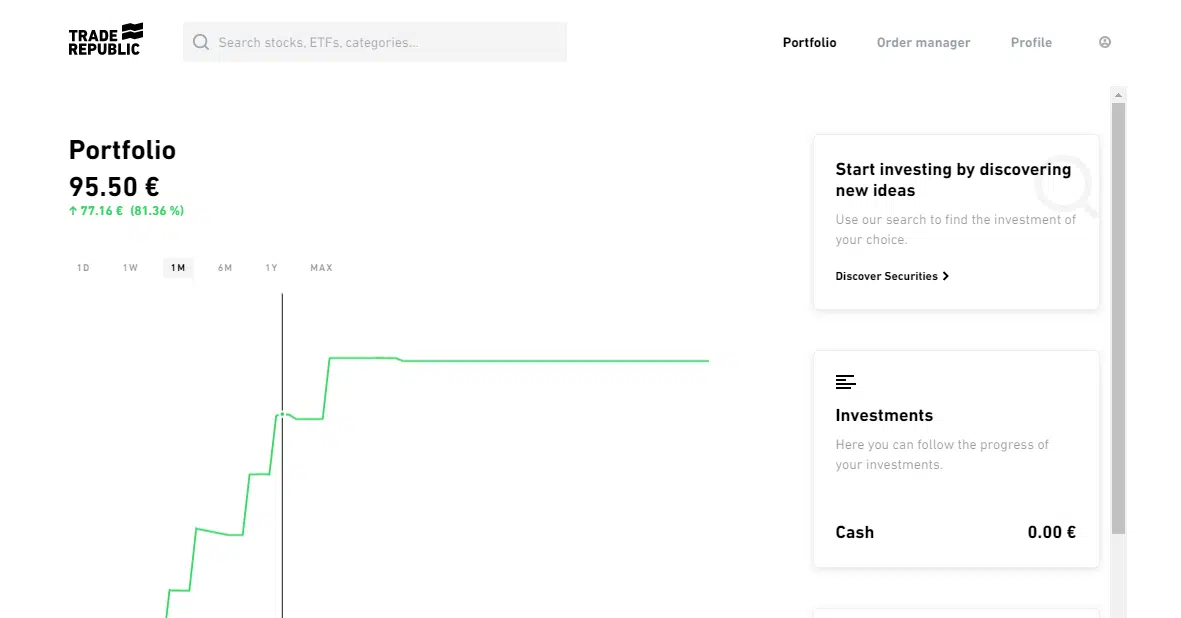
Trade Republic pros and cons
Pros
- Automatic saving plans
- Interest paid in idle cash balances
- Invest from only €1
- No minimum deposit
- Direct debit in the share-saving plans
- Supervised and regulated by a top-tier regulator
- Has a banking license - deposits are protected by deposit guarantee scheme
Cons
- €1 flat external fee in every single trade (Except saving plans)
- No demo account
- Only one base currency (EUR), except in Poland where it accepts Zloty.
- No direct access to US Stock Exchanges - you might not be able to buy some popular US-listed companies, such as Reddit
- Currency conversion fees apply
- Engages in PFOF - Payment for Order Flow
How to invest in the S&P 500 on XTB and Trade Republic (videos)
If you’re still unsure which platform to choose, watch our step-by-step videos on how to invest in the S&P 500 on XTB and on Trade Republic:
XTB vs Trade Republic: our verdict
XTB
Best for commission-free stocks and ETFs and for active tradersTrade Republic
Best for beginners and savings plans with stocks/ETFs
Choosing between these two brokers isn’t always obvious. The main differences come down to the platform, products, fees and interest:
- Choose XTB: if you want commission-free stocks and ETFs with no fee per order (up to €100,000 a month), a more advanced platform with a demo account, or access to CFDs.
- Choose Trade Republic: if you mainly want to invest through savings plans, keep your cash in a German bank earning interest, and avoid currency conversion, as long as you’re comfortable with the €1 fee on one-off orders.
The best broker for you depends on your profile, preferences and goals.
Want to know more? Explore our in-depth broker reviews, comparison table and BrokerMatch tool.
You can also read our comparison between XTB and Trading 212 or see how XTB compares with Interactive Brokers.
When investing, your capital is at risk and you may get back less than invested. Past performance doesn’t guarantee future results. CFDs are complex instruments and come with a high risk of losing money rapidly due to leverage. You should consider whether you understand how CFDs work and whether you can afford to take the high risk of losing your money.



