Investing through index funds and ETFs (Exchange-Traded Funds) is one of the most effective ways to gain passive, diversified exposure to global markets – whether you’re targeting broad indices like the S&P 500 and MSCI World, specific regions or sectors, bonds, commodities, or thematic strategies. For European investors, ETFs have become the default building block for low-cost, long-term portfolios.
That said, understanding how to buy ETFs in Europe can feel slightly confusing at first – especially since the rules differ for European investors versus those buying directly from the US. Following the introduction of PRIIPs and MiFID II disclosure rules, European retail investors generally cannot purchase US-domiciled ETFs (like SPY, QQQ, or VTI) and need to use UCITS-compliant European-domiciled versions instead.
This article walks you through everything you need to know about investing in index funds and ETFs from Europe – the rules, the differences between UCITS and US ETFs, key things to look for in an ETF, and how to actually place your first trade. Let’s build that wealth!
How to buy ETFs in Europe (step-by-step)
Sometimes people can make the investing process more complex than it needs to be. So, here’s a straightforward step-by-step guide explaining how you can invest in ETFs in Europe:
1. Choose an ETF
You have plenty of choices available, and you don’t have just to pick ETFs that track European markets. If you want, you can invest in ETFs that track investments or stock markets in the UK, Europe, the US, emerging markets like China, or even a global index fund. An example of a famous ETF is the S&P 500 (which we’ve covered in our article about how to invest in the S&P 500 from Europe).
The right Europe ETF for you will depend on your individual investing strategy and what your goals are. If you’re in need of some inspiration, one of the best ways to find an ETF that suits your needs is to look at the biggest and most popular ETFs available.
Looking at the most popular ETFs available to European investors will give you an idea about what other investors are doing, revealing the most popular index investing options.
Here’s what the biggest European ETFs look like right now in terms of assets under management (AUM) with data taken from justETF.com:
| Name | ISIN | Ticker | Annual fee (TER) | Replication method | Use of income | Fund size (€ billions) |
| iShares Core S&P 500 UCITS ETF | IE00B5BMR087 | CSPX | 0.07% | Physical | Acc | 119+ |
| iShares Core MSCI World UCITS ETF USD | IE00B4L5Y983 | SWDA | 0.20% | Physical | Acc | 115+ |
| Vanguard S&P 500 UCITS ETF | IE00B3XXRP09 | VUSA | 0.07% | Physical | Dist | 42+ |
| iShares Core MSCI Emerging Markets IMI UCITS ETF | IE00BKM4GZ66 | EIMI | 0.18% | Physical | Acc | 33+ |
| Invesco S&P 500 UCITS ETF | IE00B3YCGJ38 | SPXS | 0.05% | Synthetic | Acc | 29+ |
| Vanguard FTSE All-World UCITS ETF | IE00B3RBWM25 | VWRL | 0.14% | Physical | Dist | 20+ |
| iShares Core FTSE 100 UCITS ETF | IE0005042456 | ISF | 0.07% | Physical | Dist | 18+ |
| Xtrackers MSCI World UCITS ETF 1C | IE00BJ0KDQ92 | XDWD | 0.12% | Physical | Acc | 17+ |
| iShares Core S&P 500 UCITS ETF USD | IE0031442068 | IUSA | 0.07% | Physical | Dist | 17+ |
| iShares Core Euro Corporate Bond UCITS ETF | IE00B3F81R35 | IEAC | 0.09% | Physical | Dist | 8+ |
*Each ETF has different tickers. We decided to choose one of them and analyse it for simplicity reasons. Nonetheless, we encourage you to go to justetf.com, search for each ETF using the ISIN code, select it and look for the tab “Listing”. There, all tickers will be presented.
2. Select a broker to invest in ETFs
A broker is the platform that lets you buy and sell ETF shares – effectively an intermediary between you and the stock exchange where the ETF is listed.
Not every European broker gives you access to every ETF on the market. Once you’ve decided on the ETF you want to invest in, your next step is to find a brokerage that offers it – ideally one that’s both well-regulated and competitively priced.
Cost matters because low fees are one of the biggest reasons to choose ETFs in the first place. You don’t want to undo a 0.07% ETF TER advantage by paying high broker commissions, FX conversion fees, or platform fees – so look at the all-in cost (transaction commission + spread + FX conversion + any custody or platform fee). For long-term investors making regular contributions, even small recurring fees compound into meaningful drag over decades.
Also worth checking:
- Tax-wrapped accounts available in your country (ISA/SIPP in the UK, IKE/IKZE in Poland, ISK/KF in Sweden, aktiesparekonto in Denmark, PEA in France, etc.) – these can significantly improve long-term returns.
- Fractional shares and recurring investing (AutoInvest/Pies, Investment Plans) – useful if you want to dollar-cost-average without large minimum trade sizes.
- Available exchanges – same ETF can often be bought on multiple European exchanges (Xetra, Euronext, LSE, Borsa Italiana, SIX), sometimes in different currencies; buying in your home currency can avoid FX conversion fees.
Here’s a breakdown of some of the best ETF brokers in Europe:
| Broker | ETF fees | Min. deposit | Number of ETFs | Key regulators |
| eToro | $0 commission on real ETFs (USD base currency, FX fees apply) | $50 (varies by country) | 500+ | FCA, CySEC, ASIC |
| DEGIRO | €0 on Core Selection ETFs + €1 handling fee per trade; small annual exchange-connection fee on non-domestic exchanges | €0.01 | 5,000+ | BaFin (DE), DNB, AFM (NL) |
| BUX | €0 commission (other fees apply on some products) | €1 | 300+ | AFM, BaFin |
| Trading 212 | €/$/£0 commission (0.15% FX fee) | €/$/£1 | 13,000+ | FCA, CySEC, BaFin, ASIC |
| Interactive Brokers | Tiered: 0.05% of trade value (min €1.25, max €29) on EU ETFs; from $0.0035/share on US ETFs | €/$/£0 | 13,000+ | SEC, FINRA, SIPC, FCA, CBI, ASIC, MAS, SFC, CIRO |
| XTB | €0 on real ETFs up to €100k monthly turnover (then 0.2%, €10 min) | €0 | 500+ | FCA, KNF, CySEC, DFSA, FSC (Belize) |
| Lightyear | €0 commission (0.35% FX fee, capped at €1 per trade) | €1 | 5,000+ stocks and ETFs | EFSA (Estonia), FCA (UK) |
*XTB only offers ETFs in Portugal, Italy, Poland, Slovakia, the Czech Republic, France, Spain, Romania, and Germany.
Disclaimer: Investing involves risk of loss.
3. Buy your ETF
All you have to do is find the ETF within your chosen broker and place a buy order. For this example below, we’ll use DEGIRO.
a) Search for your ETF – for example CSPX:
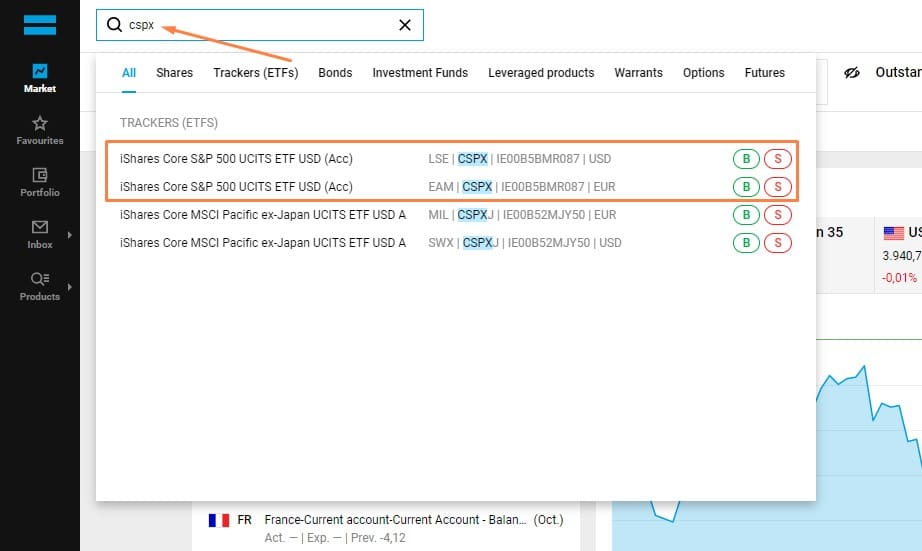
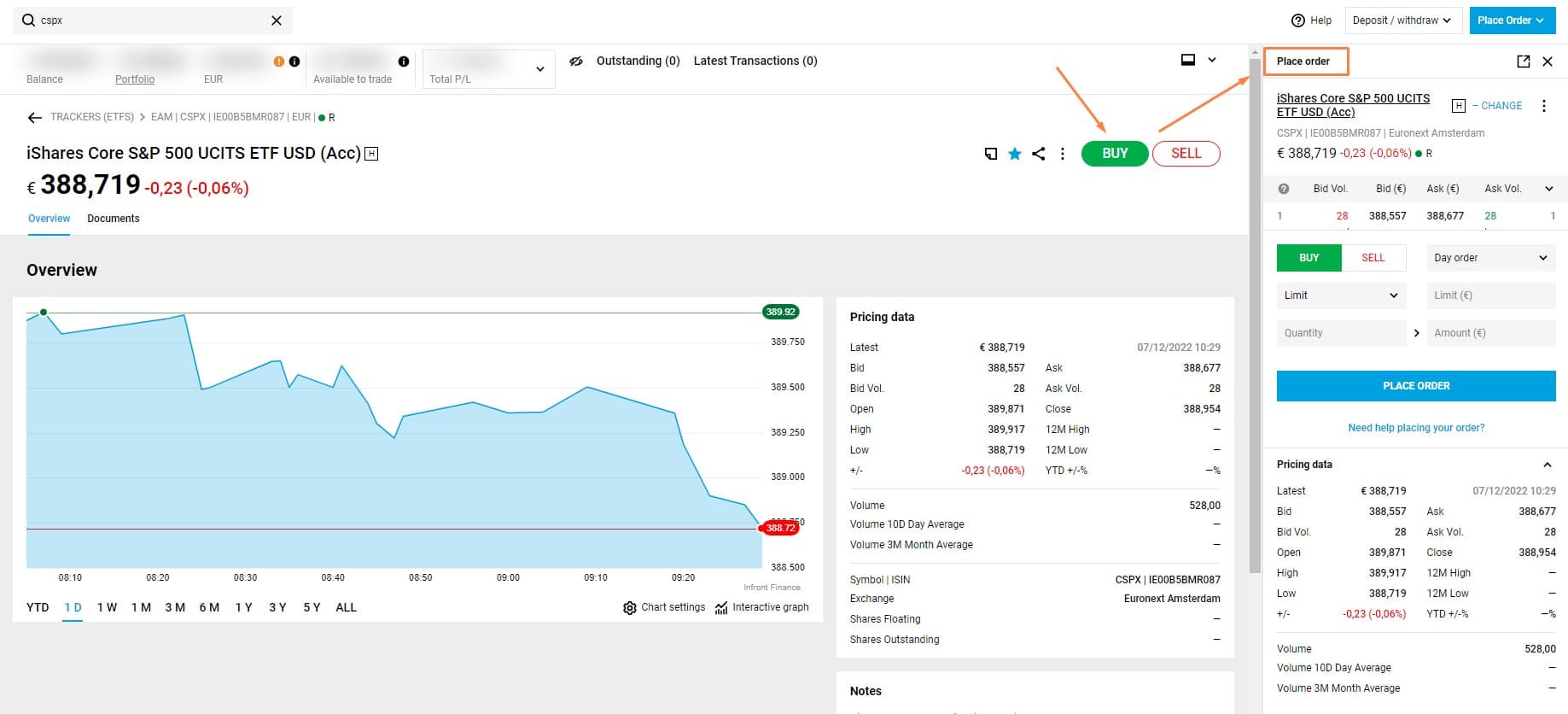
b) Click “Buy” – you might notice that several ETFs appear. Generally, you should choose the one that has the same currency as yours (to avoid currency conversion fees), the highest trading volume, and with the lowest transaction fee (ex: some ETFs are commission-free). After selecting it, and clicking “BUY”, you will be presented with the table shown on the right side:
c) Choose the order details – Now, it’s time to fill all boxes presented below (“BUY” and “Day order” appear by default, which is good):
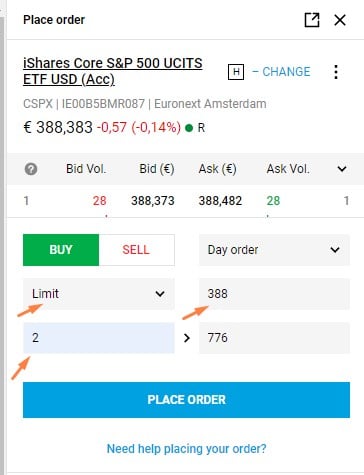
- Type of order: “Limit” usually appears by default – it lets you set a maximum price you’re willing to pay. You can also switch to “Market order,” which buys immediately at the prevailing market price (typically simpler and faster for long-term ETF investors making regular contributions).
- Limit amount: if you keep “Limit” as the order type, enter the maximum price you’re willing to pay per share in the “Limit (€)” field.
- Quantity: enter the number of ETF shares you want to buy. Many modern brokers (Trading 212, Lightyear, IBKR, eToro) also support fractional shares, so you can specify a fixed cash amount rather than a whole number of shares.
- Amount: the “Amount (€)” field is typically auto-filled based on your limit price and quantity.
d) Place your order: finally, click “Place Order.” A confirmation window will appear showing all the details. Review them carefully (ticker, quantity, price, total cost including any fees) and click “Confirm” to execute the trade.

The difference between an Index Fund and ETF
If you’re not quite clear on the difference between an index fund and an ETF (Exchange-Traded Fund), you’re not alone – the two are often used interchangeably in casual conversation, but they have some genuine practical differences.
In many ways, they’re very similar. Both let you invest in an entire basket of stocks, bonds, or other assets through a single transaction. An index fund is a type of investment that aims to track the performance of a particular index (like the S&P 500 or MSCI World). An ETF often does the same thing – except that it can be bought and sold on a stock exchange like a regular share. That’s what “Exchange-Traded” refers to.
Both European index funds and ETFs typically track a major industry benchmark or focus on a specific market segment. They simply replicate a list of underlying assets and allocate your money proportionally across them. The result is instant diversification with a single investment, usually at very low cost.
The key practical differences between an index fund and an ETF come down to how and when you can buy them:
- Index funds: typically bought directly from the fund provider or via your brokerage’s mutual-fund platform. They often have minimum investment requirements (though many providers have removed these for retail investors), and the price is set once per day at the Net Asset Value (NAV) calculated at market close. If you place an order during the day, it executes at the next available valuation point – not at a live price. Index funds are typically more tax-efficient for monthly recurring contributions in some jurisdictions (because they avoid bid-ask spreads).
- ETFs: trade on stock exchanges throughout the day at a live, continuously updated market price. You can buy or sell ETFs at any time during exchange opening hours, with full price transparency, just like buying a normal stock. ETFs are accessible through almost every modern brokerage and typically have no minimum investment beyond the price of a single share (or even a fractional share where supported).
For most retail European investors, ETFs are the more flexible and accessible option – cheap, liquid, and supported by virtually every broker. Index funds (particularly from providers like Vanguard, Fidelity, or BlackRock) remain a strong alternative for very long-term, contribution-based investors who prefer simplicity and automatic NAV-based pricing without worrying about intraday volatility or spreads.
Can you buy Index Funds from Europe or do you have to use an ETF?
Buying traditional index funds (mutual fund structures) directly from providers like Vanguard, Fidelity, or BlackRock isn’t always straightforward for European investors. UK residents can access Vanguard’s index funds directly through Vanguard UK, and several European brokers – notably Trade Republic, Comdirect (Germany), Nordnet (Nordics), and Avanza (Sweden) – offer broad access to European-domiciled index funds.
That said, ETFs are now widely accessible across Europe and are functionally equivalent for most retail investors. Almost any major index (S&P 500, MSCI World, FTSE All-World, MSCI Emerging Markets, etc.) has multiple UCITS ETF options available across European exchanges, often with lower TERs than the equivalent index fund.
So while pure index funds may have somewhat limited availability for European investors, the UCITS ETF ecosystem is excellent and covers virtually every index strategy you might want exposure to.
UCITS legislation of European ETFs
You’ll notice that almost every ETF available in Europe has “UCITS” in its name. UCITS stands for Undertakings for Collective Investment in Transferable Securities, a regulatory framework established by an EU directive that funds must comply with to be sold to retail investors across the European Union. The framework exists to protect retail investors.
You don’t need to know all the legal jargon, but UCITS rules govern how European ETFs are managed and marketed – including diversification limits, custody requirements, transparency obligations, and disclosure standards. One key requirement is that all UCITS funds must provide a Key Information Document (KID) in the local language of each country where the fund is sold. The KID summarises the most important fund details (objective, costs, risk rating, past performance) on a standardised two-page format, making it easy to compare options.
This is also why most US-domiciled ETFs (like SPY, QQQ, or VTI) cannot be sold to European retail investors: under the PRIIPs Regulation (in force since 2018) and MiFID II disclosure rules, US ETFs don’t publish a KID, which means European brokers are prohibited from selling them to retail investors. UK retail investors are subject to the same restriction post-Brexit. If you want exposure to a US-tracking strategy from Europe, you’ll need to use a UCITS-compliant European version (for example, a UCITS ETF tracking the S&P 500 like SPYL, CSP1, VUSA, or VUAG – rather than the US-domiciled SPY).
Professional clients and high-net-worth investors who pass the appropriate suitability tests may be able to access US-domiciled ETFs through certain brokers (like Interactive Brokers), but this is not available to standard retail accounts.
Differences between accumulating and distributing index funds/ETFs
Another thing you’ll notice with European and US index funds and ETFs is that they often have “Acc” or “Dist” in their name. Here’s what each term means:
- Acc (Accumulating): any income or dividends received by the fund are automatically reinvested back into the fund, increasing the share price over time rather than paying out cash. This compounds returns automatically with no extra effort on your part.
- Dist (Distributing): dividend income is paid out to your brokerage account in cash, usually quarterly or semi-annually. You can then decide to reinvest it manually or use it for other purposes (typical for income-focused investors).
Depending on your country of residency, accumulating ETFs can be more tax-efficient and operationally simpler than distributing ETFs – particularly for long-term investors who don’t need dividend income. They reduce paperwork (no annual dividend declarations in some jurisdictions), avoid cash drag from un-reinvested dividends, and remove the friction of manually reinvesting small dividend payments. Distributing ETFs, on the other hand, are typically preferred by retirees or investors who want regular income from their portfolio.
That said, the right choice depends heavily on your specific situation – tax wrapper availability (ISA, SIPP, IKE, ISK, aktiesparekonto, PEA), your country’s treatment of accumulated vs distributed gains, and whether you want income or growth. We explore the European ETF tax landscape in more detail below.
ETF taxation in Europe
Lower taxes mean higher net returns – so understanding how ETFs are taxed in your country can have a meaningful impact on long-term wealth building. Tax rules vary significantly across Europe, but here are some general principles to keep in mind:
- Maximise tax-advantaged accounts: many European countries offer tax-wrapped accounts that significantly improve long-term returns – UK ISA / SIPP / LISA, Polish IKE / IKZE, Swedish ISK / kapitalförsäkring, Danish aktiesparekonto, French PEA, German Freibetrag (tax-free allowance up to €1,000/year for singles), and Portuguese PPR for retirement saving. Using these wrappers where eligible is often the single highest-impact tax decision you can make.
- Accumulating vs distributing ETFs: in some countries, accumulating ETFs are more tax-efficient because dividend taxation is deferred until you sell the ETF (e.g., Portugal, Spain in certain cases). In a country where dividends are taxed when received – even if reinvested manually – holding an accumulating ETF effectively delays the tax event until disposal. That said, this advantage doesn’t apply everywhere.
- Watch out for “deemed dividend” or annual taxation rules: some countries tax accumulating ETFs as if dividends had been distributed, regardless of whether you actually received cash. Examples include the UK (Reporting Fund Status considerations), Germany (Vorabpauschale – annual advance taxation), Austria, and Denmark (lagerbeskatning – annual mark-to-market on ETFs). In these jurisdictions, the operational advantage of accumulating ETFs is partly or fully offset.
- Withholding tax on US dividends: physical UCITS ETFs holding US stocks lose 15% of dividends to US withholding tax (under the Ireland-US tax treaty for Irish-domiciled ETFs – which is most of them). Synthetic ETFs typically avoid this loss via swap structures, which can give them a small structural edge for US-equity exposure if you’re a long-term holder outside a tax wrapper.
Always verify your country’s specific rules – ideally with a local tax professional or your national tax authority’s published guidance. The right ETF structure for a Portuguese investor outside a tax wrapper isn’t necessarily the right one for a German or Danish investor.
How to buy US ETFs in Europe
The process is essentially the same as buying any European ETF – but with one critical difference: most US-domiciled ETFs cannot be sold to European retail investors due to PRIIPs and MiFID II disclosure rules (covered earlier). Famous US ETFs like SPY, QQQ, VTI, and VOO aren’t available to standard retail accounts at European brokers.
The good news: for almost every popular US ETF, there’s a UCITS-compliant European equivalent that tracks the same index. These are typically domiciled in Ireland or Luxembourg, comply fully with European regulations, and provide a KID document. Here are some practical examples:
- S&P 500: SPY/VOO → SPYL, CSP1, VUSA, VUAG, SPXP (UCITS versions)
- Nasdaq 100: QQQ → CSNDX, EQQQ (UCITS versions)
- Total US market: VTI → VUSA or a broader MSCI World tracker like IWDA
- FTSE All-World / Global: VT → VWCE (Vanguard FTSE All-World UCITS Acc)
- Emerging markets: VWO → EIMI (iShares Core MSCI EM IMI UCITS)
Professional clients who qualify under MiFID II rules may be able to access US-domiciled ETFs through certain brokers (most notably Interactive Brokers), but this is a specialised route requiring formal classification and is not relevant to most retail investors.
Pro tips for investing in ETFs
- Avoid trading at market open or close: bid-ask spreads tend to be wider and volatility higher in the first 15-30 minutes after the market opens and the final 15-30 minutes before close. Mid-day execution typically gives tighter spreads and more stable pricing.
- Prefer lower TERs: the Total Expense Ratio is deducted from your returns daily. A difference of 0.07% vs 0.20% may seem small, but over 30 years on a €100,000 portfolio it can add up to thousands of euros – always check the TER on justETF or the issuer’s site.
- Check tracking error: a good ETF should closely match the performance of its underlying index. Lower tracking error means better replication.
- Consider total cost of ownership, not just TER: include broker commissions, bid-ask spreads, FX conversion fees (if buying in a different currency), and any taxes when calculating the true cost of holding an ETF.
- Larger funds are generally safer: ETFs with €500M+ AUM are less likely to be liquidated, typically have tighter bid-ask spreads, and benefit from better liquidity. Smaller niche ETFs can carry liquidation risk.
- Stick to reputable issuers: the major UCITS ETF providers – iShares (BlackRock), Vanguard, SPDR (State Street), Amundi, Invesco, and Xtrackers (DWS) – all have strong operational track records and broad product ranges. Smaller or niche providers may carry slightly higher operational risk.
- Set up recurring investing: most modern European brokers (Trading 212, Lightyear, IBKR, Trade Republic, eToro) support automatic recurring contributions or “savings plans,” which lets you dollar-cost-average without thinking about market timing.
- Hold for the long term: ETFs work best as long-term holdings (10+ years). Frequent trading erodes returns through spreads, commissions, and taxes.
Pros and cons of investing in Index Funds and ETFs
Below breakdown of the major advantages and disadvantages of buying index funds and ETFs in Europe.
Pros
- Plenty of choices for investing in US, European, UK, and global markets.
- Cheap and low-cost fees in most cases.
- Lots of brokerages to choose from.
- Easy way to diversify with a single investment.
- Backed by UCITS regulatory framework.
Cons
- No direct access to US ETFs.
- ETFs track the market so there’s little chance of beating the market.
- Most ETFs are market-cap weighted so the bulk of your investment goes to the biggest holdings.
- Index funds are only available to UK-based investors.
The bottom line
To sum it up, here’s how to invest in ETFs and index funds from Europe:
- Pick a UCITS ETF that fits your investment strategy – typically a broad-market tracker like the S&P 500 (SPYL, CSP1, VUSA), MSCI World (IWDA, SWDA), FTSE All-World (VWCE), or a specific regional/sector index. Consider TER, replication method, accumulation vs distribution, and fund size.
- Find a suitable broker: a good ETF broker matters. Consider the number of ETFs available, all-in fees (commissions, spreads, FX), the regulator, tax-wrapped account availability (ISA, IKE, ISK, aktiesparekonto, PEA), and fractional shares support.
- Open an account and deposit funds: most modern European brokers offer fully digital onboarding (10-15 minutes), with deposits typically via SEPA bank transfer, card, or instant payment methods.
- Place your order: search for the ETF by ticker or ISIN, choose your order type (market for simplicity, limit for price control), confirm the quantity (or use fractional shares), and submit. Review the trade confirmation carefully before clicking final confirm.
- Set up recurring investing and hold long-term: set up automatic monthly contributions via your broker’s savings plan, Pie, or AutoInvest feature. This lets you dollar-cost-average automatically and harness the power of compounding without trying to time the market.
Investing in UCITS ETFs from Europe is one of the most effective ways to build long-term wealth, particularly for newer investors. The UCITS ecosystem covers virtually every market, sector, and strategy you might want exposure to – from broad global indices to thematic and bond-focused funds – all under a strong investor-protection framework.
Once you’ve selected your ETFs, picked a low-cost broker that supports the tax wrappers available in your country, and set up automatic monthly contributions, the rest is largely a matter of patience. ETF investing rewards consistency and time in the market – not timing the market.
Disclaimer: This article is for informational purposes only and does not constitute financial or investment advice. Investments can go down as well as up – past performance is not a reliable indicator of future returns. Tax treatment depends on your individual circumstances and country of residence, and may change. Always do your own research and consider consulting a qualified financial adviser before investing.
Other FAQs
How can I invest in the S&P 500 index fund from Europe?
You just need to select which fund or ETF you want to buy, create an account with a brokerage, and make a buy order. You can read a more in-depth guide here on how to invest in the S&P 500 from Europe.
Can you trade ETFs in Europe?
Yes! You can sign up to a share dealing platform and are free to both buy or sell ETFs, just make sure you’re using a cheap brokerage to keep your trading costs down.
Can I buy Vanguard ETFs in Europe?
Yes, but you’ll just need to check which brokerages have the Vanguard ETFs or index funds you want to buy.
Can I buy iShares ETFs in Europe?
Definitely, just double-check that the investing platform you’re looking to use will give you access.
What is the best ETF to buy in Europe?
This depends on your investing strategy and goals. Finding the best ETF to invest in for you will partly be related to your investment time horizon and attitude to risk. Whether you’re looking for capital growth or income from dividends can also help determine what’s the best ETF for you.