


If you have been looking for brokers offering commission-free stock and ETF investing, you have probably come across Trading 212, which offers investing with no commission (other fees may apply, see terms and fees). And you may be wondering whether you can trade penny stocks there, since not every platform supports them.
This article covers whether penny stocks are available on Trading 212 and how to find them, alongside what penny stocks actually are, the risks involved, and some practical guidance.
What are penny stocks?
A penny stock is typically:
- A micro-cap company trading at a very low share price.
- Highly speculative, with thin trading volume, wide bid-ask spreads, and limited public information.
- Attractive to some investors because the low price allows them to buy a large number of shares, hoping to catch a company early.
While penny stocks generally trade below $1, €1, or £1, the US Securities and Exchange Commission (SEC) generally treats as a penny stock any share trading below $5. Some trade on major exchanges, others over the counter, and not every broker offers access to both.
Note that a low share price does not automatically mean a small or illiquid company. Some penny stocks trade in high volume. Others fell to low prices after a specific event, such as a profit warning, a restructuring or a deterioration in outlook. And some companies simply have a very large number of shares outstanding, which keeps the per-share price low regardless of the company’s size.
That distinction matters when assessing risk: a share priced at £0.50 because the company has 6 billion shares in issue is a fundamentally different proposition from one priced at $0.50 after losing 95% of its value.
A note on examples: penny stock lists date quickly. Companies exit the category by rising in price, and many are delisted after failing entirely, which is itself a useful indication of the risk. For that reason, we do not name specific stocks here.
Where penny stocks trade
Where a stock is listed tells you a lot about the rules it has to follow. US exchanges remove companies whose share price stays too low, which is why many penny stocks end up on the over-the-counter (OTC) market, where disclosure requirements are lighter.
| Venue | Low-price rule | What to know |
| Nasdaq | $1 minimum closing bid price | 30 trading days below $1 trigger a deficiency notice, usually with 180 days to recover. Since 19 January 2026, 10 consecutive days at or below $0.10 lead to immediate delisting |
| NYSE | $1 average closing price | An average below $1 over 30 trading days triggers a notice and a six-month cure period |
| OTC Markets | No exchange listing standards | Tiers (OTCQX, OTCQB, OTCID and Pink Limited) with different disclosure levels. Liquidity is often thin |
| London AIM | No minimum share price | Growth market for smaller companies with lighter rules than the Main Market. Many shares trade below £1 |
Main venues for penny stocks, October 2026. Sources: Nasdaq rule summary (National Law Review), OTC Markets.
Can you trade penny stocks on Trading 212?
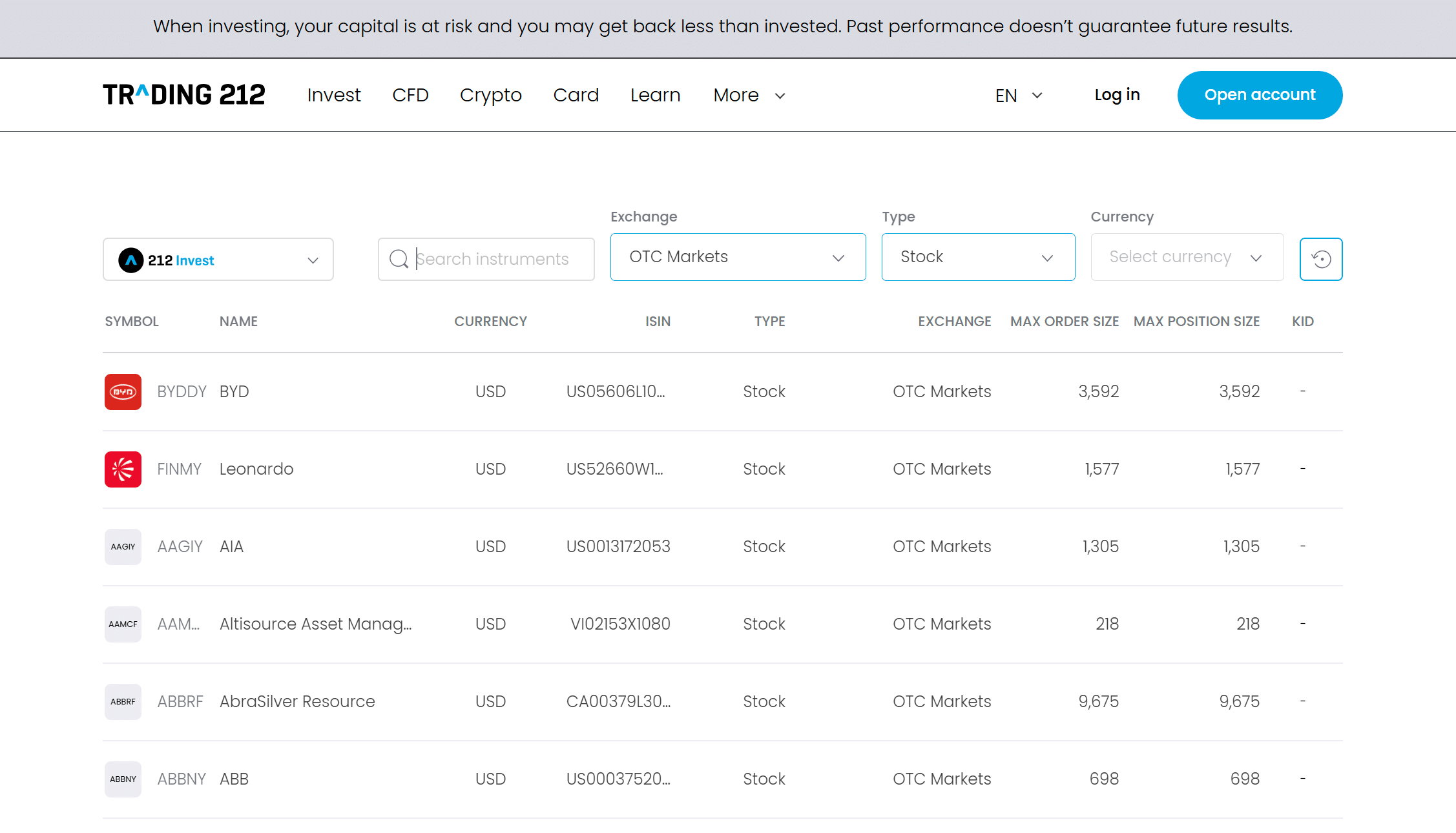
Yes. Trading 212, founded in 2006 and with more than 5 million lifetime funded accounts, gives access to penny stocks on major exchanges and to a selection of US stocks traded over the counter (OTC). According to its help centre, most of the OTC stocks it offers meet HMRC’s criteria and can be held in a Stocks and Shares ISA, though orders in OTC stocks may take longer to execute because of lower liquidity.
Note, however, that Trading 212 has previously suspended buying in certain highly illiquid microcap stocks during periods of extreme volatility, while still permitting sales. Availability can therefore change without notice, and a stock you can buy today may be restricted tomorrow. The suspensions target highly illiquid penny stocks with a market capitalisation in the tens of millions, because sudden surges in orders can trigger market manipulation investigations. Here is Trading 212’s own explanation from its help centre article on buying suspensions:
How to trade penny stocks on Trading 212
- Open an account with Trading 212. You can read our review first if you want. Trading 212 charges no commission (other fees may apply, see terms and fees). A 0.15% FX fee applies when converting funds. Other fees may apply.
- Once funded, search by ticker or company name, or browse the full instrument list on their site.
- Research thoroughly before committing: Check whether the stock has traded below $5 consistently or fell there recently, and why. Review the financial statements, cash position, and whether the company can fund itself without further share issuance. Dilution is one of the most common ways penny stock investors lose money even when the business survives.
- Decide your position size and set stop-loss and take-profit levels before entering. Limit orders give you control over price: With wide spreads and thin volume, a market order can fill at a materially worse price than the one displayed.
- Monitor the position and company announcements. Bear in mind that penny stocks carry risks well beyond those of established shares.
Position sizing matters more here than in any other part of a portfolio. Given that a meaningful proportion of penny stocks eventually go to zero, treat any individual position as capital you could lose entirely, and size it accordingly.
Penny stocks pros and cons
Pros
-
Low entry cost: you can start with a small amount of capital.
-
High percentage upside: low prices mean large moves are possible in either direction.
-
Less analyst coverage: creates occasional opportunities for well-researched investors.
- Learning experience: useful for practising risk management, if position sizes are kept small.
Cons
-
Low liquidity: difficult to exit a position without moving the price against you.
-
Limited transparency: sparse financial information and lower reporting standards, especially OTC.
-
Vulnerable to manipulation: pump-and-dump schemes are common in this segment.
-
Dilution risk: companies frequently issue new shares, reducing the value of existing holdings.
- High failure rate: many penny stock companies never grow or cease trading entirely.
Penny stock investment tips
- Research the company properly: invest only in businesses you understand. Check the cash position and whether the company can operate without raising further capital.
- Use stop-loss orders: decide your maximum acceptable loss before entering and set the stop accordingly. Be aware that in illiquid stocks, a stop may execute well below your trigger price during a sharp fall.
- Be alert to promotion schemes: misleading information is used to inflate penny stock prices, particularly in OTC markets where disclosure requirements are lighter. Treat unsolicited tips, social media hype, and paid newsletters as warning signs rather than opportunities.
- Watch the spread, not just the commission: even with no commission, the bid-ask spread is a real cost, and on illiquid stocks it can run into several percent on entry and exit combined.
- Keep it a small share of your portfolio: whatever your conviction, penny stocks should be a modest allocation alongside a diversified core, not the foundation of a portfolio.
Bottom line
Trading 212 offers investing with no commission (other fees may apply, see terms and fees) and gives access to penny stocks on major exchanges and to a selection of OTC stocks.
Be clear-eyed about what that involves, though. Penny stocks combine extreme volatility, thin liquidity, limited disclosure, and a high rate of outright failure. The occasional large winner receives far more attention than the many positions that go to zero, and that asymmetry in coverage distorts how the category is perceived.
These are speculative positions suited to investors who can genuinely absorb losing the full amount, held as a small allocation alongside a diversified core rather than as a strategy in themselves.
New users can receive a free fractional share worth up to €100/£100 by signing up with the Trading 212 promo code IITW*. Terms apply.
If you need further guidance, feel free to reach out to us.
*Sponsored Link. To get free fractional shares worth up to 100 EUR/GBP, you can open an account with Trading 212 through this link. The value of the free share is random: 80% probability of €8 to €25, 15% of €25.01 to €50, 3% of €50.01 to €75 and 2% of €75.01 to €100. Terms apply.
When investing, your capital is at risk and you may get back less than invested. Past performance doesn’t guarantee future results.
FAQs
Can I buy OTC penny stocks on Trading 212?
Yes, Trading 212 provides access to over-the-counter penny stocks, though availability of individual stocks can change and buying may be restricted in highly illiquid names.
What is the best penny stock?
There is no such thing. Penny stocks are highly volatile and speculative, and anyone presenting a specific stock as a sure thing should be treated with considerable caution. Do your own research before investing.
Can you make money on a penny stock?
Yes, though the odds are unfavourable. Large gains are possible and do occur, but a substantial proportion of penny stocks lose most or all of their value. Successful outcomes receive far more attention than the failures, which distorts perception of how likely they are.
Should you invest in penny stocks?
Only if you can genuinely afford to lose the full amount, and only as a small allocation alongside a diversified portfolio. For most investors building long-term wealth, low-cost index funds are the more reliable route.
Can I hold penny stocks in a Trading 212 ISA?
In many cases, yes. Trading 212 says most of the OTC stocks it offers meet HMRC’s eligibility criteria for a Stocks and Shares ISA, and stocks listed on recognised exchanges generally qualify too. Check the stock’s page in the app before buying.
Why can't I buy a penny stock on Trading 212?
Trading 212 may suspend buying in highly illiquid penny stocks with a market capitalisation in the tens of millions, while still allowing sales. A notice appears on the affected stock’s page.
Can a penny stock be delisted?
Yes. Nasdaq and the NYSE require a $1 minimum price, and since 19 January 2026 Nasdaq delists stocks that close at or below $0.10 for ten consecutive trading days. A delisted stock may move to the OTC market, where it is usually harder to sell.



