


Investing in real estate used to be a game for the wealthy. Technology has changed that, and today you can get exposure to property with very small amounts.
One of the best-known platforms is Fundrise, which lets investors in the United States start with as little as $10. It pools investors’ money into funds that own and finance residential and commercial property, and it has since added private credit and venture capital to its offering.
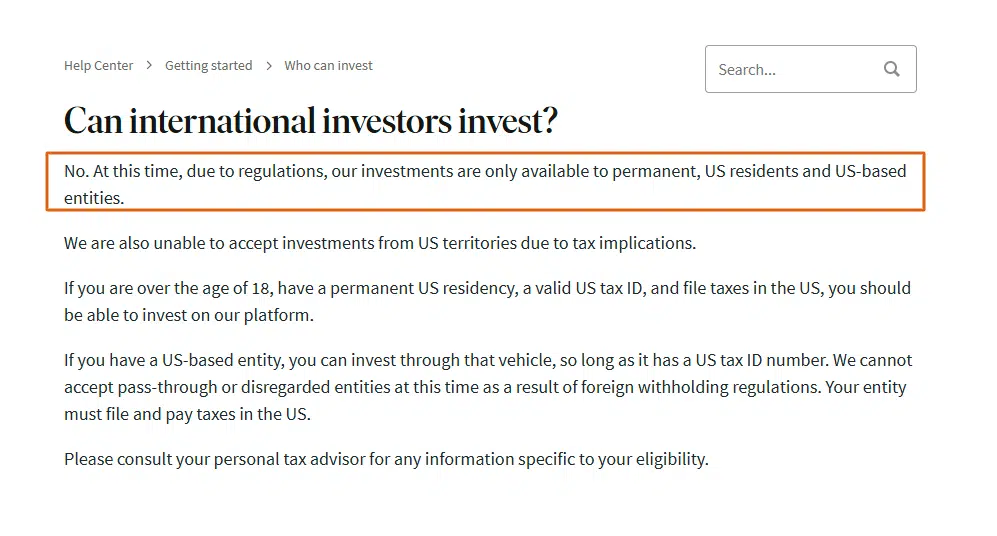
Fundrise is only available to permanent US residents, and it is not available in the UK or Europe:
That does not mean you cannot invest in real estate from the UK or the EU. In this article, we explain what Fundrise is, why it is not available outside the US, and which alternatives UK and European investors can use instead, including the risks that come with each.
What is Fundrise and why is it so popular?
Founded in Washington, D.C. in 2010, Fundrise is an online investment platform that lets non-accredited US investors access private real estate with small amounts. It manages approximately $2.87 billion of investor equity and has invested around $7 billion in US real estate.
Its core products are private real estate funds, structured mostly as REITs (real estate investment trusts). REITs own and manage income-producing buildings or hold property loans, and pass most of their income on to investors. Fundrise builds a portfolio across several of these funds, focused largely on residential and industrial property in the US.
Over time, the platform has expanded beyond property into private credit and venture capital. Its Innovation Fund, which invests in private technology companies, is now listed on the New York Stock Exchange under the ticker VCX.
Fundrise’s appeal is simplicity: a $10 minimum, no accreditation requirement, fees of around 1% a year and no landlord work. The main trade-off is liquidity. Private real estate cannot be sold quickly, so your money is tied up for years and early redemptions can carry penalties.
Is Fundrise available in the UK and the EU? What are their expansion plans?
No. Investors in the UK and the EU cannot invest with Fundrise. According to its help centre, Fundrise’s investments are only available to permanent US residents and US-based entities, due to regulations. To invest, you need permanent US residency, a valid US tax ID and to file taxes in the US.
Fundrise did briefly open its platform to investors from the UK, Canada and Australia some years ago, but that programme is no longer available, and the company has not announced any plan to return to international markets. Its offerings are registered under US securities rules, and selling them to European retail investors would require a separate regulatory setup in each market.
The good news is that UK and European investors have other ways to invest in real estate, some of them more liquid than Fundrise itself.
Fundrise alternatives in the UK and the EU
There are two main routes to real estate exposure from the UK and the EU: listed real estate (REITs and property ETFs bought through a broker) and real estate crowdfunding platforms. They work very differently, so it is worth comparing them before choosing.
| Route | Liquidity | Minimum | Regulation | Main risk |
| Property ETFs | High (trade daily) | Price of one share, or less with fractional shares | UCITS funds | Market swings |
| Individual REITs | High (trade daily) | Price of one share | Listed companies | Concentration in one company |
| Crowdfunding | Low (years, secondary market if available) | Usually €50 to €500 | ECSP licence (EU) or FCA (UK) | Borrower default and platform failure |
1. Property ETFs and REITs: the closest alternative
Fundrise’s core products are REITs, so the most direct equivalent in Europe is to buy listed REITs, or an ETF that holds many of them. Unlike Fundrise’s private funds, these trade on stock exchanges every day, so you can sell whenever you want at the market price.
One example is the iShares Developed Markets Property Yield UCITS ETF (ISIN IE00B1FZS350), which holds around 300 listed property companies and REITs from developed markets, pays out dividends and has a TER of 0.59%. Cheaper global options include the Amundi FTSE EPRA NAREIT Global UCITS ETF (TER 0.24%) and the VanEck Global Real Estate UCITS ETF (TER 0.25%).
Listed real estate is not a calm asset, though. The iShares ETF above lost 19.36% in 2022 and 4.57% in 2025 in euro terms, and it returned only around 2% a year over the five years to July 2026. Its daily price reflects interest rate expectations and market sentiment, which can move much faster than the underlying buildings.
You can buy these ETFs through most European brokers, such as eToro or Interactive Brokers.
Disclaimer: eToro is a multi-asset investment platform. The value of your investments may go up or down. Your capital is at risk. TERs and performance as of July 2026 (source: extraETF). Past performance is not a reliable indicator of future results.
2. Real estate crowdfunding platforms
Crowdfunding platforms let you invest in individual property projects, usually by lending money to a developer (debt) and sometimes by buying a share of a property (equity). With debt, you earn interest. With equity, you earn a share of the rent and of the sale value. Minimums are low, but your money is typically locked in until the project ends.
In the EU, crowdfunding platforms must hold a licence under the European Crowdfunding Service Providers Regulation (ECSPR), which applies across the EU and has been mandatory for existing platforms since the end of the transition period in November 2023. In the UK, platforms need FCA authorisation instead, and an EU licence does not cover UK investors, so many EU platforms no longer accept them.
The track record of this market calls for caution. Several platforms we previously listed in this article have since run into serious trouble. Crowdestate, once one of the leading Estonian platforms, has stopped onboarding investors and is being wound down while it tries to recover late and defaulted loans. Rising interest rates since 2022 hit property developers hard, and default rates rose across the sector.
If you still want to use a crowdfunding platform, check at least the following before investing:
- Licence: confirm the platform holds an ECSP licence (EU) or FCA authorisation (UK) with the relevant regulator, not just a claim on its website.
- Default and recovery statistics: look for published figures on late and defaulted loans and on how much has actually been recovered.
- Debt or equity: understand what you are buying and where you rank if the project fails.
- Secondary market: check whether you can exit early, and at what cost.
- Wind-down plan: find out what happens to your investments if the platform itself closes.
For platforms available in your country, see our list of real estate crowdfunding platforms available by country.
The bottom line
Fundrise is not available in the UK or the EU, and there is no sign that this will change. For most European investors, the closest and simplest alternative is listed real estate through REITs or property ETFs. You get the same kind of underlying assets as Fundrise’s REITs, with daily liquidity and the protection of regulated funds.
Real estate crowdfunding offers direct exposure to individual projects and potentially higher yields, but with much higher risk. Your money is locked in, borrowers can default and platforms can fail, as several have in recent years. If you use it, keep it to a small part of your portfolio and spread your money across projects and, ideally, platforms.
Some platforms and funds operate in EUR or USD, so you may pay currency conversion fees on deposits and withdrawals. A low-cost service such as Revolut or Wise can reduce that cost.
Happy investing!



