



| 🗺️ Supported countries | Mainly US investors. Offerings are also available in certain non-US jurisdictions, so check your eligibility with Masterworks |
| 💰 Fees | 1.5% management fee per year (paid in shares) + 20% of the profits on sale + a sourcing fee (“true-up”) of 10% of the offering amount |
| 💰 Minimum investment | Set for each investor during the onboarding call. Non-accredited investors cannot invest more than 10% of the greater of their annual income or net worth |
| 🎮 Demo account | No |
| 💻 Automated investing | No |
| 📈 Secondary market | Yes |
| 📍 Investment instrument | Physical high-end art (in the form of shares of an LLC company owning the artwork) |

Recommended
Masterworks review 2026
Hello, fellow investor! Art as an investment class has typically been reserved for the wealthiest and most knowledgeable investors because of the high initial cost and the need for storage, security and insurance.
Masterworks looks to democratize investing in high-end physical art for the ordinary folk.
Masterworks makes it possible to buy shares (fractions) of physical art from some of the most famous artists in history.
According to its website, Masterworks has distributed more than $61 million to investors from artworks it has sold. Its offerings include paintings by some of the most famous artists, such as Picasso, Banksy, Claude Monet and Andy Warhol.
The company was founded in 2017 by Scott Lynn, who is also its CEO.
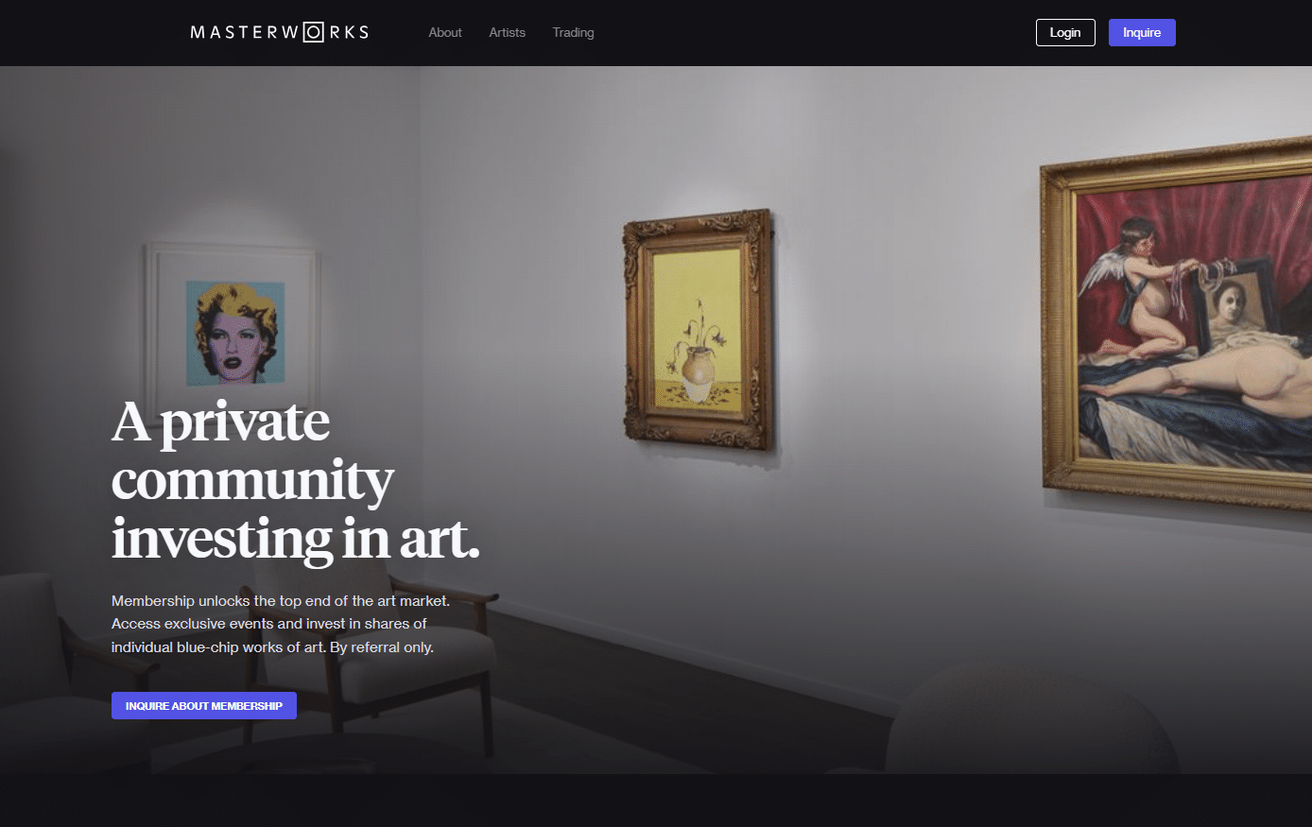
Masterworks homepage, as of October 2026
Still, there are some negatives that you should be aware of:

Their large marketing presence in digital media makes it very likely that you already heard about them. So let’s dig a bit deeper to find out what the investing process looks like and what are the pros and cons of using Masterworks!
Overview
One of Masterworks’ main selling points is the exposure to the alternative asset class of high-end art, which has so far been almost exclusively available to high-net-worth individuals. Furthermore, art historically shows a low correlation to stocks and other traditional asset classes, making it desirable when constructing a portfolio.
Masterworks does all the physical “dirty work” in finding, purchasing, insuring, storing, and selling the artwork.
However, art is also considered speculative, very volatile in price, and not well-regulated. When investing with Masterworks, you don’t automatically get a diversified portfolio of artworks. Instead, you create your own portfolio by choosing which particular artworks you want to invest in. If we draw an analogy with stocks, the investing process looks more like individual stock picking than buying a stock index fund or an ETF.
This means it’s a good idea to be familiar with the high-end art world to make informed decisions. Furthermore, you don’t actually own a fraction of an artwork directly. Still, you own the Class A shares of an LLC (Limited Liability Company) created by Masterworks, in which each artwork is owned by a separate series.
The planned investment horizon is 3-10 years, even though Masterworks has previously sold paintings after much shorter time horizons. There is no guarantee that the LLC shares will be liquid, as stated on their website: “Investors should be prepared to hold their Class A shares for an indefinite period, as there can be no assurance that the Class A shares can ever be tradable or sold.”
There is, however, a secondary market where Masterworks users can trade their shares with each other. It runs on an alternative trading system (ATS) operated by North Capital Private Securities Corporation, and the offering documents warn that there is no assurance it will provide an effective way to sell your shares. You can read more about it here.
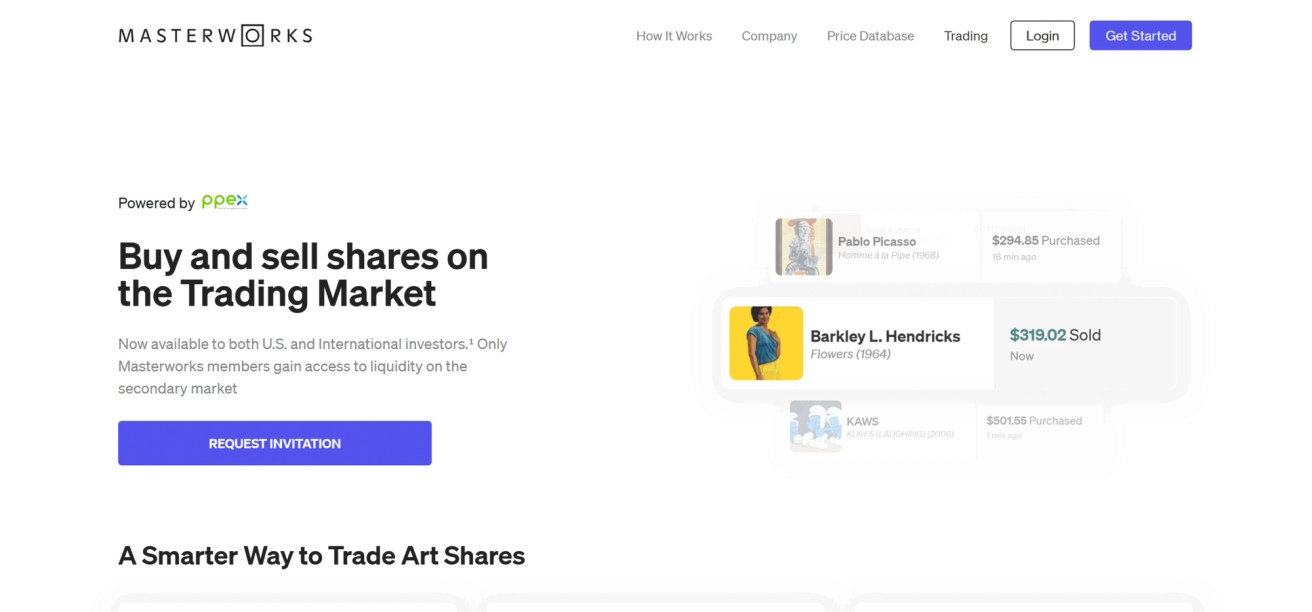
Masterworks secondary market
Highlights
The platform itself looks well-designed and easy to use. However, the fees associated with investing are fairly high.
The most prominent ones are the 1.5% management fee per year (paid in shares) and a 20% fee on future profits. On top of that, 10% of the offering amount goes to Masterworks as a sourcing fee, which it calls the “true-up”, to cover finding, buying, securitising and selling the painting.
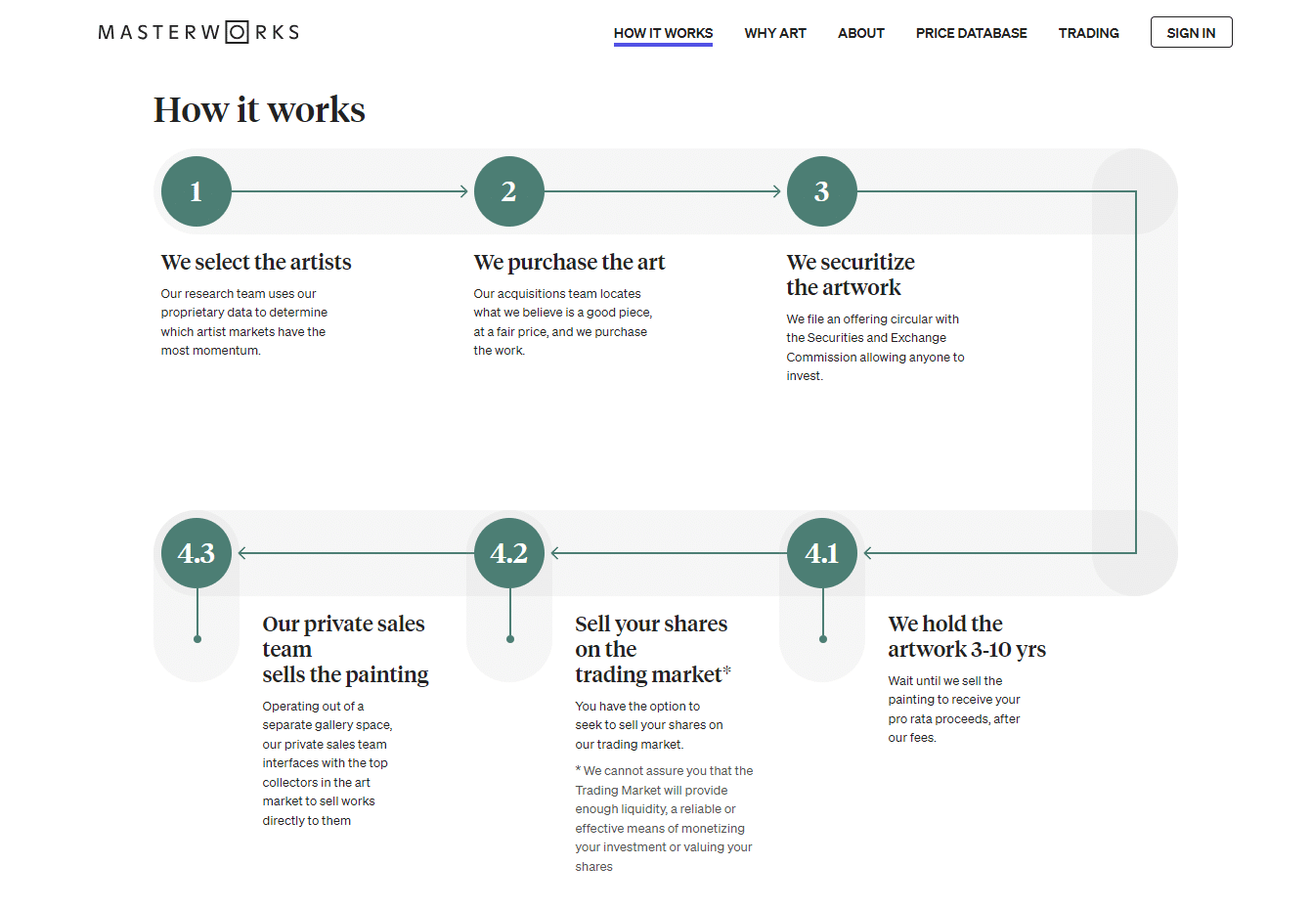
How it works
They also offer extensive market data on both the artworks and the artists, but it is important to note that past returns are not indicative of future returns. It is also hard, in general, to even get a fair estimate on the expected returns of high-end art as an asset class, let alone individual artworks.
Masterworks often cites returns in the neighbourhood of 10% to 15% per year (net of fees), but those numbers are based on a fraction of paintings that they have already sold for profit. Unbiased institutions most commonly estimate contemporary art to have somewhere between 7 and 8% return per year, with art as a whole having even lower returns (with relatively high risk).
Even Masterworks encourages investors to utilise art in a relatively smaller part of their portfolio and that “the investment is suitable only for persons who can afford to lose their entire investment”.
There are also some specific risks regarding the physical artworks themselves that are worth noting. They may not be likely, but they have to be taken into consideration. The most prominent ones are:
- Theft: artworks are insured based on their purchase price, not current appraisal.
- Title claims: if the ownership of an artwork is claimed by another party, the loss is unrecoverable.
- Counterfeits: even though the artworks are inspected by experts, some of them could prove to be counterfeit in the future.
Pros and cons
Pros
- One of the only platforms to offer fractional high-end art as an investment
- Possible low correlation with traditional asset classes
- Well-designed and easy-to-use platform
- Masterworks handles finding, purchasing, insuring, storing, appraising and selling the artworks
- Secondary market is available (only in the US), with zero trading fees
Cons
- You don’t own a piece of the actual artwork, but of an LLC that owns the artwork
- Not a well-regulated platform
- High fees in general (mark-up when buying + yearly management fee + fee for future profits)
- Relatively high-risk investment with no recurring income
- You have to construct your own portfolio (choose the artworks)
- Limited liquidity of the investments
- Specific risks such as counterfeits, title claims, and theft
Platform
In general, the platform is well-designed, with the interface being simple and intuitive to use.
It is easy to get market data about each individual artwork through their price database. These include past performance, Sharpe ratio, comparison to all art or other asset classes, and more. There is also a short biography and top reasons (in the opinion of the platform) why the particular artwork or artist is worth investing in.
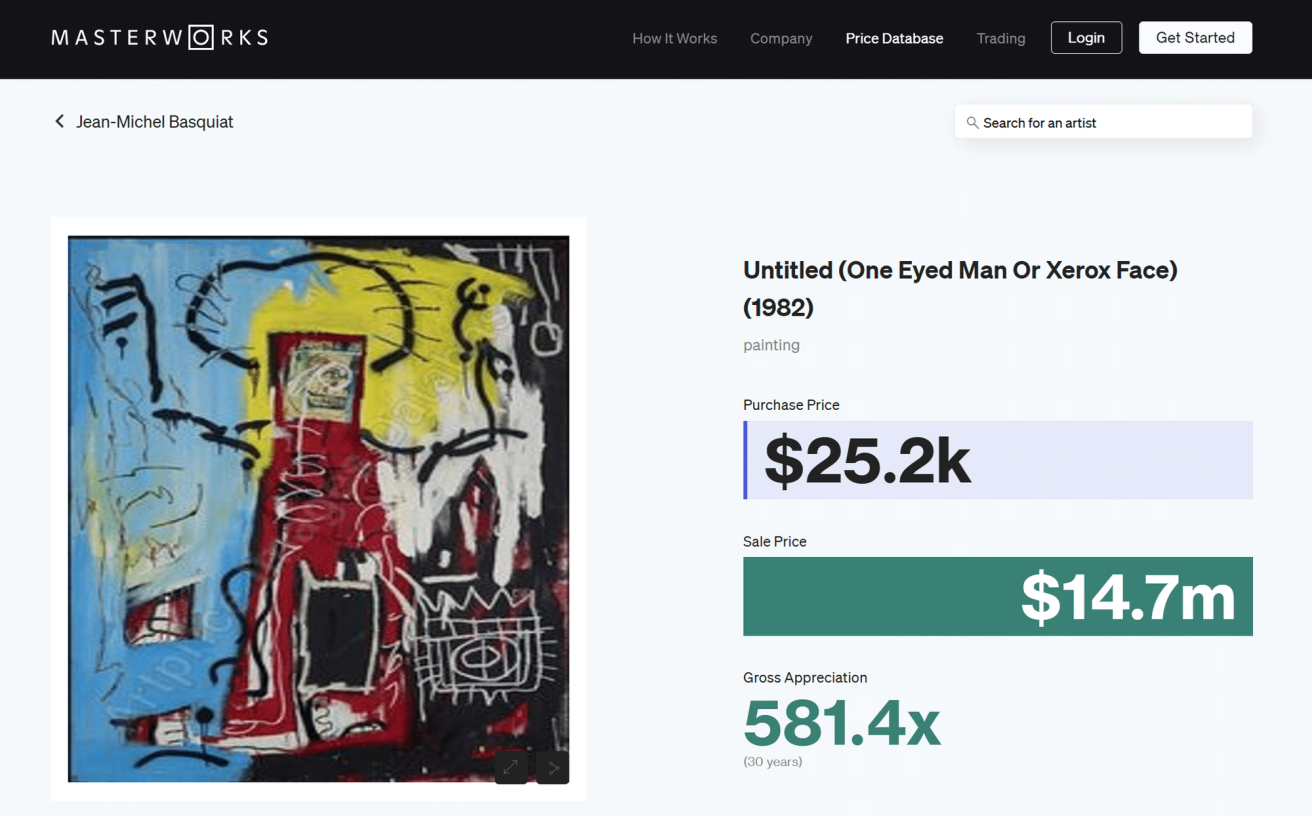
Untitled (One Eyed Man Or Xerox Face) (1982) - painting
You can also see momentum data about each artist, including total yearly auction sales, average prices, all-time record prices, and more.
There is also a “My portfolio” section, which displays your total portfolio and other sections, including educational content and the option to invite friends and thus enable them to skip the waiting list.
However, it is important to note that a lot of data is based on only a handful of data points, regards estimates, or is not disclosed by Masterworks at all and is thus not publicly available. These include the percentage of profitable users or their average return after fees.
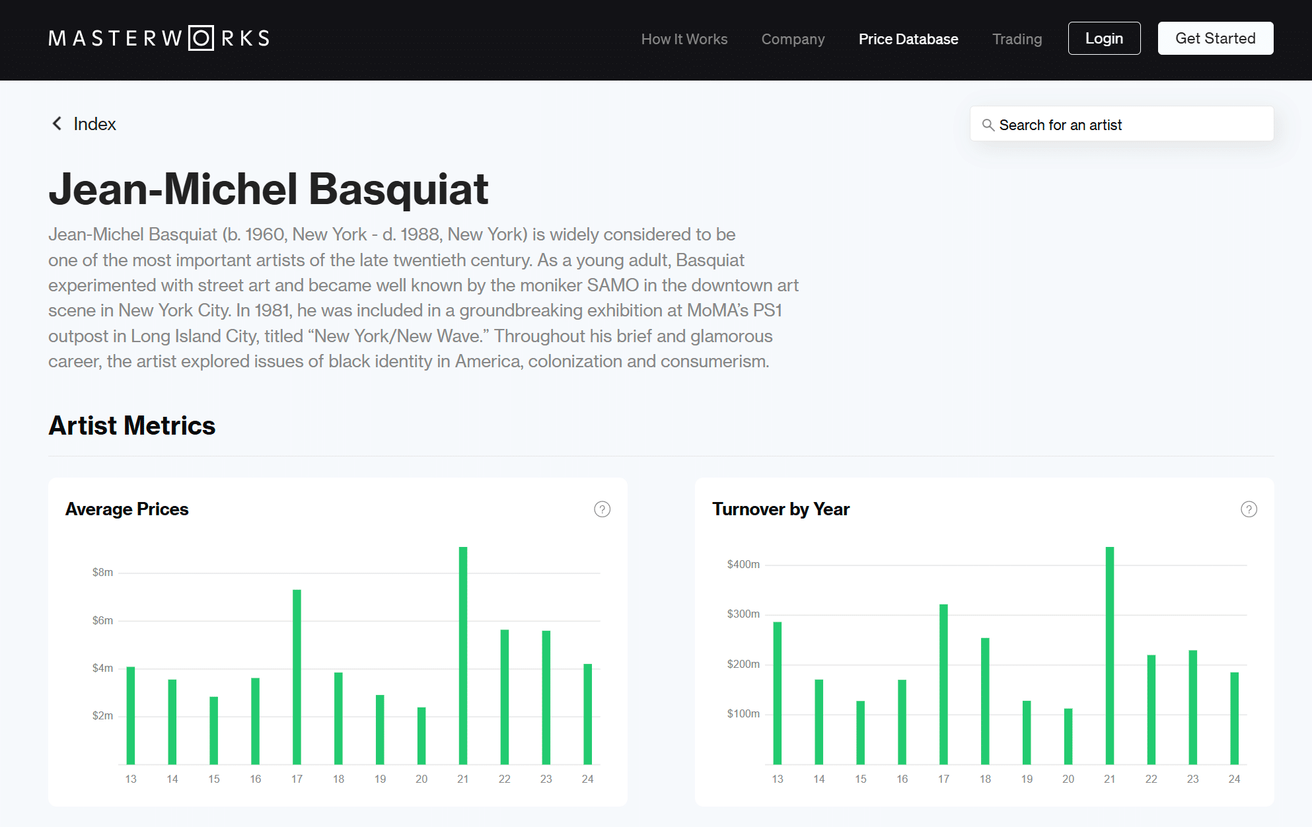
Jean-michel basquiat - metrics
Investment products
As mentioned before, Masterworks offers an indirect way to invest in high-end art made by some of the most famous global artists, valued at more than $1 million per piece. Instead of spending that kind of money on a single painting, Masterworks users can access this asset class with much less money and spread it across several artworks.
In practice, users don’t own a fraction of the physical artwork but Class A shares in an LLC (Limited Liability Company) series that owns it. The user is responsible for choosing which artworks to invest in since there is no automated investing option.
The recommended holding period for the artworks is 3-10 years, even though Masterworks has sold artworks after shorter time periods previously. If you can’t wait until the time of sale, there is also a secondary market where you can try to sell your shares to other users, although there is no guarantee of finding a buyer.
Fees
When buying shares on the primary market, the most prominent fees while investing with Masterworks are the yearly 1.5% management fee (paid in the form of equity) and 20% on future profits. This fee structure seems similar to the one commonly used at hedge funds.
However, there is also a front-load fee built into the offering (called the “true-up” by Masterworks), equal to 10% of the offering amount according to its offering circular filed with the SEC in May 2026. This fee is not obvious at first glance, and it covers sourcing, acquiring, securitising and selling the artwork.
All these fees combined are a very heavy load on future performance. Here is a simplified example of $10,000 invested in a painting that rises 50% in value over five years (8.4% a year):
| Step | Value |
| Amount invested | $10,000 |
| Art bought after the 10% true-up | $9,000 |
| Art value after a 50% rise | $13,500 |
| Your share after five years of 1.5% management fee shares | About $12,517 |
| After the 20% profit share on the $2,517 gain | About $12,014 |
| Your return per year | About 3.7%, against 8.4% for the painting |
Simplified illustration based on the fees in the Masterworks Vault 10 offering circular (May 2026). It ignores sale costs, taxes and other expenses.
In other words, in this example the fees take more than half of the painting’s appreciation.
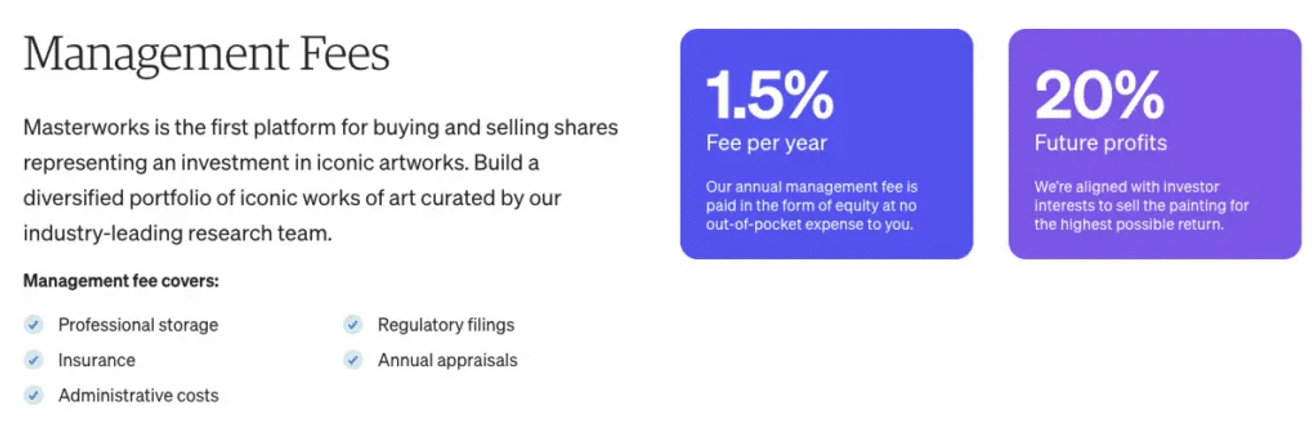
Management fees
It is important to note that there could be issues with liquidity in the secondary market, since it is a far smaller market (both in the number of participants and tradeable assets) than most other financial markets.
Safety & reliability
It is important to note right off the bat that Masterworks is not registered as a broker-dealer or an investment company with the SEC or FINRA. However, its investment vehicles (shares of LLCs owning the artwork) are qualified by the SEC, mostly under Regulation A.
This means that the issuer of the shares (Masterworks) “may make sales of the securities described in the offering statement. It does not mean that the SEC has approved, passed upon the merits of, or passed upon the accuracy or completeness of the information in the offering statement”.
Regulation A is essentially an exemption from registration in public offerings, so it forgoes much of the reporting and auditing requirements of a standard share offering.
The offering circular states that no broker-dealer is involved in the primary offering, and secondary trading takes place on an ATS run by North Capital Private Securities Corporation. Masterworks itself is not held to the same regulatory standards as a broker, and the shares are not covered by schemes such as SIPC, which in practice gives investors significantly less protection than with standard investment companies.
You can find more detailed information about Masterworks’ safety and reliability in their disclosure.
Customer support
In general, customer support seems to be more accessible and individually tailored than on most other platforms. There is a live introductory call, and after that, you can reach customer support by phone and email.
Its reviews on Trustpilot are mostly positive, often citing good customer support and an easy account opening process as major pros. Some of the most cited cons include aggressive marketing (mainly through email) and limited liquidity of investments.
Account opening
If you want to get started investing with Masterworks, the first step would be to create an account on their website using your e-mail, Google, or Apple account. This step is fairly simple and includes sharing your basic information, along with your plans about investing in art (most notably, the planned investment amount and the approximate starting time frame).
After that, you need to set up a time to speak with one of their representatives to activate the account and be able to start investing. The introductory call also answers any questions you might have and discusses your investment objectives, suitability, and what investment amount per offering makes sense for you.
There is often a waiting list, but it is unclear whether this is only a marketing tactic, since it is easy to get around with referral links. Also, some users reported the introductory call to be a bit “too pushy” in regards to trying to get you started investing as soon as possible with as large sums as possible.
After making your first investment with one of their team members, you can then make all future investments in both the primary and the secondary market by yourself using their platform.
Supported countries
Most Masterworks investors are based in the US. According to its offering documents, offerings are also available in certain non-US jurisdictions, but the list is not published.
You can open an account as a resident of other countries, but you may not be able to invest. It is best to email or book a call with Masterworks to check whether your country is eligible.
It is also important to note that Masterworks is not registered to offer investment services in any non-U.S. jurisdiction, making investor protection very limited.
Bottom line
To sum it all up, Masterworks is the best-known platform for investing in high-end physical art. Possible high returns and low correlation to traditional asset classes might be appealing for many, but there are also some cons to take into account.
Limited regulation and liquidity are reasons for concern, along with high fees and the naturally higher risk (volatility) of art as an asset class.
Hope we helped you make an informed decision about investing with Masterworks! See our website for more investment platform reviews and related topics.
FAQs
How much does Masterworks charge?
Masterworks charges a 1.5% annual management fee, paid by issuing new shares to itself, takes 20% of the profits when a painting is sold and receives a sourcing fee (“true-up”) of 10% of the offering amount.
Can I sell my Masterworks shares before the painting is sold?
You can try to sell them on the secondary market, an alternative trading system operated by North Capital Private Securities Corporation. However, there is no guarantee that a buyer will be found, so you should be ready to hold the shares until the painting is sold.
Is Masterworks regulated?
Masterworks is not a registered broker-dealer, but its offerings are qualified by the SEC, mostly under Regulation A. The shares are not covered by SIPC or by deposit insurance.
Can I invest in Masterworks from outside the US?
Sometimes. Offerings are available in certain non-US jurisdictions, but Masterworks does not publish the list, so you need to check with them during the onboarding call.