


Hello, fellow investor! This article is our honest review of the Finax robo-advisor.
What’s a robo-advisor? – you might ask. Feel free to check out our Introductory Guide to Robo-Advisors to get familiar with the concept or refresh your memory.
Upon account opening, you will be asked to complete a customer-oriented questionnaire that determines your goals and risk tolerance. Based on your answers, the platform sets up and executes an investing strategy using computer algorithms through the same methods that traditional wealth management firms use to manage their clients’ money.
It is a good starting point for investing beginners, offering a straightforward registration process, a low minimum deposit (€10), and intuitive apps for both web and mobile.
On the downside, the fees are higher than those of some of its European competitors, and higher than the headline rate suggests once VAT is added (more about this in the “fees” section).
That’s Finax in a nutshell. If you want to find out what our research team has to say after carefully analyzing Finax, keep reading.
Overview
Founded in 2017 in Slovakia, Finax is made for investors that wish to simplify and automate their investing experience as much as possible. It was set up by Juraj Hrbatý and Radoslav Kasík, and it was the first robo-advisor in Central Europe. Its customer base and assets under management still can’t compare to Europe’s largest robo-advisors, but both are increasing.
After completing a short survey, which assesses your risk tolerance and investing goals, you will be placed in a portfolio picked among 11 available setups. The core robo-advisor product is now branded Global Investing.
Besides that, Finax also offers other products:
- European Pension (PEPP) – a transferable European third pillar, meaning retirement savings built on ETFs that follow you if you move to another EU country;
- Calm Investing – a conservative short-term ETF product aimed at savings you expect to use within one to three years. This is the product previously known as the Intelligent Wallet;
- Annuity – an ETF portfolio designed for regular payouts, for people living off their assets. Previously called the Intelligent Regular Withdrawal;
- Finax Elite – private asset management with personal service, for larger portfolios;
- Financial Coach – expense tracking, budgeting and asset overview in one place;
- B2B and employer solutions – Finax also offers custom services for financial agents, employers and companies.
Finax is regulated by the National Bank of Slovakia, and your assets are protected up to €50,000 by the Slovak Investor Compensation Fund.
Highlights
| 🗺️ Supported countries | European Union |
| 💰 Fees | 1% per annum plus VAT, falling to 0.85% above €100,000 and 0.65% above €500,000 |
| 🎮 Demo account | No |
| 📈 Portfolio rebalancing | Yes |
| 💵 Minimum deposit | €10 |
| 📍 Investment instruments | ETFs |
| 🏦 Custodian | KBC (Belgium) |
Pros and cons
Pros
- Simple registration process
- Intuitive and user-friendly platform
- Minimum deposit of only €10
- Focus on the tax optimization of your investments
- Use of accumulating ETFs (instead of distributing ETFs, which are tax-inefficient in some countries)
- You can completely automate your investing by setting up recurring payments
- Automatic portfolio rebalancing
- No hidden fees
- Education materials (webinars, podcasts, and blog posts)
Cons
- Higher management fees than some competitors (1.2%, including VAT)
- Bank transfer is the only deposit option
Investment strategy
The investment strategy that Finax uses to build its portfolios is the industry-standard investment in index ETFs (Exchange-Traded Funds).
Investment strategy – asset allocation
The ETF allocation made by Finax is based on the questionnaire you fill out at the beginning. It takes into account your risk tolerance, goals, and investment horizon.
You can choose if you want the suggested allocation or, if you wish, select an even lower volatility allocation (a higher percentage of bond ETFs). You can change the allocation for free once a year if you wish to do so. More frequent allocation changes are not advised and can result in a fee.
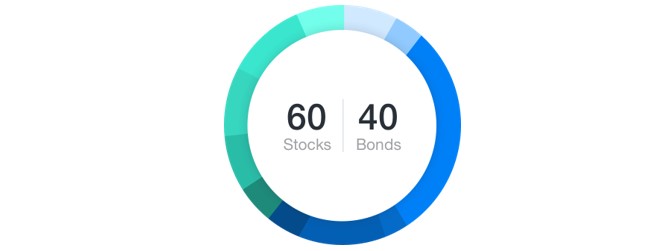
The portfolio asset class allocations range from 0% stocks and 100% bonds, to 100% stocks and 0% bonds, in 10% increments for each investment class, which is where the 11 strategies come from.
Simply put, index ETFs are low-cost funds that are easily traded on the exchange. Their goal is to replicate the underlying index (market) returns passively. Learn more about ETFs here.
With that choice, Finax aims to earn you the average market returns (minus fees) while somewhat boosting expected returns with exposure to mid- and small-cap companies, automatic portfolio rebalancing, and consideration of tax implications.
Investment strategy – asset selection
The investment portfolios are built from ten asset classes, held through physical, accumulating UCITS ETFs (six equity blocks and four bond blocks), all trading on European exchanges in euros.
Physical ETFs contain the actual securities of the index they are tracking. Compared to synthetic ETFs (a combination of financial derivatives that promise to pay the return on the benchmark), they provide higher transparency and limited counterparty risk. You can find more info on physical and synthetic ETFs here.
The ten building blocks, with the index each one tracks, are as follows:
- US large companies (S&P 500)
- US medium-sized companies (S&P 400)
- US small companies (Russell 2000)
- European large and mid-sized companies (Euro Stoxx 600)
- European small companies (MSCI Europe Small Cap)
- Emerging market companies (MSCI EM)
- Global government bonds
- European corporate bonds
- European high-yield bonds
- Emerging market government bonds
Together, these cover up to 7,400 stocks and 6,000 bonds. Finax states that the specific funds are not fixed forever: the ETF universe changes, and it may swap a fund as long as the switch does not trigger a tax liability for clients. The exact holdings are always visible in your account.
The ETFs are issued by large, established managers, and alongside accumulating dividends they offer low ongoing charges, high liquidity, and large fund size.
The ETF choice is tax-efficient in most European countries since all the ETFs are accumulating (they don’t distribute the dividends to the shareholders, but reinvest them back into the ETF). This is usually desirable since distributing dividends is often viewed as a taxable event in most countries.
Investment strategy – portfolio rebalancing
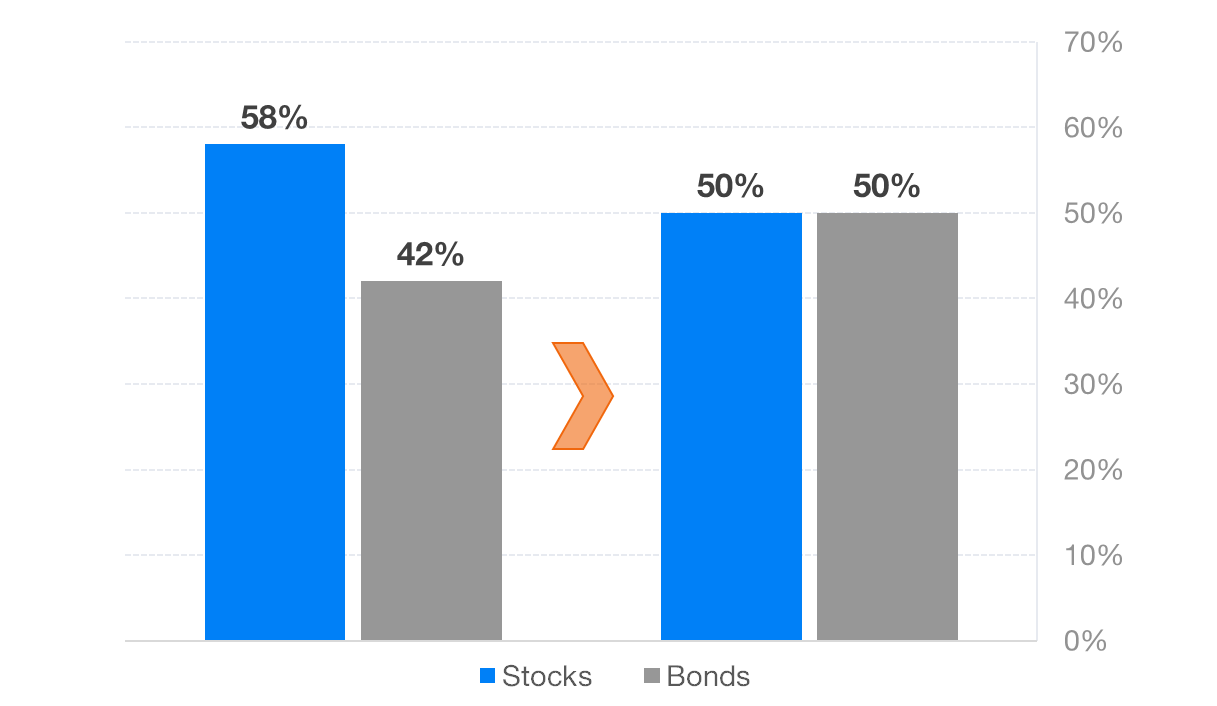
Automatic portfolio rebalancing means that Finax will try to keep your portfolio’s asset allocation close to the predetermined ratios, by rebalancing it periodically (eg: imagine that a portion of your portfolio, like US stocks, have increased a lot in value. Then, at a later stage, the robo-advisor will rebalance the portfolio to its original allocation, using dividend payments and additional contributions).
Rebalancing is free of charge and, in some countries, it also considers tax implications based on local tax regulations (source). Tax considerations have priority over rebalancing, which means that rebalancing could be postponed for several months if it would result in a tax liability.
However, if a taxable event occurs, it is your responsibility to calculate and pay capital gains taxes in your country of residence. More on the Finax rebalancing process here.
Following the initial setup, there is little to be done afterwards. If you wish to set up recurring payments to your Finax account, there is no need to even log in to the platform at all.
Fees
Finax charges one fee and little else. What matters is that the headline rate is quoted before VAT, and VAT is not small.
- Annual portfolio management fee of 1% per annum plus VAT on assets under management. With Slovak VAT at 23%, that works out at 1.23% a year in practice. It is calculated on your average account value and deducted monthly;
- 0.85% per annum plus VAT once your assets with Finax reach €100,000;
- 0.65% per annum plus VAT on assets above €500,000;
- No fees for deposits, withdrawals, ETF trades, rebalancing or closing your account;
- Additional fees apply if you don’t execute the fund transfer correctly, or if you change the portfolio allocation more than once a year.
Finax also runs discounts that reduce the fee rather than pay you a bonus. Refer a friend who opens an account and €1,000 of your savings is managed free of charge. Its own worked example: on a €20,000 portfolio with a €1,000 discount, over a 30-day month, the fee is (20,000 – 1,000) × 0.0123 × (30/365) = €19.21.
For context, 1.23% a year is at the expensive end of the European robo-advisor market, and the gap compounds. On a €20,000 portfolio held for 20 years, the difference between 1.23% and 0.50% a year is thousands of euros. That is the main trade-off with Finax, and it is worth weighing against the simplicity you get.
Full Finax pricing can be found here.
Investment platform
The Finax platform is available in both web and mobile app versions.
The interface is simple and intuitive on both platforms. Both offer access to your investment platform, along with settings, notifications, and education material (podcasts, webinars, and blog posts).
You can easily observe your investment performance across different ETFs separately and for the total portfolio as a whole.
Safety and reliability
Finax is regulated by the National Bank of Slovakia and holds a securities dealer licence, which means it has to demonstrate regularly that the company is sound and adequately capitalised.
Your assets are protected up to the amount of €50,000 by the Slovak Investor Compensation Fund. The company’s assets are separated from the client’s assets, which is especially important in the event of default. Client money flows through a separate bank account, and the ETFs are held in your name, so you remain the owner of the securities. Custody of the ETFs is provided by KBC, the Belgian banking group.
One point that often gets confused: that €50,000 covers the failure of the institution, not losses on your investments. If markets fall, the compensation fund does nothing for you.
Like most robo-advisors, Finax is a relatively young company, so its track record is still short. The strategies have been running since February 2018, and Finax publishes their performance monthly in the “Our Results” section of its blog.
Supported countries
Finax is available in all countries of the European Union, with its core markets in Slovakia, Czechia, Hungary, Poland, Croatia and Romania.
The platform runs in eight language versions: English, Slovensky, Magyar, Česky, Polski, Hrvatski, Română, and a dedicated English (Ireland) version.
Bottom line
To sum it up, Finax offers a very simple way to start your investing journey. The fee structure is as simple as it gets, and there are no hidden fees for deposits, withdrawals, trades or leaving.
However, there is no free lunch. Expect to pay a somewhat higher management fee than at some other competitors: 1% per annum plus VAT, which is 1.23% in practice. The company has since introduced volume tiers, so the rate falls to 0.85% plus VAT above €100,000 and 0.65% plus VAT above €500,000, but most retail investors will pay the full rate.
Two things have improved since our first look. The product range now includes a pan-European pension (PEPP) that moves with you across EU countries, which few competitors offer, and a short-term product for money you need within three years.
Finally, Finax’s education materials are a good starting point to learn about investing.
Looking for Finax alternatives? Check our full list of Robo-advisors available by country.
