
Saxo (formerly Saxo Bank), the Danish multi-asset broker now controlled by the Swiss private bank J. Safra Sarasin, announced significant changes to its global operations in 2024.
Since July 1, 2024, Saxo has ceased onboarding new clients in several countries, including Canada, as part of a strategic shift. Saxo has never held a Canadian licence: Canadian clients were served cross-border from its European entities, which is precisely the kind of business it decided to wind down.
This article examines the implications of this decision for current and potential clients in Canada, and offers alternative investment platforms for those affected.
Is Saxo available in Canada?
No. Since July 1, 2024, Saxo has not accepted Canadian clients, and nothing has changed since: Canada is still not on the list of supported countries in October 2026.
You can check Saxo’s full list of accepted and restricted countries here.
If you try to open a Saxo account from Canada, you won’t be able to find “Canada” in the country selector:
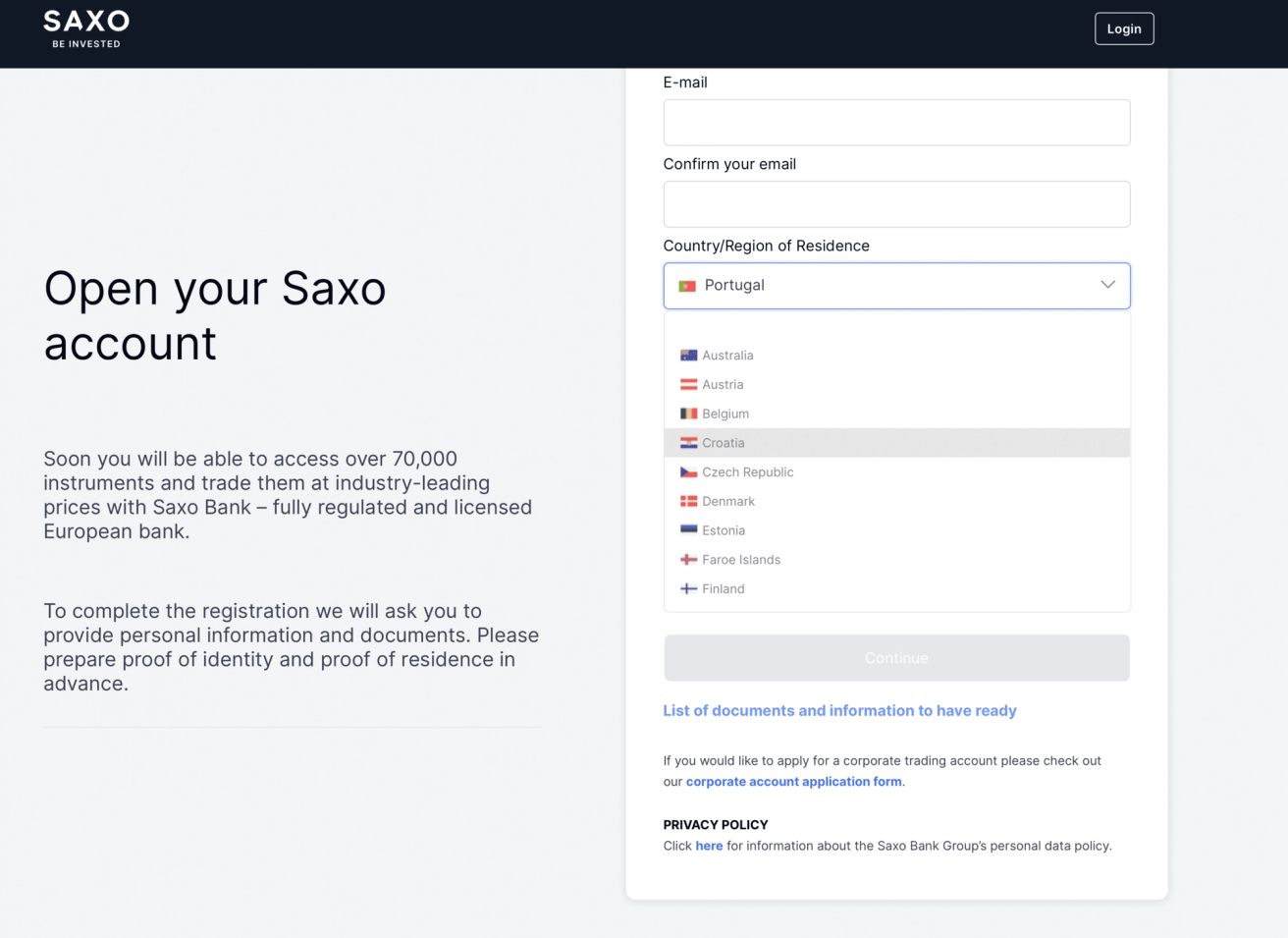
Saxo Bank available countries
Impact on existing clients
Existing clients in Canada were not offboarded immediately. Saxo planned to offboard all clients from Canada by the end of 2024, contacting each affected client directly with the process and timelines. If you still hold a Saxo account from Canada, expect to be asked to close or transfer your positions: check your Saxo inbox and arrange a transfer to a Canadian-licensed broker before any deadline Saxo gives you, so you are not forced to liquidate at a bad time.
Alternatives for Canadian investors
For affected investors, there are several reputable alternatives that accept Canadian residents (checked in October 2026):
- Interactive Brokers: best alternative platform overall. IBKR is the closest equivalent to Saxo, with the same breadth of global markets and products at lower commissions. Canadians are served by Interactive Brokers Canada Inc., regulated by CIRO (the Canadian Investment Regulatory Organization) and a member of the Canadian Investor Protection Fund (CIPF), and can open TFSA, RRSP and other registered accounts.
- Plus500: best for active CFD traders. Plus500 obtained a CIRO licence in June 2025 and serves Canadian clients through Plus500CA Ltd, a CIRO member and CIPF member. Plus500CA is registered in every province and territory except Quebec, and in Alberta it only serves accredited investors. Note that this is CFD trading, not share ownership.
- XTB: best for commission-free stocks and ETFs. According to XTB’s help centre, Canadian residents are accepted only by its French branch (XTB FR), with real stocks and ETFs as well as CFDs. As a European account, it does not offer TFSA or RRSP wrappers.
- Wealthsimple: best for beginners. A Canadian-licensed broker with commission-free stock and ETF trading, registered accounts and managed portfolios.
- Questrade: best Canadian alternative for advanced investors. Regulated by CIRO and a CIPF member since 1999, with all registered account types, USD and CAD balances and strong research tools.
CFDs are complex instruments and come with a high risk of losing money rapidly due to leverage. Most retail investor accounts lose money when trading CFDs. You should consider whether you understand how CFDs work and whether you can afford to take the high risk of losing your money. Plus500 and XTB risk warnings apply.


Questrade is not included in the comparison table above.
Why did Saxo leave Canada?
Saxo’s decision to withdraw from Canada was part of a wider retreat from 42 countries and territories announced to partners in mid-2024, and was influenced by several key factors:
- Regulatory compliance: the bank aims to better align with regulatory requirements. Serving Canadians cross-border without a Canadian licence was becoming harder to justify, and maintaining compliance in numerous jurisdictions is resource-intensive.
- Operational efficiency: by reducing its presence in multiple countries, Saxo can streamline its operations and concentrate resources on markets that align more closely with its strategic goals.
- Risk appetite: Saxo itself framed the decision as aligning its country presence with its overall risk appetite, exiting markets where financial, legal and operational risks outweighed the business.
- Strategic focus: the retreat prepared the ground for the sale of the bank. In March 2026, the Swiss private banking group J. Safra Sarasin completed the acquisition of about 71% of Saxo, and on 6 July 2026 it agreed to buy the remaining 28.69% from co-founder Kim Fournais, subject to regulatory approval. Fournais stays on as chairman.
Conclusion
Saxo’s exit from the Canadian market is now complete for new clients and, per Saxo’s own timeline, for existing ones too.
For most Canadians, a CIRO-regulated broker such as Interactive Brokers Canada, Wealthsimple or Questrade also brings something Saxo never offered: registered accounts, such as the TFSA (Tax-Free Savings Account), RRSP (Registered Retirement Savings Plan) and FHSA (First Home Savings Account), and CIPF protection.
Can I still open a Saxo account from Canada?
No. Canada is not in Saxo’s country selector, and applications from Canadian residents have been rejected since 1 July 2024.
Which Saxo alternative offers a TFSA or RRSP?
Interactive Brokers Canada, Wealthsimple and Questrade all offer registered accounts. XTB and Plus500 do not.
Is Plus500 available in Quebec?
No. Plus500CA is registered in every Canadian jurisdiction except Quebec, and in Alberta it only accepts accredited investors.