




Capital.com is a global trading platform that offers access to thousands of financial instruments, including stocks, indices, commodities and forex. In the UK, its product range covers leveraged CFDs (Contracts for Difference) and spread betting, alongside the unleveraged 1X account. In all cases, you speculate on price movements without owning the underlying asset.
Capital.com stands out for its zero-commission structure (costs are covered by the spread and other charges) and its wide choice of markets. It suits active traders who want to trade short-term price movements, with or without leverage.
On the downside, it isn’t designed for long-term investors, because you don’t own shares or ETFs and overnight funding applies to leveraged positions held overnight.
1X CFDs behave a little closer to traditional investing, as most unleveraged positions don’t incur overnight funding, which lowers the cost of holding them. Even so, the product is still a derivative, not a way to own assets.
In the UK, the broker operates through Capital Com (UK) Limited, authorised and regulated by the Financial Conduct Authority (FCA), with an office in London. Client money is held in segregated accounts, and eligible clients are covered by the Financial Services Compensation Scheme (FSCS) up to £85,000 if the firm fails.
In this review, we look at Capital.com‘s fees, platforms, products and limitations, so you can decide whether it fits how you trade.
Disclaimer: CFDs are complex instruments and come with a high risk of losing money rapidly due to leverage. 65% of retail CFD accounts lose money when trading CFDs with this provider. You should consider whether you understand how CFDs work and whether you can afford to take the high risk of losing your money.
Video summary
Overview
Launched in 2016, Capital.com is one of Europe’s best-known CFD brokers, with access to more than 5,000 markets, including shares, ETFs, indices, forex pairs and commodities, available in the UK as CFDs and spread bets.
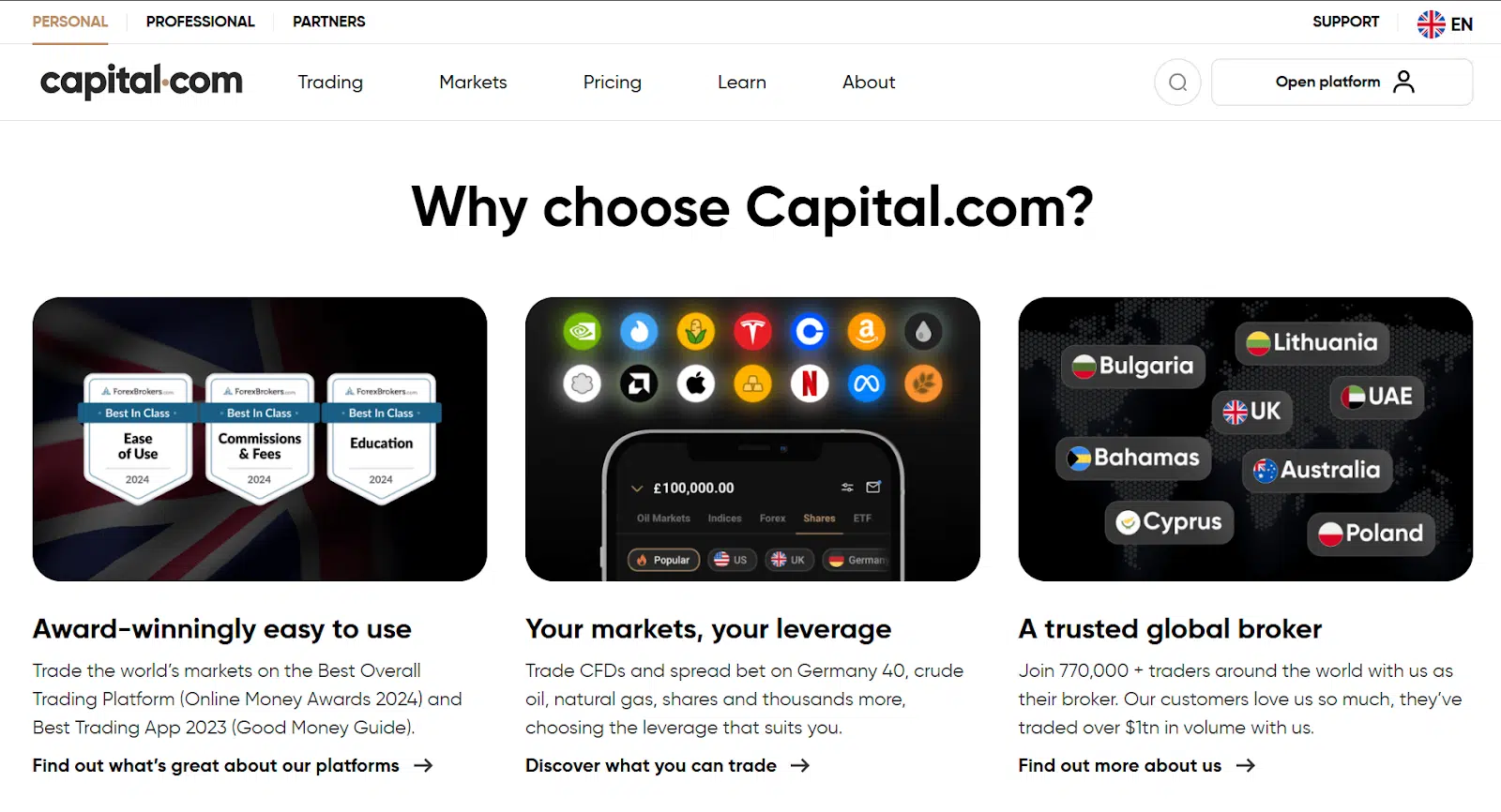
Capital.com earns its revenue mainly through spreads (the difference between the buy and sell price), overnight funding on leveraged positions held after market hours, currency conversion and guaranteed stop-loss premiums when they are triggered. We explain each of these in the fees section.
Capital.com doesn’t charge trading commissions. Its trading tools, educational resources and clean interface make it attractive to beginner and intermediate traders. More experienced traders can also connect MetaTrader 4, MetaTrader 5 and TradingView to their account.
In the UK, the platform also supports spread betting and a 1X (unleveraged) mode, which gives you more flexibility depending on your strategy and tax situation.
Because every instrument is a derivative, you don’t get ownership rights or dividends from the underlying shares or ETFs, which matters if you are investing for the long term.
Highlights
| 🗺️ Supported countries | Worldwide, including the UK |
| 💰 CFD commissions | 0% (spread-only model) |
| 💰 Currency conversion fee | 0.7% for retail clients (0.5% for professional clients), built into the exchange rate |
| 💰 Overnight funding | Applies to leveraged positions held overnight, and to some instruments even at 1:1 |
| 💰 Inactivity fee | £0 |
| 💰 Deposit and withdrawal fees | £0 |
| 💵 Minimum deposit | £20 for most payment methods |
| 💵 Interest on uninvested cash | 0% |
| 📍 Products offered | CFDs, spread betting, 1X |
| 🎮 Demo account | Yes |
| 📜 Investor compensation | Up to £85,000 under the FSCS |
| 📜 Regulators | FCA (UK), CySEC (EU), ASIC (Australia), SCB (Bahamas), SCA (UAE) |
Source: Capital.com UK charges and fees page, September 2026.
Pros and cons
Pros
- 0% commission trading (only spreads apply)
- Offers a 1X (non-leveraged) account with no overnight funding fees
- Spread betting is available
- User-friendly web and mobile platforms
- Integration with MT4 and TradingView
- Wide range of tradable assets (over 5,000 markets)
- Low minimum deposit of £20
- 24/7 index CFD trading (extended hours)
- 24/7 customer support
- Excellent educational resources, including guides and webinars
- Demo account
Cons
- No ownership of underlying assets (CFD/spread betting only)
- Overnight financing fees can become expensive for long-term, highly leveraged positions.
- Not suitable for passive or dividend-focused investors
- No interest on uninvested cash
Account types
Capital.com has two regulatory classifications for UK clients under FCA rules: Retail and Elective Professional.
- Retail account: the default option, and the right one for most traders. Retail clients get the full FCA protections:
- negative balance protection,
- leverage limits (up to 1:30 on major currency pairs, 1:20 on indices, 1:10 on commodities and 1:5 on shares),
- access to all CFD products offered to UK retail traders.
- Elective professional account: experienced traders who meet the FCA’s criteria (trading activity, financial experience and portfolio size) can apply for professional classification. This allows higher leverage, but removes protections:
- no guaranteed negative balance protection,
- limited access to the Financial Ombudsman Service (FOS),
- no FSCS cover for trading losses (the FSCS still applies if the firm fails).
Capital.com doesn’t use tiered account levels such as “Basic” or “Advanced”. All UK clients get the same platform, and the difference is only the classification and the protections that come with it.
Trading platforms
Capital.com offers its own web and mobile platforms, plus integrations with MetaTrader and TradingView.
Web platform
The web platform is fast and intuitive, so placing trades or analysing markets is straightforward even if you are not an experienced trader.
The layout is clean: watchlists, open positions and the order ticket sit on one side, with a large customisable chart in the main area.
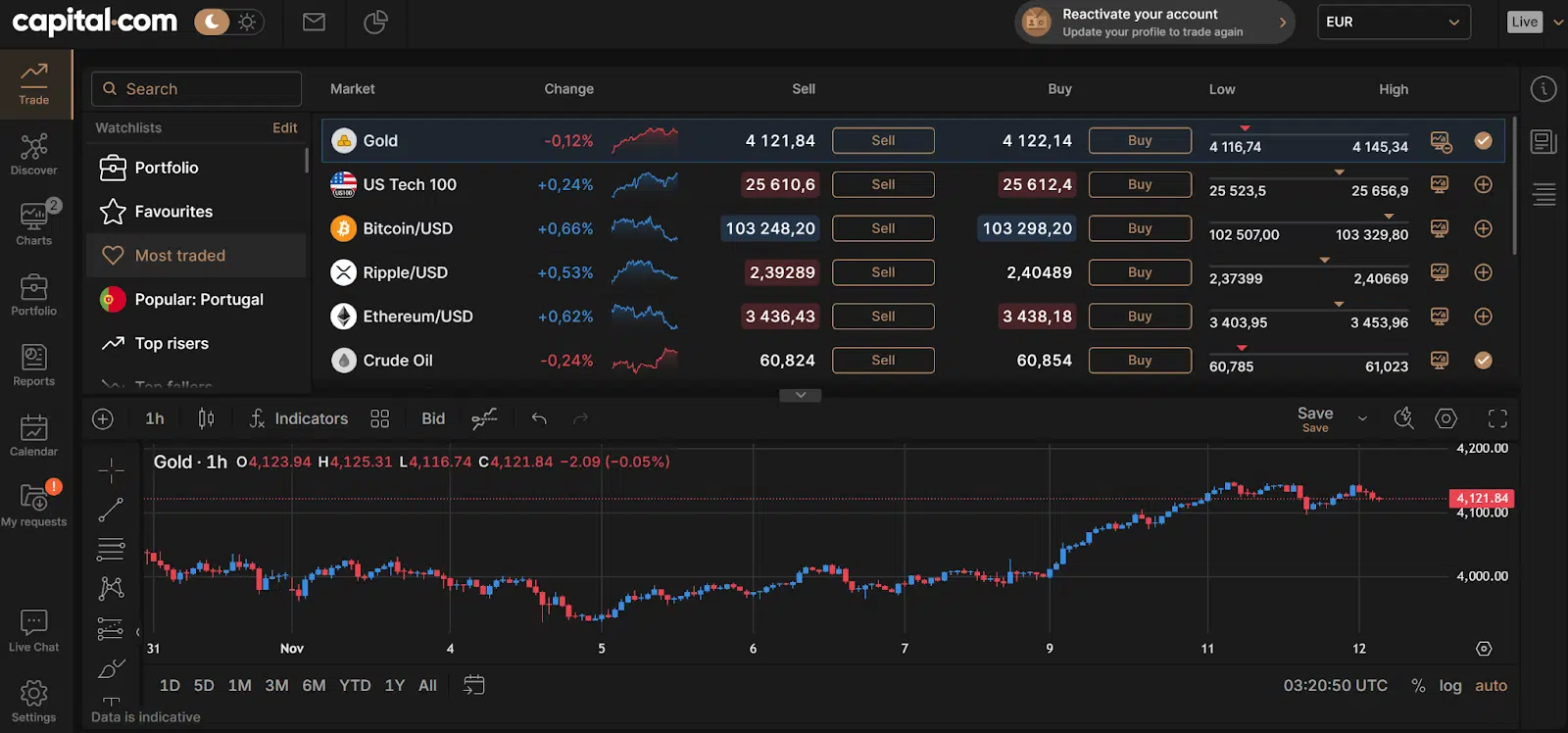
You can search instruments by name, ticker or asset class and add them to your favourites with one click. Each instrument page shows the bid and ask prices, the daily change, the price range and fundamentals where available.
The charts offer multiple timeframes, from seconds to monthly, and more than 100 technical tools, such as trendlines, Fibonacci retracements and channels. You can switch chart types and save layouts.
Placing an order is simple: choose your direction and position size and set stop-loss and take-profit levels in the same ticket. The platform shows the margin requirement, estimated costs and potential profit or loss before you confirm, which matters with leveraged products.
Mobile app
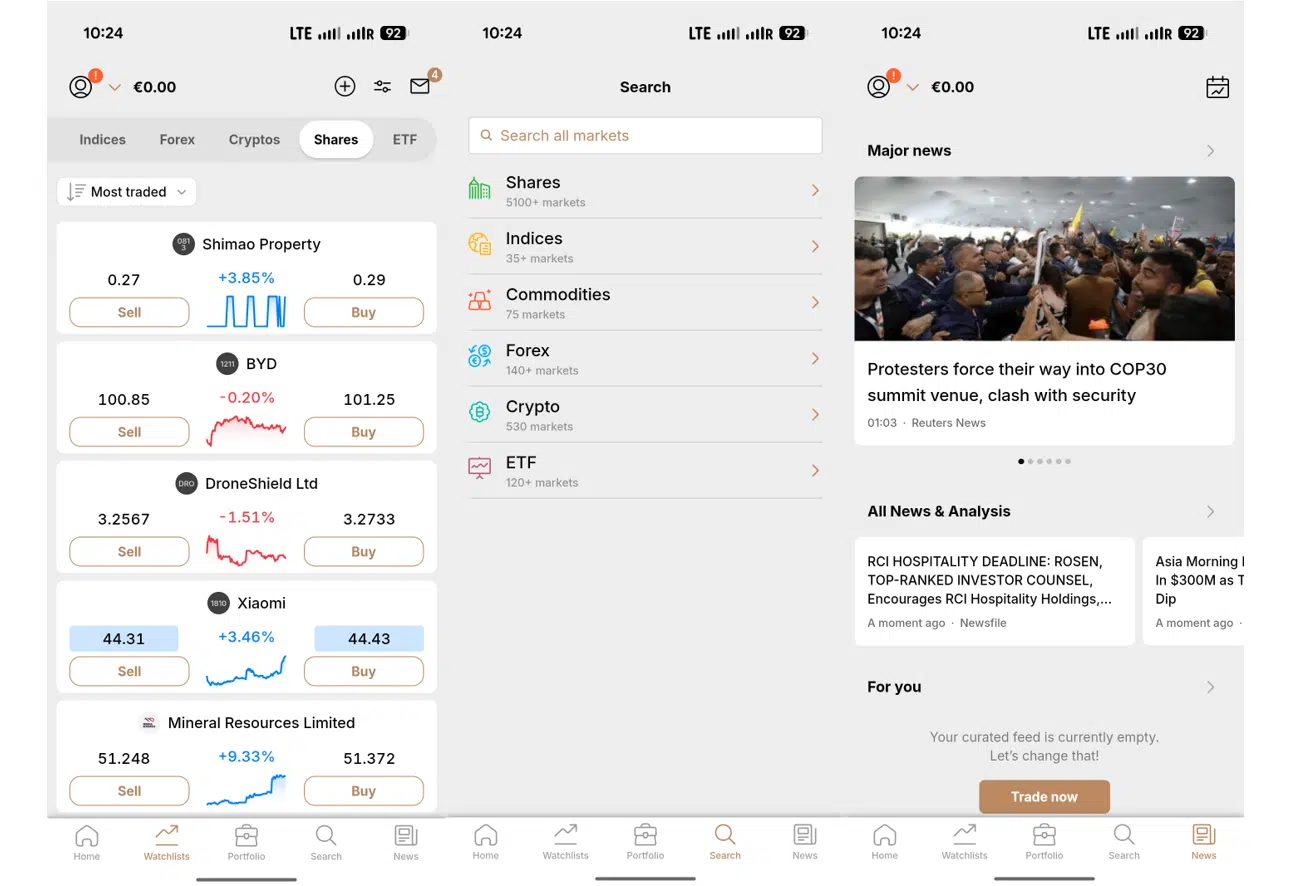
Available for iOS and Android, the app mirrors the web experience, with price alerts, charting tools and watchlists. Like the web platform, it includes a demo mode with virtual funds.
MetaTrader 4 and MetaTrader 5
Capital.com also integrates with MetaTrader 4 and MetaTrader 5, which work differently from its own platforms.
While Capital.com’s interface focuses on simplicity, MetaTrader is built for algorithmic trading. It supports Expert Advisors (EAs), so you can automate strategies and run them 24/5 on your account, backtest them or run custom scripts.
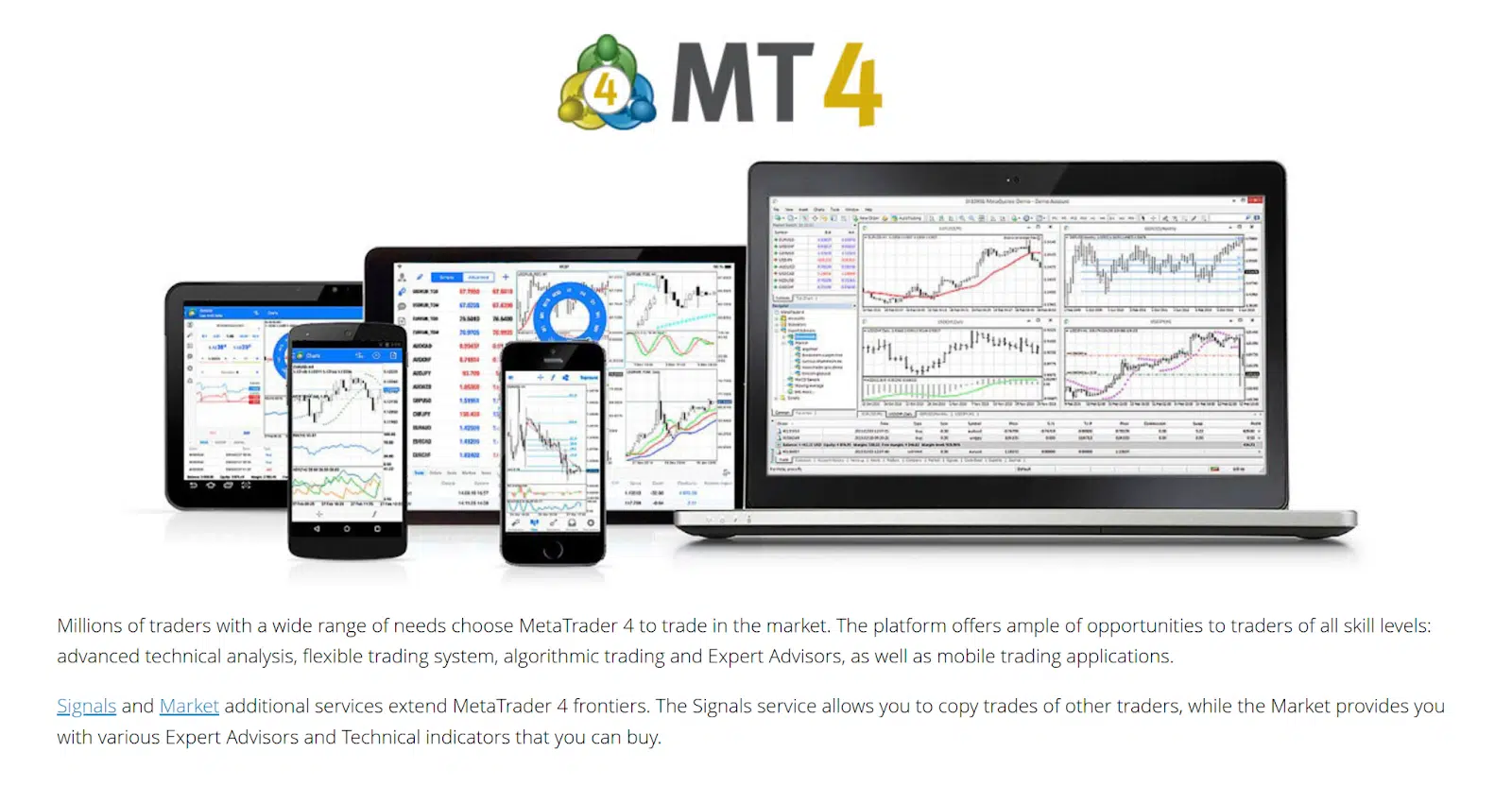
MetaTrader also offers deeper technical analysis: thousands of custom indicators, your own tools built with the MQL scripting language and several chart windows at once.
TradingView
Connecting your Capital.com account to TradingView lets you trade straight from TradingView charts.
TradingView stands out for its charting depth and its community, with hundreds of indicators, customisable layouts, multi-timeframe analysis and Pine Script for building your own strategies. Traders can also share charts and ideas or follow other people’s analysis.

Markets and products
In the UK, Capital.com offers three ways to trade: leveraged CFDs, spread betting and the unleveraged 1X account.
CFDs (with leverage)
- Shares: CFDs on companies listed on exchanges such as NASDAQ, NYSE, the LSE and Euronext.
- ETFs: exposure to popular ETFs through CFDs.
- Indices: major benchmarks such as the FTSE 100, DAX 40, CAC 40, S&P 500 and Euro Stoxx 50.
- Forex: over 130 currency pairs, including EUR/USD, GBP/USD and EUR/JPY.
- Commodities: precious metals, oil, natural gas and agricultural products.
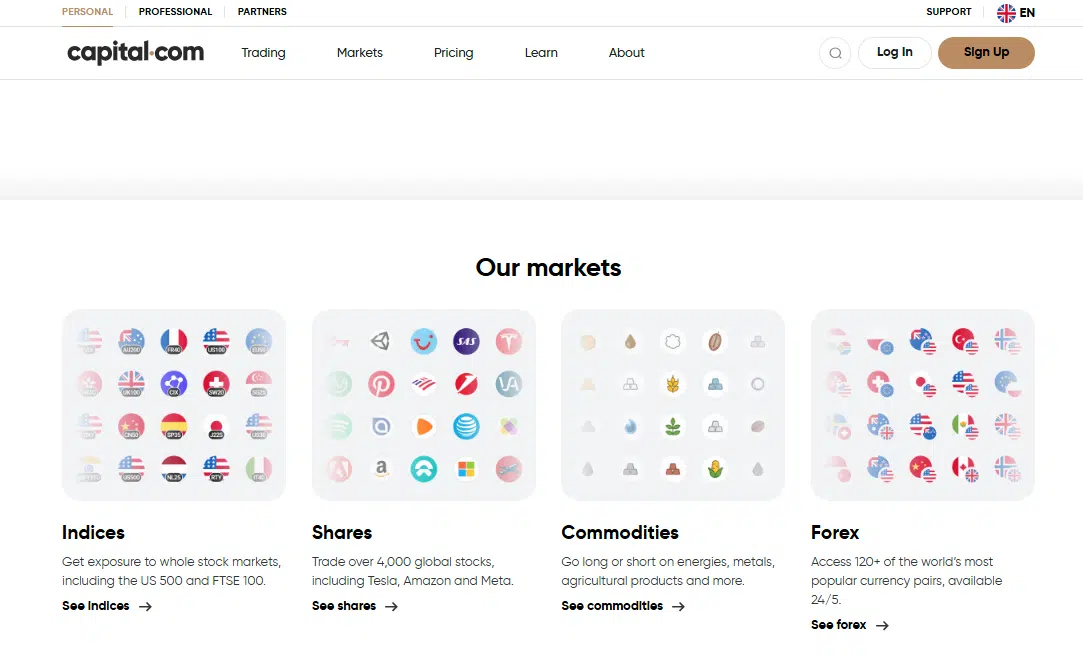
Because these instruments are CFDs, you don’t own the underlying assets, but you can go long or short with leverage.
Spread betting
UK clients can also trade through spread betting, on thousands of markets across indices, forex, commodities and shares, using the same platform, charts and risk management tools as CFDs.
For many UK residents, the appeal is the tax treatment: profits from spread betting are generally free of UK Capital Gains Tax and Stamp Duty, although this depends on your personal circumstances and tax rules can change.
Like CFDs, spread betting is leveraged, so both gains and losses are amplified.
Example of a spread betting trade
Suppose the UK 100 index is quoted at 7,500/7,501. You place a £1-per-point buy bet at 7,501 because you expect the index to rise. If it moves to 7,531 and you close the position, the market has moved 30 points in your favour, so your profit is 30 × £1 = £30.
If it drops to 7,471 instead, the market has moved 30 points against you, and you lose £30.
1X account (unleveraged CFDs)
The 1X account is a simpler way to trade, using CFDs without leverage.
Instead of trading on margin, you only use the money you deposit, which brings the experience closer to traditional investing and limits your losses to the amount invested.
With 1:1 positions, overnight funding doesn’t apply on most markets, although Capital.com lists some instruments where it applies regardless of leverage. Guaranteed stop-losses are not available on 1X, and the product is still a derivative.
24/5 index CFD trading
Capital.com offers 24/5 trading on major index CFDs, from Sunday to Friday (UTC), so you can trade before markets open and after they close.
The indices available include the EU Stocks 50, Germany 40, UK 100, US 500, US Tech 100, Japan 225 and Hong Kong 50. Prices come from futures markets, so there is price action even when the underlying exchanges are closed.
Execution quality is the same as during regular hours (Capital.com reported an average execution speed of 0.014 seconds in October 2025), but trading outside standard hours can mean lower liquidity and wider spreads, which increases risk.
Fees
| Fee type | Amount |
| CFD trading (shares and ETFs) | 0% commission (spread only) |
| Indices, commodities and forex CFDs | 0% commission (spread only) |
| Overnight funding (swap) | Varies by asset class. For indices, 4% a year plus or minus the benchmark rate |
| Currency conversion | 0.7% for retail clients (0.5% for professional clients) |
| Deposit and withdrawal | £0 |
| Inactivity | £0 |
| Guaranteed stop-loss | Premium charged only if triggered |
| Minimum deposit and withdrawal | £20 |
Source: Capital.com UK charges and fees page, September 2026.
How Capital.com makes money
Capital.com uses a zero-commission model, so you don’t pay a fixed commission to open or close a position. Instead, it earns revenue in four main ways.
1. Spreads
The spread is the difference between the buy (ask) and sell (bid) price, and it is the main source of revenue. Every time you open a position, you effectively pay this difference.
Spreads vary with:
- Market liquidity: popular markets such as EUR/USD or gold usually have tighter spreads than less traded assets.
- Volatility: spreads can widen in volatile conditions.
Capital.com gives this example for a CFD on Apple shares:
- You hold a position of 10 Apple shares, quoted at $240.00 / $240.13.
- The spread is 0.13 points.
- You pay half of the spread when you open the position and the other half when you close it.
- The total cost is 10 × 0.13 = $1.30.
The larger your position or the wider the spread, the higher your cost. For major currency pairs such as EUR/USD, spreads start from around 0.6 pips in normal conditions.
2. Overnight funding
When you hold a leveraged position overnight, Capital.com applies a daily funding charge (and sometimes pays you, depending on the position). It compensates the broker for financing the leveraged part of your position.
Example of buying a CFD on one Adidas share:
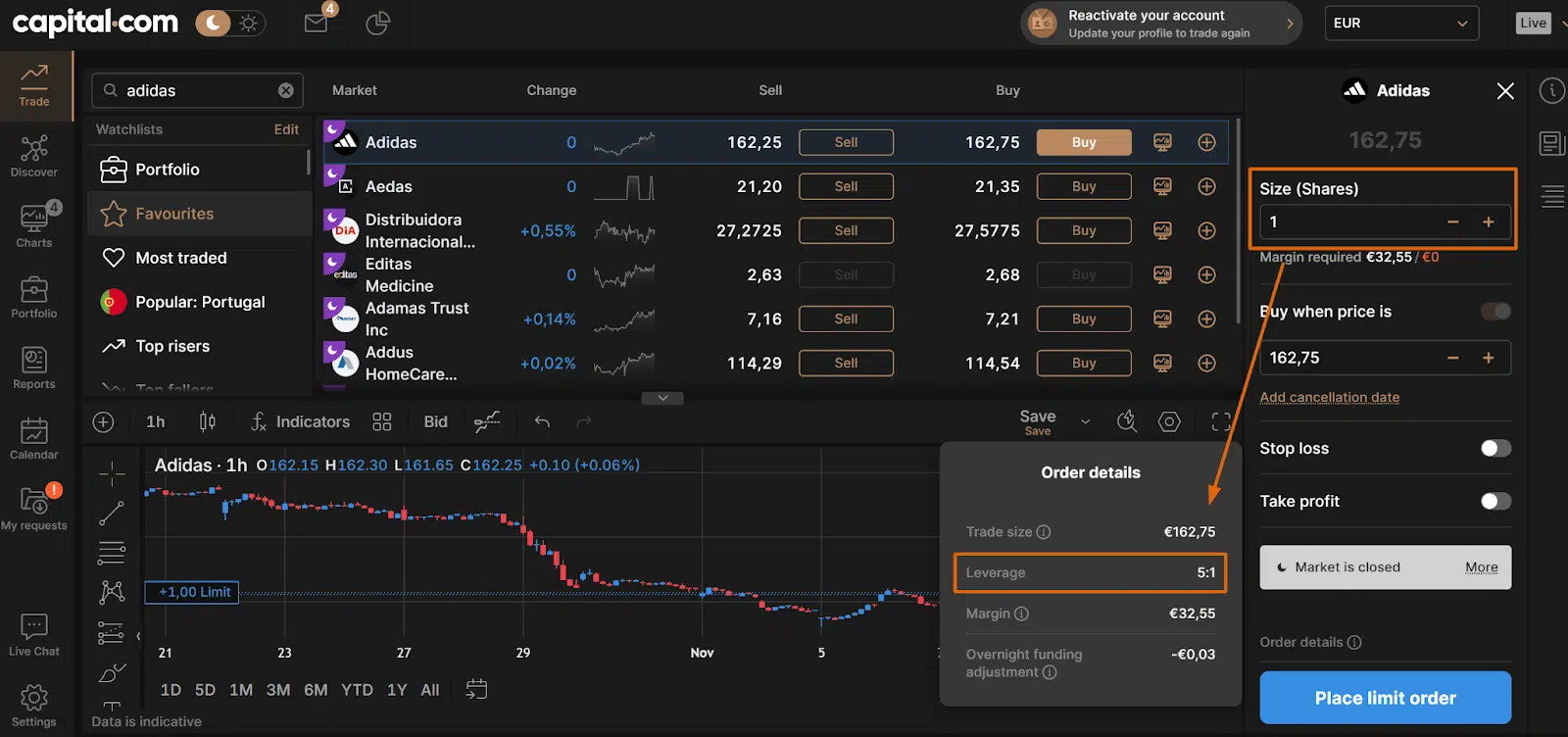
One Adidas share costs €162.75, but the margin requirement is only €32.55. In other words, you only need €32.55 of your own money for €162.75 of exposure. The difference of €130.20 is financed, which is where the leverage of 5:1 shown in the order details comes from.
Funding rates depend on:
- the type of asset (forex, index, share or commodity),
- the direction of your trade (long or short),
- the benchmark interest rate (SONIA for GBP-denominated markets, SOFR for USD-denominated ones),
- Capital.com’s own daily fee.
Why overnight funding adds up
Funding is charged every day you keep a leveraged position open, so small daily costs build up over weeks or months:
- even if the index or share rises, funding eats into your profit,
- if the market moves sideways, funding alone can turn the trade into a loss.
For indices, Capital.com’s own daily fee is 4% a year, plus or minus the relevant benchmark rate (SONIA or SOFR). With rates at current levels, the total annual cost can be several percentage points of your position value.
Funding is applied to your full exposure, not the margin you deposited. If your margin is $1,000 with 1:10 leverage, your exposure is $10,000, and the daily cost is calculated on $10,000.
This makes CFDs and spread bets an expensive way to hold a position for the long term.
3. Currency conversion
If you trade an instrument priced in a currency other than your account currency, a 0.7% mark-up applies for retail clients (0.5% for professional clients). The fee is built into the exchange rate rather than charged separately, and Capital.com shows the rate used in the reports section. It applies when profit, loss, overnight funding, dividends or guaranteed stop-loss fees settle in another currency. If the instrument is priced in your base currency, there is no conversion cost.
4. Guaranteed stop-loss orders (GSL)
A guaranteed stop-loss closes your trade at the price you set, even if the market gaps, which removes the risk of slippage.
The guarantee comes with a premium, charged only if the order is triggered. Capital.com calculates it as the GSL premium (a percentage) × the position’s open price × the quantity, and shows the amount on the deal ticket when you select it.

Security and regulation
In the UK, Capital.com operates through Capital Com (UK) Limited, authorised and regulated by the Financial Conduct Authority (FCA) under firm reference number 793714.
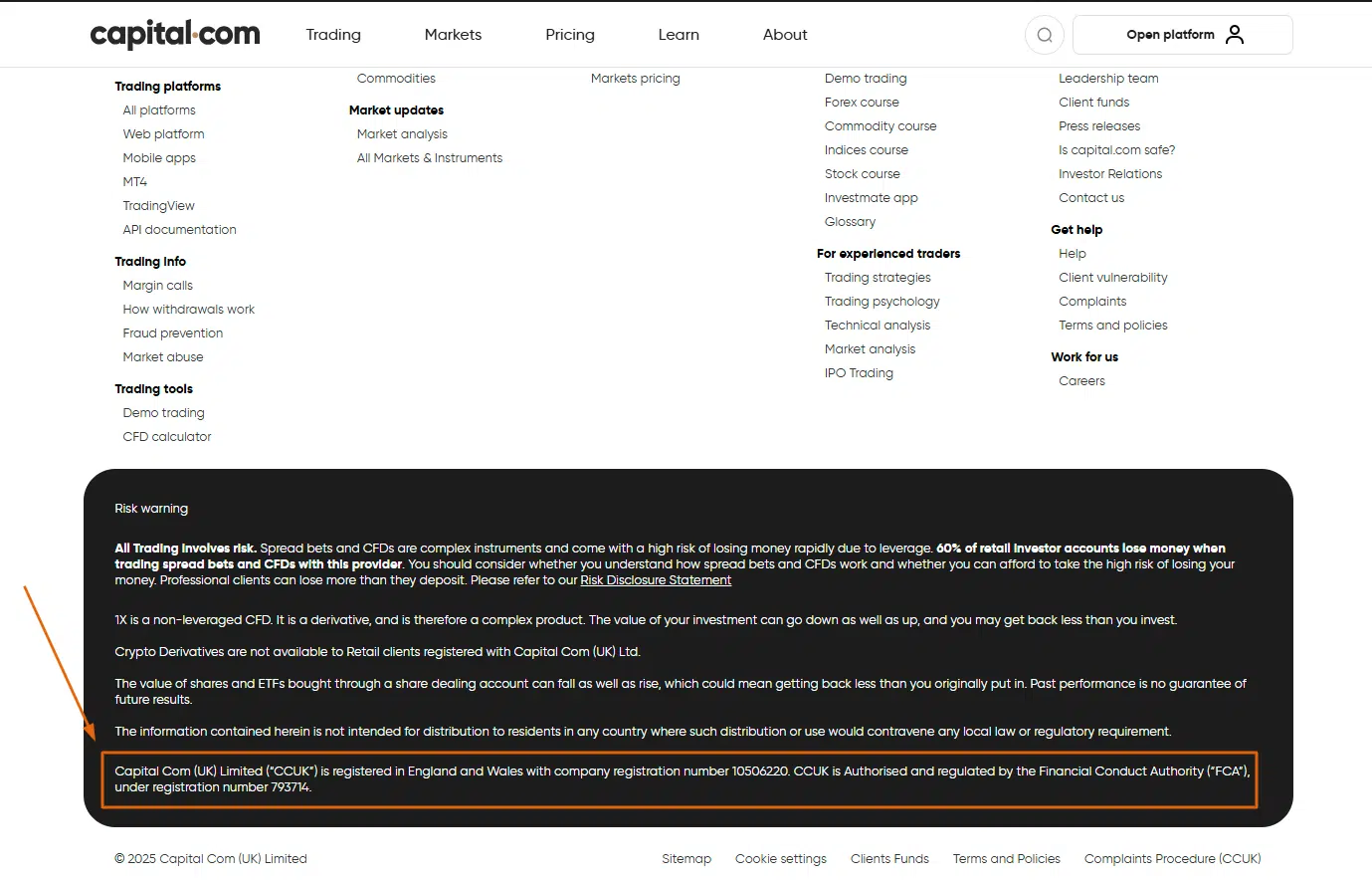
Client money is held under the FCA’s Client Assets Sourcebook (CASS) rules, which means retail client funds are kept in segregated client bank accounts at authorised UK or EEA institutions, separate from Capital.com’s own money, so the firm can’t use them for its business.
If Capital.com became insolvent, segregated funds should be ring-fenced and returned to clients, provided there is no shortfall.
If a regulated firm fails and client money can’t be returned in full, eligible clients can claim through the Financial Services Compensation Scheme (FSCS), which covers up to £85,000 per person, per firm.
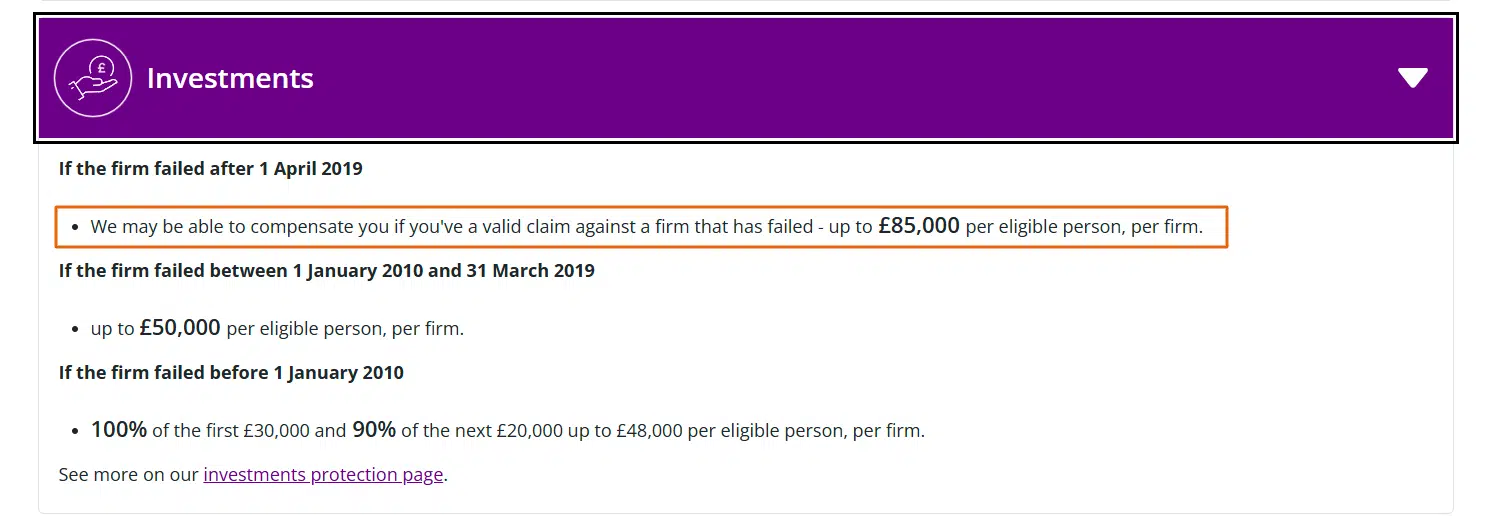
Note that the FSCS doesn’t cover trading losses. If your trades lose value because the market moved, that loss is yours. The FSCS only applies if the firm fails and can’t return your money.
Under FCA rules for CFD and spread betting providers, UK retail clients also have negative balance protection, so your account balance can’t fall below zero and you can’t lose more than you deposit. This protection doesn’t apply to professional clients.
Opening an account
Opening an account is fully digital:
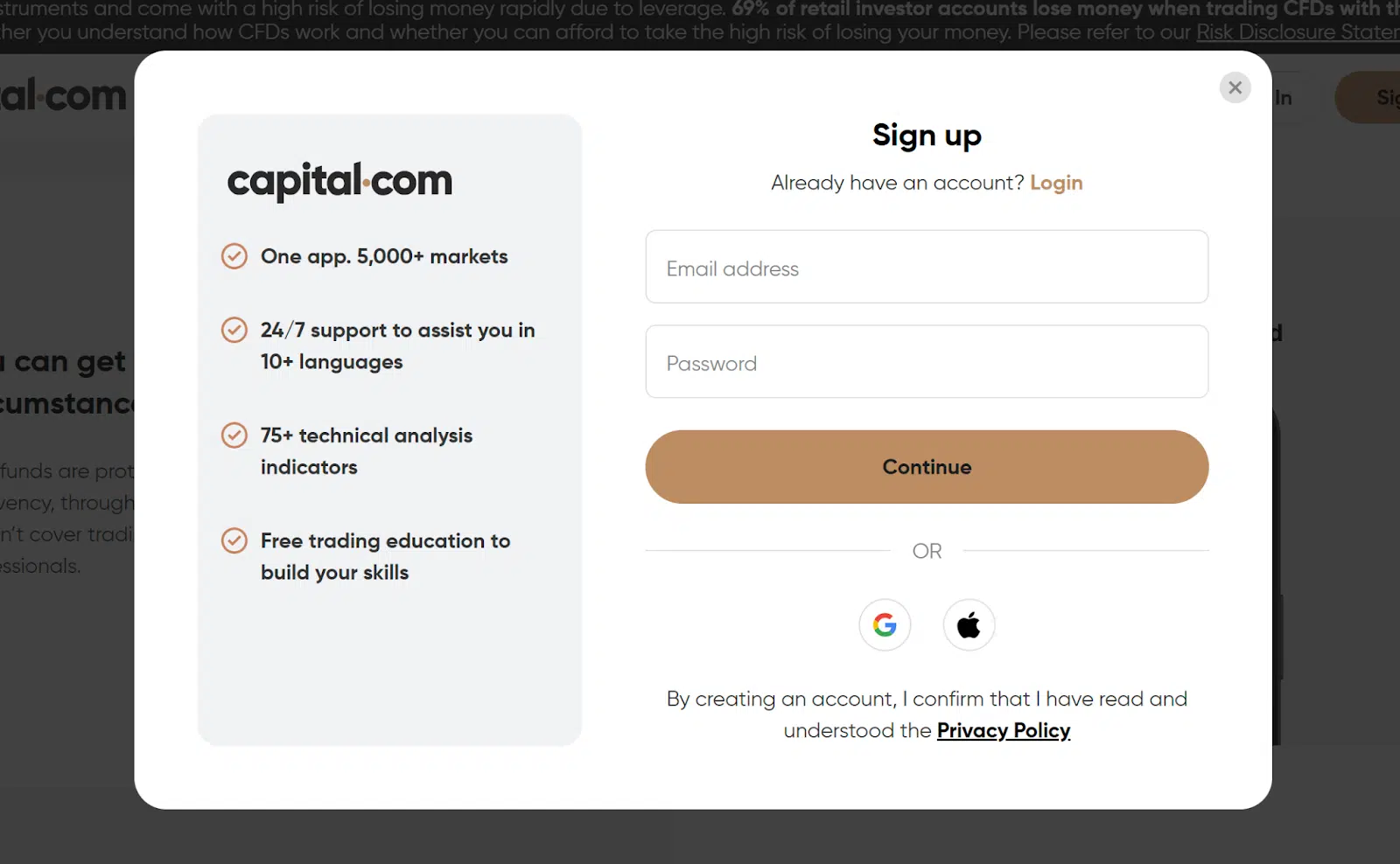
- Sign up with your email or a social login.
- Verify your identity with an official document and proof of address.
- Complete the appropriateness questionnaire required by UK rules.
- Deposit funds by bank transfer, card or e-wallet, from £20.
Verification is usually completed within 24 hours, and you can start with a demo account before trading real money.
Customer support
Capital.com offers 24/7 support in several languages through:
- live chat on web and mobile,
- email,
- phone support during business hours,
- a help centre with FAQs.
Support is generally well rated, although response times can vary at busy periods.
Final verdict: is Capital.com worth it?
Capital.com offers a modern, FCA-regulated and user-friendly platform for UK traders who want to speculate on short-term price movements in shares, ETFs, forex and commodities.
Its zero-commission structure, charting tools and integrations with MetaTrader and TradingView appeal to active traders who understand leveraged products.
However, it isn’t designed for long-term investors who want to own assets and receive dividends. Overnight funding accumulates, the 0.7% conversion mark-up adds up if you trade in other currencies, and CFD trading carries a high risk of loss.
If your goal is active trading, Capital.com is a strong contender among UK CFD brokers.
Disclaimer: CFDs are complex instruments and come with a high risk of losing money rapidly due to leverage. 65% of retail CFD accounts lose money when trading CFDs with this provider. You should consider whether you understand how CFDs work and whether you can afford to take the high risk of losing your money.
